


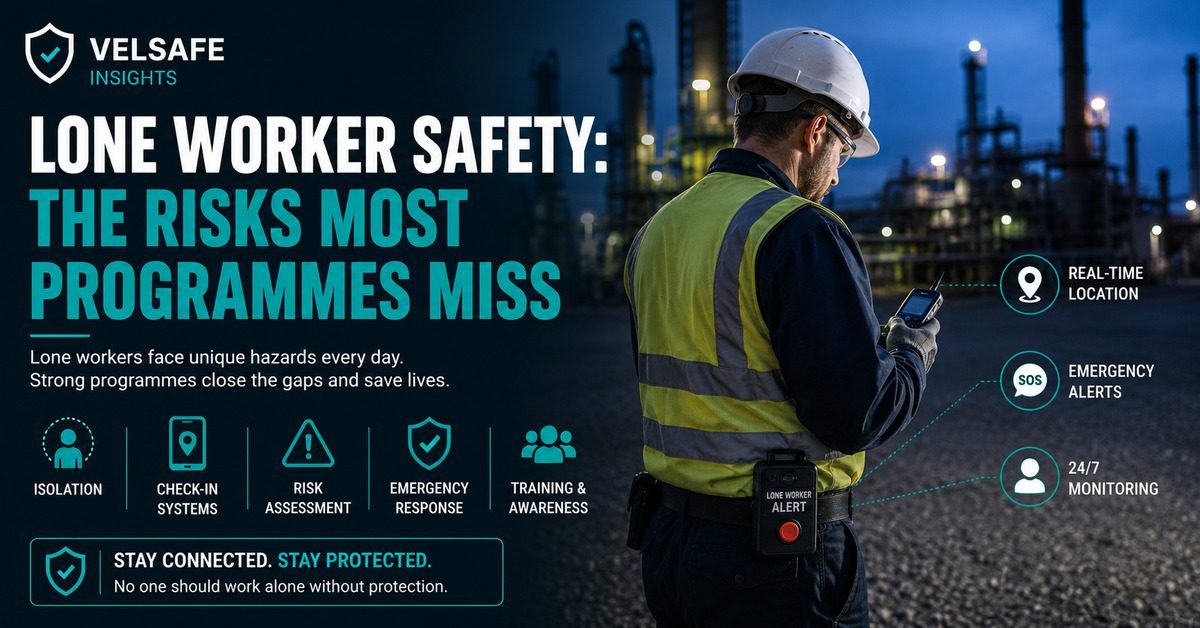
After That, the Programme Is All There Is.
Lone workers face elevated risk in every industry from construction and healthcare to remote tech sites and home offices. Most programmes focus on check-in schedules and miss the hazards that actually drive serious injury. Here is what the data shows and what effective programmes do differently.
Lone workers face a disproportionate share of serious injuries and fatalities because the absence of a co-worker removes the most common emergency response mechanism: someone present to call for help, apply first aid, or intervene when conditions deteriorate. Programmes that rely on scheduled check-ins and incident reporting are addressing the symptom, not the cause. The hazards that put lone workers at greatest risk are structural, not procedural, and most safety programmes are not designed to address them.
This two-part analysis covers the complete lone worker risk profile: who lone workers are, what actually drives their injury and fatality rates, the regulatory framework employers must work within, the industries with the highest exposure, and what effective programmes do that typical check-in-based programmes do not.
1. Who Qualifies as a Lone Worker
A lone worker is any employee who performs tasks without close or direct supervision and without another worker in the immediate vicinity who could provide assistance in an emergency. This definition is operational, not location-based. A worker in a building is still a lone worker if no one else is on the same floor or in the same building at the time. A remote field technician is a lone worker. So is a home health aide visiting a patient, a long-haul truck driver, a night-shift security officer, and a work-from-home employee who experiences a medical emergency.
Federal OSHA does not define “lone worker” in its regulations. The definition matters because it determines which employees your General Duty Clause obligations extend to. Safety managers who define lone working too narrowly, applying it only to field staff in remote locations, routinely miss the largest populations: healthcare workers in client homes, night-shift manufacturing employees, and remote office workers whose medical emergency goes undetected for hours.
The fastest-growing lone worker population in the US is not field workers. It is office and knowledge workers who perform some portion of their work remotely, often from home. The hazards are different from field lone work, but the emergency response gap is the same: if a home-based worker suffers a cardiac event, there may be no one present to call emergency services. Most lone worker programmes do not cover this population at all.
2. The Real Lone Worker Risk Profile
When organisations audit their lone worker risks, they tend to find three categories of hazard. The first is the hazard that motivated the programme, usually a specific incident or regulatory pressure. The second and third are almost always structural risks that the programme was not designed to address.
The medical emergency gap is the most commonly overlooked lone worker risk. A cardiac arrest victim who collapses in a co-worker environment has a reasonable chance of survival if bystander CPR begins within four minutes and emergency services arrive within eight. A lone worker who collapses at a remote site or in an empty building may not be found for hours. The response gap, not the underlying medical event, is what turns a survivable cardiac event into a fatality.
The violence risk gap is the second most commonly missed risk. Workplace violence studies consistently show that lone workers, particularly healthcare workers in client homes, late-night retail staff, and field technicians visiting unfamiliar sites, face elevated violence risk. The absence of co-worker witnesses does two things: it removes the deterrent effect of observation, and it eliminates the fastest path to emergency response when an incident occurs.
3. Industries with the Highest Lone Worker Exposure
Home health aides, visiting nurses, and community health workers operate in client homes without any colleague present. They face the full profile of lone worker risk: medical emergency response gaps, violence from clients or third parties, and environmental hazards in uncontrolled settings. BLS injury data shows home health aides among the most frequently injured workers in any sector.
Night watchmen, site managers performing early-morning or late-evening tasks, and workers on remote construction sites frequently operate without co-workers present. Falls from height and equipment incidents with no one to call emergency services are the primary risk scenarios. Many small contractors have no lone worker protocol at all.
Long-haul truck drivers, delivery drivers, and field service technicians operate in isolation for extended periods. Driver fatigue combined with the lone work condition creates a particularly high-risk profile. Medical events behind the wheel and violence at delivery locations are the leading cause scenarios for serious harm in this category.
Semiconductor fabrication facilities with hazardous chemicals, cleanroom environments with limited staff on night shifts, and wind turbine technicians working at height in remote locations all present high lone worker risk. The hazard severity in these environments means the response window, if a co-worker is absent, is extremely narrow.
Fully remote workers represent the newest and fastest-growing lone worker category. While the physical hazard profile differs from field work, the emergency response gap is structurally identical. A remote employee suffering a medical event at home may not be found until a missed meeting triggers a welfare check hours later.
Night-shift manufacturing workers, utility field workers, and maintenance staff performing after-hours tasks frequently operate without direct supervision. Mechanical equipment, electrical hazards, and confined spaces are the dominant risk factors in this category. OSHA’s confined space standard (29 CFR 1910.146) specifically prohibits lone entry into permit-required spaces, recognising that entry without a standby is inherently uncontrolled.
4. What Most Lone Worker Programmes Miss
The most common lone worker programme is a check-in schedule: the worker calls or texts at set intervals, and a supervisor is notified if they miss a check-in. This approach has a structural flaw. It addresses the detection problem but does nothing to reduce the probability of an event, and it only reduces the response time gap if someone is actively monitoring the check-in at all times, including nights, weekends, and holidays.
Miss 1: The Check-In Coverage Gap
A check-in schedule that operates during business hours provides no coverage for workers who operate outside those hours. A field technician who starts work at 6am and has a cardiac event at 6:15am, before the first scheduled check-in at 8am, is completely unprotected. The programme exists but provides no functional benefit when the event occurs.
Miss 2: Scope That Excludes Large Populations
Most lone worker programmes are written for the most visible population, usually field staff or remote site workers. They often exclude healthcare workers operating in client homes, night-shift office staff, and fully remote employees. The programme applies to 20 workers while 200 workers operate in lone conditions without protection.
Miss 3: No Pre-Task Risk Assessment
Effective lone worker programmes require a brief risk assessment before the task begins, not after the worker has already arrived at the site. The assessment should ask: can this task be safely performed alone? What is the emergency response time at this location? What are the specific hazards at this site? A programme that applies a generic check-in schedule without task-specific risk assessment is not a risk management programme. It is a recordkeeping programme.
Miss 4: Technology Without a Response Protocol
Lone worker monitoring apps and satellite communicators are effective tools. They are not a programme. Many organisations deploy technology without defining who receives the alert when an employee triggers an SOS, what that person is authorised to do, and what the escalation path is if the primary contact does not respond. The technology detects the event. Without a tested response protocol, detection does not reliably lead to assistance.
5. The Regulatory Framework: What the Law Requires
Federal OSHA has no dedicated lone worker standard. The obligation falls under Section 5(a)(1) of the Occupational Safety and Health Act, the General Duty Clause, which requires employers to provide a workplace free from recognised hazards that are causing or likely to cause death or serious physical harm. Lone working creates recognised hazards in the form of delayed emergency response, elevated violence risk, and the removal of co-worker observation as a safety control. OSHA has used the General Duty Clause to cite employers for lone worker hazards, particularly in healthcare and field service environments.
Several OSHA standards have provisions that specifically address the absence of other workers. 29 CFR 1910.146, the permit-required confined space standard, prohibits lone entry into permit spaces and requires an authorised attendant outside the space whenever an entry is in progress. 29 CFR 1910.269, the electric power generation standard, requires that certain high-voltage work not be performed by a lone employee. These standards recognise the principle that certain hazard profiles require a second person to be present, regardless of the lone worker’s experience or training.
Several US states have enacted or proposed lone worker provisions that go beyond the federal General Duty Clause. California’s Occupational Safety and Health Act (Cal/OSHA) has been used to enforce lone worker obligations in healthcare settings, particularly for home health workers. Oregon OSHA has specific guidance on agricultural lone worker safety. Employers with operations in state-plan states should review state-specific guidance in addition to the federal framework, as state obligations may be more specific and more prescriptive than the federal General Duty Clause baseline.
6. What Effective Lone Worker Programmes Do Differently
Define Lone Work Operationally, Not Geographically
Effective programmes map every role, not every location, against the lone work definition. They identify which employees operate without a co-worker who could provide assistance in an emergency, regardless of whether that employee is in a remote field location or a downtown office after hours. This mapping exercise consistently reveals that the programme’s covered population is far smaller than the actual lone worker population.
Require a Pre-Task Risk Assessment
Before any lone task begins, the worker and supervisor confirm: what are the specific hazards at this location, what is the emergency response time, what communication technology is available and confirmed working, and is this task safe to perform alone? Some tasks are identified as not safe for lone performance and require a second worker or are deferred. This step is the primary risk reduction mechanism, and most programmes lack it entirely.
Use Automated Check-In with Man-Down Detection
Check-in schedules rely on the worker being conscious and capable of initiating the check-in. Man-down or no-motion detection, which triggers an alert if the device detects no movement for a set period, addresses the gap created by an incapacitating event. Devices combining GPS tracking, automatic check-in intervals, manual SOS activation, and man-down detection provide the most complete coverage. They do not eliminate the need for a tested response protocol.
Test the Response Protocol, Not Just the Equipment
The response protocol defines who receives an alert, what they are authorised to do, who the backup contact is, and what constitutes a welfare check versus an emergency dispatch. Programmes that test only the alert technology, without testing whether the named contacts can be reached and can act at 2am on a Saturday, have not tested their programme. Full protocol testing, at least annually, is what separates a paper programme from a functioning one.
Key Takeaways
Your Lone Worker Population Is Larger Than Your Programme Covers
Map roles, not locations, against the operational lone work definition. Healthcare workers in client homes, remote employees, and after-hours office staff are lone workers. Most programmes are built for field crews and miss the majority of the actual population that operates in lone conditions.
The General Duty Clause Creates Real Liability
OSHA does not need a dedicated lone worker standard to cite an employer. Section 5(a)(1) applies wherever a recognised hazard exists. If your organisation has documented lone worker incidents or near-misses, or if lone work is a feature of the job description, the hazard is recognised and the obligation exists. A post-incident inspection is not when you want to discover your programme’s gaps.
A Check-In Schedule Is Not a Lone Worker Programme
Check-in schedules reduce detection time for a missed check-in. They do not reduce the probability of the event, they provide no protection before the first scheduled check-in, and they only function if someone is actively monitoring the check-in at all times. An effective programme requires a pre-task risk assessment, coverage that matches the actual lone worker population, monitoring technology that can detect an incapacitating event, and a tested response protocol that works outside business hours. All four components are needed. Programmes with only the first one are providing the appearance of protection without the substance.
Frequently Asked Questions
Does OSHA have a specific lone worker regulation?
No. Federal OSHA has no dedicated lone worker standard. Lone worker obligations fall under Section 5(a)(1) of the OSH Act, the General Duty Clause, which requires employers to address recognised hazards. Several industry-specific standards, including 29 CFR 1910.146 for confined spaces and 29 CFR 1910.269 for electric power work, prohibit certain tasks being performed by a lone employee. State-plan states may have additional provisions.
Who is considered a lone worker under safety law?
A lone worker is any employee who performs tasks without another worker present who could provide assistance in an emergency. There is no federal OSHA definition, which means employers must apply the concept broadly to any work situation where the absence of a co-worker creates or worsens a hazard. This includes field workers, after-hours office staff, home health workers, remote employees, and night-shift manufacturing workers.
What are the most common hazards for lone workers?
The most serious lone worker hazards are medical emergencies with delayed response, workplace violence without bystander intervention, falls from height with no one to summon emergency services, and equipment failure or entrapment in remote locations. The common factor is that the harm is made worse by the absence of another person, not by the absence of a safety procedure. Most lone worker injuries and fatalities are survivable events that became fatal because of the delayed response created by working alone.
Does a check-in programme satisfy the lone worker obligation?
A check-in schedule is one component of a programme, not the programme itself. It does not reduce the probability of an event, it only partially addresses the response time gap, and it provides no protection before the first scheduled check-in of the day. For OSHA purposes under the General Duty Clause, the question is whether the employer has taken feasible measures to reduce the hazard of working alone. A check-in schedule that operates only during business hours, covers only part of the lone worker population, and has no tested response protocol is unlikely to satisfy that standard if a serious injury or fatality occurs.
Are remote and work-from-home employees covered by lone worker obligations?
OSHA’s jurisdiction over home offices is limited, but the employer’s duty of care obligations exist regardless of the work location. A fully remote employee who suffers a medical emergency at home during work hours is in a lone work situation in the functional sense: no co-worker is present to initiate an emergency response. Employers who include remote workers in their lone worker risk assessments and programmes are taking the position that the duty of care follows the worker, not the location. This is consistent with how OSHA and UK HSE guidance frames the obligation.
What technology should a lone worker programme use?
Effective lone worker technology combines GPS location tracking, automated timed check-ins, manual SOS activation, and man-down or no-motion detection that triggers an alert without the worker initiating it. Satellite-based devices provide coverage in areas without cellular service. The technology choice should match the risk profile: a remote wind turbine technician requires satellite capability, while a night-shift office worker may be adequately served by a smartphone app. Technology alone is not a programme. The device must be paired with a tested response protocol that specifies who receives the alert and what they do.
Which OSHA standards explicitly prohibit lone work?
29 CFR 1910.146, the permit-required confined space standard, requires an authorised attendant outside the space whenever an authorised entrant is inside. A lone worker may not enter a permit-required confined space under this standard. 29 CFR 1910.269, covering electric power generation, transmission, and distribution, restricts certain work to multi-person crews when the hazard severity requires it. These are the two most commonly cited standards that create an absolute prohibition on lone performance of specific tasks, regardless of the employer’s broader lone worker programme.
Sources
- OSH Act Section 5(a)(1): General Duty Clause : the statutory basis for OSHA enforcement of lone worker hazards in the absence of a specific standard.
- 29 CFR 1910.146: Permit-Required Confined Spaces : requires an authorised attendant outside any permit space being entered; prohibits lone entry.
- OSHA Workplace Violence Prevention : guidance and enforcement data on violence risk for lone and isolated workers, particularly in healthcare and field service.
- BLS Injuries, Illnesses and Fatalities Programme : annual data on workplace injury and illness rates by occupation and industry, including home health aides and transportation workers.
- UK Health and Safety Executive: Lone Working Guidance : comprehensive guidance on lone worker risk assessment, management, and programme design, widely referenced internationally.
- NIOSH Mining Program : research on isolated and remote work risks in extractive industries, with application to other lone work environments including wind energy and field operations.
Related VelSafe Articles
Actionable LOTO tips for workers and supervisors, covering 29 CFR 1910.147 requirements and the isolation steps most frequently missed during maintenance work.
A case study in how removing a procedural step in isolation work leads to fatality, with OSHA citation analysis and corrective actions applicable across industries.
What the General Duty Clause and industry-specific OSHA standards require when identifying and documenting hazards, including the pre-task assessment obligations that apply directly to lone work situations.
Audit Your Lone Worker Programme
VelSafe covers lone worker risk profiles, the General Duty Clause framework, industry-specific hazard analysis, and programme design across every sector. Browse the full safety library.
