

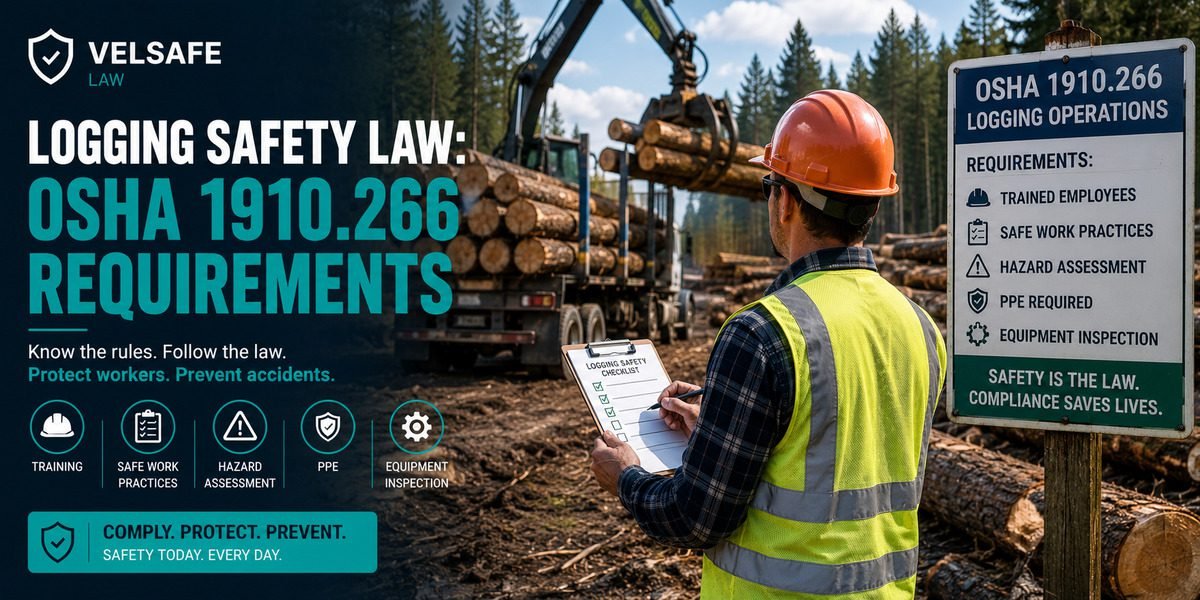
What 29 CFR 1910.266 Requires
Logging kills more workers per 100,000 than any other US industry. OSHA’s 29 CFR 1910.266 sets binding chainsaw, PPE, and felling rules. Here is what employers must do and what happens when they don’t.
OSHA’s 29 CFR 1910.266 governs logging operations in general industry, covering every aspect of the work from chainsaw handling and personal protective equipment to felling procedures, skidding operations, and first aid requirements. Logging has held the top spot for fatal injury rates among US industries for decades, and the standard exists because the hazard exposure in logging is both severe and largely preventable. Employers who operate logging crews without a compliant programme face citation exposure under one of OSHA’s most actively enforced standards.
This article covers what 29 CFR 1910.266 requires, who is covered, the specific obligations that generate the most OSHA citations, the penalty structure, and what a compliant logging safety programme must include.
1. Legal Framework: What 29 CFR 1910.266 Covers
29 CFR 1910.266 applies to all logging operations, defined as the felling of timber, the bucking, skidding, yarding, loading, unloading, and transportation of logs, and the construction and maintenance of roads, trails, and other infrastructure used in those operations. The standard is part of Subpart R (Special Industries) of OSHA’s general industry standards and applies when the employer’s primary activity is logging or when logging operations are conducted on behalf of another employer.
The standard does not cover the construction of logging roads by a highway contractor, the operation of sawmills, or the transport of logs on public roads by a regulated carrier. Those operations fall under separate OSHA standards or DOT regulations. Employers who are uncertain whether 1910.266 applies to a specific operation should consult the definitions in 1910.266(b), which provide precise scope boundaries.
2. Compliance Table: Who Must Comply and What Is Required
3. What 29 CFR 1910.266 Actually Requires
The standard is organised into functional areas. Each area carries its own set of requirements, and OSHA cites each deficiency separately. A logging crew with three PPE violations and two chainsaw violations faces five separate citation items.
Safety and Health Programme (1910.266(c))
Every employer must establish and maintain a written safety and health programme for logging operations. The programme must be available to employees and their representatives. It must be reviewed and updated at least annually and whenever there is a change in the work environment or work practices that could affect employee safety. The programme is the foundational document : inspectors ask to see it first.
First Aid and Emergency Response (1910.266(d))
At least one employee on each logging site must be trained in first aid and CPR, with training that meets or exceeds the requirements of 29 CFR 1910.151(b). A first aid kit must be available at the logging site and must be inspected before each use and replenished as necessary. In logging, where sites are remote and emergency response times can be 30 minutes or longer, the first aid requirement is a survival requirement, not a paperwork requirement.
Personal Protective Equipment (1910.266(d))
The standard specifies PPE for all employees engaged in logging operations. Required equipment includes a protective helmet meeting ANSI Z89.1, eye and face protection, hearing protection in high-noise environments, leg protection meeting the requirements of ASTM F1897 (cut-resistant chainsaw chaps), foot protection meeting ASTM F2412 and F2413 (chainsaw-resistant boots), and hand protection appropriate to the task. The standard requires that PPE be provided, maintained, and replaced when it is no longer serviceable.
Chainsaw Requirements (1910.266(i))
Chainsaws used in logging operations must be equipped with a chain brake or kickback protection device, an anti-vibration system, a throttle lockout, and a chain catcher. The employer must train each employee who operates a chainsaw before that employee begins chainsaw work. Training must include how to fell trees safely, how to avoid kickback, and how to perform daily maintenance on the saw. Employees must not start a chainsaw by drop-starting or by bracing the saw against the body.
Felling and Bucking Operations (1910.266(h))
Before felling any tree, the operator must plan and clear an escape route. The escape route must be at a 45-degree angle to the back-cut and away from the anticipated fall direction. Two trees may not be felled simultaneously. An employee may not approach a felled tree, a machine, or another worker without first visually confirming they are aware of the approach. These requirements address the single most common cause of logging fatalities: struck-by events during felling operations.
4. Most Commonly Cited Violation Areas
5. OSHA Penalty Schedule for Logging Violations
6. Common Failures That Trigger OSHA Citations
No Chainsaw Chain Brake
Operating a chainsaw without a functioning chain brake is one of the most frequently cited violations under 1910.266(i). The chain brake is designed to stop the chain within milliseconds of a kickback event. Employers who allow employees to remove or bypass this device face serious citation classification.
Missing Leg Protection
Cut-resistant chainsaw chaps meeting ASTM F1897 are required for all chainsaw operators under 1910.266(d). OSHA inspectors routinely cite employers where workers are observed operating chainsaws without chaps, and this citation is compounded when a laceration injury has occurred.
No Planned Escape Route
Before felling any tree, 29 CFR 1910.266(h)(1) requires the operator to plan and clear a retreat path. Failure to establish an escape route is the procedural failure most directly connected to logging fatalities. OSHA cites this as a serious violation when observed during felling operations.
No First Aid Provider On Site
The requirement under 1910.266(d)(2) for a trained first aid and CPR provider to be present at every logging site is often overlooked by small crews. If the crew is working in a remote location and no one has current first aid certification, the employer is in violation regardless of whether any incident occurs.
Undocumented or Absent Training
29 CFR 1910.266(i)(4) requires chainsaw training before an employee uses a saw on the job. Many small logging employers conduct verbal walk-throughs without documentation. OSHA requires that training be provided and that the employer be able to demonstrate it occurred. No records means no defence.
No Written Safety Programme
The written safety and health programme required by 1910.266(c) is the baseline document inspectors check first. An employer without a written programme has no foundational defence against citations in any other area of the standard. A programme that has never been reviewed or updated since it was first written has the same problem.
7. Employer Responsibilities Under 29 CFR 1910.266
Establish a Written Programme
The written safety and health programme must cover each type of work performed, the specific hazards associated with each type, and the controls in place. It must be available to workers and their representatives, and reviewed at least annually or after any incident or significant change.
Train All Employees Before Assignment
No employee may operate a chainsaw, operate logging machinery, or engage in felling operations without completing task-specific training first. Training must include hazard recognition, the safe work procedures for each task, and the PPE required. It must be documented.
Provide and Maintain All Required PPE
The employer bears the cost of providing all PPE required under 1910.266(d). PPE must be maintained in a safe and sanitary condition and replaced when damaged or worn. Allowing employees to work without required PPE because they forgot it or chose not to wear it is a citation event for the employer, not the employee.
Maintain Equipment in Safe Operating Condition
All chainsaws and logging machinery must be maintained according to the manufacturer’s specifications. Chainsaws with defective chain brakes, missing kickback guards, or non-functioning throttle lockouts must be removed from service immediately and not returned to service until repaired.
Legal Disclaimer
Key Takeaways
The Chain Brake Is Not Optional
29 CFR 1910.266(i) requires a functioning chain brake on every chainsaw used in logging operations. Removing or bypassing this device is a serious violation regardless of operator experience. No crew should operate a saw without it, and inspectors check it first.
Remote Sites Get Cited Too
OSHA conducts programmed inspections in high-hazard industries including logging, and fatality inspections bring state and federal investigators to sites that would otherwise never see an inspector. The first aid requirement and PPE requirements apply regardless of how remote the site is or how small the crew is.
Written Programme First, Everything Else Second
Every other obligation under 29 CFR 1910.266 flows from the written safety and health programme required by 1910.266(c). An employer without a written programme has no documented basis for its training, PPE selection, or felling procedures. OSHA uses the written programme to determine whether hazard identification and control was a deliberate management decision or an accident, and that determination shapes whether a citation is classified as serious or willful.
Frequently Asked Questions
Does 29 CFR 1910.266 apply to a small logging crew of two or three people?
Yes. The standard applies to all employers engaged in logging operations regardless of crew size. There is no minimum employee threshold under 1910.266. A two-person crew must have a written safety programme, at least one member with first aid and CPR certification, and all required PPE for each task performed. Crew size does not reduce the obligation.
What chainsaw features are required under 29 CFR 1910.266(i)?
Chainsaws used in logging must have a chain brake or equivalent kickback protection, an anti-vibration system, a throttle lockout that requires two actions to engage, and a chain catcher. The saw must be maintained according to the manufacturer’s specifications, and any saw with a defective safety feature must be removed from service until repaired. These are minimum requirements, not recommendations.
What PPE is legally required for chainsaw operators in logging?
29 CFR 1910.266(d) requires chainsaw operators to wear a protective helmet meeting ANSI Z89.1, eye and face protection, hearing protection in areas exceeding the noise thresholds in 29 CFR 1910.95, leg protection meeting ASTM F1897 (cut-resistant chaps), foot protection meeting ASTM F2412 and F2413, and gloves appropriate for chainsaw work. The employer must provide, maintain, and replace this equipment.
What must the written safety and health programme include?
The programme under 1910.266(c) must identify each type of work the employer performs, describe the specific hazards associated with each type of work, and document the controls in place to address those hazards. It must be available to employees and their representatives. The programme must be reviewed and updated at least annually and after any significant incident or change in operations. A generic programme downloaded from the internet that has never been tailored to the employer’s operations will not satisfy this requirement.
What are the felling safety requirements under 1910.266(h)?
Before felling any tree, the operator must plan an escape route at approximately 45 degrees from the anticipated fall direction, clear that route of obstacles, and notify other workers in the area. The operator must not approach a machine, another worker, or a felled tree without confirming that the other person or operator is aware of the approach. Two trees may not be felled at the same time. These are legally binding procedural requirements, not best practice guidance.
How does OSHA classify chainsaw violations after a logging fatality?
Post-fatality inspections in logging almost always result in serious or willful citation classifications. If the employer was aware of the hazard and had not corrected it, a willful classification applies and the maximum penalty is $165,514 per violation. If the employer had been cited for the same violation in a prior inspection within five years, a repeat classification applies with the same maximum. OSHA also coordinates with state agencies on worker’s compensation and potential criminal referrals after fatalities.
Does 29 CFR 1910.266 cover tree trimming and arborist work?
No. Commercial tree trimming and arborist operations are generally covered by OSHA’s Arboricultural Operations standard (29 CFR 1910.269 for utility line clearance) or the General Duty Clause, not 1910.266. The logging standard applies to operations whose primary activity is the harvest of timber. Employers who perform both logging and arborist work may be subject to different standards depending on the specific task being performed. A compliance consultation with OSHA or a qualified EHS professional can clarify which standard governs a specific operation.
Sources
- OSHA 29 CFR 1910.266: Logging Operations : the primary federal standard governing all aspects of logging operations in general industry, including chainsaw requirements, PPE, felling procedures, and training.
- OSHA Logging Safety and Health Topics Page : OSHA’s central resource for logging hazards, standards, publications, and enforcement data.
- OSHA Penalty Schedule (2025) : current penalty amounts adjusted for inflation under the Federal Civil Penalties Inflation Adjustment Act, effective January 2025.
- BLS Census of Fatal Occupational Injuries (CFOI) : annual data on fatal work injuries by industry, occupation, and event type; the source for logging fatality rates.
- NIOSH Logging Safety : National Institute for Occupational Safety and Health research on logging fatality patterns, chainsaw injury mechanisms, and control recommendations.
- ASTM F1897: Standard Specification for Leg Protection for Chain Saw Users : the referenced standard for cut-resistant chainsaw chaps required under 29 CFR 1910.266(d).
Related VelSafe Articles
What 29 CFR 1910.1025 requires for lead exposure in general industry, including action levels, PELs, medical surveillance, and penalty exposure.
A case study in how omitting the tryout step in a lockout/tagout procedure leads to fatal energy release, with OSHA citation analysis and corrective actions.
Actionable securement tips for operators transporting heavy equipment and logs, covering FMCSA requirements, tie-down calculations, and common citation triggers.
Build a Compliant Logging Safety Programme
VelSafe covers 29 CFR 1910.266 requirements, chainsaw PPE standards, felling procedures, and employer obligations in depth. Browse our full library of logging and general industry safety content.