

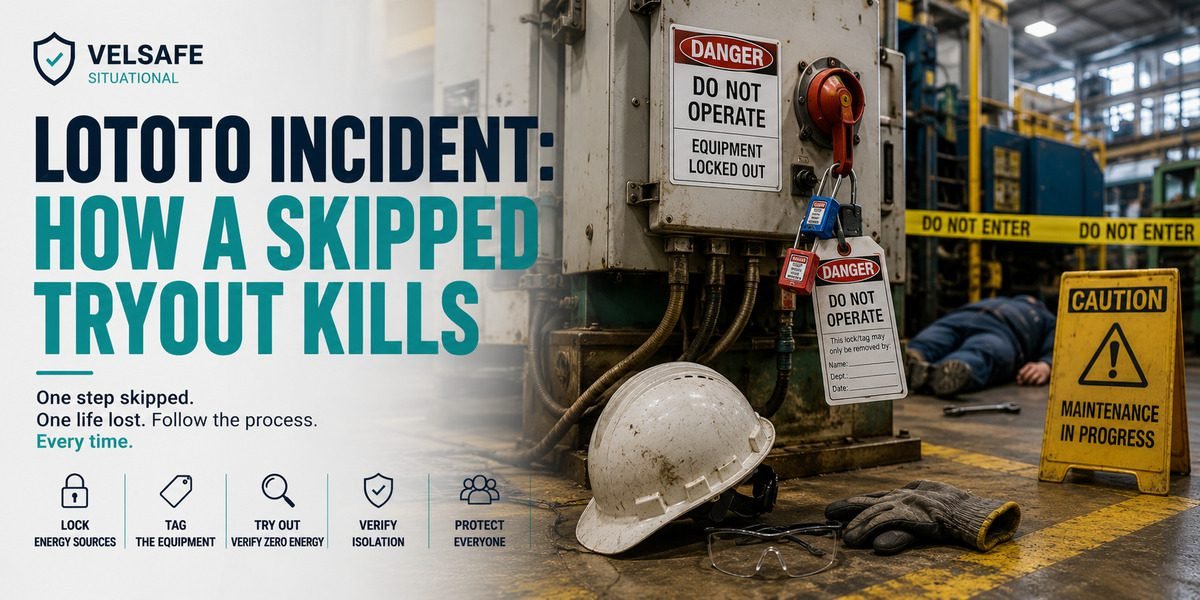
Industrial machinery locked out with danger tags and padlocks, fallen hard hat and PPE on the floor, with caution tape and a maintenance in progress sign indicating a serious LOTO incident scene

LOTOTO Incident: How a Skipped Tryout Kills

SITUATIONAL: ELECTRICAL AND LOTO
LOTOTO Incident:
When the Tryout Step Is Skipped
LOTO procedures were followed. The lock was on the switch. The tag was in place. But when the authorized technician removed a belt guard, the conveyor started. The tryout step had been skipped. This is a composite educational scenario based on documented OSHA violation patterns under 29 CFR 1910.147.
~120
Fatalities Prevented Annually
OSHA estimates proper LOTO compliance prevents approximately 120 worker deaths per year.
OSHA, 29 CFR 1910.147
50,000
Injuries Per Year
Approximately 50,000 injuries annually involve hazardous energy release that LOTO procedures are designed to prevent.
OSHA, Control of Hazardous Energy
$16,550
Max Serious Violation
Maximum OSHA penalty per serious LOTO violation as of January 2025. Willful or repeat violations reach $165,514 each.
OSHA Penalty Schedule, 2025

LOTO (Lockout/Tagout) is one of OSHA’s most-cited standards for a reason. Employers apply locks. Supervisors sign off on tags. Yet workers continue to be caught in machinery that was supposed to be de-energized. The single most common gap is the one that LOTOTO directly addresses: verification. Lockout/Tagout/Tryout adds a mandatory test before work begins to confirm that isolation actually worked. When that step is skipped, the assumption of safety replaces the confirmation of it.

This composite educational scenario is based on documented OSHA violation patterns under 29 CFR 1910.147. It illustrates how a correctly initiated LOTO procedure can still result in a serious injury when the verification step is absent from written procedures or ignored in practice. The sequence of events, regulatory findings, corrective actions, and lessons that follow apply to general industry facilities across sectors.


1. The Scenario: A Conveyor Belt Restart

Location
General Manufacturing Plant
Packaging line, mid-shift maintenance window
Workers Involved
1 Authorized Technician
4 years of site experience, LOTO-trained 18 months prior
Outcome
Crush Injury, Right Hand
Three fractured fingers; 6-week lost-time injury. OSHA recordable.
Root Cause
Tryout Step Absent
Written LOTO procedure did not include a verification step. Residual mechanical energy released on belt guard removal.

The maintenance technician received a work order to replace a worn belt guide on a packaging conveyor. The conveyor’s main disconnect was locked and tagged at the motor control panel before work began. The padlock was personal-issue, the tag was signed and dated, and the technician confirmed the conveyor did not start when the run button was pressed.

What the technician did not do was attempt to operate the machine at the point of work after removing the belt guard cover. A tension spring in the belt-tensioning mechanism had stored mechanical energy. When the guard was removed and the technician reached into the belt path to access the guide, the spring released, driving the belt forward. The technician’s right hand was caught between the belt and a roller.

The LOTO procedure used at the facility did not contain a tryout step. The written procedure called for lockout and tagout at the electrical disconnect only. It did not require the authorized employee to verify de-energization at the point of work or to release stored mechanical energy before reaching into the hazard zone. The facility’s LOTO program had not been reviewed or updated in over three years.


2. Incident Timeline

07:45
Work Order Issued
Technician receives written work order to replace worn belt guide on Conveyor 4. Estimated task time: 30 minutes.
08:02
LOTO Initiated Correctly
Technician turns off conveyor at run station, walks to motor control panel, opens disconnect, applies personal padlock and LOTO tag. Confirms conveyor will not start at run button.
08:07
Tryout Step Skipped
Technician proceeds directly to remove the belt guard on Conveyor 4. No attempt is made to test for stored mechanical energy at the point of work. Written procedure does not require this step.
08:11
Stored Energy Releases
Technician reaches into belt path to access the worn guide. Belt-tensioning spring releases stored mechanical energy. Belt moves forward. Technician’s right hand is caught between belt and tail roller.
08:13
Emergency Response
Coworker calls emergency services. Technician transported to hospital. Three metacarpal fractures confirmed. OSHA reportable injury recorded within 24 hours.
Day 3
OSHA Inspection Opened
OSHA compliance officer arrives on site. Requests all LOTO procedures, training records, and equipment-specific energy control programmes. Inspection covers all 14 conveyors in the facility.

3. What Went Wrong: Three Failure Points

Failure 1

No Tryout Step in Written Procedure

The facility’s energy control procedure for Conveyor 4 addressed electrical isolation only. It did not identify stored mechanical energy in the belt-tensioning system, did not require release of that energy, and did not include a verification step at the point of work. Under 29 CFR 1910.147(c)(4), machine-specific procedures must address all forms of hazardous energy and all energy-isolation steps required to control them.
Failure 2

Periodic Inspection Had Not Occurred

29 CFR 1910.147(c)(6) requires employers to certify that periodic inspections of energy control procedures have been performed at least annually. The facility’s LOTO programme had not been reviewed in over three years. Had a periodic inspection occurred, the absence of a stored-energy step for the tensioning mechanism would have been identified before the injury.
Failure 3

Training Did Not Cover Stored Energy

The technician’s LOTO training 18 months prior covered the basics of lockout and tagout but did not address stored mechanical, pneumatic, hydraulic, or gravitational energy. 29 CFR 1910.147(c)(7) requires training to ensure authorized employees understand the types of energy, hazards, and methods needed to control each type. General awareness training does not satisfy this requirement for equipment with multiple energy sources.

4. OSHA Investigation Findings

Violation
Standard
Classification
Energy control procedure did not address stored mechanical energy or require verification step
29 CFR 1910.147(c)(4)(i)
Serious
No documented annual periodic inspection of energy control procedures
29 CFR 1910.147(c)(6)(i)
Serious
Training did not address all types of hazardous energy present on serviced equipment
29 CFR 1910.147(c)(7)(i)
Serious
Authorized employee did not verify isolation and de-energization before work began
29 CFR 1910.147(d)(6)
Serious
Source: OSHA 29 CFR 1910.147 | OSHA Penalty Schedule 2025

5. Root Cause Analysis

Contributing Factors to the LOTOTO Failure
Incomplete written energy control procedure Primary
Procedure did not identify stored mechanical energy or require its release before work began.
No periodic review of LOTO programme Systemic
Three years without a procedure audit. Equipment modifications were not reflected in current procedures.
Training gaps on stored energy types Contributory
Technician trained on electrical isolation only. Mechanical, pneumatic, and hydraulic energy not covered in refresher content.
Time pressure and normalisation of deviation Behavioural
30-minute task window created time pressure. Technician had performed similar repairs without incident, normalising the shortcut.
Source: OSHA 29 CFR 1910.147 Requirements

6. Corrective Actions Required

1

Rewrite All Machine-Specific LOTO Procedures

Each procedure must identify every form of hazardous energy present (electrical, mechanical, pneumatic, hydraulic, gravitational, thermal), specify the isolation point for each, describe the release method for stored energy, and include an explicit tryout step requiring the authorized employee to verify de-energization at the point of work before entering the hazard zone.
2

Conduct Annual Periodic Inspections Going Forward

Under 29 CFR 1910.147(c)(6), periodic inspections must be certified annually. The inspection must be performed by an authorized employee other than the one using the procedure. It must cover the adequacy of the procedure and whether the employee understands it. Results must be certified with the date, machine, employees involved, and inspector name.
3

Retrain All Authorized Employees on Stored Energy

Retraining must specifically cover all types of hazardous energy present at the facility, the methods used to isolate and release each type, and the mandatory verification step that confirms de-energization before entry. Retraining is required under 1910.147(c)(7)(iii) whenever there is reason to believe an employee does not have the required knowledge or skills.
4

Abate Citations and Verify All 14 Conveyors

OSHA’s inspection of all 14 conveyors means abatement must cover every piece of equipment, not just Conveyor 4. Each machine requires a reviewed and updated procedure, a documented periodic inspection, and evidence of trained authorized employees before the abatement deadline stated in the citations.

7. Lessons Learned

A Lock on a Switch Is Not a Safe Machine

Electrical isolation is one step in energy control, not the whole procedure. Machines can retain mechanical, pneumatic, hydraulic, gravitational, or thermal energy even after the electrical disconnect is locked. The tryout step confirms that energy at the point of work is at zero, not just that a switch is open. Any facility whose LOTO procedures stop at electrical lockout has an incomplete programme.

Outdated Procedures Are as Dangerous as No Procedures

A LOTO procedure written three years ago does not reflect the machine as it exists today. Tensioning systems, pneumatic lines, hydraulic accumulators, and gravity-loaded components are added or modified over time. The annual periodic inspection exists specifically to catch these gaps before a worker finds them by injury. Treating the inspection as paperwork rather than a real equipment review is how outdated procedures persist.

LOTOTO Cannot Be a Verbal Add-On to a LOTO Programme

Adding the tryout step verbally during training while leaving it out of written procedures creates the worst outcome: workers know it exists but the procedure does not require it. Under production pressure or time constraints, workers default to what the written procedure says. If verification is not a required documented step in the machine-specific procedure, it will not happen consistently.

8. LOTOTO Prevention Checklist

Before Each Maintenance Task
Required for Every Machine Procedure
Obtain the machine-specific LOTO procedure and review it before starting
Identification of all energy types present (electrical, mechanical, pneumatic, hydraulic, gravitational, thermal)
Notify affected employees before beginning LOTO sequence
Step-by-step isolation instructions for each energy source
Shut down machine at operating controls before going to isolation point
Explicit stored energy release steps (drain, bleed, discharge, block)
Apply lock and tag at each isolation point, one lock per authorized employee
Mandatory tryout verification step before entering point-of-work hazard zone
Release or restrain all stored energy before entering hazard zone
Certification documentation including date, machine ID, and inspector name
Perform tryout: attempt to operate at point of work to verify zero energy state
Annual review schedule with assigned responsible party
Source: OSHA Control of Hazardous Energy (29 CFR 1910.147)

Key Takeaways

The tryout step belongs in the written procedure, not just in training

Under time pressure, employees follow written procedures. If the tryout step appears only in training but not in the machine-specific document, it will be skipped. The verification requirement under 29 CFR 1910.147(d)(6) must be written into every machine-specific energy control procedure as a mandatory numbered step.

Annual periodic inspection is not optional paperwork

29 CFR 1910.147(c)(6) requires documented annual inspections of energy control procedures, certified by an employee other than the one using the procedure. This inspection is the mechanism that catches outdated procedures before an injury does. Three years without a review is a serious citation waiting to happen, regardless of whether an injury occurs.

Four serious citations from one incident means four separate penalty lines

Each citation in this scenario is cited per standard, per machine. With 14 conveyors in the facility, each with deficient procedures, missing inspections, and undertrained employees, the total penalty exposure is substantial. At up to $16,550 per serious violation, a multi-machine LOTO inspection rarely ends with a single penalty line. A complete LOTO programme review costs a fraction of what a single OSHA inspection citation cycle costs.

Frequently Asked Questions

What is the difference between LOTO and LOTOTO?

LOTO (Lockout/Tagout) refers to isolating a machine’s energy sources and securing them with a lock and tag before servicing. LOTOTO (Lockout/Tagout/Tryout) adds a mandatory verification step: after isolation, the authorized employee attempts to operate the machine at the point of work to confirm it is in a zero-energy state. The tryout step is not a separate OSHA standard but is required by 29 CFR 1910.147(d)(6), which mandates that employees verify isolation before beginning work.

What does 29 CFR 1910.147(d)(6) require?

29 CFR 1910.147(d)(6) states that prior to starting work on machines or equipment that have been locked out or tagged out, the authorized employee must verify that isolation and de-energization of the machine have been accomplished. This is the regulatory basis for the tryout step in LOTOTO. The standard requires verification, not merely the application of a lock. Facilities whose written procedures do not include this step are not in compliance.

What types of stored energy must LOTO procedures address?

29 CFR 1910.147 requires procedures to address all forms of hazardous energy, including electrical, mechanical (springs, flywheels, rotating parts), pneumatic (compressed air lines), hydraulic (pressurised fluid systems), gravitational (suspended components, counterweights), and thermal (hot surfaces, steam). Procedures that address only electrical energy are incomplete and will not survive an OSHA inspection at a facility with multi-source equipment.

How often must employers conduct periodic inspections of LOTO procedures?

29 CFR 1910.147(c)(6)(i) requires at least one periodic inspection per year for each energy control procedure. The inspection must be certified in writing, identifying the date, machine, employees covered, and the name of the authorized employee who performed the inspection. The inspector must be an authorized employee other than the one who uses that procedure. A three-year lapse without a documented inspection is a serious citation in nearly every OSHA hazardous energy enforcement action.

Does LOTOTO apply in construction as well as general industry?

29 CFR 1910.147 applies to general industry. Construction employers are covered by 29 CFR 1926.417, which addresses lockout/tagout for electrical equipment but does not contain the same level of procedural detail as the general industry standard. However, the General Duty Clause applies to construction sites with multi-source energy hazards, and OSHA has cited construction employers for inadequate energy control under both 1926.417 and the General Duty Clause when stored energy was involved.

What is the penalty for LOTO violations under OSHA?

As of January 2025, OSHA maximum penalties are $16,550 per serious violation and $165,514 per willful or repeat violation. LOTO citations are typically per standard section and per machine, so a facility with multiple pieces of equipment and multiple procedural failures can face substantial total penalty exposure from a single inspection. Willful violations, where OSHA finds the employer knew of the hazard and made no effort to correct it, carry significantly higher penalties.

Can a group LOTO situation use a single lock for multiple employees?

No. Under 29 CFR 1910.147(f)(3), when servicing or maintenance is performed by a crew, each authorized employee must apply their own personal lock to each lockout device. Group lockout boxes are permitted as a mechanism to accomplish this: a supervisor places a lock on the energy isolation device and on the group lockout box, and each crew member then places their personal lock on the group box. No work may begin until every crew member has their lock in place.

Sources

Government and Regulatory Sources

  • OSHA. 29 CFR 1910.147: The Control of Hazardous Energy (Lockout/Tagout): Full regulatory text covering procedure requirements, periodic inspection, training, and verification steps for general industry.
  • OSHA. (2025). Civil Penalty Schedule: Current maximum penalties for serious, willful, repeat, and other-than-serious violations as of January 2025.
  • OSHA. 29 CFR 1910.147(d)(6): Verification of isolation and de-energization requirement before authorized employees begin servicing work.
  • OSHA. 29 CFR 1910.147(c)(6): Periodic inspection requirement mandating annual certification of energy control procedures.

Research and Industry Sources

  • OSHA. LOTO Standards Overview: OSHA summary of energy control requirements, applicability by industry, and enforcement data supporting estimated injury and fatality prevention figures.
  • National Safety Council. Lockout/Tagout: Industry guidance on LOTO programme development, common failure patterns, and LOTOTO verification best practices.

Related VelSafe Articles

Worker Safety
Lockout/Tagout: What Workers Must Know Before Any Repair
Step-by-step LOTO procedure for frontline workers, covering isolation points, personal locks, and verification before entering hazard zones.
Law
Legal Consequences of Ignoring Lockout/Tagout in Construction
OSHA citation patterns, employer liability, and penalty case analysis for LOTO non-compliance in construction environments.
Tips
Lockout/Tagout Safety Tips to Prevent Workplace Injuries
Actionable LOTO tips for supervisors and safety coordinators, covering common procedural gaps, stored energy identification, and LOTOTO verification in practice.

Build a LOTO Programme That Passes Inspection
VelSafe covers 29 CFR 1910.147 in depth, including machine-specific procedure requirements, stored energy types, periodic inspection obligations, and LOTOTO verification standards.
Explore VelSafe Safety Resources

Comments are closed.