

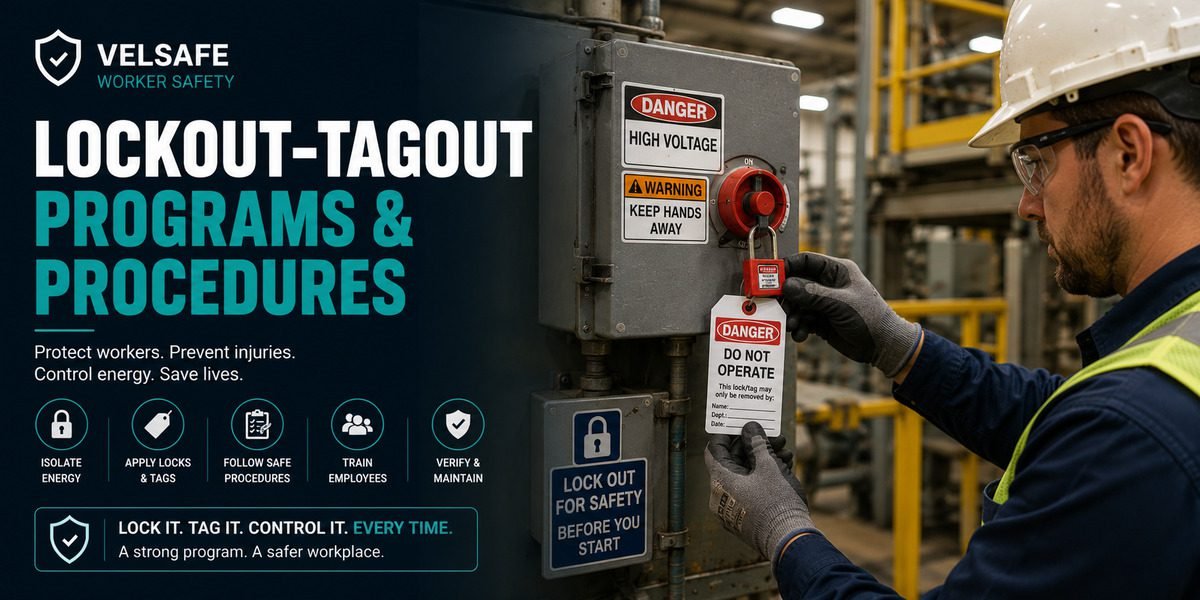
OSHA’s lockout/tagout standard (29 CFR 1910.147) requires workers to isolate and lock out all hazardous energy before servicing or maintaining any equipment. Failure to follow a proper lockout tagout procedure is one of the most common causes of amputations, electrocutions, and crush injuries in general industry and manufacturing. This article covers the six steps every authorised employee must complete, what personal protective equipment is required, and what to do when a procedure is missing or unclear.
The standard applies to electrical, hydraulic, pneumatic, thermal, mechanical, and gravitational energy sources. It covers servicing and maintenance activities on machines where unexpected energisation, start-up, or release of stored energy could cause injury. If you work in manufacturing, warehousing, or any facility with powered equipment, this standard applies to your worksite.
Why Hazardous Energy Control Cannot Be Skipped
Critical Warning
Equipment that appears to be off can still carry electrical charge, stored hydraulic pressure, or spring tension that is powerful enough to cause fatal injuries. Workers who assume a machine is safe without verifying zero energy state are at risk every time.
OSHA’s LOTO standard exists specifically because well-intentioned workers have been killed by equipment they believed was shut down. Unexpected energisation does not require a malfunction. It can happen when a colleague restores power from another location, when stored pressure releases, or when gravity causes movement in a suspended load. The lockout/tagout procedure eliminates each of these risks when followed correctly.
LOTO violations consistently rank among OSHA’s most frequently cited standards in general industry. Willful or repeated violations carry penalties up to $161,323 per violation. More importantly, every citation reflects a real risk that a worker could have been seriously injured or killed.
Types of Hazardous Energy Covered by LOTO
The lockout/tagout standard covers six categories of hazardous energy. Each presents a different risk and requires different isolation techniques. Workers must be trained on the specific energy types present at their worksite.
LOTO Devices and When Each Is Required
OSHA requires employers to provide lockout/tagout devices at no cost to workers. Each device must be durable, standardised, and substantial enough to prevent removal without force. The following table covers the most common devices used in general industry.
| Device | Used For | Key Requirement |
|---|---|---|
| Padlock (personal lock) | Isolating circuit breakers, valves, and energy-isolation points | One lock per authorised employee. Only the worker who applied it may remove it. |
| Lockout hasp | Group lockout when multiple workers service the same equipment | Each worker applies their own personal lock to the hasp. Equipment stays locked until all locks are removed. |
| Circuit breaker lockout | Securing electrical panels and breaker switches in the OFF position | Must fit the specific breaker type. Universal clamp-style devices are available for multiple panel configurations. |
| Valve lockout device | Securing ball valves, gate valves, and other flow-control devices | Must physically prevent the valve from being opened. Size-specific devices are required for a secure fit. |
| Tagout device (tag only) | Only permitted when it is physically impossible to apply a lock | Must include the worker’s name, date applied, and contact information. Cannot be used as a substitute for a lock when a lock is possible. |
| Plug lockout device | Securing electrical plugs so the cord cannot be re-inserted | Required when the energy-isolation point is a plug rather than a fixed disconnect. Worker’s personal lock must secure the device. |
When to Stop Work and Report Immediately
A worker is never obligated to begin or continue service work if the energy control conditions are not correct. Stop work and notify your supervisor if any of the following situations exist.
No Written LOTO Procedure Exists
OSHA requires employers to develop and document machine-specific energy control procedures. If no written procedure exists for the equipment you are about to service, do not proceed. Request the procedure from your supervisor before beginning work.
A Lock or Tag Is Missing
If an energy-isolation point shows no lock or tag after you expect one to have been applied, do not assume the equipment is safe. Report the discrepancy immediately. A missing lock may mean another worker has already started servicing from a different location.
Unknown or Unmarked Energy Sources
If you discover energy-isolation points during service that are not listed in the written procedure, stop work. The procedure is incomplete. Do not continue until all energy sources have been identified, documented, and isolated.
Unexpected Sound, Movement, or Pressure Release
Any sound, movement, or pressure release after the LOTO procedure has been applied signals a failure in the energy control. Evacuate the area and report. Do not investigate the cause yourself until the machine has been safely re-isolated by a qualified person.
The Six-Step Lockout/Tagout Procedure
OSHA’s lockout/tagout standard (29 CFR 1910.147) sets out a sequence of steps that every authorised employee must follow before beginning service or maintenance work. These steps must be followed in order. Skipping or combining steps is a violation of the standard.
Prepare for Energy Control
Review the written machine-specific LOTO procedure before doing anything else. Identify all energy sources (electrical, hydraulic, pneumatic, thermal, mechanical, gravitational), the location of each isolation point, and the type of lock or blocking device required.
Notify all affected employees that the equipment will be shut down and locked out. Gather your personal padlock, hasp if needed, and any other LOTO devices specified in the procedure.
Shut Down the Equipment
Use the normal stopping procedure to shut down the machine. This means using the machine’s own controls, not the energy-isolation point. The machine must be at a complete stop before proceeding. Do not turn off a running machine at the disconnect switch without first stopping it through its normal control sequence.
Isolate All Energy Sources
Disconnect or isolate the equipment from all energy sources. For electrical equipment, this means opening the circuit breaker or disconnect switch. For hydraulic or pneumatic systems, close the supply valve. For thermal systems, isolate the heat source.
If the equipment has multiple energy sources, each one must be individually isolated. There is no acceptable shortcut for complex machines with multiple feeds.
Apply Lockout or Tagout Devices
Apply your personal padlock to each isolation point. If multiple workers are servicing the same equipment, each person applies their own lock to the hasp at the same time. If a lock cannot be applied, attach a tagout device with your name and the date.
Never share a lock with another worker. Never allow a supervisor or colleague to apply a lock on your behalf.
Release or Restrain Stored Energy
After isolating the energy source, residual or stored energy may still be present. Bleed compressed air or hydraulic lines to zero pressure. Discharge capacitors. Allow heated components to cool. Block, lower, or pin suspended loads and raised platforms. Relieve spring tension using the method specified in the procedure.
This step is often skipped under time pressure. It is also the step most likely to cause a serious injury if skipped. Residual pressure and stored mechanical energy can release without warning.
Verify the Equipment Is De-Energised
Before touching the equipment, verify that it is in a zero-energy state. For electrical systems, use a voltage tester to confirm no live circuits exist. For pneumatic or hydraulic systems, check that pressure gauges read zero. For mechanical systems, attempt to move suspended parts by hand (with appropriate protection).
You may also attempt to start the equipment using its normal controls to verify it will not start. Return controls to the off position after the test. Only after a confirmed zero-energy state should any work begin.
LOTO Do and Do Not
DO
- +Apply your own personal padlock to every isolation point before beginning work.
- +Verify zero energy state using a test instrument before touching equipment.
- +Follow the written machine-specific procedure for every piece of equipment you service.
- +Notify all affected workers before and after each lockout/tagout procedure.
- +Release or restrain all stored energy (pressure, gravity, spring tension) before contact.
- +Remove your personal lock only after all tools are clear and all workers have left the machine area.
DO NOT
- xUse a tag alone when a lock can be applied to the isolation point.
- xRemove another worker’s lock, even if you believe the work is complete.
- xBegin work without a written LOTO procedure for that specific piece of equipment.
- xAllow a supervisor to override or bypass the LOTO procedure due to production pressure.
- xSkip the stored-energy release step because the machine appears to have stopped moving.
- xShare a single lock with a co-worker on a group lockout. Each person needs their own lock.
Emergency Response During LOTO Operations
If an emergency occurs during service or maintenance work, follow the steps below in sequence. Do not attempt to re-energise equipment until all personnel are accounted for and the emergency has been assessed.
Clear the area immediately
If equipment moves unexpectedly or energy is released without warning, all workers in the area must move away from the machine. Do not attempt to stop a moving part by hand.
Call for emergency help
If a worker is injured, call emergency services immediately. Do not move an injured person unless they are in immediate danger from the environment. Administer first aid only if you are trained to do so.
Do not remove locks to speed up rescue
If a worker is trapped in or near equipment, only the employer’s authorised supervisor may remove a lock under strict emergency lock-removal procedures. Removing a lock without authorisation can cause additional machine movement that worsens the situation.
Report and document the incident
After the emergency is resolved, report the event to the employer and document the sequence of events. Do not resume work on the equipment until a full investigation of the energy-control failure has been completed and the procedure has been corrected.
Supervisor Responsibilities Under 29 CFR 1910.147
OSHA places specific obligations on employers and supervisors that go beyond telling workers to use locks. If these responsibilities are not met, supervisors and employers are directly liable for violations, even if it is the worker who failed to apply a lock.
Develop Machine-Specific Written Procedures
29 CFR 1910.147(c)(4) requires documented energy control procedures for each piece of equipment where a worker may be exposed to hazardous energy. Generic procedures are not sufficient. Each procedure must list specific isolation points, device types, and release methods for that machine.
Train All Authorised and Affected Employees
29 CFR 1910.147(c)(7) requires training for both authorised employees (those who perform LOTO) and affected employees (those who work in the area). Retraining is required whenever a workplace inspection reveals that a worker does not understand or is not following the procedures correctly.
Conduct Annual Procedure Inspections
At least once per year, a supervisor or qualified person must review each energy control procedure with the authorised employees who use it. The review must be documented, including the machine name, date, employees involved, and the reviewing supervisor. This annual inspection is a hard requirement under 29 CFR 1910.147(c)(6).
Provide LOTO Devices at No Cost to Workers
Employers must supply standardised, durable lockout devices for each energy-isolation point. Workers must never be required to provide their own locks. Each worker performing LOTO must have at least one personal padlock that is uniquely keyed to them alone.
LOTO Worker Checklist
Use this checklist before, during, and after every lockout/tagout operation. The checklist does not replace the written machine-specific procedure. Both must be followed.
BEFORE Starting Work
- ✓Locate and review the written LOTO procedure for this equipment
- ✓Collect all required LOTO devices and PPE
- ✓Notify all affected workers in the area
- ✓Identify all energy sources listed in the procedure
- ✓Confirm no unknown energy sources exist not listed in the procedure
DURING the Job
- ✓Shut down the equipment using normal stop controls
- ✓Isolate all energy sources at each isolation point
- ✓Apply your personal lock to every isolated point
- ✓Release or restrain all residual and stored energy
- ✓Verify zero energy state with a test instrument before contact
AFTER Completing Work
- ✓Confirm all tools and materials have been removed from the machine
- ✓Ensure all workers are clear of the machine area
- ✓Remove only your own personal lock from each isolation point
- ✓Restore energy and perform a controlled start-up test
- ✓Notify all affected workers that the equipment is back in service
Key Takeaways
Zero Energy State Must Be Verified, Not Assumed
Switching a machine off and applying a lock is not enough. Workers must release or restrain all residual energy and then confirm zero-energy state with a test instrument or physical verification before touching any part of the equipment. Assumption is the most common cause of LOTO-related fatalities.
Each Worker Applies Their Own Lock
Group lockout with a hasp does not allow one person to lock out for the whole team. Every authorised employee performing service or maintenance work must apply their own personal padlock. The equipment remains locked until every individual lock has been removed by the worker who applied it.
Production Pressure Never Justifies Skipping LOTO
Workers are protected by 29 CFR 1910.147 from being directed to skip energy control procedures. If a supervisor instructs a worker to work on equipment without proper lockout, the worker has the right to refuse. OSHA’s whistleblower protection (Section 11(c) of the OSH Act) prohibits retaliation against workers who refuse unsafe tasks. An amputation takes seconds. A lockout takes minutes.
Frequently Asked Questions
What is the difference between lockout and tagout?
Lockout uses a physical locking device (a padlock) to keep an energy-isolation point in the safe (off) position. Tagout uses a warning tag attached to the isolation point when a lock cannot be applied. OSHA’s standard requires lockout whenever a lock can physically be attached. Tagout alone provides less protection because a tag can be removed without tools.
Who qualifies as an authorised employee under OSHA’s LOTO standard?
An authorised employee is a worker who is trained in the purpose and use of energy control procedures and who applies locks or tags to isolate energy. Affected employees are those who operate or work near equipment that may be locked out but who do not perform the service work themselves. OSHA requires separate training for each group, covering different responsibilities.
Does a worker need to lock out equipment even when working alone?
Yes. OSHA’s lockout/tagout standard applies whether one worker or ten are performing the service work. A worker working alone still needs to isolate all energy sources and apply their personal lock. The risk of unexpected start-up exists regardless of how many people are present, because energy can be restored by remote controls, automated systems, or other personnel who are unaware that service work is in progress.
Can a supervisor remove a worker’s lock?
Only under an employer’s documented emergency lock-removal procedure, and only after making all reasonable efforts to locate the worker and verify they are not in contact with the equipment. The employer must document the removal and notify the worker before they return to work. Removing a worker’s lock without following this procedure is a direct violation of 29 CFR 1910.147.
What energy sources are covered by OSHA’s lockout/tagout standard?
29 CFR 1910.147 covers electrical, mechanical, hydraulic, pneumatic, chemical, and thermal energy sources. It applies whenever unexpected energisation, start-up, or release of stored energy could cause injury. Some additional energy types such as radiation may be covered under separate OSHA standards depending on the industry and the specific hazard involved.
How often must LOTO procedures be reviewed and updated?
OSHA requires an annual inspection of each energy control procedure under 29 CFR 1910.147(c)(6). The inspection must be conducted with the authorised employees who use each procedure and must be certified in writing. Procedures must also be updated whenever equipment is modified, when inspections reveal that the procedure does not adequately protect workers, or when workers are found not following the existing procedure correctly.
What should a worker do if there is no written LOTO procedure for a piece of equipment?
Stop work and notify the supervisor immediately. Do not attempt to create an ad hoc procedure on the spot. OSHA requires the employer to develop and document procedures before service or maintenance work is performed on equipment with hazardous energy. A worker who proceeds without a documented procedure, or who improvises one, is not protected by the standard and creates a serious injury risk.
What are the penalties for lockout/tagout violations?
OSHA may cite employers up to $16,131 per serious violation as of 2024. Willful or repeated violations carry penalties up to $161,323 per violation. LOTO violations are among OSHA’s most frequently cited standards in general industry, meaning inspectors actively look for them. Beyond citations, employers face civil liability when a worker is injured due to an absent or inadequate energy control programme.
Sources
Government and Regulatory Sources
- OSHA 29 CFR 1910.147: Control of Hazardous Energy (Lockout/Tagout): the full text of the standard governing energy control programmes in general industry, including written programme, procedure, training, and device requirements.
- OSHA: Hazardous Energy Control Resource Page: OSHA’s primary guidance page covering the estimated 120 fatalities and 50,000 injuries prevented annually by LOTO compliance, plus compliance assistance resources.
- OSHA 29 CFR 1910.333: Selection and Use of Work Practices (Electrical): electrical safety work practice requirements that reference and complement LOTO procedures for electrical energy sources.
- OSHA Penalty Schedule: current maximum penalty amounts for serious, repeat, and wilful LOTO violations, adjusted annually.
Research and Industry Sources
- NFPA 70E: Standard for Electrical Safety in the Workplace: the electrical industry standard that establishes lockout/tagout and arc flash requirements for qualified and unqualified electrical workers.
- ANSI Z244.1: Control of Hazardous Energy: the American National Standard that supplements OSHA 1910.147 and provides detailed guidance on lockout, tagout, and alternative energy control methods.
Related VelSafe Articles
Covers how LOTO procedures specifically protect workers from electrical shock, arc flash, and electrocution during maintenance tasks.
Examines OSHA citations, civil liability, and criminal consequences for employers who fail to implement energy control programmes on construction sites.
A comprehensive overview of the safety programme elements OSHA expects from general industry employers, including hazard communication, PPE, and energy control.
A case study examining how production pressure leads to LOTO and safety procedure violations in manufacturing facilities, and what the consequences look like in practice.