

TIPS: Construction and Driver Safety
Chain Failure Is Arithmetic, Not Accident
What Federal Cargo Rules Actually Require Before You Move
What Federal Cargo Rules Actually Require Before You Move
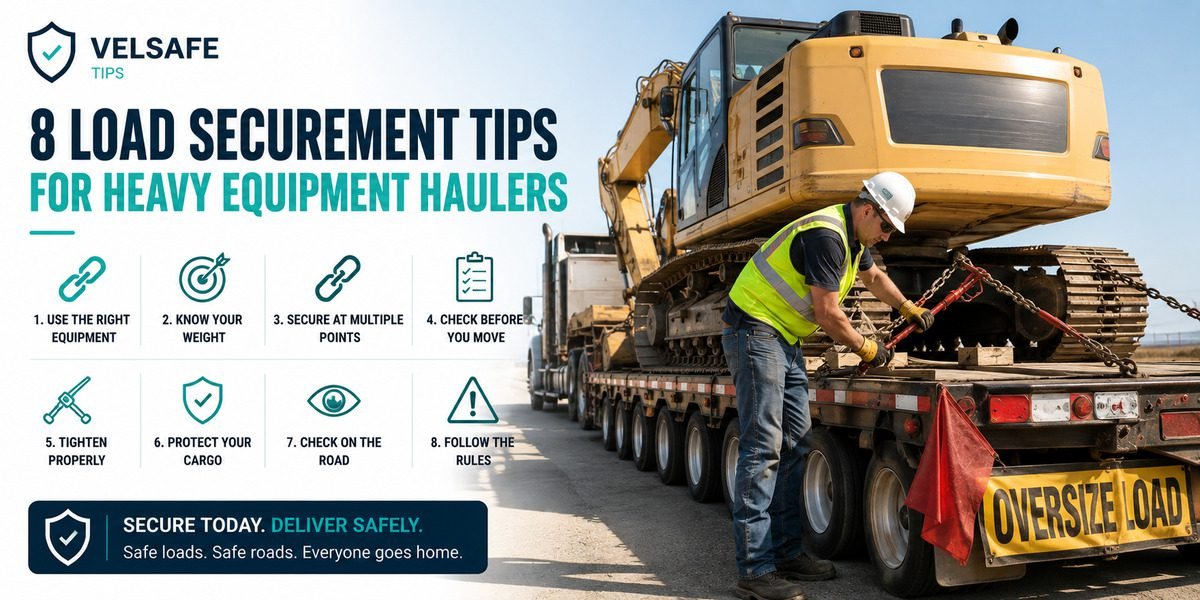
FMCSA cargo securement violations are among the most cited roadside deficiencies for flatbed and lowboy operations. These eight tips cover correct tie-down ratings, anchor point selection, and the inspection stops federal regulations require.
50%
Minimum Aggregate WLL
FMCSA requires aggregate working load limit of all tie-downs to be at least 50% of cargo weight for loads under 10,000 lbs.
49 CFR 393.100, FMCSA
4+
Tie-Downs Required
Heavy equipment exceeding 10,000 lbs requires a minimum of four tie-downs under federal cargo securement rules.
49 CFR 393.130, FMCSA
150mi
Re-Inspection Interval
Drivers must inspect cargo within the first 50 miles and then every 150 miles or three hours, whichever comes first.
49 CFR 393.100(b), FMCSA
Federal Motor Carrier Safety Administration rules under 49 CFR Part 393 set specific, measurable requirements for securing heavy equipment on flatbeds, step-decks, and lowboys. Failure to meet them results in out-of-service orders, fines, and civil liability when cargo shifts during transit. This article covers the eight most critical securement steps for construction and rigging equipment loads hauled on US highways.
These tips apply to drivers transporting crawlers, wheel loaders, excavators, graders, and other heavy construction equipment. They are drawn directly from 49 CFR 393 Subpart I requirements and standard industry practice for rigging and transport operations.
Quick Summary: 8 Load Securement Tips
Quick Summary: 8 Load Securement Tips
Tip 1
Match Aggregate Tie-Down WLL to Cargo Weight
Tip 2
Use the Required Minimum Number of Tie-Downs
Tip 3
Secure to Manufacturer-Designated Anchor Points Only
Tip 4
Lower All Attachments and Blades Before Transport
Tip 5
Chock Wheels on All Rubber-Tired Equipment
Tip 6
Use Edge Protectors on All Straps and Chains
Tip 7
Conduct Required En-Route Cargo Inspections
Tip 8
Confirm Your Trailer Is Rated for the Load Weight
Common Securement Violations: What Inspectors Cite
Most Common Load Securement Violations in Roadside Inspections
Insufficient tie-down WLL
Very High
Tie-downs with inadequate working load limit ratings are the single most cited cargo violation category.
Too few tie-downs for cargo weight
High
Fewer than the required four tie-downs for heavy equipment loads is a common out-of-service trigger.
Damaged or missing edge protectors
Moderate-High
Straps contacting sharp steel edges without protectors weaken under load and fail inspection criteria.
Raised attachments or booms during transport
Moderate
Equipment transported with raised booms, arms, or blades creates shifting loads and height clearance hazards.
Missing wheel chocks on rubber-tired equipment
Moderate
Wheel loaders and other rubber-tired equipment must be chocked in addition to being strapped to prevent forward and rearward movement.
Source: FMCSA Cargo Securement | 49 CFR Part 393 Subpart I
The 8 Load Securement Tips
1
Match Aggregate Tie-Down WLL to Cargo Weight
Why It Matters
Under 49 CFR 393.100, the total working load limit of all tie-downs combined must meet a minimum threshold based on cargo weight. Using straps or chains rated too low is a direct federal violation and creates a real risk of load shift.
What To Do
Add up the WLL marked on each strap, chain, or binder you intend to use. For equipment weighing 10,000 lbs or less, the total WLL must be at least 50% of the cargo weight. For heavier equipment, the aggregate WLL must equal the total cargo weight. Always weigh the equipment before selecting tie-downs.
Common Mistake
Drivers use the same straps they use for lighter loads without checking the WLL label. A 4-inch webbing strap may be rated only 5,400 lbs WLL. Four of them give 21,600 lbs aggregate, which falls short for a 50,000 lb excavator.
Pro Tip
Keep a WLL calculation sheet in your cab. Record the rated WLL for each individual tie-down, sum them, and compare against the cargo weight before every load. This also provides documentation if you are inspected.
2
Use the Required Minimum Number of Tie-Downs
Why It Matters
49 CFR 393.108 sets minimum tie-down counts based on cargo length and weight. Heavy equipment over 10,000 lbs requires at least four tie-downs. Using fewer exposes you to an out-of-service order at any weigh station or roadside inspection.
What To Do
For equipment weighing over 10,000 lbs, use at minimum four tie-downs: one forward, one rearward, and one on each side. When the equipment exceeds 20 feet in length, add one additional tie-down for every additional 10 feet of length. Spread tie-downs evenly across the deck to distribute load forces.
Common Mistake
Operators count the number of chains without checking whether the count meets the requirement for the specific cargo length. A 30-foot excavator needs at least five tie-downs, not four.
Pro Tip
Place tie-downs at attachment points as close as possible to where the cargo weight is concentrated. For tracked equipment, attach at the front and rear of each track frame to prevent rotation as well as forward-rearward movement.
3
Secure to Manufacturer-Designated Anchor Points Only
Why It Matters
Heavy equipment has specific tie-down attachment points designated by the manufacturer. Using improvised attachment points such as hydraulic cylinders, boom pins, or structural gussets can damage the equipment and may not hold under dynamic road loads.
What To Do
Read the operator manual for the specific piece of equipment you are transporting. Manufacturers specify the exact locations for tie-down chains or shackles. On most crawler excavators this means attaching to the main frame lifting lugs or dedicated transport anchor tabs. On wheel loaders, use the counterweight tie-down pads if present.
Common Mistake
Drivers run chains through bucket lips, around lifting eyes rated for vertical lift only, or through any conveniently sized opening. Lifting eyes are rated for vertical load only and are not designed for the lateral and longitudinal forces that occur during road transport.
Pro Tip
Photograph the attachment points before departure. If a problem occurs in transit or at inspection, the photos confirm you used manufacturer-approved securement locations.
4
Lower All Attachments and Blades Before Transport
Why It Matters
Raised booms, dozer blades, grader moldboards, and bucket arms create a higher centre of gravity and increase rollover risk during turns and lane changes. They also create height and width clearance hazards. Many states have specific height limits for permitted loads.
What To Do
Before loading, verify that all hydraulically operated attachments are fully lowered and pinned or blocked in the travel position. Lock out any hydraulic circuits that could allow movement in transit. Check the overall height with attachments lowered against any overpass clearances on your planned route.
Common Mistake
Assuming the hydraulic lock holds during transport without blocking the attachment mechanically. Hydraulic systems can drift under temperature changes and road vibration, allowing attachments to creep upward during a long haul.
Pro Tip
For equipment with hydraulic quick-couplers, confirm the attachment is fully seated and locked before loading. A loose attachment can shift independently of the base machine and create a secondary securement problem.
5
Chock Wheels on All Rubber-Tired Equipment
Why It Matters
Wheel loaders, motor graders, and rubber-tired scrapers can roll forward or rearward on the deck even when tie-downs are correctly installed. Tie-downs secure against tipping and lateral movement, but wheel chocks prevent rolling under braking and acceleration forces.
What To Do
After driving the equipment onto the trailer, engage the parking brake and shut off the machine. Place hardwood or rubber wheel chocks against the front face of rear wheels and the rear face of front wheels before applying any tie-downs. Use chocks rated for the equipment weight. Remove chocks only after all tie-downs are released at the destination.
Common Mistake
Relying on the equipment’s own parking brake instead of chocks. Parking brakes release over time, especially in hot weather when brake fluid or air pressure changes. At a minimum, chocks must be used in addition to, not instead of, the parking brake.
Pro Tip
Secure the chocks themselves with a lightweight chain or strap to the trailer deck so they cannot fall out from under the wheels during transit. A chock that falls out mid-route no longer serves any function.
6
Use Edge Protectors on All Straps and Chains
Why It Matters
Webbing straps that contact sharp steel edges on crawler tracks, bucket teeth, or trailer stake pockets can be cut through under tension. A strap that fails under load can release suddenly, causing the equipment to shift at highway speed.
What To Do
Place rubberised or steel edge protectors at every point where a webbing strap crosses a sharp corner or abrasive surface. For chain tie-downs, use binder hooks rated for the chain class and inspect the chain links for cracks or nicks before every use. Protectors must be held in place when tension is applied.
Common Mistake
Using folded cardboard or makeshift padding as edge protection. Cardboard compresses under load and does not protect the strap from a steel edge. Use purpose-built corner protectors rated for tie-down applications.
Pro Tip
Mark your edge protectors with the equipment size they are designed for. Keeping them organised by size and attachment method speeds up loading and ensures the correct protector is always used.
7
Conduct Required En-Route Cargo Inspections
Why It Matters
49 CFR 393.100(b) requires drivers to inspect and adjust securement within the first 50 miles of a trip and again every 150 miles or three hours, whichever comes first. Skipping these stops is a federal violation and leaves load shift undiscovered until damage occurs.
What To Do
Set a cab reminder for the 50-mile mark. At each mandatory stop, walk the full length of the trailer and check every tie-down for tension, damage, and correct seating. Check that edge protectors have not slipped. Look for any lateral movement of the equipment from its original load position. Retighten or replace any tie-down that has loosened.
Common Mistake
Drivers inspect the securement only at the 50-mile stop and then skip subsequent checks to save time. Tie-downs lose tension as webbing stretches and chain links seat into their resting positions under vibration. Re-inspection is required regardless of how tight everything was at departure.
Pro Tip
Document each inspection stop on your logs. Note the time, mileage, and condition of each tie-down at every check. If an inspector later asks whether inspections were conducted, your log provides the evidence.
8
Confirm Your Trailer Is Rated for the Load Weight
Why It Matters
A flatbed or lowboy with a rated capacity below the equipment weight fails before the tie-downs do. Overloading a trailer deck causes structural damage, floor collapse, and axle weight violations. Trailer ratings are not estimates, they are engineering limits.
What To Do
Check the trailer manufacturer’s rating plate for maximum payload capacity before loading. Weigh the equipment at a certified scale if you are not certain of its weight. Account for fuel, fluids, and any attached tooling. Verify that the equipment weight does not exceed the trailer deck rating and that individual axle group weights comply with federal bridge law limits under 23 USC 127.
Common Mistake
Accepting the equipment operator’s estimate of machine weight rather than a certified scale ticket. Equipment weight varies with fuel load, hydraulic fluid, and attached tooling. An excavator that is rated at 45,000 lbs new may weigh significantly more with a hydraulic thumb and full fuel.
Pro Tip
Obtain a scale ticket for the loaded combination at a certified weigh station early in the route. If you are near or over the legal axle limit, you know before an inspection catches it rather than after.
Pre-Transport Compliance Checklist
Pre-Transport Checklist Item
Requirement / Reference
Aggregate WLL calculated and documented
49 CFR 393.100: must meet 50% (under 10k lbs) or 100% (over 10k lbs) of cargo weight
Minimum tie-down count verified for cargo length and weight
49 CFR 393.108: 4 minimum for equipment over 10,000 lbs; add one per additional 10 ft of length
Tie-downs attached at manufacturer-designated points
Equipment operator manual: transport anchor lugs or tie-down tabs only
All attachments fully lowered and mechanically locked in travel position
Equipment operator manual: hydraulic lock plus physical block or pin required
Wheel chocks placed and secured (rubber-tired equipment)
49 CFR 393.130: chocking required in addition to parking brake
Edge protectors installed at all strap-to-metal contact points
49 CFR 393.102: tie-down devices must be protected from sharp edges
En-route inspection stops scheduled (50 mi, then every 150 mi or 3 hrs)
49 CFR 393.100(b): mandatory frequency, no exceptions for permit loads
Trailer payload rating confirmed against equipment weight
Trailer manufacturer rating plate: do not exceed stated deck capacity or axle group limits
Source: 49 CFR Part 393 Subpart I, FMCSA | FMCSA Cargo Securement Resources
Three Common Mistakes to Avoid
Using Load Binders Without Chain Ratings
A Grade 70 binder requires Grade 70 chain. Mixing chain grades and binder ratings results in a mismatched system where the weaker component defines the WLL. Always match chain grade to binder rating throughout the entire tie-down assembly.
Routing Chains Through Bucket Teeth
Bucket teeth are cutting tools, not tie-down anchor points. Running a chain through the bucket creates point loading on the tooth welds and can cause teeth to shear off. Use the manufacturer anchor lugs or bucket cylinder pins if specified for transport.
Overtightening Ratchet Straps
Overtightening webbing straps can damage the strap fibers at the point of maximum stress and reduce WLL. Ratchet straps should be tensioned firmly but not cranked beyond hand-tight resistance. Over-tensioned straps also distort the ratchet mechanism and make release difficult in an emergency.
Key Takeaways
WLL Arithmetic Is Not Optional
The aggregate working load limit of your entire tie-down system must meet the FMCSA threshold before the truck moves. This is arithmetic, not judgment. Calculate it every time, document it every time, and keep the calculation with your cargo paperwork.
Manufacturer Anchor Points Exist for a Reason
Equipment builders engineer specific transport anchor points to handle the forces of road transport. Using any other attachment point shifts the load into a structure not designed for it. Locate the anchor points in the operator manual before every load, without exception.
En-Route Inspections Are a Federal Requirement, Not a Suggestion
49 CFR 393.100(b) requires cargo inspection at or before 50 miles and then at every 150-mile or 3-hour interval. Skipping these stops when hauling heavy equipment is a federal violation. Tie-downs that were properly tensioned at departure can lose tension as chain links settle and webbing relaxes. Only a physical inspection detects this. Stop, walk the trailer, and adjust before continuing.
Frequently Asked Questions
What is the minimum aggregate WLL required to secure heavy equipment under FMCSA rules?
Under 49 CFR 393.100, the aggregate WLL of all tie-downs must equal at least 50% of the cargo weight for loads weighing 10,000 lbs or less. For equipment over 10,000 lbs, the aggregate WLL must equal the full weight of the equipment. Count only the marked WLL on each individual tie-down device, not the break strength.
How many tie-downs are required to haul a 50,000 lb excavator on a flatbed?
At minimum, four tie-downs are required for any heavy equipment over 10,000 lbs under 49 CFR 393.130. If the machine is longer than 20 feet, one additional tie-down is required for each additional 10 feet of length. The four mandatory tie-downs should be positioned at the front, rear, and each side of the machine.
Do wheel chocks replace tie-downs for rubber-tired construction equipment?
No. Wheel chocks prevent rolling and supplement the securement system, but they do not replace the required number of tie-downs. FMCSA regulations require both: the minimum tie-down count must be met regardless of whether chocks are used. Chocks address forward and rearward movement; tie-downs address lateral movement and tipping.
When must a driver stop to re-inspect cargo securement on a heavy equipment load?
49 CFR 393.100(b) requires drivers to inspect and, where necessary, adjust or retighten the securement system within the first 50 miles of the trip. After that first stop, re-inspection is required at intervals of no more than 150 miles or three hours of driving, whichever comes first. This requirement applies for the entire duration of the trip.
Can I use the bucket cylinder pins or hydraulic lines as anchor points for a chain tie-down?
No. Hydraulic cylinders and hydraulic lines are not structural anchor points and are not rated for tie-down loads. Attaching chains to cylinders can cause rod damage and seal failure. Always use only the manufacturer-designated anchor points, which are listed in the equipment’s operator manual. If no manual is available, contact the manufacturer before loading.
What chain grade is required for securing heavy equipment under federal rules?
FMCSA does not mandate a specific chain grade, but it requires that all tie-down components meet the WLL requirements for the load. Grade 70 transport chain is the industry standard for flatbed cargo securement because its WLL is published and stamped on each link. Grade 30 proof coil chain is not acceptable for heavy equipment transport because its WLL is insufficient for most machine weights. Never mix chain grades in a single assembly.
Are edge protectors required by federal law for webbing straps?
49 CFR 393.102(b) states that tie-down devices must be protected from sharp edges that could damage the device. While it does not use the term “edge protector” specifically, any strap in contact with a sharp steel edge without protection fails this requirement. A strap that is damaged by an edge is also considered out of compliance with the WLL requirement because its effective strength is reduced.
What happens if a driver is found out of compliance with cargo securement rules at a weigh station?
Out-of-service violations under the North American Standard Out-of-Service Criteria require the driver to correct the deficiency before the vehicle can move. Depending on the severity, fines can be issued to both the driver and the carrier. Repeat violations affect the carrier’s Safety Measurement System score, which can trigger an FMCSA compliance review or investigation.
Sources
Government and Regulatory Sources
- FMCSA. 49 CFR Part 393 Subpart I: Cargo Securement Rules: Federal requirements for tie-down count, WLL, en-route inspection frequency, and use of blocking and bracing for heavy equipment transport.
- FMCSA. Cargo Securement Resources and Training Materials: Agency guidance and training resources for cargo securement compliance, including heavy equipment and flatbed loads.
- OSHA. 29 CFR 1926.1416: Rigging Equipment for Material Handling: Requirements for inspecting and using rigging equipment including chains, hooks, and shackles used in crane and rigging operations adjacent to transport tasks.
Research and Industry Sources
- NCCCO. Rigger Certification Program: Rigging and Transport Practices: Industry certification body standards for rigging, attachment point identification, and load securement practices in crane and rigging operations.
- American Trucking Associations. Cargo Securement Guidance and Best Practices: Industry guidance on flatbed and heavy haul securement methods, including specific guidance for construction equipment transport.
Related VelSafe Articles
Tips
8 Hot Work Safety Tips for Construction Sites
Covers permit requirements, fire watch duties, and equipment controls for welding and cutting on active construction sites.
Insights
When a Contractor Is Hurt on Your Site, Are You Responsible?
Explains OSHA’s multi-employer citation policy and how host employers can be held liable for contractor injuries on managed construction sites.
Insights
Hydraulic Safety: Hazards, Regulations, and Insights
Covers hydraulic hazards relevant to heavy equipment operation, maintenance, and transport including injection injuries, line failures, and pressure management.
Build a Safer Hauling Programme
VelSafe covers cargo securement, crane and rigging safety, and driver compliance training. Explore the full course library for your fleet and field teams.
Explore VelSafe Training