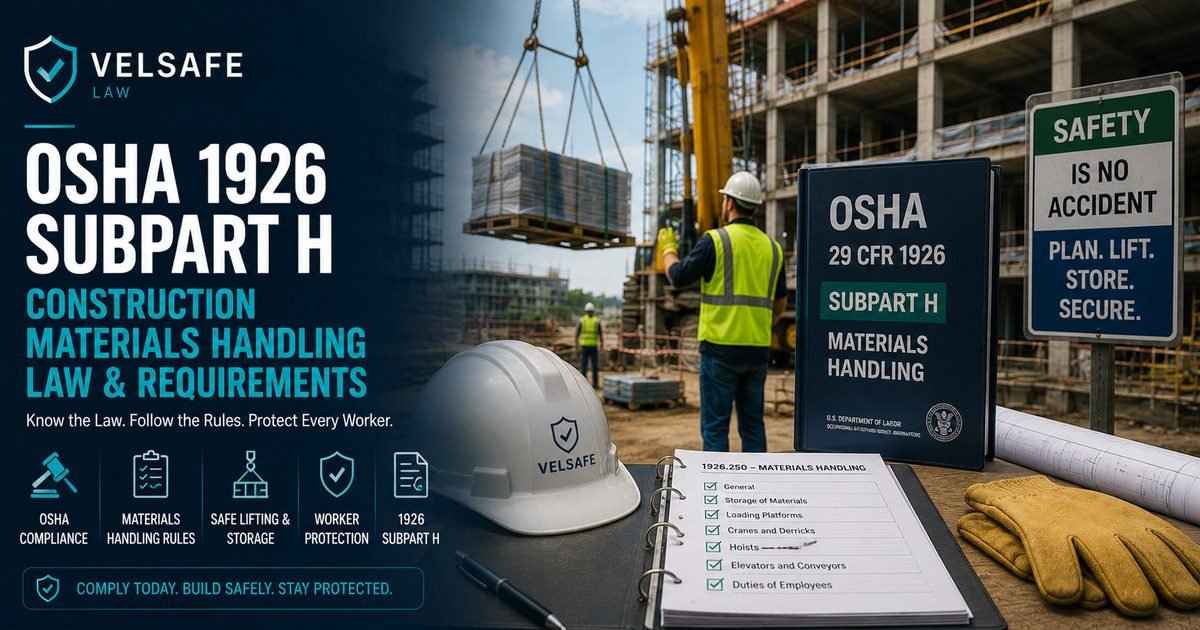
LAW: Construction Materials Handling
29 CFR 1926 Subpart H: What Every
Construction Employer Must Comply With
OSHA 29 CFR 1926 Subpart H governs construction materials handling, storage, use, and disposal on US construction sites. It covers everything from how high you can stack bricks to what inspections rigging equipment must pass before each shift. Violations carry penalties up to $16,550 per serious citation and $165,514 for willful or repeated findings. This article explains what the law requires, what triggers citations, and how to build a compliant programme.
$16,550
Per Serious Violation
OSHA maximum civil penalty per serious violation of 29 CFR 1926 Subpart H. Willful or repeated violations reach $165,514 per citation plus $16,550 per day for failure to abate.
OSHA Penalty Schedule 2026
3
Core Standards in Subpart H
1926.250 (general storage), 1926.251 (rigging equipment), and 1926.252 (waste disposal) constitute the full legal framework for materials handling on construction sites.
29 CFR 1926 Subpart H
7 ft
Max Brick Stack Height
1926.250(b)(1) sets the maximum height for brick stacks at 7 feet. Loose stacks above 4 feet must be tapered back 2 inches per foot of additional height. These specific limits are directly citable.
29 CFR 1926.250(b)(1)
The subpart contains three standards with different scopes. 1926.250 sets general storage requirements. 1926.251 covers rigging equipment for material handling including slings, chains, wire rope, and hardware. 1926.252 governs waste material disposal. Compliance with all three is required simultaneously, a site that handles rigging correctly but stores materials unsafely is still in violation.
1926.250 sets binding requirements for how materials must be stored on construction sites. The standard is precise on dimensions, these are not guidelines, they are directly citable limits.
Stacking and Height Limits
All tiered materials stacked, racked, or interlocked to prevent collapse
Brick stacks: maximum 7 feet; loose stacks tapered 2 in. per foot above 4 ft
Masonry blocks: taper back one-half block per tier above 6 feet
Lumber: maximum 20 feet; manually handled lumber maximum 16 feet
Cylindrical materials: stacked and blocked to prevent spreading or tilting
1926.250(b)
Floor Loads and Building Storage
Maximum safe floor load limits posted conspicuously in all storage areas
Materials not stored on scaffolds or runways beyond immediate operation needs
Used lumber: all nails withdrawn before stacking
Lumber: stacked on level, solidly supported sills
Bagged materials: stacked by stepping back tiers and cross-keying bags
1926.250(a), (b)
Housekeeping
Storage areas kept free of materials creating tripping hazards
Free of fire, explosion, or pest harborage hazards
Vegetation control where necessary
No materials stored in aisles or emergency egress paths
1926.250(a)(2)
Rigging Pre-Use Inspection
All rigging equipment inspected prior to use on each shift
Inspection continued as necessary during use
Defective equipment removed from service immediately
Inspection must be performed by a competent person
1926.250(d)(4)
1926.251 is the most technically detailed standard in Subpart H. It covers alloy steel chains, wire rope slings, metal mesh slings, natural and synthetic fiber rope, and synthetic web slings. The standard specifies rated capacities for each sling type and configuration through tables incorporated by reference, and requires that rigging equipment never be loaded beyond its rated capacity.
Identification markings and rated capacity
All rigging equipment must have permanently affixed and legible identification markings showing the manufacturer’s recommended safe working load. Equipment must never be loaded in excess of that rated capacity. Custom-made hooks, clamps, and grabs must be marked to indicate their safe working loads. When not in use, rigging equipment must be removed from the work area so it does not present a hazard. Source: 1926.251(a)(2)
Daily sling inspection before use
Each day before use, every sling and all its fastenings and attachments must be inspected for damage or defects by a competent person. Additional inspections must be performed during use where service conditions warrant. Damaged or defective slings must be immediately removed from service. There is no exception for light-use or low-load applications, the daily inspection requirement applies regardless of the load being handled. Source: 1926.251(a)(1)
Sling capacity tables govern all lifts
1926.251 incorporates capacity tables for alloy steel chains, wire rope slings, metal mesh slings, and synthetic web slings. These tables specify rated load capacities for different sling configurations (vertical, choker, basket) and sizes. No lift may be rigged without confirming the sling configuration’s rated capacity meets or exceeds the load weight. The tables are the legal standard, manufacturer specifications alone do not satisfy the requirement if they differ from the incorporated tables. Source: 1926.251(b)-(e)
Rigging not inspected before the shift, 1926.251(a)(1)
The most common Subpart H citation for rigging operations. 1926.251 requires inspection by a competent person prior to each shift and during use where conditions warrant. A sling or chain that is visually used daily but has no inspection record, or where no competent person has been designated, generates a serious citation per sling and per shift it was used uninspected.
Rigging loaded beyond rated capacity or markings missing, 1926.251(a)(2)
Rigging equipment without legible capacity markings, because the tag has worn off, been removed, or was never present, cannot be legally used. An unlabelled sling must be removed from service until it is properly identified. Using rigging beyond its rated capacity is among the most hazardous violations in the standard and is typically cited as willful if the employer knew the load weight and the rating.
Materials stacked above permitted heights, 1926.250(b)
Brick stacks above 7 feet, loose brick above 4 feet without the 2-inch taper, masonry blocks above 6 feet without the half-block taper, and lumber above 20 feet are all directly citable under 1926.250(b). These are common on active construction sites where storage areas expand under production pressure without re-assessment of compliance with height limits.
Floor load limits not posted, 1926.250(a)(1)
1926.250(a)(1) requires maximum safe floor load limits to be conspicuously posted in all storage areas within buildings and structures. Missing or illegible signs are a common other-than-serious citation, one that is easy to correct before an inspection and therefore reflects a failure to conduct routine self-inspection rather than an inherently difficult compliance problem.
Used lumber stored with nails still in, 1926.250(b)(2)
One of the most straightforward citations in the subpart: 1926.250(b)(2) requires all nails to be withdrawn from used lumber before stacking. Exposed nail points create puncture hazards for workers handling the lumber stack. This violation is typically cited as other-than-serious but demonstrates the level of specificity in Subpart H, inspectors look for specific material conditions, not only major structural failures.
Designate a competent person for rigging
1926.251 requires a competent person to inspect slings and attachments each day before use. The employer must designate a specific individual for this role, it cannot be fulfilled by general awareness that workers “check their equipment.” The competent person must have the knowledge and authority to identify hazards and remove defective equipment from service.
Post floor load limits in all indoor storage areas
This requirement applies wherever materials are stored inside a building or structure on the construction site. The posting must be conspicuous, OSHA has cited employers where signs were present but not legible or not visible from the point of material placement. Review postings quarterly and after any storage area reconfiguration.
Establish and enforce height limits for each material type
The height limits in 1926.250(b) are specific to material type. A site that stores brick, masonry, lumber, and steel simultaneously must have supervisors who know the separate limits for each. A single storage procedure covering “all materials” without material-specific limits does not satisfy the standard when different materials have different maximum heights.
Remove defective rigging from service immediately
1926.251 uses “immediately”, not “by end of shift” or “when replacement is available.” A defective sling discovered during the pre-shift inspection or during use must be taken out of service at that moment, tagged, and physically separated from serviceable equipment. Tagging alone without removal is insufficient if the defective equipment remains accessible to workers.
Legal Disclaimer
This article provides educational information about regulations and legal requirements. It does not constitute legal advice. Requirements vary by industry, jurisdiction, and specific workplace conditions. Consult a qualified safety professional or employment attorney for guidance specific to your workplace.
The height and taper limits in 1926.250 are not guidelines, they are directly citable
7 feet for brick, 20 feet for lumber, 16 feet for manually handled lumber, these figures appear in the federal standard and generate citations when exceeded. Supervisors responsible for storage areas must know the specific limits for every material type on their site.
Rigging inspection is a daily requirement, not a periodic one
1926.251 requires inspection before each shift and during use. A sling that was inspected on Monday is not compliant on Tuesday without a fresh inspection. The competent person designation must be documented, not assumed, and must have authority to remove equipment from service on the spot.
Multi-employer site liability means a subcontractor’s Subpart H violation can become the general contractor’s citation
Under OSHA’s multi-employer worksite policy, a general contractor who controls the work area can be cited for Subpart H violations created by a subcontractor if the GC had the ability to detect and correct the hazard. Storage heights, housekeeping, and rigging compliance visible to site supervisors are all within the controlling employer’s exposure. Routine site-wide safety inspections, not just trade-specific checks, are the GC’s primary defence against downstream citations.
What is 29 CFR 1926 Subpart H and who does it apply to?
29 CFR 1926 Subpart H, Materials Handling, Storage, Use, and Disposal, applies to all employers engaged in construction activities covered by federal OSHA. This includes general contractors, subcontractors of all trades, and employers at multi-employer construction worksites. State-plan states adopt equivalent or more stringent standards. The subpart covers how materials are stored, how rigging equipment is selected and inspected, and how waste materials are disposed.
How high can brick be stacked on a construction site under OSHA rules?
Under 29 CFR 1926.250(b)(1), brick stacks shall not exceed 7 feet in height. When a loose brick stack reaches 4 feet, it must be tapered back 2 inches for every foot of height above the 4-foot level. These are binding limits, not recommendations, exceeding them is a citable violation under 1926.250(b).
How often must rigging equipment be inspected on a construction site?
Under 29 CFR 1926.251(a)(1), rigging equipment must be inspected prior to use on each shift and as necessary during use. Slings and all fastenings and attachments must be inspected each day before use by a competent person. There is no exception for equipment used on light-duty lifts or for equipment that passed inspection the previous day. Defective equipment must be removed from service immediately.
What happens if rigging equipment does not have capacity markings?
1926.251(a)(2) requires all rigging equipment to have permanently affixed and legible identification markings indicating the manufacturer’s recommended safe working load. Equipment without legible markings, whether the tag has worn off or was never present, may not be used. It must be removed from service until properly identified. Using unmarked rigging is a citable violation, and if the load weight is known to exceed the unmarked equipment’s capacity, OSHA may classify the violation as willful.
Can a general contractor be cited for a subcontractor’s Subpart H violation?
Yes. Under OSHA’s multi-employer worksite policy, a controlling employer, typically the general contractor, can be cited for hazards created by a subcontractor if the GC had the ability to detect and correct the condition through reasonable diligence. Storage height violations and housekeeping deficiencies visible to any site supervisor fall within this exposure. A general contractor who conducts routine site-wide inspections and documents corrective action has a stronger defence than one who relies solely on subcontractor self-reporting.
Does Subpart H apply to crane operations on construction sites?
1926.251 applies to rigging equipment used in conjunction with cranes and other material handling equipment for movement by hoisting. The rigging requirements, sling inspection, capacity limits, identification markings, apply regardless of the type of lifting equipment the sling is connected to. Crane operations themselves are governed by 29 CFR 1926 Subpart CC (Cranes and Derricks in Construction). Both subparts apply simultaneously, a lift cannot be legally compliant on crane requirements while using uninspected rigging.
What must employers do about waste material disposal on construction sites?
Under 29 CFR 1926.252, whenever materials are dropped more than 20 feet to any point outside the exterior walls of a building, an enclosed chute must be used. A chute is a downward-sloping tube or trough that directs the falling material to a controlled landing point. Where materials are dropped inside the structure and within 6 feet of an exterior wall opening, the area must be enclosed with a barricade at least 42 inches high. The bottom of every chute must have an enclosure to prevent debris from bouncing beyond a safe landing area.
Worker Safety
Safe Materials Handling: What Every Worker Must Know
The frontline worker guide covering lifting technique, secure storage, aisle compliance, and the five-step pre-task procedure for materials handling tasks.
Situational
Warehouse Rack Collapse: What the Investigation Found
OSHA case analysis: a 5 mph turret truck impact collapsed 231 feet of racking and 1.5 million pounds of goods. What the investigation found and what every site must change.
Law
VelSafe Construction Compliance Law Articles
Explore VelSafe’s full law library for plain-language explainers of OSHA construction standards, penalty schedules, and employer compliance obligations across all major 1926 subparts.
CONSTRUCTION COMPLIANCE LAW
Know the Law Before the Inspector Does
Explore VelSafe’s full library of OSHA construction law explainers, compliance tables, and penalty guides covering all major 29 CFR 1926 subparts.
Explore All Law Articles