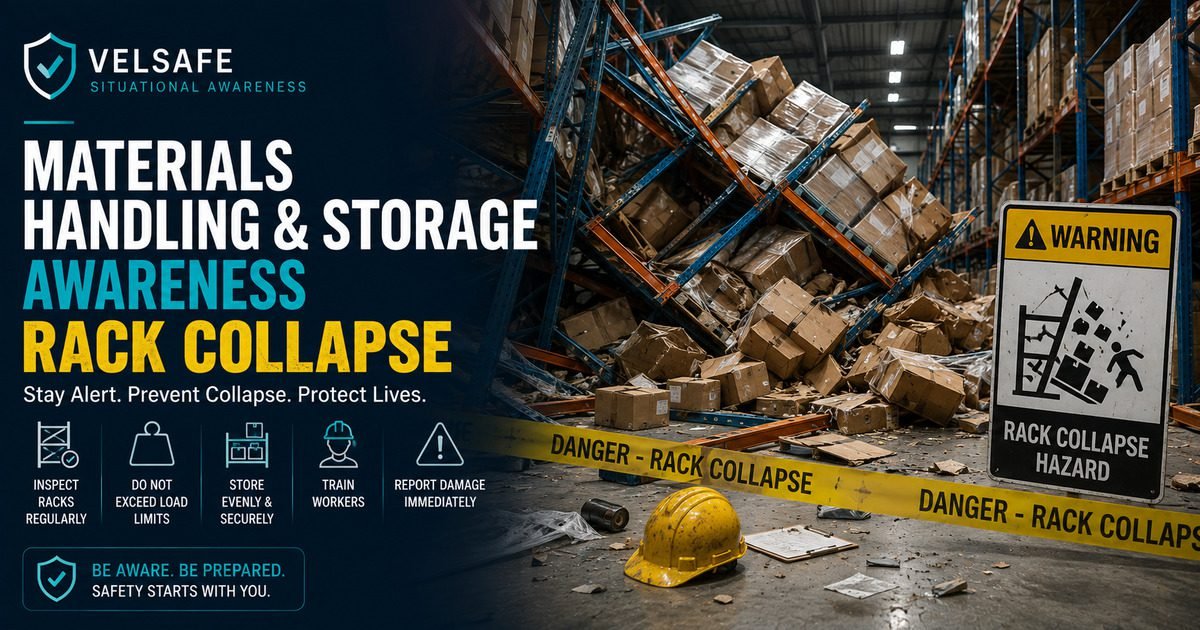
SITUATIONAL: Materials Handling Incident
The Truck Was Moving at 5 mph.
The Rack Held 1.5 Million Pounds.
In a large distribution centre, a warehouse rack collapse started when a turret truck switched from manual to automated mode and struck a rack upright. The truck was travelling at walking speed. The racking system was 231 feet long, fully loaded, and had no impact protection on its uprights. One worker was killed. Another was hospitalised. The collapse happened so fast the victim had no time to move. This analysis examines what the investigation found, what the regulations required, and what every warehouse and manufacturing site must do differently.
5 mph
Speed at Impact
The turret truck was travelling at 5 mph when it struck the rack upright, walking speed. Even a low-speed impact on an unprotected upright can trigger a progressive rack collapse carrying millions of pounds of stored goods.
Safety+Health Magazine / OSHA case
231 ft
Length of Collapsed Racking
The entire 231-foot racking system collapsed in a chain reaction from a single upright impact. One point of failure brought down a structure carrying 1.5 million pounds of stored goods.
OSHA case investigation
70%
Forklift Accidents Preventable
OSHA estimates that up to 70% of powered industrial truck accidents in the US could be prevented through proper training, equipment maintenance, and engineering controls.
OSHA Powered Industrial Trucks
A large distribution centre operates a high-bay storage system served by automated narrow-aisle turret trucks. The racking system runs 231 feet in length and is loaded with palletised goods totalling approximately 1.5 million pounds. The uprights of the racking have no impact protection, no bollards, no column guards, no end-of-aisle barriers.
On the day of the incident, a turret truck is in the process of being switched from manual operation mode to automated operation mode while inside a racking aisle. During the transition, the truck moves and strikes one of the vertical upright supports of the rack at 5 mph. The impact is brief and at low speed. The worker nearby has no warning. The 231-foot racking system begins to collapse progressively, section by section, in what investigators later describe as a domino effect. One worker is killed. Another is hospitalised. The racking collapse is complete in seconds.
What was already known and not acted on
The voluntary standard ANSI MH16.1, the recognised industry standard for warehouse racking, requires impact protection on rack uprights in areas where powered industrial trucks operate. The employer had not installed bollards, column guards, or any other upright protection. Workers were permitted to be in aisles adjacent to racking during turret truck operations. The hazard existed, was known to the industry, and had not been controlled.
Before Shift
The high-bay racking system is fully loaded with palletised goods. No impact protection exists on rack uprights. Workers are permitted to access aisles adjacent to active turret truck routes. No specific exclusion zone policy is in place for mode-switching operations.
Mode Switch
A turret truck operator begins switching the vehicle from manual to automated operation mode while positioned inside a racking aisle. The procedure for this transition has not been assessed for the hazard of uncontrolled vehicle movement during mode change.
Impact
The truck moves during the mode switch and strikes a rack upright at approximately 5 mph. The upright is unprotected. The impact is sufficient to compromise the structural integrity of the upright and initiate a progressive collapse of the racking system.
Collapse
The 231-foot racking system collapses in a chain reaction. 1.5 million pounds of stored goods fall. The collapse is so rapid that, per the OSHA investigation, the victim had little to no reaction time to get clear. One worker is killed. A second worker is hospitalised.
Investigation
OSHA investigates and issues one serious violation under the General Duty Clause. The initial fine of $13,653 is reduced to $9,600 after settlement. The employer subsequently installs bollards and impact barriers, bans workers from aisles where turret trucks operate, and moves product retrieval work to aisles clear of automated equipment.
No impact protection on rack uprights
The ANSI MH16.1 standard for warehouse racking, the recognised industry standard that OSHA references under the General Duty Clause, calls for bollards, column guards, or other impact protection on uprights in areas where powered industrial trucks operate. This facility had none. A single low-speed impact on an unprotected upright in a fully loaded, interconnected system was sufficient to trigger a catastrophic chain collapse. The protection would have cost a fraction of the damage, fines, and human cost of the incident.
Mode-switching performed inside an active racking aisle
The transition from manual to automated operation of a turret truck involves a period of potential uncontrolled or unexpected movement. This hazard had not been assessed. The procedure was carried out inside a narrow racking aisle, surrounded by loaded rack uprights, with no exclusion zone in place. A proper pre-task hazard assessment would have identified that mode-switching in a racking aisle was incompatible with the proximity of unprotected structural elements and the presence of nearby workers.
Workers permitted in the collapse zone
The investigation found that employees were permitted to be in aisles adjacent to active turret truck operations. In a fully loaded high-bay racking environment, the potential collapse zone extends beyond the immediate aisle, a progressive collapse can bring down interconnected sections far from the initial impact point. No exclusion zone, no pedestrian separation, and no communication protocol between truck operators and nearby workers existed.
Racking not inspected for cumulative impact damage
High-bay racking in active distribution environments is subject to repeated minor impacts from equipment operation. Individual impacts that appear minor in isolation can cumulatively weaken uprights and connections to the point where a subsequent impact triggers failure at stresses below what the originally undamaged system would tolerate. Without a documented racking inspection programme, the structural condition of the uprights before the fatal impact is unknown. Post-incident investigations consistently find that the incident impact was not the first impact, it was the last one a weakened system could absorb.
OSHA cited the employer under the General Duty Clause, Section 5(a)(1) of the OSH Act, because no specific standard explicitly requires rack upright protection in so many words. However, the General Duty Clause applies when a recognised hazard exists that is likely to cause death or serious harm and can be materially reduced by feasible controls. All three elements were present.
OSH Act Section 5(a)(1): General Duty Clause
Employers must furnish a workplace free from recognised hazards likely to cause death or serious physical harm. The hazard of rack collapse from vehicle impact in a high-bay storage environment is a recognised hazard in the materials handling industry. ANSI MH16.1 acknowledges it. The solution (upright protection) is well established. The employer’s failure to implement it was cited as a serious violation.
29 CFR 1910.176(b): Secure Storage
Storage of material shall not create a hazard. Materials stored in tiers shall be stacked, blocked, interlocked and limited in height so that they are stable and secure against sliding or collapse. A racking system with unprotected uprights in a powered truck environment, holding 1.5 million pounds of goods, in the absence of a documented inspection programme for impact damage, is a condition that fails this standard.
29 CFR 1910.178: Powered Industrial Trucks
OSHA’s powered industrial truck standard requires safe operation, operator training, and pre-shift inspection. The mode-switching procedure that allowed uncontrolled movement in a racking aisle reflects a gap in operating procedures and task hazard assessment for a non-routine task, transitioning between operating modes while positioned adjacent to loaded racks.
ANSI MH16.1: Rack Safety Standard
The voluntary ANSI MH16.1 standard for steel storage racks calls for impact protection on uprights in areas where powered industrial trucks operate. OSHA references voluntary consensus standards under the General Duty Clause as evidence of recognised hazards. Failure to implement controls specified in ANSI MH16.1 establishes both that the hazard was recognised by the industry and that feasible controls existed.
Install impact protection on all rack uprights in powered truck areas
Bollards, column guards, and end-of-aisle barriers must be installed on every rack upright accessible to powered industrial trucks. This is not optional in facilities with both racking and vehicle traffic, it is the recognised control for a recognised hazard. The post-incident employer installed these controls. They should have been present from commissioning. Prioritise uprights at aisle ends, at corners, and at any point where a vehicle turning radius brings equipment close to rack columns.
Prohibit workers from any aisle where automated or turret trucks are operating
Pedestrian separation from automated narrow-aisle equipment is a primary control, not a supplementary one. The corrective action taken after the incident moved product retrieval work to aisles where turret trucks are not permitted. This is the correct hierarchy: eliminate the pedestrian-vehicle interaction before relying on PPE, warning signs, or training. Define exclusion zones, enforce them, and audit them during every shift.
Write and assess a specific procedure for mode-switching operations
Non-routine tasks, mode changes, equipment start-up, transition between operation types, require their own written procedures and pre-task hazard assessments. “Switch from manual to automated” is not a safe work procedure. A safe work procedure for this task specifies where the vehicle must be positioned before switching modes, what movements are possible during the transition, what exclusion zones must be clear, and who must be notified before the switch begins.
Implement a documented racking inspection programme
ANSI MH16.1-2023 requires racking to be inspected regularly. Most safety professionals recommend monthly visual checks by in-house staff and an annual engineering inspection, with additional inspections after any known impact, modification, or seismic event. Every inspection must be documented with the date, the inspector, the uprights and beams checked, any damage found, and the action taken. Undocumented checks are not inspections, they are unverifiable activities that provide no protection in a post-incident investigation.
Speed is not a reliable safety metric for equipment in racking environments
5 mph is slow. It is slower than a running person. It is the speed limit in many car parks. But in a fully loaded, 231-foot interconnected racking system with unprotected uprights, 5 mph was enough to kill one person and hospitalise another. The lesson for safety managers is that speed limits for vehicles operating near racking are not the primary control, physical separation and upright protection are. Speed limits reduce severity; they do not eliminate the consequence of an impact on an unprotected structure.
The incident that kills someone is rarely the first impact, it is the last one a damaged system absorbs
High-bay racking in active distribution environments absorbs minor impacts regularly. Each impact that goes unreported and uninspected may weaken an upright or connection incrementally. Without a reporting culture that treats every rack impact as a mandatory inspection trigger and a documented inspection programme that provides a baseline for structural condition, the only way a failure becomes known is when the rack collapses. By then it is too late to use that knowledge.
Non-routine tasks carry disproportionate risk and require explicit procedure
Routine tasks, loading, picking, transport, are trained, repeated, and familiar. Non-routine tasks, mode switching, system commissioning, maintenance in operational areas, are performed infrequently, are less well understood, and often lack written procedures. This incident arose during a non-routine task with no written procedure and no hazard assessment. Non-routine tasks in materials handling environments must be treated with at least the same hazard assessment rigour as routine tasks, and frequently more.
Engineering Controls
Bollards and column guards on all uprights in powered truck zones
End-of-aisle barriers at every rack row entry
Physical pedestrian separation from automated equipment aisles
Rack load capacity labels visible on every bay
Inspection Programme
Monthly visual inspection of all uprights, beams, and connections
Annual engineering inspection documented on file
Mandatory inspection after every reported rack impact
Damaged rack tagged out of service immediately
Procedures and Training
Written procedures for all non-routine tasks including mode-switching and equipment transitions
Pre-task hazard assessment for every non-routine operation in racking areas
Operators trained and certified per 29 CFR 1910.178 with refresher training after incidents
All rack impacts reported immediately, no incident too minor to report
Exclusion zones communicated at every shift start and audited during shift
Impact protection on uprights is not optional, it is the control
ANSI MH16.1 calls for it. OSHA cites its absence under the General Duty Clause. A single low-speed impact on an unprotected upright in a fully loaded interconnected system can collapse an entire aisle. Bollards and column guards exist precisely because this hazard is known, quantified, and preventable.
Any rack impact is a mandatory inspection trigger
The incident impact may not be the first. Cumulative undetected damage lowers the threshold at which the next impact causes structural failure. A reporting culture where every rack contact, however minor it appears, triggers a documented inspection is the only way to know the structural condition of the system before the next event.
If workers and powered trucks share the same space, separation must be engineered, not assumed
Training and awareness do not protect workers in the collapse zone of a 1.5-million-pound racking system. Physical separation, aisles where pedestrians are not permitted when vehicles operate, exclusion zones enforced by barriers and procedure, and product retrieval tasks relocated away from automated equipment routes, is the only control that works when the failure mode is too fast for human reaction. The post-incident changes at this facility confirmed this. The pre-incident programme did not include them.
Is there a specific OSHA standard requiring rack upright protection?
No single OSHA standard uses the words “rack upright protection” or “bollards.” However, 29 CFR 1910.176(b) requires storage to be stable and secure, and the General Duty Clause applies when a recognised hazard exists with a feasible control. OSHA cites the ANSI MH16.1 voluntary standard as evidence of industry recognition of the hazard and the existence of feasible controls. Failure to implement the controls recommended in ANSI MH16.1 exposes an employer to General Duty Clause citations.
How often should warehouse racking be inspected?
ANSI MH16.1-2023 requires regular inspections. Most safety professionals recommend monthly visual checks by trained in-house staff and an annual engineering inspection by a qualified person. In addition, an immediate inspection must follow any reported rack impact, modification, or seismic event. Facilities with heavy forklift traffic or a history of rack contacts should inspect more frequently. All inspections must be documented.
What should workers do if they see a rack that has been hit by equipment?
Stop work in the affected area immediately. Do not approach or add load to a rack that shows visible bending, leaning, or damage to an upright or beam connection. Report the damage to a supervisor. The rack should be tagged out of service and the area barricaded before any further use or investigation. Damaged racking must be inspected by a qualified person and repaired or replaced before returning to service. Workers should never remove the out-of-service tag without supervisor authorisation following inspection.
Can a slow-moving forklift really cause a complete rack collapse?
Yes. This incident demonstrates that a turret truck at 5 mph was sufficient to collapse a 231-foot racking system carrying 1.5 million pounds. The critical variable is not the speed of the vehicle, it is the structural condition of the upright and the interconnected loading of the rack. An upright that has been incrementally weakened by prior impacts may fail at a stress well below what the original specification would require. In a fully loaded interconnected system, progressive collapse can carry the failure far beyond the initial impact point.
What is the OSHA General Duty Clause and when does it apply to racking?
Section 5(a)(1) of the OSH Act requires employers to provide a workplace free from recognised hazards likely to cause death or serious harm where feasible controls exist. It applies when no specific standard directly addresses the hazard. For racking, OSHA uses the General Duty Clause when: (1) the hazard of collapse or impact-related structural failure is recognised by the industry, (2) the employer failed to implement controls known to reduce the hazard (such as those described in ANSI MH16.1), and (3) the controls were feasible to implement.
Do these risks apply to construction sites with crane and rigging operations as well?
Yes. Crane and rigging operations on construction sites share the same core hazard pattern: a failure in load control, load assessment, or exclusion zone enforcement results in a falling or swinging load that workers cannot react to in time. OSHA has documented multiple fatalities involving crane loads that toppled because the load weight was miscalculated, the lift angle was incorrect, or workers were within the swing radius. The corrective actions, pre-lift assessment, load verification, exclusion zones, and competent person oversight, apply directly across both settings.
What are an employer’s OSHA reporting obligations after a rack collapse fatality?
Under 29 CFR 1904.39, employers must report all work-related fatalities to OSHA within 8 hours and all work-related in-patient hospitalisations, amputations, and losses of an eye within 24 hours. These reports can be made by phone to the nearest OSHA area office, online via OSHA’s reporting portal, or to the OSHA hotline. Failure to report triggers separate citations and penalties. The scene must also be preserved to allow for investigation.
Worker Safety
Safe Materials Handling: What Every Worker Must Know
The worker safety guide covering lifting technique, storage requirements, aisle rules, and the five-step pre-task procedure for materials handling tasks.
Situational
LOTOTO Incident: How a Skipped Tryout Kills
An energy control incident analysis, the same pattern of non-routine task hazard underestimation that produced the racking collapse examined in this article.
Law
VelSafe Compliance Law Articles
Plain-language explainers of OSHA standards, General Duty Clause obligations, and employer legal requirements relevant to warehouse and construction safety programmes.
VELSAFE SITUATIONAL LIBRARY
What Went Wrong. What the Law Required. What Changes the Outcome.
Explore VelSafe’s full library of incident analyses, real scenarios, regulatory root causes, and corrective actions that transfer to your workplace.
Explore All Situational Articles