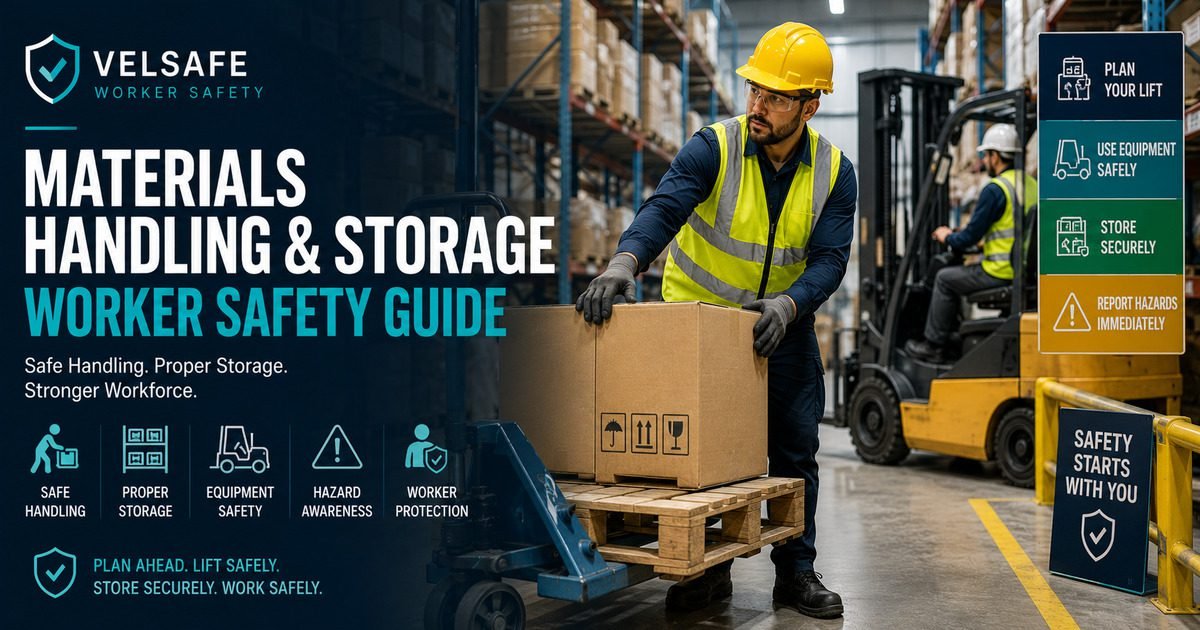
WORKER SAFETY: Materials Handling and Storage
Most Warehouse and Shop Floor Injuries Start
Before Anyone Lifts a Thing
Materials handling injuries, strains, crush events, stack collapses, and struck-by incidents, are the leading cause of lost workdays in warehousing and general manufacturing. Most of them are not caused by a single bad lift. They are caused by stored materials that were never positioned correctly, aisles that drifted out of compliance, and load weights that were never checked. This guide covers what every worker, supervisor, and operator needs to know before the next shift starts.
4.8
Injuries Per 100 Workers
Warehouse injury rate in 2024, more than double the 2.3 all-industry average. Overexertion from manual materials handling is the leading cause.
Industry data, 2024
47%
From Overexertion
Of all warehouse injuries between 2016 and 2020 were attributed to overexertion or bodily reaction, lifting, bending, pulling, and pushing during materials handling tasks.
DOL OIG / BLS
1910.176
Governing OSHA Standard
29 CFR 1910.176 covers materials handling and storage in general industry: aisle clearance, secure storage, housekeeping, and mechanical equipment safe use.
OSHA 29 CFR 1910.176
Materials handling covers every task involving moving, lifting, carrying, stacking, or storing goods and materials in a workplace. This includes manual lifting of boxes and containers, operating forklifts and other powered industrial trucks, rigging and slinging loads, using hand trucks and pallet jacks, and positioning materials on racking, shelving, and storage systems.
Overexertion
Lifting, lowering, pushing, pulling, carrying, or holding materials beyond what the body can safely handle. The leading cause of materials handling injuries and musculoskeletal disorders in warehousing and manufacturing.
Struck-By and Caught-Between
Falling materials from improperly stacked or unsecured storage, collapsing racking, forklift loads shifting, and workers caught between moving equipment and fixed structures or loads.
Slips, Trips, and Falls
Blocked aisles, materials stored on walkways, uneven floors from spills or debris, and poor housekeeping in storage areas. Workers carrying loads cannot see floor hazards below the load.
Powered Equipment Hazards
Forklift tipover, pedestrian contact, and load falls account for between 35,000 and 62,000 forklift injuries annually in the United States, with overturning comprising 25% of all forklift accidents.
Most materials handling incidents are preceded by visible warning signs that were either not recognised or not acted on. Workers and supervisors must know when to stop work and report the condition before an injury occurs.
Follow these steps in order before beginning any materials handling or storage task. Skipping the assessment step is how most materials handling injuries begin.
Stack or racking collapse
Clear the area immediately. Do not approach the collapse zone until it has been confirmed stable by a supervisor. Call for emergency services if anyone is trapped or injured. Isolate the area with barriers before any recovery operation begins. Do not attempt to push collapsed materials back upright without engineering assessment of the rack.
Worker struck by forklift or load
Do not move the injured worker unless there is immediate danger of a second event. Call emergency services. Stop all forklift traffic in the area. Preserve the scene for investigation, do not move equipment or materials until OSHA is notified. Employers must report work-related amputations, hospitalisations, and fatalities to OSHA within 24 hours (fatalities within 8 hours).
Acute musculoskeletal injury from lifting
Stop the task. Do not attempt to complete the lift with an injury present. Report the injury to a supervisor immediately. Access first aid and medical evaluation for any injury involving the back, shoulder, or joints, do not “walk it off.” Early medical intervention reduces both injury severity and recovery time significantly.
Conduct a pre-shift aisle and storage area walk
Walk your storage and handling areas at the start of each shift. Check that aisles are clear and within marked boundaries, storage is within height and weight limits, and no racking damage from the prior shift went unreported. A five-minute walk prevents hours of post-incident administration.
Make mechanical assistance the default, not the exception
If your workers are hand-carrying loads that mechanical equipment could move, your engineering controls are not working. OSHA requires safe materials management including engineering controls before relying on manual technique. Audit equipment availability against task demands quarterly.
Tag and take out of service any damaged racking on sight
Supervisors have the authority and the obligation to remove damaged racking from service without waiting for a formal maintenance request to process. A “do not use” tag and a barrier take one minute. A rack collapse investigation takes weeks and may involve OSHA.
Track early symptom reports as leading indicators
Workers who report recurring soreness, hand numbness, or back pain during handling tasks are telling you about a hazard before it becomes a recordable injury. Log these reports, investigate the task and workstation, and rotate or re-engineer before the injury occurs.
Use equipment, do not absorb the hazard with your body
Mechanical assistance is the primary control for materials handling injuries. Good lifting technique is a last-resort backup when equipment is genuinely not available. Technique does not offset a load that is too heavy.
Storage that looks stable can collapse without warning
Materials stacked too high, not interlocked, or beyond rack ratings can hold for days before shifting. Any visible instability, lean, bulge, or gap, is a report-now situation, not a watch-it situation.
Most materials handling injuries happen before anyone lifts anything
A blocked aisle, an overloaded rack, a missing mechanical aid, or an unknown load weight are all hazards that exist before the first lift begins. The five-minute pre-task check, walk the path, check the load, confirm equipment is available, prevents more injuries than any technique correction made during the lift.
What OSHA standard covers materials handling and storage in general industry?
29 CFR 1910.176 (Handling Materials, General), found in OSHA Subpart N, is the primary standard. It requires safe aisle clearances and markings, secure and stable material storage, housekeeping in storage areas, and the safe use of mechanical handling equipment. Additional standards apply to specific equipment: 1910.178 covers powered industrial trucks (forklifts), and 1910.184 covers slings used in lifting operations.
Does OSHA require aisles to be a specific width or colour?
1910.176 requires sufficient safe clearances for the mechanical handling equipment in use and requires permanent aisles to be appropriately marked, but does not specify a colour or a minimum width. Yellow is industry convention, not a legal requirement. Aisle width depends on the widest piece of equipment used in the space plus a margin for pedestrian traffic.
What is the maximum safe lifting weight under OSHA?
OSHA does not set a single maximum manual lifting weight in 1910.176. The standard requires hazard assessment and the use of mechanical equipment where available. The National Institute for Occupational Safety and Health (NIOSH) Lifting Equation provides a recommended weight limit based on task variables including lift distance, frequency, and torso twisting. Most safety programmes set 50 lbs as a two-person lift threshold, but this should be based on your specific task conditions rather than a universal number.
What do I do if I see damaged racking at work?
Stop using the damaged rack immediately and report it to your supervisor. Do not add load to, lean against, or remove load from a rack that is visibly bent, leaning, or has a damaged upright without first isolating the area. In many workplaces, any worker can tag a rack out of service and must do so without waiting for supervisor approval. After the rack is off-loaded by a safe method, it should be inspected by a qualified person before returning to service.
Is my employer required to provide lifting equipment for heavy loads?
Under the General Duty Clause of the OSH Act, employers are required to provide a workplace free from recognised hazards likely to cause serious harm. OSHA consistently treats the failure to provide mechanical handling equipment for tasks that generate musculoskeletal injury risk as a recognised hazard. OSHA’s multi-employer worksites guidance and the Warehousing National Emphasis Programme specifically target the absence of ergonomic controls including lifting equipment.
What should workers do if they experience pain during materials handling tasks?
Stop the task and report the pain to a supervisor before continuing. Early symptom reporting is the single most effective way to prevent acute musculoskeletal pain from developing into a recordable injury or a long-term condition. Employees who report symptoms early enable employers to modify the task, adjust the workstation, or provide medical evaluation before the injury worsens. Employees have the right to report work-related injuries and illnesses without retaliation under 29 CFR 1904.35.
Does the OSHA Warehousing NEP affect materials handling inspections?
OSHA’s Warehousing and Distribution Centre National Emphasis Programme is active through mid-2027. It targets 1910.176 aisle and storage violations alongside powered industrial truck and ergonomic hazards as programmed inspection items. Warehouse, distribution centre, and e-commerce fulfilment facilities selected for NEP inspections will have materials handling compliance checked as part of the standard protocol, not just in response to complaints or incidents.
Worker Safety
Lockout-Tagout Programs and Procedures
Energy control procedures that apply when maintaining or servicing materials handling equipment including conveyors, pallet jacks, and powered storage systems.
Law
OSHA Requirements: Bench and Pedestal Grinders
Compliance requirements for abrasive wheel equipment commonly found in general industry and manufacturing facilities alongside materials handling operations.
Insights
VelSafe Insights: Workplace Safety Analysis
Evidence-based analysis of OSHA enforcement trends, injury patterns, and compliance gaps across warehousing, manufacturing, and general industry sectors.
WORKER SAFETY LIBRARY
More Safety Guidance for Frontline Workers and Supervisors
Explore VelSafe’s full worker safety library: hazard-by-hazard guides, OSHA rights explainers, and step-by-step safe work procedures.
Explore Worker Safety Articles