

An OSHA compliance officer conducts a scheduled inspection at a mid-size commercial construction site. During records review, the inspector finds no documentation that three workers who joined the site twelve days ago received any safety orientation. Two of those workers are subcontractor employees. One is a temporary labour hire.
The contractor argues that the workers were experienced and did not need a formal orientation. The inspector does not accept the argument. The citation under 29 CFR 1926.21(b)(2) is issued. The penalty is $15,625 per worker, per instance.
The legal obligation to provide safety orientation on construction sites is not conditional on worker experience, employment type, or the perceived hazard level of the work. It is a baseline requirement that applies from the first day of work. This guide explains exactly what that obligation requires.
The Regulatory Framework: What the Law Actually Says
Construction safety orientation obligations flow from multiple provisions of 29 CFR Part 1926, the primary OSHA standard for the construction industry.
29 CFR 1926.21(b)(2) is the foundational training requirement. It states that the employer shall instruct each employee in the recognition and avoidance of unsafe conditions and the regulations applicable to the work environment to control or eliminate any hazards or other exposure to illness or injury. This provision applies broadly across all construction activities.
29 CFR 1926 Subpart C (General Safety and Health Provisions) establishes the employer’s comprehensive responsibility for the safety and health programme on the construction site, including the obligation to ensure that workers have the training, information, and equipment they need before beginning work.
Additional training obligations are triggered by specific hazards: fall protection training under 1926.503, scaffold training under 1926.454, hazard communication training under 1910.1200 (applicable to construction through 1926.59), and PPE training under 1926.95 are among the most commonly required.
When OSHA inspects a construction site following an incident or complaint, the first records requested are typically the training and orientation documentation for the affected workers. Inspectors check training dates against hire dates, verify that content covered the hazards present at the site, and confirm that training was provided in a language the worker understood. The absence of documentation is treated as evidence that training did not occur.
Who Must Receive Orientation: No Exceptions
All Workers Including Subcontractors and Temporary Staff
Every worker who sets foot on the construction site as part of the work must receive site-specific safety orientation before beginning work. This obligation covers direct employees, subcontractor employees, temporary labour hires, and long-service workers returning to a new site or project. Experience at a previous site does not substitute for orientation to the current one.
The general contractor bears primary responsibility for ensuring that all workers on the site, including those employed by subcontractors, have been oriented to site-specific hazards, emergency procedures, and site rules. Subcontractors are responsible for ensuring their own employees receive trade-specific training and hazard recognition instruction.
New Workers at Elevated Risk
Workers who are new to a site are statistically at significantly higher risk of injury than experienced workers on the same site. The first weeks of any new site assignment represent the period of highest risk across virtually every construction trade. This is the primary reason OSHA’s training requirements apply without exception to experienced workers arriving at a new site: site-specific orientation reduces the elevated risk that comes with unfamiliarity, regardless of general experience level.
General contractors frequently assume that safety orientation for subcontractor employees is entirely the subcontractor’s responsibility. Under OSHA’s multi-employer worksite policy, the general contractor (controlling employer) has an obligation to ensure that all workers on site have received site-specific orientation covering the hazards, emergency procedures, and rules of that specific project. A subcontractor’s internal training programme does not satisfy the general contractor’s site-specific orientation obligation.
Mandatory Orientation Content Under OSHA 1926
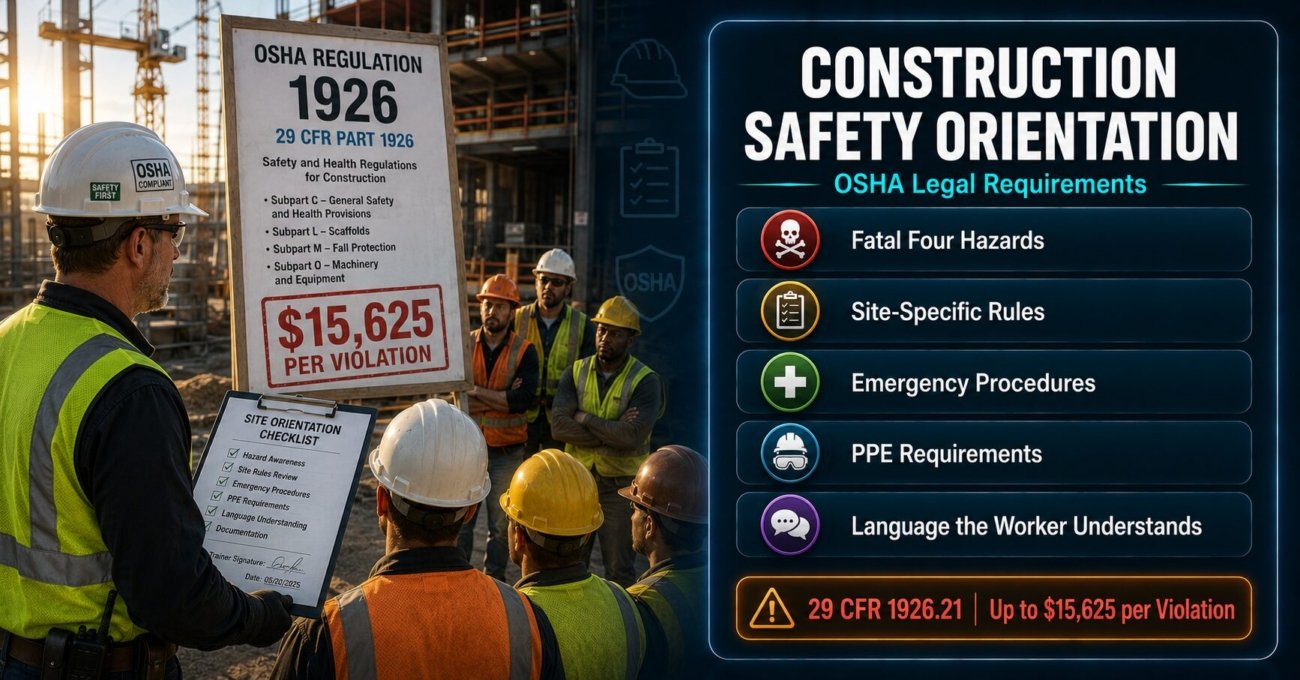
The Fatal Four Hazards
OSHA identifies four hazard categories as responsible for more than 60% of all construction fatalities. These are known collectively as the Fatal Four and must be addressed in every construction safety orientation regardless of the specific work being performed on the site.
- Falls: From roofs, ladders, scaffolds, and elevated work surfaces. Workers must be trained on fall protection requirements specific to the site, including the location and use of personal fall arrest systems, the locations of guardrail systems, and the requirement to use fall protection when working at heights of six feet or more above a lower level.
- Struck-by objects: From falling tools, swinging equipment, and moving vehicles. Workers must understand exclusion zones, required PPE, and the mandatory use of hard hats at all times in the work area.
- Electrocution: From contact with overhead power lines, buried utilities, and live electrical equipment. Workers must know the location of all known electrical hazards on the site and the minimum approach distances.
- Caught-in or between: From trench collapses, unguarded machinery, and pinch points. Workers must be aware of any excavation, trenching, or machinery hazards present on the site and the controls in place.
Site-Specific Hazards, Rules, and Emergency Procedures
Beyond the Fatal Four, orientation must cover the specific hazards present on this site and the controls in place for each. This includes confined spaces if present, high-voltage areas, heavy equipment movement patterns, and any unique structural or environmental conditions.
Site rules that must be covered include: entry and exit points and procedures, parking and access routes, designated smoking and break areas, PPE requirements for specific site zones, and the identity and contact information of the safety officer or site supervisor.
Emergency procedures that must be covered include: the location of first aid kits and medical personnel, the procedure for reporting injuries and near misses, fire evacuation routes and assembly points, and the emergency contact numbers posted on the site.
Hazard Communication and PPE
Workers who may be exposed to hazardous chemicals on the site must receive hazard communication training under 29 CFR 1910.1200 (HazCom / GHS), including how to read Safety Data Sheets and what the GHS pictograms mean. This training must occur before the worker’s initial work assignment and whenever a new chemical hazard is introduced to the work area.
PPE training under 29 CFR 1926.95 must cover what PPE is required for which tasks and areas, how to properly fit and use each type of PPE, the limitations of the PPE provided, and the correct storage, inspection, and replacement procedures. The December 2024 amendment to 29 CFR 1926.95, effective January 13, 2025, added an explicit requirement that PPE properly fit each individual worker.
Inspectors routinely test orientation effectiveness by asking workers directly about the hazards present on the site. A worker who cannot identify the location of the nearest fire exit, explain what PPE is required in their work zone, or describe the procedure for reporting an injury demonstrates that orientation, even if formally documented, was not effective. OSHA can cite an employer for inadequate training even when training records exist if the content of the training did not result in demonstrable competency.
The Language Requirement: Training Must Be Understood
Under 29 CFR 1926.21(b)(2), training must be provided in a manner that the employee can understand. This is not a recommendation. It is a legal requirement with enforcement teeth.
A safety orientation conducted entirely in English for a crew that primarily speaks Spanish does not satisfy the legal requirement even if the workers were physically present for it. If the workers did not understand the training, the training did not occur for purposes of OSHA compliance.
Employers are required to provide training in the language or languages of their workforce, or to use qualified interpreters who can ensure the content is accurately conveyed. Where workers have low literacy levels, orientation must use visual demonstrations, hands-on instruction, and bilingual supervisors rather than written materials alone.
Handing a Spanish-speaking worker an English-language orientation checklist and asking them to sign it does not constitute OSHA-compliant training. The worker’s signature on a document they cannot read does not demonstrate that the required training occurred. Employers with multilingual workforces must maintain translated orientation materials, bilingual supervisors or interpreters, and training records that accurately reflect the language in which each worker’s orientation was conducted.
Documentation Requirements
OSHA does not specify a single mandatory format for construction safety orientation documentation. However, in the absence of records, OSHA presumes training did not occur. Employers must be able to demonstrate that orientation took place, that it covered the required content, and that each worker who participated understood what was covered.
Effective documentation includes: the date of orientation, the name and job title of each worker who participated, the topics covered, the language in which training was delivered, the name and qualifications of the person who conducted the orientation, and the signatures of the workers and the trainer.
Documentation must be retained and must be readily available for review during an OSHA inspection. Records that cannot be located during an inspection provide no compliance protection even if the training actually occurred.
Verbal orientation without documentation is the most common orientation compliance failure on construction sites. Supervisors frequently orient new workers informally as they walk the site, covering important information, but creating no written record. In the event of an incident or inspection, the employer has no evidence that orientation occurred. The same outcome follows as if no orientation had been conducted at all.
Knowledge Check
Test your understanding of OSHA’s construction safety orientation requirements.
No. 29 CFR 1926.21(b)(2) requires that each employee be instructed in the recognition and avoidance of unsafe conditions specific to the work environment. Work experience at previous sites does not satisfy this requirement. The general contractor, as the controlling employer, bears responsibility for ensuring that all workers on the site, including subcontractor employees, receive site-specific orientation covering the hazards, emergency procedures, and rules of this specific project. An experienced worker who has not been oriented to this site’s specific hazards is legally unoriented for OSHA purposes.
No, not for the 8 Spanish-speaking workers. 29 CFR 1926.21(b)(2) requires that training be provided in a manner that the employee can understand. Conducting English-only orientation for workers who do not understand English does not satisfy the requirement regardless of their presence or their signatures on attendance sheets. The employer must provide training in Spanish for those workers, using bilingual personnel or qualified interpreters. The attendance record for the English-only orientation provides no compliance protection for the workers who did not understand it.
Yes. OSHA’s training requirements are outcome-based, not attendance-based. The purpose of training is to ensure that workers have the knowledge and skills to recognise hazards and respond safely. If a worker who attended orientation cannot demonstrate basic knowledge of emergency procedures, OSHA can conclude that the training was inadequate, regardless of the documented attendance. Employers should verify orientation effectiveness by confirming worker competency, not just recording attendance.
Up to $15,625 per violation, per worker, as a serious violation under OSHA’s current penalty structure. If the failure is determined to be a repeat or wilful violation, penalties can reach $156,259 per violation. With three workers, a serious violation finding could result in penalties of up to $46,875 for a single inspection. Penalties are adjusted based on the employer’s history, good faith, and size of the business, but the base penalty for failing to train workers in hazard recognition is substantial. The cost of providing orientation is always lower than the cost of not providing it.
Construction Safety Orientation Compliance Checklist
✓ Every worker, including subcontractor and temporary employees, has received orientation before beginning work
✓ Orientation covers the Fatal Four: falls, struck-by, electrocution, caught-in/between
✓ Orientation covers site-specific hazards unique to this project
✓ Emergency procedures, evacuation routes, and first aid locations are covered
✓ PPE requirements for each zone and task are explained and demonstrated
✓ Hazard communication training is provided for workers exposed to chemicals
✓ Orientation is conducted in each worker’s primary language or with qualified interpreter
✓ Written records document the date, attendees, content, language, trainer, and worker signatures
✓ Records are retained and available for inspection at the site
✓ Worker comprehension of key topics is verified, not just attendance
Sources
- 29 CFR 1926.21: Safety Training and Education (Construction)
- 29 CFR 1926 Subpart C: General Safety and Health Provisions
- 29 CFR 1926.503: Fall Protection Training Requirements
- 29 CFR 1926.95: Personal Protective Equipment (including January 2025 fit amendment)
- OSHA: The Fatal Four in Construction
- OSHA: Penalty and Debt Collection (current penalty amounts)