


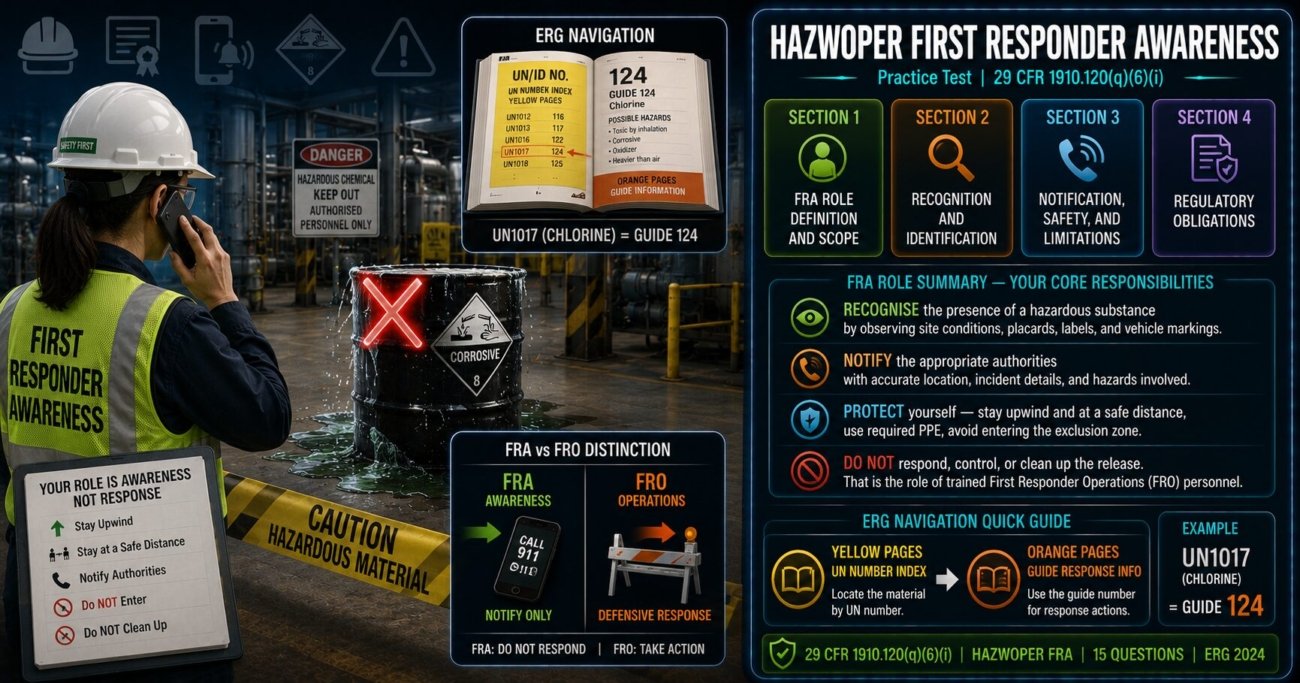
This practice test covers HAZWOPER First Responder Awareness (FRA) level requirements under 29 CFR 1910.120(q)(6)(i) and the parallel construction standard at 29 CFR 1926.65(q)(6)(i). Questions address the definition and scope of the awareness level, what FRA personnel are authorised and not authorised to do, notification and incident escalation procedures, initial isolation and protective actions, use of the Emergency Response Guidebook, and the distinction between FRA and higher HAZWOPER response levels. Each answer includes a detailed explanation referencing the applicable regulatory provision or emergency response standard.
Section 1: FRA Role Definition and Scope
Answer: FRA level workers are those who are likely to witness or discover a hazardous substance release and who initiate the emergency response sequence by notifying the appropriate authorities of the release. They take no further action beyond notification.
Explanation: The FRA designation is the entry-level HAZWOPER emergency response certification. It defines a specific and limited role: witness, recognise, notify, and stay out. FRA workers must be able to recognise the presence of a hazardous substance release, understand the risks associated with it, and know how to initiate the emergency response chain. They are explicitly not trained or authorised to take defensive or offensive action against the release. The minimum training requirement for FRA is sufficient to demonstrate competency in these functions, with no specific hour requirement stated in the standard (though most training programmes provide a minimum of 8 hours).
Answer: The technician should move away from the release to avoid exposure, then notify the facility’s emergency response coordinator or the designated emergency contact – she should not attempt to stop the leak, apply absorbent material, or take any action to control the release.
Explanation: The FRA trained worker’s role is defined as notification, not response. Attempting to stop or control a hazardous substance release exceeds the FRA scope and may constitute First Responder Operations level response, which requires additional training under 29 CFR 1910.120(q)(6)(ii). The technician’s correct actions in sequence are: recognise the hazard (CORROSIVE label, liquid release), protect herself by moving upwind and away from the release, and notify the appropriate emergency response personnel using the facility’s established notification procedure. She should not re-enter the area, attempt to contain the release, or approach the pipe to get a better look at the label or the leak source.
Answer: Recognising that a release has occurred or may have occurred, identifying the presence of a placard or label on a container, and initiating notification to the appropriate emergency response personnel.
Explanation: FRA training specifically equips workers to: recognise the presence or potential presence of hazardous substances in an emergency, identify the hazards of the substances as far as can be done from a safe distance using placards, labels, shipping papers, and the ERG, and notify the appropriate authorities. Actions outside FRA scope include: approaching the release to assess it more closely, applying PPE and entering the hazard zone, using any containment or control measures, and making any tactical decisions about the response. The key distinction is that FRA personnel provide the information that triggers the emergency response chain; they do not participate in the response itself.
Answer: First Responder Operations (FRO) level personnel respond to hazardous substance releases in a defensive manner without trying to stop the release, while FRA personnel only observe, recognise, and notify. FRO requires a minimum of 8 hours of training beyond awareness level, competency demonstration, and specific skills including PPE use and basic hazard and risk assessment techniques.
Explanation: Under 29 CFR 1910.120(q)(6)(ii), FRO level adds the capability to respond defensively to a hazardous substance release. Defensive response means actions such as establishing a perimeter, protecting exposures from further contamination, and controlling movement into the hazard area without taking actions to stop the release itself. FRO personnel use PPE appropriate for the defensive role, which may include structural firefighting protective clothing for some scenarios. FRA personnel do not use any HAZMAT-specific PPE in response to an incident and do not take any action beyond notification. The practical consequence is that FRA personnel have no role in securing a release scene, managing bystanders within an established perimeter, or coordinating with arriving responders.
Section 2: Recognition and Identification
Answer: The number 3 with a flame symbol indicates Class 3: Flammable Liquid. The FRA worker needs to know that this class indicates a material that can ignite under normal or elevated temperatures, that flammable vapours may be present in concentrations exceeding the lower explosive limit even at a distance from the visible liquid, and that ignition sources including phones, electrical switches, and vehicle engines should be kept away from the area.
Explanation: FRA training includes the ability to identify hazard classes from DOT placards and GHS labels. The nine DOT hazard classes and their primary placard identifiers are a core FRA competency. For a Class 3 flammable liquid, the key recognition elements are the diamond shape, the number 3, and the flame pictogram. FRA workers must understand that flammable vapours may travel beyond the visible liquid release and may ignite at a distance. The FRA worker’s action following recognition is to move upwind and away from the area, keep all personnel and ignition sources away, and notify emergency response personnel with the placard class information so that arriving responders can identify the appropriate ERG guide page.
Answer: The location of the release as specifically as possible, the nature of the container or vehicle involved, any visible placard class, hazard class number, or product name visible from a safe distance, whether anyone has been injured or is in the hazard zone, the weather conditions including wind direction, and her name and callback number.
Explanation: Effective initial notification requires transmitting the information that will allow the receiving emergency response coordinator to dispatch the appropriate resources and begin the response. The minimum information for a useful notification is: where, what (to the extent identifiable from a distance), and whether there are people in danger. Wind direction is particularly important for toxic gas releases because it determines the direction in which the responders should approach and the area that may require evacuation. FRA workers should not approach closer than is necessary to gather this information, and should communicate that they are at a safe distance and that they have not and will not attempt to intervene.
Answer: He should look up UN1017 in the yellow-bordered pages of the ERG (sorted by UN identification number), which will direct him to Guide 124. Guide 124 covers toxic gases including chlorine (UN1017), providing initial isolation distances, protective action distances, and emergency response information.
Explanation: The ERG is the primary reference document for FRA workers to identify the hazards of a material they observe from a safe distance. The yellow section (UN number index) and orange section (guide pages) are the two sections FRA workers use most frequently. For a placard-identified material, the UN number is the fastest entry point. Guide 124 for UN1017 (chlorine) would inform the FRA worker that chlorine is a toxic gas requiring initial isolation of at least 100 feet in all directions for small spills and 330 feet for large spills, and that first responders should approach from upwind. This information allows the FRA worker to ensure that bystanders and themselves are at sufficient distance while waiting for emergency responders and allows the FRA worker to relay the guide number to the emergency coordinator during notification.
Answer: Yes. The absence of placards does not mean the material is not hazardous. Placards may not be required for quantities below HAZMAT threshold quantities, may have been damaged in the accident, or may not have been applied as required. The physical characteristics of the release, including a strong solvent odour and liquid release from a tank area, are indicators of a potential hazardous substance. The FRA worker should treat the situation as a potential HAZMAT incident, stay upwind and at a distance, and notify emergency response personnel.
Explanation: FRA training addresses the recognition of potential hazardous substance releases in the absence of complete labelling information. A vehicle accident with an unexplained chemical odour, physical symptoms in bystanders, unusual colouring or behaviour of a released liquid, or a container or vehicle type commonly used for chemical transport are all recognition indicators that should prompt an FRA response (notification and safe distance) regardless of whether placards are visible. The FRA worker should communicate to the emergency coordinator that no placards were observed and describe the physical characteristics of the release so that arriving responders can plan their approach accordingly.
Section 3: Notification, Safety, and Limitations
Answer: He should call 911 immediately and provide the location and nature of the release to the extent he can identify it from a safe distance. He should then attempt to reach other facility personnel such as a supervisor, site safety officer, or the backup emergency contact if one is posted. He should not re-enter the area or wait for a callback before calling 911.
Explanation: The notification obligation under HAZWOPER FRA does not depend on successfully reaching a specific person. The objective is to initiate the emergency response. If the primary notification number is unavailable, the FRA worker must escalate to 911 without delay. In many states and localities, calling 911 for a known or suspected hazardous material release is a legal obligation, not merely a best practice. The FRA worker should also be familiar with any posted backup emergency contacts for the facility and should attempt to reach those contacts as well, but not at the cost of delaying the 911 notification.
Answer: The FRA worker should warn the bystander to stay back and move away from the release area, communicating verbally from her current position. She should not re-enter the hazard zone to physically stop the bystander, but she should make every reasonable verbal effort to prevent the bystander from approaching the release.
Explanation: An FRA worker’s role includes avoiding actions that could endanger themselves or others. Warning bystanders verbally from a safe position is within the FRA role. Physically entering the hazard zone to stop a bystander is outside the FRA role and beyond the FRA worker’s training and PPE protection level. If the bystander enters the hazard zone despite warnings, the FRA worker should communicate this to the emergency response coordinator during notification so that arriving responders know there is a person in the hazard zone.
Answer: No. Participating in spill cleanup is a hazardous waste operation or emergency response activity that exceeds FRA scope. Cleanup of a corrosive chemical release requires training at minimum at the First Responder Operations level, appropriate chemical-resistant PPE specified by the site’s emergency response plan, and compliance with the employer’s HAZWOPER programme procedures. The FRA worker should decline this instruction and notify the site safety officer or emergency coordinator.
Explanation: OSHA’s HAZWOPER standard under 29 CFR 1910.120(q) defines the scope of each response level. Spill cleanup is explicitly beyond the FRA level. An FRA worker instructed to participate in a cleanup is being assigned a task for which they have not received the required training. Under OSHA’s employee rights provisions, an employee has the right to refuse work that poses an imminent danger for which they have not been trained. The FRA worker should communicate clearly that spill cleanup is outside their HAZWOPER authorisation level and request that qualified personnel be assigned to the task.
Answer: The orange guide pages contain the emergency response information corresponding to each material by guide number, including potential hazards (fire or explosion, and health), public safety measures (initial isolation distance, protective action guidance), emergency response actions for fire, spill, and first aid, and whether to evacuate or shelter in place. FRA workers use these pages to communicate initial isolation distances and approach directions to emergency coordinators and arriving responders.
Explanation: The ERG is structured to allow quick access to response information from multiple identification pathways. FRA workers will most commonly use the yellow section (UN number) or orange section (guide pages) to look up materials they have identified from placards or labels. The guide pages are written in plain language and provide guidance specifically calibrated for the first 30 minutes of a response, which is the period in which FRA workers are likely to be the only trained personnel present. FRA workers do not need to memorise ERG content but must be trained in how to access it quickly and how to interpret and communicate the isolation distances and protective action guidance it provides.
Section 4: Regulatory Obligations and Employer Responsibilities
Answer: Employees trained at the FRA level must be able to demonstrate competency in: recognising the presence of hazardous substances in an emergency, identifying the hazards of the substances as far as identification can be made from a safe distance using placards, labels, ERG, and other available sources, understanding the role and limitations of the FRA worker, knowing how to make appropriate notifications, and understanding the basic hazard and risk assessment techniques applicable to their role (specifically, recognising that they are not trained or equipped to respond).
Explanation: 29 CFR 1910.120(q)(6)(i) does not specify a minimum hour requirement for FRA training. It specifies a competency outcome: the employee must be able to demonstrate the listed capabilities. Most FRA training programmes require a minimum of 8 hours to cover these competencies adequately, but the standard is competency-based, not hour-based. The employer is responsible for ensuring that each FRA-trained employee can demonstrate the required competencies, not merely that they attended a training session of a specified duration.
Answer: Under 29 CFR 1910.120(q)(8), emergency response organisations must provide annual refresher training of sufficient content and duration to maintain competencies, or the employer must demonstrate that the employee has maintained competency through another method. The specific hour requirement is not stated for FRA refreshers, but annual refresher or documented competency demonstration is required.
Explanation: Unlike the 40-hour and 24-hour HAZWOPER training tiers under 29 CFR 1910.120(e), the emergency response provisions under 29 CFR 1910.120(q) do not specify an 8-hour annual refresher minimum for all levels. They require that emergency responders receive annual refresher training of sufficient content and duration to maintain their competencies, or that the employer can demonstrate through another means that they have maintained competency. For FRA level, this means an annual refresher that reinforces recognition, notification, and ERG use skills, with documentation that the employee participated and demonstrated continued competency. The flexibility in format and duration does not mean that refreshers are optional.
Answer: The state plan standard applies. OSHA-approved State Plans must meet or exceed federal OSHA standards. When a state plan establishes more stringent requirements for FRA competency, those state requirements apply to all employers covered by the state plan in that state. Federal OSHA standards represent the minimum, and state plan states may establish higher requirements.
Explanation: Under the OSH Act, states with approved State Plans have the authority to administer their own occupational safety and health programmes and to establish standards that are at least as effective as federal OSHA standards. When a state plan standard is more stringent than the federal standard on the same topic, covered employers must comply with the state plan standard. Employers operating in multiple states should verify the applicable requirements in each state, particularly for HAZWOPER training, where some state plans have established more specific competency requirements or hour minimums than the federal standard.
Knowledge Summary
FRA workers are trained to recognise, notify, and protect themselves — not to respond to, control, or clean up a hazardous substance release.
The ERG is the FRA worker’s primary identification tool. Yellow pages (UN number index) lead to orange guide pages (response information) for quick hazard and isolation distance identification.
If the primary notification contact is unavailable, the FRA worker must call 911 without delay. The objective is to initiate the emergency response, not to reach a specific person.
FRA training is competency-based under 29 CFR 1910.120(q)(6)(i). The employee must be able to demonstrate the required capabilities, not merely attend a training session.
Annual refresher training under 29 CFR 1910.120(q)(8) is required to maintain FRA competency. Check state plan requirements, as some states establish more stringent hour or content minimums.
Sources
- 29 CFR 1910.120(q): HAZWOPER Emergency Response Requirements (FRA defined at q(6)(i))
- 29 CFR 1926.65(q): HAZWOPER Emergency Response – Construction Standard
- PHMSA: Emergency Response Guidebook (ERG 2024) – Primary FRA reference tool
- OSHA: HAZWOPER Standards Interpretation and Guidance
- EPA: HAZWOPER Overview and State Plan Variation Guidance
