
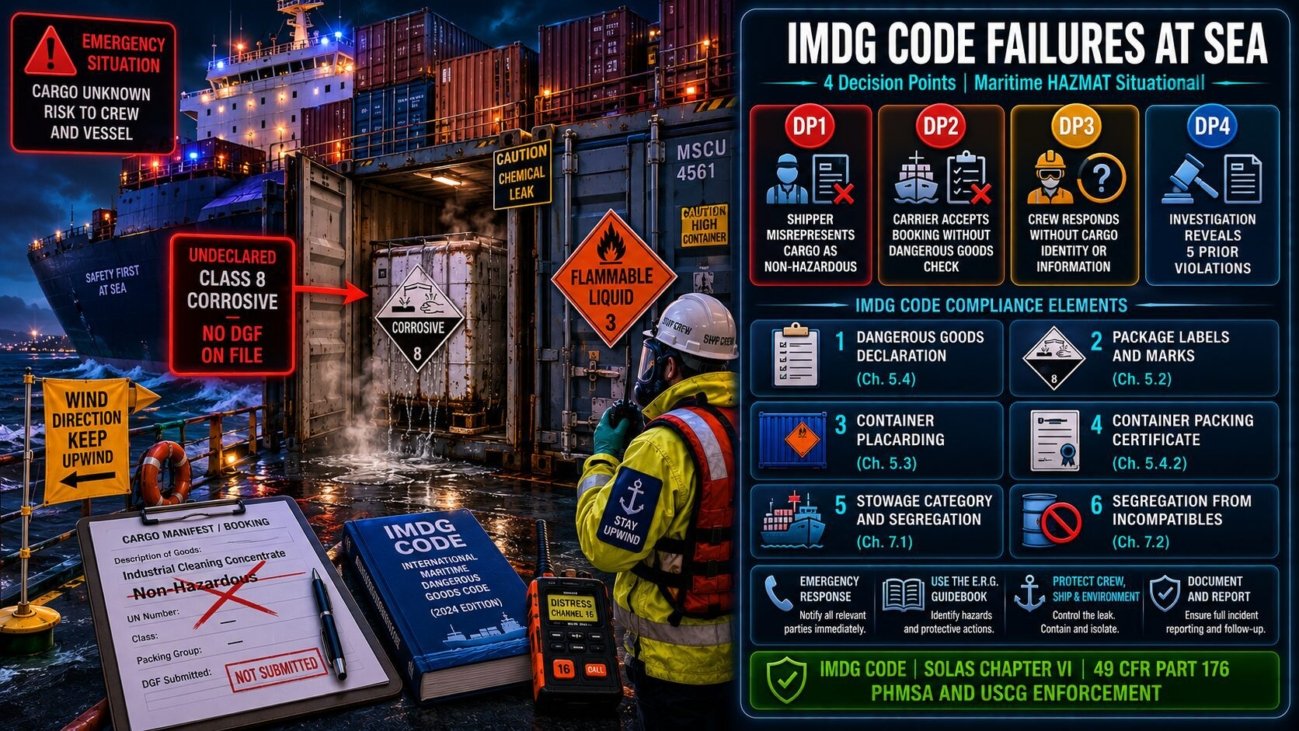
A container ship is two days out of the Port of Los Angeles, bound for Shanghai, when the crew detects a chemical odour on Deck 4. The chief officer locates the source: a 20-foot container stowed in Bay 12, Row 4. The container manifest lists the contents as industrial cleaning concentrate, non-hazardous. The shipper’s export declaration mirrors that description.
The actual contents are 200 drums of a corrosive liquid with a pH below 2. The material required IMDG Code Class 8 labelling, a corrosive placard on the container, a dangerous goods declaration from the shipper, stowage in an above-deck location away from foodstuffs, and segregation from the incompatible materials stowed in the adjacent bay. None of these requirements were met because the shipper declared the material as non-hazardous to avoid the documentation requirements and additional freight costs associated with dangerous goods shipment.
The container is leaking. The adjacent bay contains drums of a Class 3 flammable liquid, legitimately declared and properly stowed. The corrosive leak has begun reaching the container floor. The vessel is 500 miles from the nearest port. The crew must respond with the information available to them, which does not include the actual identity of the leaking material.
This scenario illustrates the most dangerous category of IMDG Code non-compliance: undeclared dangerous goods at sea, where misrepresentation of cargo hazards removes the information that crew and emergency responders need to manage an incident safely. This guide works through the key decision points in IMDG Code compliance that this scenario failed at, one by one.
Vessel: Container ship, Pacific transit, 500 miles from nearest port.
Cargo: 200 drums of corrosive liquid (actual: Class 8, pH below 2) declared as non-hazardous industrial cleaning concentrate.
Stowage: Below deck, Bay 12. Adjacent bay contains Class 3 flammable liquid (legitimately declared).
IMDG failures: No dangerous goods declaration, no Class 8 container placard, no corrosive package labels, incorrect stowage category, no segregation from incompatible cargo.
Outcome: Leaking container discovered at sea. Crew responding without knowledge of actual cargo identity or IMDG emergency response procedures for the material.
Have you recently reviewed a shipper’s export declaration or a container manifest for ocean freight? Could you identify whether the described cargo matches a material that would require an IMDG dangerous goods declaration? If you are involved in preparing, reviewing, or accepting ocean freight shipments, this scenario describes what happens when that check is absent. The IMDG Code is not an international trade formality. It is a vessel safety system. Its failures happen at sea, where the consequences of wrong information are irreversible.
Decision Point 1: The Shipper Prepares the Export Documentation
The shipper’s export coordinator prepares the shipping documentation for the 200 drums of corrosive liquid. She knows from the Safety Data Sheet that the product has a pH of 1.8 and is classified as a corrosive under GHS. She also knows that declaring it as dangerous goods under the IMDG Code will require a multimodal dangerous goods form, Class 8 container placards, a surcharge from the ocean carrier, and potentially a longer booking timeline because dangerous goods containers require specific stowage assignment.
To avoid these requirements, she describes the material on the shipper’s letter of instruction as industrial cleaning concentrate, non-hazardous. The ocean carrier’s booking system accepts the description. The dangerous goods check is not triggered.
What are the shipper’s legal obligations under the IMDG Code and US regulations, and what are the consequences of misrepresenting the cargo as non-hazardous?
The shipper is required by IMDG Code Chapter 5.4 and 49 CFR Part 176 (which incorporates IMDG Code requirements for US-origin ocean shipments) to provide a dangerous goods declaration for any material meeting the IMDG Code classification criteria before it is accepted for ocean carriage.
A corrosive liquid with pH below 2 is classified as a Class 8 dangerous good under the IMDG Code. The material requires a UN number (likely UN1760 Corrosive Liquid, N.O.S., or a more specific entry from the IMDG Code dangerous goods list), proper shipping name, packing group, Class 8 labels on packages, and a Class 8 placard on the container. The dangerous goods declaration must be provided to the ocean carrier before the container is accepted.
The consequences of misrepresentation are severe. Under 49 CFR 171.2, knowingly offering hazardous materials for transportation without required documentation is a federal violation subject to civil penalties up to $84,425 per violation per day. Under the SOLAS Convention, deliberate misrepresentation of cargo is a maritime safety offence. If the undeclared dangerous goods cause an incident at sea, the shipper faces criminal liability, civil liability for all resulting damages including cargo loss, vessel damage, and costs of emergency response, and potential loss of ocean freight booking privileges with major carriers.
The coordinator’s calculation that avoiding the dangerous goods documentation requirements saves time and freight costs does not account for the legal and financial exposure created by the misrepresentation, which vastly exceeds any shipping surcharge.
Decision Point 2: The Ocean Carrier Accepts the Container
The container arrives at the marine terminal. The terminal’s dangerous goods checker reviews the container booking and the documentation provided. The booking shows non-hazardous cargo. No dangerous goods declaration is present. The checker confirms the booking and assigns the container to a below-deck stowage position in Bay 12.
The terminal operator has a verification procedure for containers whose contents, based on weight, description, or other indicators, may require dangerous goods treatment. The container in question weighs 14,200 kg, consistent with heavy liquid cargo. The booking description of industrial cleaning concentrate is consistent with heavy liquid cargo. No additional verification is triggered.
What verification obligations does the ocean carrier and terminal operator have for containers booked as non-hazardous, and what risk indicators were present in this case?
Ocean carriers and terminal operators are not required to verify the contents of every container declared as non-hazardous. However, IMDG Code Regulation 1.3 and SOLAS Chapter VI require that carriers and terminal operators have procedures for identifying containers that may contain undeclared dangerous goods, particularly based on cargo description, container weight, and shipper history.
The risk indicators present in this case were not individually conclusive but were collectively suggestive. Industrial cleaning concentrates are a commodity category that frequently contains materials classified as Class 8 corrosives or Class 3 flammable liquids. A container weight of 14,200 kg for what is described as cleaning concentrate in drums is consistent with high-density liquid cargo, which is more common among dangerous goods than non-hazardous liquids. A shipper without an established history of ocean freight for this commodity type might also warrant additional scrutiny.
The practical limitation is that carriers process thousands of container bookings per vessel loading and cannot individually verify the contents of containers without specific reason. The IMDG Code’s primary control for undeclared dangerous goods is the shipper’s declaration obligation, with carrier verification as a secondary check for obvious cases. The scenario illustrates why the shipper’s declaration obligation is the most important control in the system: when it fails, the downstream verification controls are unlikely to catch the failure in routine processing.
What carriers can do is implement enhanced screening for commodity descriptions associated with frequent dangerous goods misclassification, including cleaning concentrates, industrial chemicals, laboratory supplies, and similar categories. Some major ocean carriers now require SDS submission for all shipments in high-risk commodity categories regardless of declared hazard status.
Decision Point 3: The Crew Discovers the Leak at Sea
The chief officer confirms the leak is from Bay 12, Container 4. The ship’s dangerous goods manifest for Bay 12 shows no dangerous goods. The adjacent bay’s legitimate Class 3 cargo is documented with a Multimodal Dangerous Goods Form and an emergency contact number. The leaking container has no dangerous goods documentation because none exists.
The chief officer knows only that the container’s booking description is industrial cleaning concentrate. She does not know the actual chemical identity, the pH, the corrosive classification, or the appropriate emergency response procedures. The IMDG Code’s Emergency Schedules (EmS) cannot be accessed without a proper shipping name or UN number. The vessel’s copy of the IMDG Code and the Medical First Aid Guide for Use in Accidents involving Dangerous Goods cannot be used effectively without knowing what the material is.
The captain contacts the vessel’s designated person ashore and the shipowner’s emergency response service. Both are working from the same booking information: industrial cleaning concentrate, non-hazardous.
What response options does the crew have when a leaking container’s actual contents are unknown, and how does this scenario illustrate the function of the IMDG Code’s documentation requirements?
The crew’s response options are significantly constrained by the absence of cargo identification information. The IMDG Code’s documentation requirements exist precisely to prevent this situation. The Multimodal Dangerous Goods Form, container placard, package labels, and stowage plan entry are not administrative requirements – they are the information chain that enables a crew to respond to an incident with knowledge of what they are dealing with.
Without cargo identity, the crew must treat the incident as involving an unknown corrosive or chemical material and apply maximum precaution: full chemical protective equipment for any crew approaching the container, isolation of the affected bay, continuous monitoring of the adjacent flammable liquid cargo for signs of heat or ignition, and contact with CHEMTREC or an equivalent maritime emergency response service to narrow down the identity of the material from its physical properties and origin.
The IMDG Code’s Emergency Schedules (EmS) provide first aid and firefighting guidance keyed to each proper shipping name. For Class 8 corrosive liquids, the EmS would specify: do not allow the material to enter the bilge, neutralisation is not recommended at sea, avoid skin and eye contact, and specific first aid for corrosive exposure including immediate water flushing. None of this guidance can be accessed from the booking description industrial cleaning concentrate.
The scenario illustrates that the IMDG Code’s documentation requirements are not a trade compliance formality. They are an emergency response information system. Their failure at the shipper’s desk creates a knowledge deficit that cannot be recovered at sea, 500 miles from port, with a leaking unknown chemical adjacent to declared flammable cargo.
Decision Point 4: The Post-Voyage Investigation
The vessel reaches port. The leaking container is inspected by the US Coast Guard and PHMSA investigators. The actual contents are confirmed as a Class 8 corrosive liquid (UN1760, PG II). The investigation identifies the shipper by tracing the container booking through the terminal’s records. The shipper’s export coordinator is identified as the person who prepared the documentation.
The investigation finds that this is not the first shipment of the same material described as non-hazardous. Records show the same shipper has booked the same commodity under the same non-hazardous description on at least four prior occasions over 18 months. None of the prior shipments resulted in an incident or enforcement action.
The investigators determine that the misrepresentation was knowing and repeated, and refer the matter to the Department of Justice for criminal prosecution consideration alongside the civil penalty assessment.
What do the repeated prior shipments establish about the shipper’s liability, and how does the enforcement framework for IMDG non-compliance work in the United States?
The repeated prior shipments establish that the misrepresentation was not an error or oversight. They establish a pattern of knowing non-compliance. Under 49 CFR 171.2 and the Hazardous Materials Transportation Act, a pattern of knowing violations significantly increases civil penalty exposure and supports criminal referral under 49 U.S.C. 5124.
US enforcement of IMDG Code violations for US-origin or US-destination ocean shipments is administered jointly by PHMSA and the US Coast Guard. PHMSA handles civil penalties under the HMR framework. The Coast Guard handles maritime safety violations under SOLAS and the Port and Tanker Safety Act. The Department of Justice handles criminal prosecution when the facts support a knowing violation that endangers life or property.
The civil penalty exposure for the shipper in this case includes: up to $84,425 per day per violation for each of the five documented shipments (four prior plus the current incident), with the possibility that each drum of improperly documented material is counted as a separate violation. The criminal exposure under 49 U.S.C. 5124 includes fines and up to five years imprisonment for knowing violations that result in serious injury, death, or substantial property damage.
The four prior shipments that proceeded without incident do not reduce the penalty exposure for the current shipment. They increase it by establishing knowing, repeated conduct. The absence of prior enforcement action on those shipments reflects detection limitations in the container freight system, not regulatory tolerance of the practice.
Lessons Learned: What Compliant IMDG Ocean Freight Looks Like
The Dangerous Goods Declaration Is Not Optional Documentation
The IMDG Code Multimodal Dangerous Goods Form (DGF) is the foundational document in maritime dangerous goods compliance. It must be completed by the shipper, not the freight forwarder on the shipper’s behalf without verification, before any dangerous goods container is tendered for ocean carriage. The DGF must contain the proper shipping name, UN number, class, packing group, total quantity, number and type of packages, and the shipper’s certification that the goods are properly classified, packaged, marked, labelled, and in proper condition for transport. A freight forwarder who prepares a DGF from shipper-provided information without independent verification of the classification is not insulated from liability if the classification is wrong.
Stowage and Segregation Are Vessel Safety Functions
IMDG Code Chapter 7 governs stowage and segregation of dangerous goods on container ships. The stowage categories (SW1 through SW22) specify whether a dangerous good may be carried below deck, above deck only, or under specific conditions. Class 8 corrosive liquids in certain packing groups may not be stowed below deck. The segregation requirements specify minimum distances and separation methods between incompatible dangerous goods classes. A Class 8 corrosive liquid stowed adjacent to a Class 3 flammable liquid without the required segregation creates a reactive hazard in the event of a simultaneous leak or fire. These requirements are not port formalities – they are design specifications for managing simultaneous failures at sea.
IMDG Code Compliance Quick Reference
Sources
- IMO: International Maritime Dangerous Goods (IMDG) Code
- 49 CFR Part 176: Carriage by Vessel (US IMDG implementation)
- US Coast Guard: Maritime Law Enforcement and Port Security (dangerous goods enforcement)
- PHMSA: Hazardous Materials Enforcement (civil penalty schedule)
- IMO: SOLAS Convention Chapter VI (Carriage of Cargoes)