
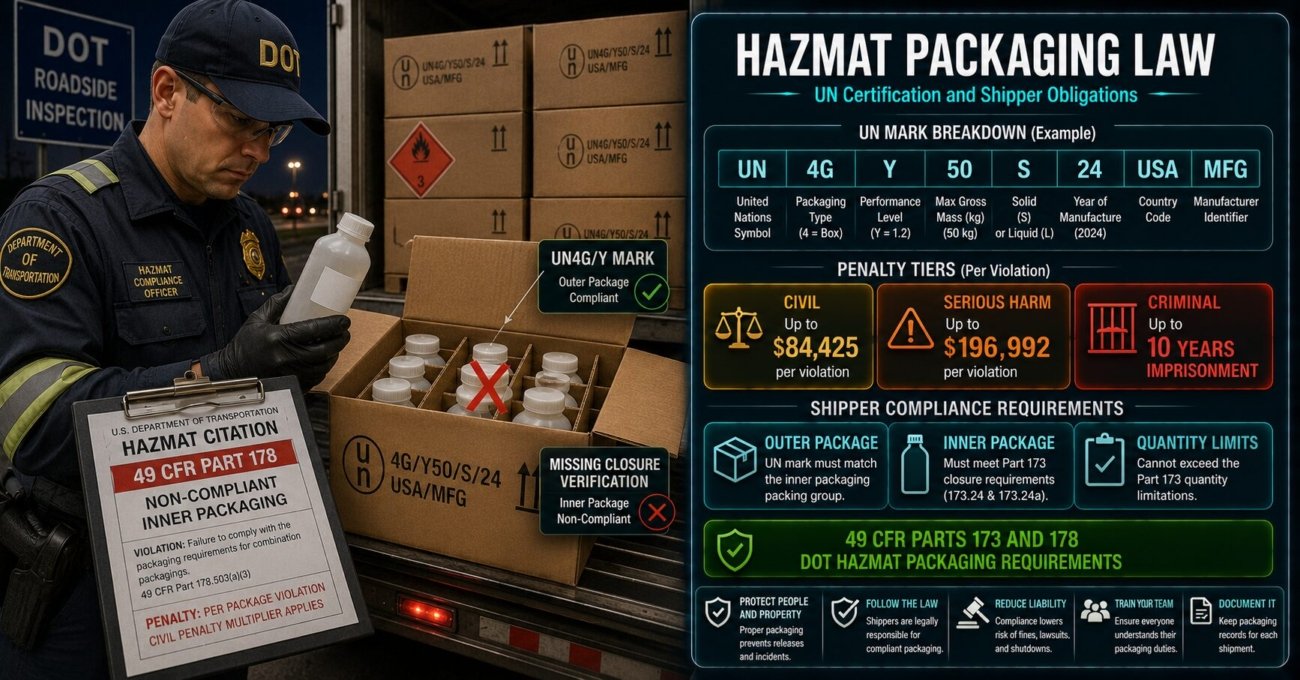
A DOT compliance officer stops a commercial delivery vehicle during a roadside inspection. The vehicle is carrying 24 packages of corrosive cleaning concentrate, each containing one litre. The outer boxes bear a UN4G marking. The compliance officer removes one package and examines the inner plastic bottle. The bottle has no UN marking. The closure is a standard commercial cap, not a closure tested to retain liquid under the pressure differential testing required for UN-certified packaging.
The shipper is cited for two separate violations: non-UN-certified inner packaging for a Packing Group II corrosive liquid, and use of a combination package where the inner packaging does not meet the performance requirements of 49 CFR Part 178. The citations carry a combined civil penalty of $19,876.
The shipper’s compliance manager argues that the company has been shipping the product in the same packaging for three years without incident. The compliance officer notes that absence of prior enforcement action is not evidence of compliance. The packaging was non-compliant for three years. It happened to be inspected this time.
This guide explains the legal framework governing HAZMAT packaging in the United States, what the UN specification marking system means and requires, and where the most common and costly packaging violations occur.
DOT’s Hazardous Materials Regulations under 49 CFR Parts 100-185 place packaging responsibility squarely on the shipper. The question an inspector asks is not whether the packaging has worked in the past but whether it meets the regulatory standard at the time of inspection. A package that passes the visual inspection but fails on the required specifications is non-compliant even if it has never leaked.
The Legal Basis for HAZMAT Packaging Requirements
The authority to regulate hazardous materials packaging in transportation derives from the Hazardous Materials Transportation Act (HMTA), codified at 49 U.S.C. Chapter 51. The HMTA authorises the Secretary of Transportation to designate materials as hazardous, prescribe packaging requirements, and establish civil and criminal penalties for violations.
The implementing regulations are found in 49 CFR Parts 100 to 185, collectively called the Hazardous Materials Regulations (HMR). Three subparts are most directly relevant to packaging:
- 49 CFR Part 173: Shippers General Requirements for Shipments and Packagings. This part specifies which packaging types are authorised for each hazardous material, combination packaging requirements, quantity limits, and exceptions including limited quantities and excepted quantities.
- 49 CFR Part 178: Specifications for Packagings. This part contains the technical performance standards that UN-specification packagings must meet, including drop tests, stacking tests, hydraulic pressure tests, and closure performance tests.
- 49 CFR Part 180: Continuing Qualification and Maintenance of Packagings. This part governs the ongoing testing, marking, and qualification of reusable packagings including cylinders and intermediate bulk containers.
The Hazardous Materials Table at 49 CFR 172.101 connects these parts: Columns 8A, 8B, and 8C of the table direct the shipper to the applicable Part 173 sections for exceptions, non-bulk packaging, and bulk packaging respectively for each specific material.
Shippers who rely on carrier knowledge of packaging requirements, or who assume that using the same packaging as their supplier uses, are meeting the standard, are misplacing their reliance. The legal obligation to select and use compliant packaging rests entirely with the shipper under 49 CFR 173.1. The carrier’s obligation is to refuse a shipment with obviously defective packaging under 49 CFR 177.817(e), not to verify packaging specifications.
The UN Specification Marking System: What It Means Legally
The UN specification marking on a package is not a product label or a brand mark. It is a manufacturer’s certification that the packaging has been tested to and meets the performance standards of 49 CFR Part 178 for the stated package type, packing group level, and intended contents.
A complete UN specification mark reads as follows:
Example: UN 4G/Y50/S/24/USA/ABC123
- UN: Identifies this as a United Nations specification packaging
- 4G: Packaging type code. 4 = fibreboard box; G = packaging type. Other common codes: 1A1 (steel drum, non-removable head), 3H2 (plastic jerrycan, removable head), 6HA1 (composite packaging, plastic inner)
- Y: Packing group performance level. X = PG I, II, and III. Y = PG II and III only. Z = PG III only
- 50: Maximum gross mass in kilograms for which the packaging is tested and certified
- S: For solids or inner packagings. For liquids, this would be the specific gravity and a hydraulic test pressure (for example, 1.4/100)
- 24: Year of manufacture (2024)
- USA: Country authorising the manufacturer
- ABC123: Manufacturer’s identification code
Every element of this marking is legally significant. A shipper who uses a Y-marked package for a Packing Group I material is using packaging that is not certified for that hazard level, regardless of whether the package physically contains the material without incident.
Many shippers verify that the package type (4G, 1A2, etc.) is correct for their shipment but do not check whether the packing group designation (X, Y, or Z) matches the material’s assigned packing group. A PG I flammable liquid must be shipped in X-marked packaging. Using Y-marked packaging for a PG I material is a violation regardless of whether the package type is otherwise appropriate. Check both the type code and the packing group letter before approving a packaging for use.
Combination Packaging: The Inner and Outer Packaging Legal Relationship
Combination packagings consist of an outer packaging (the UN-certified box, drum, or jerrycan) and one or more inner packagings (the bottles, bags, or ampoules inside). Under 49 CFR 173.24a, both components carry legal requirements.
The outer packaging must bear a valid UN specification mark appropriate for the packing group and material. The inner packaging must meet the requirements specified in the applicable Part 173 section for the material. For most hazardous liquids, this means the inner packaging must be constructed of a material compatible with the contents, must have a closure that retains the liquid under the differential pressure conditions the package will experience in transportation, and must meet any capacity limits specified in the authorising Part 173 section.
The inner packaging is not required to bear a UN mark in most combination packaging configurations. However, the absence of a UN mark on the inner packaging does not mean the inner packaging has no legal requirements. The inner packaging must still meet the material compatibility and closure performance requirements of Part 173. Using a commercial food-grade bottle as an inner packaging for a corrosive liquid is non-compliant even if the outer box bears a valid UN4G mark.
Quantity Limits for Combination Packagings
Each authorised combination packaging configuration in Part 173 specifies maximum inner packaging capacity, maximum outer packaging gross mass, and, for certain materials, maximum total net quantity per outer packaging. Exceeding these limits renders the entire package non-compliant even if the packaging type is otherwise correct.
For example, under 49 CFR 173.202 (flammable liquids, PG III), the authorised non-bulk combination packaging for glass inner packagings is a maximum of 1 litre per inner packaging in a fibreboard outer. Exceeding 1 litre in any inner packaging, even by a small amount, is a violation. The authorised limit is the authorised limit.
Civil and Criminal Penalty Exposure for Packaging Violations
DOT civil penalties for HAZMAT packaging violations are assessed under 49 U.S.C. 5123. As of the most recent PHMSA penalty schedule adjustment, civil penalties range from a minimum of $583 to a maximum of $84,425 per violation per day. For violations that result in death, serious illness, or severe injury to any person, or in substantial destruction of property, the maximum civil penalty increases to $196,992 per violation.
Packaging violations are typically cited as per-package violations, not per-shipment violations. A shipment of 50 packages, each containing non-compliant inner packaging, may be cited as 50 separate violations. At the standard serious violation penalty level, 50 packages at $19,876 each represents potential civil penalty exposure of nearly $1 million for a single shipment.
Criminal penalties under 49 U.S.C. 5124 apply when a person knowingly violates the HAZMAT regulations and the violation results in death or serious injury. Criminal penalties include fines and imprisonment of up to 10 years, or up to 20 years if the violation involves a terrorist act.
In addition to federal penalties, HAZMAT packaging violations that result in releases may trigger cleanup liability under CERCLA, state environmental enforcement, and civil tort liability to injured parties. The total legal exposure from a single non-compliant package that releases during transport typically exceeds the civil penalty many times over.
The most frequent defence offered by shippers cited for packaging violations is that they have shipped the same product in the same packaging for years without incident or citation. This defence has no regulatory or legal merit. Compliance is assessed at the time of inspection, not retroactively. Prior enforcement inaction does not create a compliance exception, a grandfather provision, or a defence against citation. It means only that the violation was not previously discovered. When discovered, it is cited from the date of discovery, not from the date the practice began.
Knowledge Check
Test your understanding of HAZMAT packaging legal requirements.
Yes. While inner packagings in combination packages are not required to bear a UN mark, they must still meet the closure performance and compatibility requirements of the applicable Part 173 section. If the shipper cannot demonstrate that the inner bottle closures have been verified to meet these requirements, the packaging configuration is unverified and potentially non-compliant. The shipper should obtain closure performance test data from the bottle manufacturer or have the closure tested against the Part 178 requirements applicable to combination packaging inner containers. Two years of use without incident is not documentation of compliance.
Possibly, but only after verifying the mark matches the requirements. The X designation confirms the drum is certified for PG I, II, and III use. The 250 indicates a maximum gross mass of 250 kg. The S indicates the drum was tested for solids or inner packagings, not for liquids at a specific gravity and hydraulic pressure. For a liquid application, the mark would need to show the specific gravity and test pressure instead of S (for example, 1.4/100 for a liquid with SG 1.4 tested at 100 kPa). The shipper must verify with the drum manufacturer that this specific drum has been tested for liquid use at the required hydraulic pressure before using it for the PG I toxic liquid. Using a drum marked for solid use to ship liquids is a violation.
No – a Y-marked package IS appropriate for PG II materials. The packing group designation letters in UN marks indicate which packing groups the packaging is certified for: X covers PG I, II, and III; Y covers PG II and III; Z covers PG III only. A Y-marked package used for a PG II material is correctly matched. The compliance issue would arise only if the material were PG I, which requires X-marked packaging. The new compliance officer should document this verification and confirm the outer box gross mass limit and other specifications also match the shipment parameters, but the packing group designation itself is compliant for a PG II material.
HAZMAT Packaging Compliance Checklist
✓ The authorised packaging type has been identified from Columns 8A-8C of the Hazardous Materials Table for this specific material
✓ The outer packaging bears a valid UN specification mark
✓ The packing group letter in the UN mark (X, Y, or Z) is appropriate for the material’s assigned packing group
✓ The gross mass of the filled package does not exceed the mass stated in the UN mark
✓ For liquid packagings, the UN mark shows specific gravity and hydraulic test pressure (not S)
✓ Inner packaging materials are compatible with the contents
✓ Inner packaging closures have been verified to meet Part 173 performance requirements
✓ Inner packaging quantities are within the limits specified in the applicable Part 173 section
✓ The packaging is in good condition with no damage, deformation, or deterioration
✓ Reusable packagings are within their authorised reuse life under 49 CFR Part 180
Sources
- 49 CFR Part 173: Shippers General Requirements for Shipments and Packagings
- 49 CFR Part 178: Specifications for Packagings
- 49 CFR Part 180: Continuing Qualification and Maintenance of Packagings
- PHMSA: Hazardous Materials Civil Penalty Policy and Schedule
- 49 CFR 172.101: Hazardous Materials Table (Columns 8A-8C for packaging authorisations)