
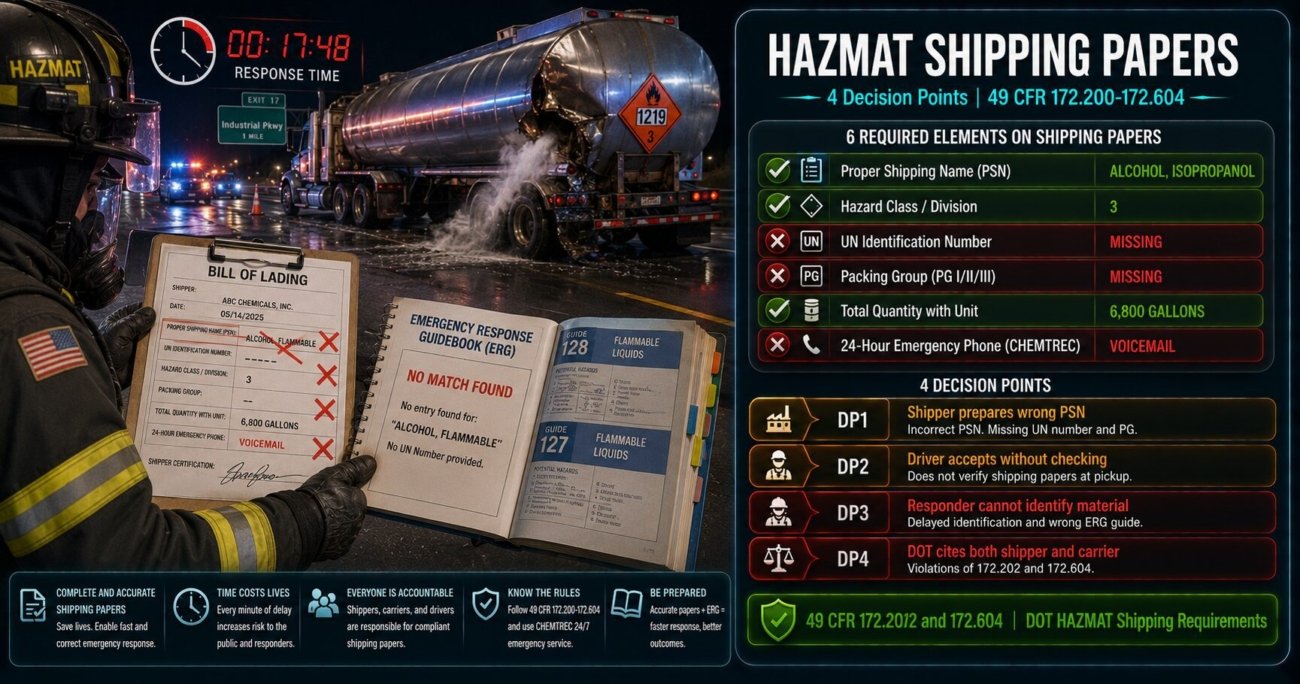
A tanker truck carrying 6,800 gallons of isopropyl alcohol is involved in a rear-end collision on a state highway at 2:17 PM. The driver is uninjured but the rear fitting is leaking. First responders arrive within nine minutes.
The first responder asks the driver for the shipping papers. The driver produces a bill of lading that lists the cargo as ALCOHOL, FLAMMABLE. There is no UN number. There is no packing group. There is no emergency response telephone number. The quantity is listed as approximately 6,800 gallons with no unit of measure confirmation for the hazardous material entry.
The first responder opens his Emergency Response Guidebook and searches for ALCOHOL, FLAMMABLE. The entry does not exist in the ERG because it is not a proper shipping name. Valuable minutes pass while the responder attempts to identify the specific material from the description on the bill of lading and a partially visible placard on the damaged rear of the tanker.
The shipping papers in this shipment failed at the moment they existed to serve. Their purpose is not administrative. Their purpose is to tell an emergency responder, in the first 90 seconds of an incident, exactly what they are dealing with. Papers that do not contain a UN number cannot do that.
Shipment: Isopropyl alcohol, bulk tanker, approximately 6,800 gallons.
Incident: Rear-end collision, leaking rear fitting, first responders on scene within 9 minutes.
Shipping paper failure: No UN number, no packing group, no emergency response telephone number, incorrect proper shipping name (ALCOHOL, FLAMMABLE is not a valid PSN).
Consequence: Delayed hazard identification by first responders, increased incident response time, potential for incorrect initial protective actions.
Regulation: 49 CFR 172.200-172.204 govern shipping paper content requirements for hazardous materials.
When did you last review a shipping paper for a HAZMAT shipment your facility sent or received? Could an emergency responder use that paper to identify the material, its hazards, and who to call in under 90 seconds? If you are not certain, this guide covers exactly what must be on the paper and why each element exists.
Decision Point 1: The Shipper Prepares the Bill of Lading
The shipper’s traffic coordinator prepares the bill of lading for the isopropyl alcohol shipment. She knows the product is flammable. She has shipped it many times before. She types ALCOHOL, FLAMMABLE in the description field because that is what appears on the previous shipment’s paperwork and no one has ever raised a concern about it.
She does not look up the proper shipping name in the Hazardous Materials Table. She does not include a UN number because she does not know the shipment requires one. She includes the emergency contact number for the company’s main switchboard, not a 24-hour HAZMAT emergency response number.
What are the specific required elements missing from this shipping paper, and why does each one matter to emergency responders?
The shipping paper has four critical deficiencies under 49 CFR 172.200-172.204:
1. Incorrect proper shipping name. ALCOHOL, FLAMMABLE is an italicised cross-reference entry in the Hazardous Materials Table, not a proper shipping name. The correct PSN for isopropyl alcohol is ISOPROPANOL or ISOPROPYL ALCOHOL. Under 49 CFR 172.101, the most specific proper shipping name must be used. The PSN drives the ERG guide number. A responder who cannot look up the PSN cannot find the correct response guide.
2. Missing UN identification number. The UN number (UN1219 for isopropyl alcohol) must appear on the shipping paper immediately before or after the proper shipping name under 49 CFR 172.202(a)(2). The UN number is the primary identifier used by emergency responders in the ERG and is required on placards and package marks. Without it, the responder cannot confirm the material identity or find the guide page.
3. Missing packing group. Under 49 CFR 172.202(a)(4), the packing group must be included on the shipping paper for materials assigned a packing group. Isopropyl alcohol is PG II. The packing group tells the responder the degree of danger and influences protective action distances.
4. Inadequate emergency response telephone number. Under 49 CFR 172.604, every shipping paper must include a telephone number that is monitored at all times (24 hours, 7 days) by a person knowledgeable about the hazardous material and able to provide emergency response information. A company main switchboard that is unstaffed after business hours does not satisfy this requirement. CHEMTREC (1-800-424-9300) is the most widely used service that satisfies this requirement.
Decision Point 2: The Driver Accepts the Shipment
The driver arrives to pick up the load. The dispatcher hands him the bill of lading. The driver reviews it briefly, signs the carrier’s copy, and departs. He has been driving tankers for 11 years. He has seen bills of lading like this before. He does not flag any concerns about the description or the missing fields.
Under DOT regulations, the carrier who accepts a HAZMAT shipment also accepts responsibility for ensuring that the shipping papers are in order before transport begins.
What obligation does the carrier and driver have regarding shipping paper accuracy, and what should the driver have done before accepting this shipment?
Under 49 CFR 177.817, a carrier may not accept a HAZMAT shipment unless the shipping papers are complete and accurate. The carrier’s responsibility for shipping paper accuracy is shared with the shipper, not delegated entirely to the shipper.
Before accepting this shipment the driver should have verified: that the description matches the Hazardous Materials Table entry for the material being shipped (a quick ERG cross-reference would have shown that ALCOHOL, FLAMMABLE does not appear as a proper shipping name), that a UN number is present in the correct format (UN followed by four digits), that the packing group is listed, and that the emergency telephone number is a 24-hour monitored number, not a business switchboard.
An experienced driver who has completed HAZMAT training under 49 CFR 172.700 should be able to perform this check in under five minutes. The training requirement for HAZMAT employees specifically covers recognition of shipping paper requirements precisely because the driver is the last check before a potentially non-compliant shipment leaves the facility.
When a driver identifies a shipping paper deficiency, the correct response is to notify the shipper before departing and request corrected paperwork. Accepting and departing with a deficient shipping paper makes the carrier jointly responsible for the deficiency.
Decision Point 3: The First Responder Needs Information
At the incident scene, the first responder has the bill of lading in hand. She can see that the rear of the tanker has a placard, but it is damaged and only partially readable. The material is leaking. She needs to know the initial isolation distance, whether the vapours are heavier or lighter than air, whether water is an appropriate suppression agent, and what PPE her crew needs before approaching.
She has an ERG. She has a radio to call CHEMTREC. The shipping paper’s emergency number connects to a voicemail after three rings.
What information should a compliant shipping paper have provided that would have resolved this situation in under 90 seconds?
A fully compliant shipping paper for this shipment would have enabled the following 90-second response:
Step 1 (15 seconds): Read the proper shipping name (ISOPROPANOL) and UN number (UN1219) from the shipping paper. Open ERG to the yellow-bordered pages, locate UN1219, note Guide 129.
Step 2 (30 seconds): Read Guide 129. Isopropanol: highly flammable liquid, vapours heavier than air, initial isolation 100 feet in all directions for small spills (330 feet for large spills or fire), water fog or dry chemical for fire, keep people upwind and away from low areas where vapours collect.
Step 3 (45 seconds): Call the 24-hour emergency number from the shipping paper. CHEMTREC confirms the material, provides direct contact with the shipper’s emergency team, and can relay SDS Section 4 first aid and Section 6 spill response data.
None of this was possible with the actual shipping paper because the proper shipping name was wrong, the UN number was missing, and the emergency number was unmanned. The 90-second response becomes a multi-minute identification process during which responders are operating without confirmed hazard information near a leaking flammable liquid tanker.
The shipping paper format required by 49 CFR 172.202 is not a bureaucratic formality. It is an emergency response tool. Every field that is missing or incorrect is a second of delayed response when seconds matter most.
Decision Point 4: The Post-Incident DOT Investigation
Following the incident, a DOT Hazardous Materials Inspector reviews the shipping documentation. The investigation finds three separate violations: incorrect proper shipping name (49 CFR 172.101), missing UN identification number (49 CFR 172.202(a)(2)), and inadequate emergency response telephone number (49 CFR 172.604). The inspector issues citations to both the shipper and the carrier.
The shipper’s traffic coordinator explains that the shipping paper was prepared the same way it has always been prepared and that no previous inspector had ever raised a concern. The carrier’s safety director explains that drivers are not expected to audit shipping papers prepared by shippers.
Are either of these explanations a valid defence against the DOT citations, and what corrective actions should each party implement?
Neither explanation is a valid regulatory defence, and both reflect systemic compliance failures rather than isolated errors.
For the shipper: Prior practice does not establish compliance. The fact that no previous inspector raised a concern means only that the violation was not previously detected, not that it did not exist. Under 49 CFR 172.200, the shipper is responsible for ensuring that each shipping paper contains all required information. The traffic coordinator’s training should have covered shipping paper content requirements. The corrective action is: review all active shipping paper templates against the Hazardous Materials Table entries for the materials being shipped, add UN numbers, correct proper shipping names, and replace the emergency telephone number with a 24-hour monitored HAZMAT response service.
For the carrier: Carriers are jointly responsible for shipping paper accuracy under 49 CFR 177.817. The statement that drivers are not expected to audit shipping papers is inconsistent with this regulatory obligation and with the function-specific HAZMAT training drivers must receive under 49 CFR 172.702. Driver HAZMAT training must cover shipping paper content requirements. The corrective action is: update driver training to include a shipping paper verification checklist, and implement a policy that drivers must not depart with a HAZMAT shipment if the shipping paper does not contain the required elements.
Lessons Learned: What Compliant HAZMAT Shipping Papers Look Like
The Five Required Elements for Every HAZMAT Shipping Paper Entry
Under 49 CFR 172.202, every HAZMAT entry on a shipping paper must contain five elements in a specific sequence. They must appear in this order or an order that groups them clearly together:
- Proper shipping name from Column 2 of the Hazardous Materials Table (49 CFR 172.101), not a trade name or common name
- Hazard class or division number from Column 3 (for example, 3 for flammable liquid)
- UN or NA identification number from Column 4, preceded by UN or NA (for example, UN1219)
- Packing group from Column 5 in Roman numerals (PG I, PG II, or PG III), where applicable
- Total quantity with unit of measure
For a compliant entry on the shipping paper for this shipment, the description line would read: ISOPROPANOL, 3, UN1219, PG II, 6,800 gallons.
The 24-Hour Emergency Response Telephone Number
Under 49 CFR 172.604, the emergency response telephone number must be immediately available to first responders, monitored at all times by a person who has comprehensive knowledge of the hazardous material and can provide emergency response information. The number must be in North America and must be operational 24 hours a day, 7 days a week, 365 days a year.
Options that satisfy this requirement include: CHEMTREC (1-800-424-9300), CHEMTEL (1-813-248-0585), INFOTRAC (1-800-535-5053), and several other registered emergency response information providers. A company’s internal emergency coordinator may also be listed if they are available 24 hours and meet the knowledge requirement. A company main line, a supervisor’s direct number, or a number that goes to voicemail does not satisfy the requirement under any circumstances.