

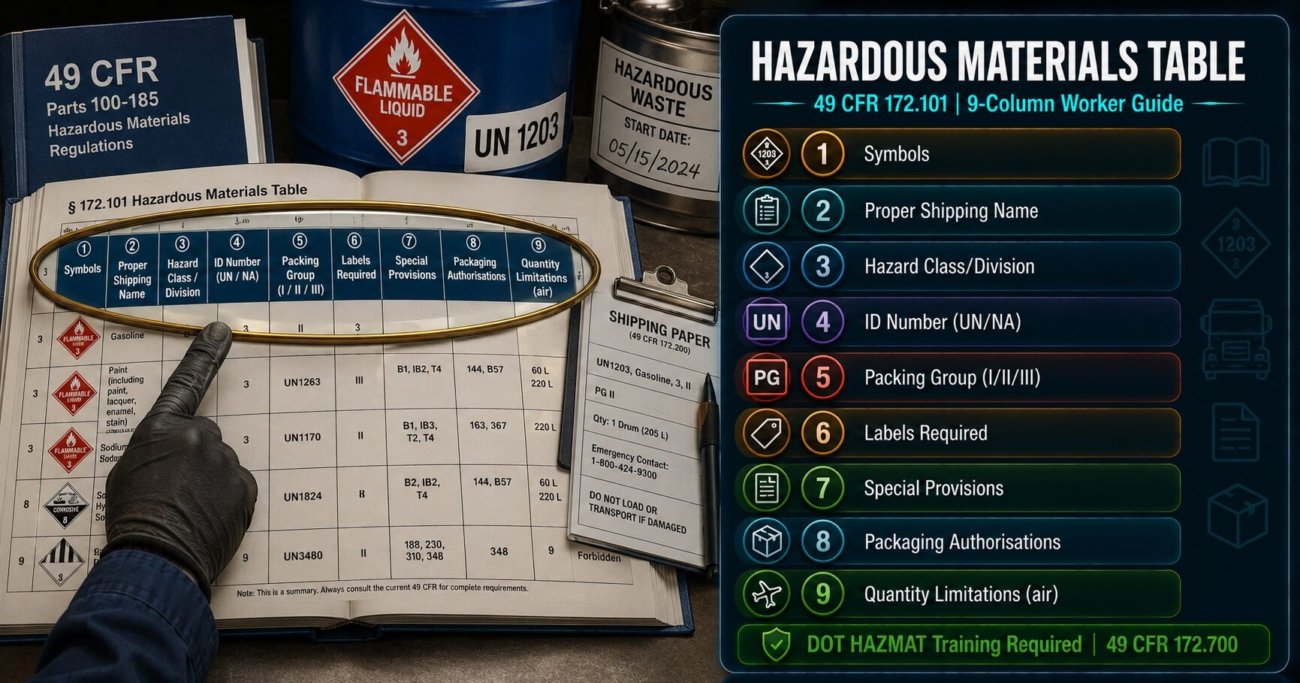
A warehouse receiving coordinator accepts a pallet of drums from a carrier. The shipping paper lists the material as PAINT. She files the paper and moves on. Later that day, a forklift punctures one of the drums. The material that spills is not ordinary paint. It is a flammable coating with a flash point of 22 degrees Celsius, classified as a Class 3 Flammable Liquid under 49 CFR Part 173.
She did not know that PAINT is a proper shipping name in the Hazardous Materials Table at 49 CFR 172.101. She did not know that the shipping paper should have included a UN number, a hazard class, and a packing group. She did not know any of this because no one had ever explained what the Hazardous Materials Table is or how to use it.
The Hazardous Materials Table is the central reference document for HAZMAT transportation in the United States. Every person involved in shipping, receiving, handling, or transporting hazardous materials needs to understand its structure. This guide explains what the table contains, how to read it, and how it determines every other compliance requirement in a HAZMAT shipment.
The Hazardous Materials Table at 49 CFR 172.101 is the starting point for every HAZMAT shipment. It determines the proper shipping name, the hazard class and division, the identification number, the packing group, the required labels, the applicable special provisions, and the packaging sections that govern the shipment. A worker who cannot read the table cannot correctly prepare or verify any HAZMAT shipment documentation.
What the Hazardous Materials Table Is
The Hazardous Materials Table (HMT) at 49 CFR 172.101 is a comprehensive listing of materials that the Department of Transportation has determined are hazardous for transportation purposes. The table contains approximately 3,000 entries organised alphabetically by proper shipping name.
The table is the master reference for DOT HAZMAT compliance. No requirement in the HAZMAT regulations makes complete sense without reference to the table, because the table is where the classification of a specific material is established. Classification drives every subsequent requirement: what packaging to use, what labels to apply, what marks are required, what documents must accompany the shipment, and what training the people handling it must have received.
The table is published in the Code of Federal Regulations (49 CFR 172.101) and is freely accessible through the eCFR at ecfr.gov. It is also reproduced in the Emergency Response Guidebook (ERG) in a condensed format organised by UN number rather than by name.
The Nine Columns of the Hazardous Materials Table
The HMT has nine columns. Each column provides different information about the material. Understanding what each column contains is essential for correctly classifying and documenting any HAZMAT shipment.
Column 1 contains symbols that modify how the entry applies. The most important are: the plus sign (+), which means the proper shipping name and hazard class are fixed regardless of whether the material meets the technical definition of that class; the letter A, which means the entry applies only to transportation by air; and the letter W, which means the entry applies only to transportation by water. An entry with no symbol in Column 1 applies to all modes of transport.
Column 2 contains the proper shipping name (PSN), which is the standardised name that must appear on shipping papers, package marks, and placards. Entries in italics are not proper shipping names but are cross-references directing the user to the correct entry. For example, ALCOHOL, FLAMMABLE in italics directs the user to FLAMMABLE LIQUIDS, N.O.S. or the specific alcohol name. Only non-italic entries are proper shipping names.
Column 3 contains the primary hazard class or division number for the material. The nine DOT hazard classes are: 1 Explosives, 2 Gases, 3 Flammable Liquids, 4 Flammable Solids and Related, 5 Oxidising Substances and Organic Peroxides, 6 Toxic and Infectious Substances, 7 Radioactive Materials, 8 Corrosives, and 9 Miscellaneous Dangerous Goods. Some classes have subdivisions (for example, 2.1 Flammable Gas, 2.2 Non-Flammable Gas, 2.3 Toxic Gas).
Column 4 contains the UN or NA identification number for the material. UN numbers are four-digit numbers assigned by the United Nations and used internationally. NA numbers are North American numbers assigned by DOT for materials not assigned a UN number. The identification number must appear on shipping papers, package marks, and placards (on orange panels in certain situations). It is the primary tool used by emergency responders to identify a material using the ERG.
Column 5 contains the packing group (PG) for the material, if applicable. Packing groups indicate the degree of danger: PG I (great danger), PG II (medium danger), and PG III (minor danger). The packing group determines which performance level of UN-certified packaging is required. Class 1 explosives and Class 7 radioactive materials do not use packing groups.
Column 6 specifies the hazard class labels that must be applied to packages of the material. The primary hazard label is always listed. If subsidiary hazard labels are required, they appear after the primary label. For example, an entry might list FLAMMABLE LIQUID, TOXIC, indicating that both the Class 3 flammable liquid label and the Class 6.1 toxic label are required.
Column 7 contains codes for special provisions that modify the general requirements for the material. Special provisions are found in 49 CFR 172.102 and may grant exceptions, impose additional requirements, or clarify how the material is to be described. For example, special provision A1 limits certain requirements to air transport only. Workers must look up any special provisions listed for their material to ensure they are applying the correct requirements.
Column 8 is divided into three sub-columns (8A, 8B, 8C) covering exceptions, non-bulk packaging, and bulk packaging respectively. These direct the user to specific sections of 49 CFR Part 173 that authorise the packaging types for the material. Column 8A also shows the maximum inner packaging quantity for limited quantities exceptions. Workers selecting packaging must confirm that the packaging they intend to use is authorised by the applicable 49 CFR Part 173 section.
Column 9 is divided into two sub-columns covering quantity limitations for passenger aircraft or railcar (9A) and cargo aircraft only (9B). These are the maximum per-package quantities permitted for air transport. A forbidden designation means the material may not be transported by that mode. Workers shipping by air must verify that their package quantities do not exceed the limits in Column 9.
How to Use the Table: A Step-by-Step Approach
Step 1: Find Your Material by Proper Shipping Name
The HMT is organised alphabetically by proper shipping name. If you know the proper shipping name of your material, locate it in the table directly. If you do not know the proper shipping name, start with the material’s chemical name, trade name, or common description and search the table for the most specific matching entry.
If the material you are looking for does not appear by its exact name, look for a generic entry in the relevant hazard class. For example, a flammable liquid that does not have its own entry might be shipped as FLAMMABLE LIQUID, N.O.S. (not otherwise specified), with the technical chemical name in parentheses on the shipping paper.
Step 2: Read Across All Nine Columns
Once you have located the correct entry, read across all nine columns before beginning to prepare your documentation or select packaging. Do not stop at Column 4 with the UN number. The full entry tells you what labels are required (Column 6), whether special provisions apply (Column 7), and what packaging is authorised (Column 8). All of this information must be correct before the shipment can be prepared.
Step 3: Check for Multiple Entries
Many materials appear multiple times in the table under different proper shipping names or with different packing groups depending on concentration, flash point, or other properties. When multiple entries are possible, select the most specific one. If a material has its own specific entry, use that entry rather than an N.O.S. entry. If the material can fall under different packing groups depending on its properties, test or assess the material to determine which packing group applies.
Some shippers default to generic N.O.S. entries because they are easier to find or remember. This is incorrect when a specific proper shipping name exists for the material. For example, shipping isopropanol as FLAMMABLE LIQUID, N.O.S. is not correct when ISOPROPANOL has its own HMT entry with specific properties and requirements. Using the wrong entry invalidates the shipping documentation and may result in incorrect packaging, labelling, or placarding.
HAZMAT Employee Training: Who Must Be Trained and When
Under 49 CFR 172.700 to 172.704, every HAZMAT employee must receive training before performing HAZMAT functions and must be retrained at least every three years. The training requirement applies to anyone whose job involves preparing hazardous materials for transport, transporting hazardous materials, or handling hazardous materials during transportation.
HAZMAT employee training must cover general awareness (familiarisation with the regulations and the ability to recognise hazardous materials), function-specific training (the requirements of the regulations relevant to the employee’s specific job functions), safety training (including emergency response, accident prevention, and personal safety procedures), and security awareness training.
Familiarity with the Hazardous Materials Table is a core component of function-specific training for anyone who classifies, describes, or documents HAZMAT shipments. An employee who cannot read the HMT correctly cannot perform these functions compliantly regardless of how much other HAZMAT knowledge they have.
HAZMAT employee training records must be retained for three years following the training or for the duration of employment, whichever is longer. During a DOT inspection or incident investigation, inspectors will request training records for all HAZMAT employees who had a role in the shipment. Missing or expired training records for any employee who touched the shipment create compliance exposure for the employer.
Hazardous Materials Table Reference Checklist
✓ I have located the correct entry in the HMT at 49 CFR 172.101 for this material
✓ I have used the most specific proper shipping name available, not a generic N.O.S. entry if a specific entry exists
✓ I have recorded the Column 3 hazard class and division for the shipping paper
✓ I have recorded the Column 4 UN or NA identification number for the shipping paper and package marks
✓ I have determined the Column 5 packing group and confirmed the packaging meets that requirement
✓ I have checked Column 6 and applied all required primary and subsidiary hazard labels
✓ I have checked Column 7 and looked up any special provisions that modify the requirements
✓ I have checked Column 8 and confirmed the packaging I am using is authorised for this material
✓ If shipping by air, I have checked Column 9 for quantity limitations
✓ My HAZMAT employee training is current (within the last three years)
Sources
- 49 CFR 172.101: Hazardous Materials Table (full searchable text)
- 49 CFR Part 172 Subpart G: Training Requirements (172.700-172.704)
- PHMSA: Emergency Response Guidebook (includes UN number index)
- PHMSA: HAZMAT Employee Training Overview
- 49 CFR Part 173: Shippers General Requirements for Shipments and Packagings