
Every day in the United States, approximately 1 million hazardous materials shipments move by road, rail, air, and water. The vast majority arrive safely. The ones that do not often share a common thread: someone in the chain did not know, or did not follow, the rules that exist to keep dangerous goods from becoming dangerous incidents.
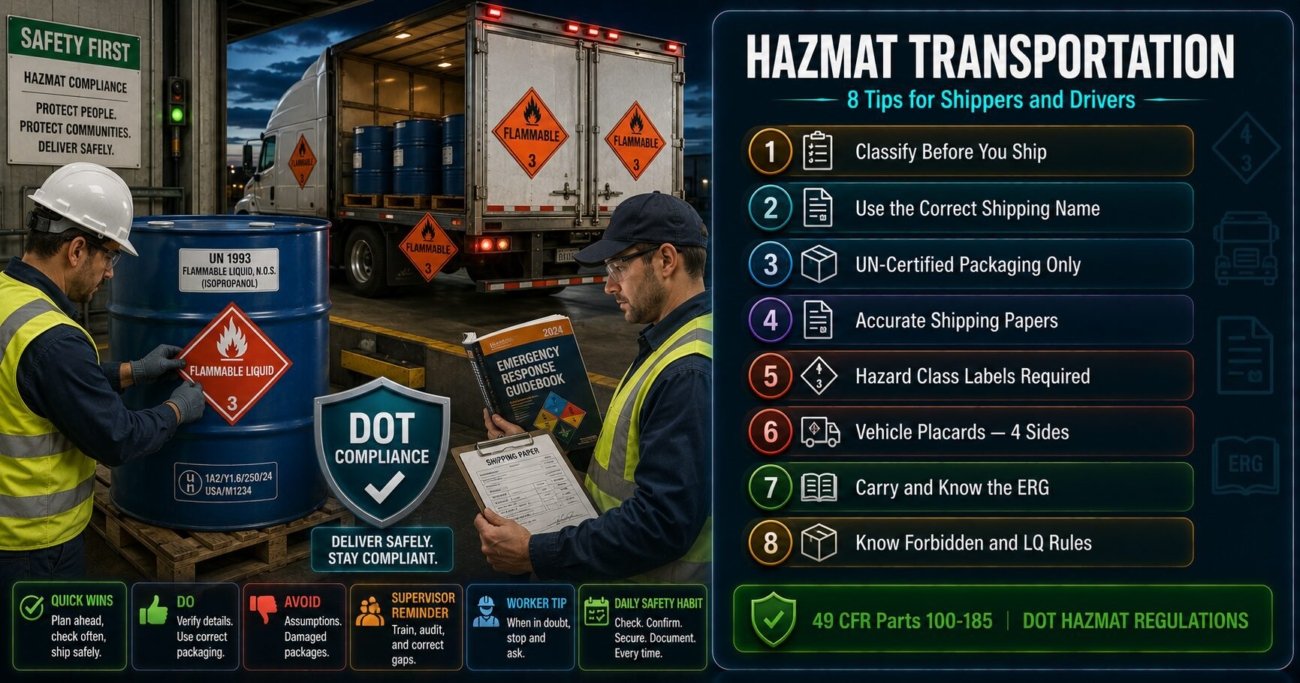
DOT HAZMAT regulations under 49 CFR Parts 100 to 185 govern the transportation of hazardous materials in the United States. These rules apply to shippers, carriers, and anyone who handles a hazardous materials package during transportation. These tips address what every person involved in HAZMAT transportation should know before the shipment leaves the loading dock.
Tip 1: Know Whether Your Material Is a Hazardous Material Before It Ships
The first question in any HAZMAT shipment is whether the material being shipped meets the DOT definition of a hazardous material. Under 49 CFR 171.8, a hazardous material is a substance or material that the Secretary of Transportation has determined is capable of posing an unreasonable risk to health, safety, and property when transported in commerce.
The Hazardous Materials Table at 49 CFR 172.101 lists approximately 3,000 materials by proper shipping name. If your material appears in the table, or if it meets the criteria for a hazard class defined in 49 CFR Part 173, it is a hazardous material for transportation purposes. The determination must be made before any shipping papers are prepared and before the shipment is tendered to a carrier.
Cross-check every new chemical product against the Hazardous Materials Table at 49 CFR 172.101 before you ship it for the first time. The table is searchable in the eCFR at ecfr.gov. If the material is listed, all subsequent DOT requirements flow from that listing: proper shipping name, hazard class, packing group, labels, marks, and shipping papers.
Tip 2: Use the Correct Proper Shipping Name
The proper shipping name (PSN) is the standardised name assigned to a hazardous material in the Hazardous Materials Table. It must appear exactly as listed in the table on shipping papers, package marks, and placards. Using a trade name, common name, or abbreviated name in place of the proper shipping name is a violation of 49 CFR 172.101 and invalidates the shipping documentation.
Many hazardous materials have multiple possible proper shipping names. When more than one entry could apply, the shipper must select the most specific description. For example, a shipment of methyl alcohol must use METHANOL, not FLAMMABLE LIQUID, N.O.S. or ALCOHOL, N.O.S. The specific name takes priority over generic names.
Do: Look up the exact proper shipping name in the Hazardous Materials Table for every shipment. The PSN must match the table entry exactly, including capitalisation as required.
Avoid: Using trade names or abbreviations on shipping papers. CAUSTIC SODA is not an acceptable PSN; SODIUM HYDROXIDE, SOLID is the correct entry.
Tip 3: Select the Right Packaging and Confirm It Is UN-Certified
Packaging for hazardous materials must be authorised by the applicable section of 49 CFR Part 173 for the specific material and packing group. Most hazardous materials in quantities above de minimis amounts must be shipped in UN performance-tested packaging bearing the UN specification marking (the UN symbol, a code indicating the packaging type and specification, and other required information).
The UN packaging marking is not optional decoration. It is evidence that the packaging has been tested and certified to withstand the stresses of transportation, including drop, vibration, stacking, and internal pressure. Shipping a hazardous material in a non-certified package, or in a certified package rated for a lower packing group than the material requires, is a serious violation that also creates liability for any incident that results from the packaging failure.
When reusing hazardous materials packaging, confirm that the UN marking on the container is appropriate for the material you are shipping, not just for the material that was originally in the container. The original contents and packing group must be compatible with your current shipment. If in doubt, use new certified packaging.
Tip 4: Complete Shipping Papers Accurately and Keep Them Accessible
Shipping papers (bills of lading, air waybills, or dangerous goods declarations, depending on the transport mode) must accompany every hazardous materials shipment and must contain the required information in the required format under 49 CFR 172.200 to 172.204. The required information includes the proper shipping name, hazard class and division, UN identification number, packing group, total quantity, and any required special provisions or emergency response information.
For road transport, the shipping papers must be within immediate reach of the driver while driving, placed on the driver’s seat when the driver is out of the vehicle, or in a door pocket on the driver’s side. The purpose is to enable emergency responders to identify the hazardous material immediately if an incident occurs. Papers that are in the cab but buried under other documents, or left in a trailer that the driver cannot access, do not satisfy this requirement.
Audit a sample of completed shipping papers each week. The most common errors are incorrect or missing UN numbers, missing packing group designations, incorrect total quantity, and missing emergency response telephone numbers. A single inaccurate shipping paper can result in a citation under 49 CFR 172.201 and can mislead emergency responders at an incident scene.
Tip 5: Understand Hazard Class Labels and When They Are Required
Hazard class labels are the diamond-shaped labels required on packages of hazardous materials. They communicate the primary hazard of the material to anyone handling the package, including workers at intermediate facilities, emergency responders, and receiving personnel. Under 49 CFR 172.400, each package of hazardous materials must be labelled with the labels required by the column 6 entry in the Hazardous Materials Table for the primary hazard class and any subsidiary hazard classes.
Labels must be placed on the same side of the package as the proper shipping name mark, must be at least 100 mm (approximately 4 inches) on each side, and must be fully visible and not obscured by other marks, straps, or materials. A label that cannot be read by an emergency responder might as well not be there.
Do: Apply labels before the package leaves your facility. Verify that all required labels for both primary and subsidiary hazard classes are present and legible.
Avoid: Assuming that one label covers all hazards. Many materials have both a primary and a subsidiary hazard requiring separate labels. A corrosive liquid that is also toxic requires both the CORROSIVE label (class 8) and the TOXIC label (class 6.1).
Tip 6: Know the Placard Requirements for Road Shipments
Placards are the large diamond-shaped signs (at least 250 mm per side) required on motor vehicles and freight containers transporting hazardous materials. Placarding requirements under 49 CFR 172.500 depend on the hazard class and the aggregate quantity being transported. Some classes require placards regardless of quantity (Table 1 materials, including explosives, poison gases, and radioactive materials). Others require placards only when 1,001 pounds or more of the material is being transported (Table 2 materials).
Placards must be displayed on all four sides of the transport vehicle. Missing or incorrect placards are among the most frequently cited HAZMAT violations by DOT enforcement personnel during roadside inspections. A carrier who accepts a shipment that requires placarding must ensure the vehicle is correctly placarded before departure.
If you are a driver picking up a hazardous materials load, confirm that the vehicle is correctly placarded before leaving the shipper’s facility. You are jointly responsible for placarding once you accept the shipment. If the shipper’s facility cannot confirm the correct placard, consult the Emergency Response Guidebook (ERG) or contact your dispatcher before departing.
Tip 7: Carry the Emergency Response Guidebook and Know How to Use It
The Emergency Response Guidebook (ERG) is published by the Pipeline and Hazardous Materials Safety Administration (PHMSA) and Transport Canada and is updated every four years. The current edition is the ERG 2024. Every commercial motor vehicle transporting hazardous materials in the United States should carry a current copy of the ERG.
The ERG allows emergency responders and drivers to quickly identify the hazards of a material and the initial actions to take in the event of a spill, fire, or release. It is organised by UN identification number and by proper shipping name, with response guides that cover initial isolation distances, protective action distances, fire response, and first aid. Knowing how to look up a material by UN number in the ERG takes less than two minutes to learn and is a skill every HAZMAT shipper and carrier employee should have.
Before each trip involving hazardous materials, open the ERG to the guide page for the primary material you are transporting. Note the initial isolation distance and the protective action distance. This takes 60 seconds and means that if you are first on scene at an incident involving your load, you know how far to establish the initial perimeter before emergency services arrive.
Tip 8: Never Transport Forbidden Materials and Know the Limited Quantity Exceptions
Certain materials are forbidden from transportation entirely under 49 CFR 173.21 to 173.23, including self-reactive materials that are unstable at transport temperatures, materials that have been condemned by proper authority, and leaking packages of hazardous materials. No exceptions apply to forbidden materials.
At the other end of the spectrum, the limited quantities (LQ) provision under 49 CFR 173.150 to 173.156 allows certain hazardous materials to be shipped in smaller quantities with significantly reduced labelling, marking, and documentation requirements. LQ shipments must still use appropriate inner packaging but may be shipped without hazard class labels and with simplified marks. Understanding which materials qualify for LQ and what the maximum inner packaging sizes and gross weights are can significantly simplify compliance for small quantity shippers of common hazardous materials such as paint, adhesives, and cleaning products.
Check whether your regular hazardous material shipments qualify for the limited quantities exception before your next shipment. Column 8A of the Hazardous Materials Table shows the maximum inner packaging size for LQ eligibility. If your shipment qualifies and you are shipping in appropriate inner packaging with the correct LQ mark, you can ship without hazard labels and with simplified shipping papers, significantly reducing compliance burden for routine small shipments.
HAZMAT Transportation Quick Reference
HAZMAT Transportation Compliance Checklist
✓ Material has been classified against the Hazardous Materials Table at 49 CFR 172.101
✓ Correct proper shipping name selected from the table (most specific description)
✓ UN-certified packaging selected and confirmed appropriate for the hazard class and packing group
✓ Shipping papers completed with all required information including UN number, packing group, and emergency phone
✓ Required hazard class labels applied to package (primary and subsidiary hazard classes)
✓ Required marks applied including proper shipping name and UN identification number
✓ Vehicle placarded correctly for the hazard class and quantity being transported
✓ Shipping papers accessible in cab per 49 CFR 177.817
✓ Current Emergency Response Guidebook (ERG 2024) in cab
✓ Driver has current HAZMAT training certification per 49 CFR 172.700