
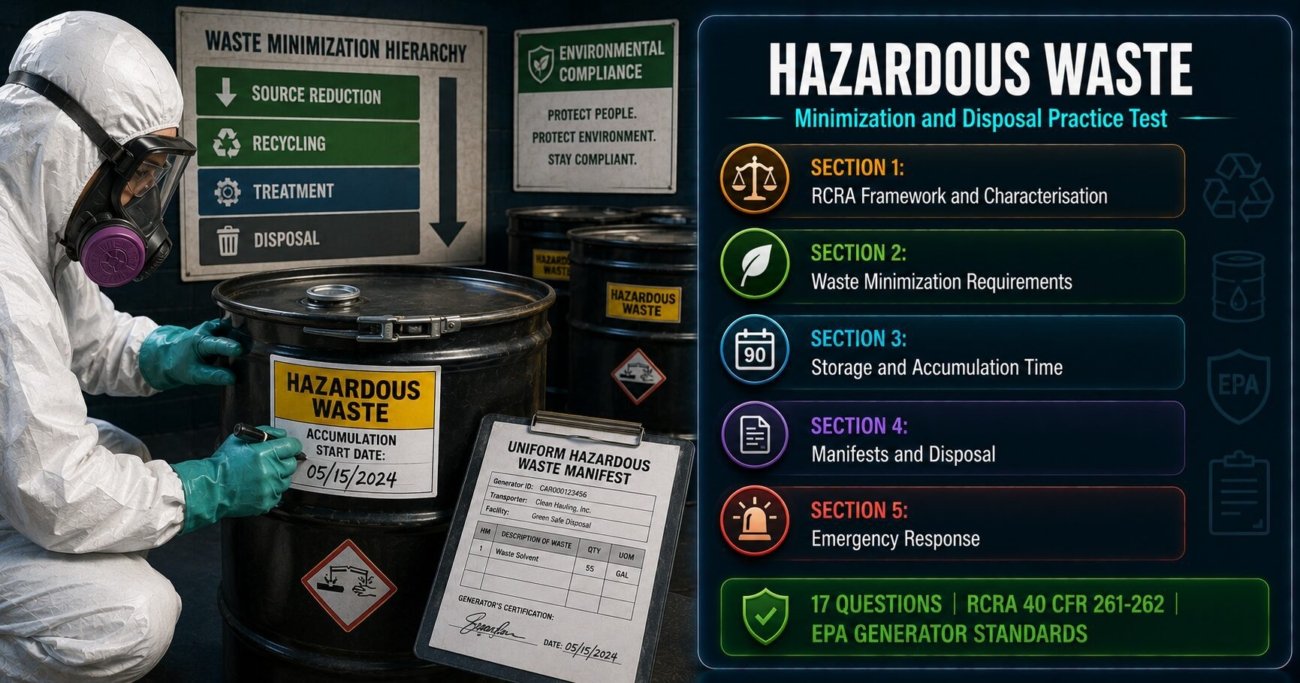
This practice test covers hazardous waste minimization and disposal requirements under the Resource Conservation and Recovery Act (RCRA), administered by the EPA. Questions address waste characterization, generator classifications, waste minimization obligations, storage requirements, manifests, and disposal standards. Each answer includes a detailed explanation referencing the applicable regulatory provision.
Section 1: RCRA Framework and Hazardous Waste Characterization
Answer: Ignitability, corrosivity, reactivity, and toxicity. Defined at 40 CFR Part 261, Subpart C.
Explanation: The Resource Conservation and Recovery Act (RCRA) and its implementing regulations at 40 CFR establish two pathways for a solid waste to be classified as hazardous: it is listed as a hazardous waste by EPA (40 CFR Part 261, Subpart D), or it exhibits one or more hazardous characteristics. The four characteristics are ignitability (40 CFR 261.21), corrosivity (261.22), reactivity (261.23), and toxicity (261.24). A waste exhibiting any of these characteristics is a RCRA hazardous waste subject to the full regulatory scheme unless an exemption applies. Generators must determine whether their wastes meet any characteristic before deciding how to manage them.
Answer: Yes. It is a characteristic hazardous waste by ignitability (waste code D001).
Explanation: Under 40 CFR 261.21, a solid waste is ignitable if it is a liquid with a flash point less than 60 degrees Celsius (140 degrees Fahrenheit). A flash point of 55 degrees Fahrenheit is well below this threshold. The waste would be assigned EPA waste code D001. Even though the waste does not appear on a listed waste list, it must be managed as a RCRA hazardous waste because of its characteristic. The generator must count it toward their monthly hazardous waste generation quantity, store it in compliant containers, and dispose of it through a licensed hazardous waste disposal facility using a hazardous waste manifest.
Answer: Listed wastes are hazardous by regulation regardless of their actual properties. Characteristic wastes are hazardous because they exhibit measurable hazardous properties. The distinction affects delisting petitions and the mixture rule.
Explanation: Listed hazardous wastes are those that EPA has determined pose sufficient hazard to warrant regulatory control, documented in Subpart D of 40 CFR Part 261 (F, K, P, and U lists). They are hazardous by definition regardless of whether a specific sample exhibits measurable hazardous properties. Characteristic wastes are hazardous only as long as they exhibit the characteristic; if the characteristic can be eliminated through treatment, the waste may no longer be hazardous. The distinction matters for the mixture rule: mixing a listed hazardous waste with a non-hazardous waste renders the entire mixture a listed hazardous waste. Mixing a characteristic hazardous waste with a non-hazardous waste may or may not render the mixture hazardous, depending on whether the resulting mixture still exhibits the characteristic.
Answer: Very Small Quantity Generator (VSQG), formerly known as Conditionally Exempt Small Quantity Generator.
Explanation: Under EPA’s 2016 RCRA Generator Improvements Rule (effective May 2017), generators producing 100 kilograms or less of hazardous waste per month are classified as Very Small Quantity Generators (VSQGs). VSQGs face significantly reduced requirements compared to Small Quantity Generators (SQGs, 100-1000 kg/month) and Large Quantity Generators (LQGs, more than 1000 kg/month). VSQGs are not required to obtain an EPA identification number, do not need to use a manifest for on-site accumulation, and face no accumulation time limits for quantities below the threshold. However, VSQGs must still ensure their waste is delivered to a person who owns or operates a facility that is permitted, licensed, or registered by a state to manage hazardous waste. The reduced requirements do not exempt VSQGs from proper disposal obligations.
Section 2: Waste Minimization Requirements
Answer: LQGs must certify on each hazardous waste manifest that they have a programme in place to reduce the volume and toxicity of hazardous waste generated to the degree economically practicable.
Explanation: RCRA Section 3002(b) requires Large Quantity Generators to include a certification on each Uniform Hazardous Waste Manifest stating that the generator has a programme in place to reduce the volume or quantity and toxicity of such waste to the degree determined by the generator to be economically practicable. This is a certification of programme existence, not a specific reduction target. However, EPA expects generators to implement genuine waste minimization activities such as source reduction (process changes, material substitutions), recycling, and treatment that reduces hazard. The manifest certification is a legal attestation; signing it without an actual programme in place creates legal exposure.
Answer: Source reduction prevents waste generation at the source. Recycling manages waste after it is generated. EPA prefers source reduction as the higher priority approach.
Explanation: The EPA Waste Minimization hierarchy, consistent with the Pollution Prevention Act of 1990, establishes a preference order: source reduction first, recycling second, treatment third, and disposal last. Source reduction includes process changes that use less hazardous materials, product reformulation, better inventory management to reduce expired materials, and equipment modifications that generate less waste. Recycling includes reclamation, reuse, and beneficial use of waste streams. Source reduction is preferred because it prevents the hazard from being created at all, while recycling still requires management of a hazardous waste stream. EPA views genuine recycling positively but recognises that it carries residual risks that source reduction avoids entirely.
Answer: Source reduction through process modification. The regulatory benefit is elimination of the hazardous waste stream and all associated RCRA management obligations for that waste.
Explanation: Eliminating the generation of a hazardous waste through process modification is the highest form of source reduction under the EPA waste minimization hierarchy. When a waste stream is eliminated, the generator no longer needs to characterise, count, store, manifest, or dispose of that waste under RCRA. If the change reduces the facility’s total monthly generation below a lower generator classification threshold, it may also reduce the facility’s regulatory obligations for all remaining waste streams. This type of change should be documented thoroughly, including the process change description and the before-and-after waste generation quantities, both for regulatory purposes and to support future manifest certifications about waste minimization programmes.
Section 3: Storage, Containers, and Accumulation Time
Answer: Move the container to the LQG’s central accumulation area within 3 days.
Explanation: Under 40 CFR 262.15, generators may accumulate hazardous waste in satellite accumulation areas (SAAs) at or near the point of generation under specific conditions without a RCRA storage permit, provided the waste remains under the control of the operator of the process generating the waste. There is no accumulation time limit for SAAs as long as the container is not full. However, once a container in an SAA is full, the generator has 3 days to move it to the central accumulation area (CAA). The 90-day (LQG) or 270-day (SQG) accumulation clock begins when the waste arrives at the CAA, not when it was placed in the SAA.
Answer: Containers must be closed except when adding or removing waste, must be in good condition, must be compatible with the waste, must be labelled with the words Hazardous Waste and the accumulation start date, and must be inspected weekly.
Explanation: 40 CFR 262.16 (SQGs) and 262.17 (LQGs) require that containers of hazardous waste be kept closed during storage, be maintained in good condition without leaks or deterioration, and be made of or lined with materials compatible with the stored waste. LQG containers must be labelled with the words Hazardous Waste, a description of the waste contents, the hazards of the waste, and the accumulation start date. The accumulation start date is critical because it starts the 90-day clock for LQGs (270 days for SQGs). LQGs must inspect container storage areas at least weekly to check for leaks or deterioration. The weekly inspection must be documented in the facility’s inspection log.
Answer: The waste must be shipped within 3 days (by Day 90) or the generator may apply to the EPA regional administrator for a 30-day extension for unforeseen, temporary, and uncontrollable circumstances.
Explanation: LQGs may accumulate hazardous waste on-site for up to 90 days without a RCRA storage permit. If the 90-day limit cannot be met due to unforeseen, temporary, and uncontrollable circumstances, the generator may apply to the EPA regional administrator for an extension of up to 30 days under 40 CFR 262.17(b). The extension is not automatic and must be requested in advance of the deadline. Exceeding the 90-day limit without an approved extension converts the accumulation area into an unpermitted hazardous waste storage facility, a serious RCRA violation. The situation described, transporter unavailability, may qualify as an uncontrollable circumstance, but the generator must document the circumstances and apply for the extension before Day 90.
Section 4: Manifests and Disposal
Answer: The manifest tracks hazardous waste from generation to disposal (cradle-to-grave). If no signed copy is received within 35 days, the generator must contact the transporter and the designated facility. If no copy is received within 60 days, the generator must file an exception report with the appropriate regulatory authority.
Explanation: The Uniform Hazardous Waste Manifest (EPA Form 8700-22) is the primary tracking document for off-site hazardous waste shipments under RCRA. The manifest must accompany the waste from the generator to the designated treatment, storage, or disposal facility (TSDF). Upon receiving the waste, the TSDF signs and returns a copy to the generator. Under 40 CFR 262.42, if the generator has not received the signed copy within 35 days of shipment, they must contact the transporter and TSDF to determine the status of the waste. If no signed copy is received within 60 days of shipment, the generator must submit an exception report to EPA or the authorized state agency, including a copy of the original manifest and an explanation of the steps taken to locate the waste.
Answer: The entire mixture is a P-listed hazardous waste under RCRA’s mixture rule.
Explanation: Under 40 CFR 261.3(a)(2)(iii) (the mixture rule), a mixture of a listed hazardous waste and a solid waste is itself a listed hazardous waste unless the listed waste was listed solely for an ignitability, corrosivity, or reactivity characteristic and the mixture does not exhibit that characteristic. P-listed wastes are acutely hazardous commercial chemical products; they are not listed solely for a characteristic. Therefore, mixing any quantity of P-listed waste with non-hazardous waste renders the entire mixture a P-listed hazardous waste. This is one of the most consequential rules in RCRA generator compliance because small mismanagement decisions can dramatically increase regulated waste volumes and disposal costs.
Answer: A TSDF is a facility permitted under RCRA Subtitle C to treat, store, or dispose of hazardous waste. Generators may not knowingly transport hazardous waste to a facility that does not have the required RCRA permit, license, or interim status.
Explanation: Under RCRA Section 3005, facilities that treat, store, or dispose of hazardous waste must obtain a RCRA permit from EPA or an authorized state agency. Generators who ship hazardous waste to an unpermitted facility face joint and several liability for any resulting environmental contamination under both RCRA and CERCLA (Superfund). Generators should verify the RCRA status of any facility they use by checking EPA’s RCRAInfo database (rcrainfo.epa.gov). Generators retain liability for their waste even after it leaves their facility and even if they were unaware the receiving facility was unpermitted. Due diligence in selecting TSDFs is a generator’s legal and financial obligation.
Answer: Hazardous waste must be treated to meet EPA-specified treatment standards before it can be land disposed. Generators must provide waste characterisation and LDR notification to the designated TSDF.
Explanation: The Land Disposal Restrictions programme at 40 CFR Part 268 prohibits the land disposal of hazardous waste unless the waste has been treated to meet EPA’s treatment standards. Treatment standards are expressed either as concentration limits in the treated waste or as required treatment technologies. Generators must determine the applicable treatment standards for their waste and provide an LDR notification with each shipment to the TSDF, including the waste codes, the LDR treatment standards that apply, and whether the waste meets those standards. If the waste does not meet treatment standards, it must be treated before disposal, and the TSDF is responsible for ensuring that treated waste meets the standards before land disposal. LDR paperwork must be retained for three years.
Section 5: Emergency Response and Compliance
Answer: The emergency coordinator must respond to emergencies involving hazardous waste, coordinate emergency response activities, notify appropriate authorities of releases, and prevent unplanned releases from threatening human health or the environment.
Explanation: Under 40 CFR 262.264 (LQG emergency response requirements), the emergency coordinator must be familiar with the facility’s emergency contingency plan, all aspects of the facility’s operations, the location and characteristics of hazardous wastes handled, and emergency response equipment available on site. In the event of an emergency involving hazardous waste, the coordinator must: notify the National Response Center (1-800-424-8802) if a reportable quantity of a listed chemical is released; assess the extent of any release; implement appropriate emergency response actions; prevent the spread of fires, explosions, or releases; and document all emergency response actions in the facility’s operating record.
Answer: Stop the improper disposal immediately, classify and begin properly managing the waste, notify EPA or the authorized state agency of the past improper disposal, assess and remediate any contamination, and review all waste streams to identify any other misclassified wastes.
Explanation: Past improper disposal of hazardous waste as solid waste creates both RCRA and CERCLA liability. The facility should consult with environmental counsel immediately. The facility must reclassify the waste and put proper management procedures in place going forward. The past disposal should be disclosed to the relevant regulatory authority; voluntary disclosure typically results in significantly reduced penalties compared to enforcement-initiated discovery. The disposal site should be assessed for contamination. Depending on the quantities involved and the nature of the waste, cleanup obligations may arise under RCRA corrective action or CERCLA authorities. Proactive disclosure and remediation are both legally advantageous and the appropriate compliance response.
Answer: The contingency plan documents emergency response procedures for incidents involving hazardous waste. LQGs must follow the National Contingency Plan (NCP) standards as required by 40 CFR 262.262, and the plan must be coordinated with local emergency response organisations.
Explanation: Under 40 CFR 262.262, LQGs must have a written contingency plan designed to minimise hazards from fires, explosions, or unplanned sudden or non-sudden releases of hazardous waste or hazardous constituents. The plan must describe the actions facility personnel are required to take in response to emergencies, be consistent with the local emergency response plan, and be submitted to all local police and fire departments, hospitals, and state and local emergency response teams that may be called upon to provide emergency services. The plan must list the names and addresses of all emergency coordinators, describe all emergency equipment, and be revised whenever the facility changes in a way that materially affects the plan. A copy must be kept at the facility and submitted to the local emergency planning committee (LEPC).
Knowledge Summary
Hazardous waste can be listed (by EPA regulation) or characteristic (by measurable property). Both require RCRA management.
Generator classification (VSQG, SQG, LQG) is determined by monthly generation quantity and drives regulatory obligations.
The waste minimization hierarchy is source reduction first, recycling second, treatment third, disposal last.
LQG accumulation time limit is 90 days. Exceeding it without an approved extension creates an unpermitted storage facility.
The mixture rule: mixing listed hazardous waste with non-hazardous waste makes the entire mixture a listed hazardous waste.
Generators retain liability for their waste even after it leaves their facility, making TSDF due diligence essential.
Land Disposal Restrictions require treatment to EPA standards before land disposal; LDR notifications must accompany each shipment.
Sources
- 40 CFR Part 261: Identification and Listing of Hazardous Waste
- 40 CFR Part 262: Standards Applicable to Generators of Hazardous Waste
- EPA: Resource Conservation and Recovery Act (RCRA) Overview
- EPA: Hazardous Waste Generators Regulatory Summary
- EPA RCRAInfo: RCRA Facility Search and Compliance Information