
Knowing that a chemical is hazardous is not the same as knowing what it can do to you, how quickly, through which route of exposure, and at what concentration. Hazardous chemical information awareness is the skill of connecting a chemical you are working with to the specific information that tells you how to protect yourself from it.
This guide covers the four primary sources of hazardous chemical information available to every US worker, how to use each one effectively, and how to apply that information to real workplace decisions about PPE, exposure controls, and emergency response.
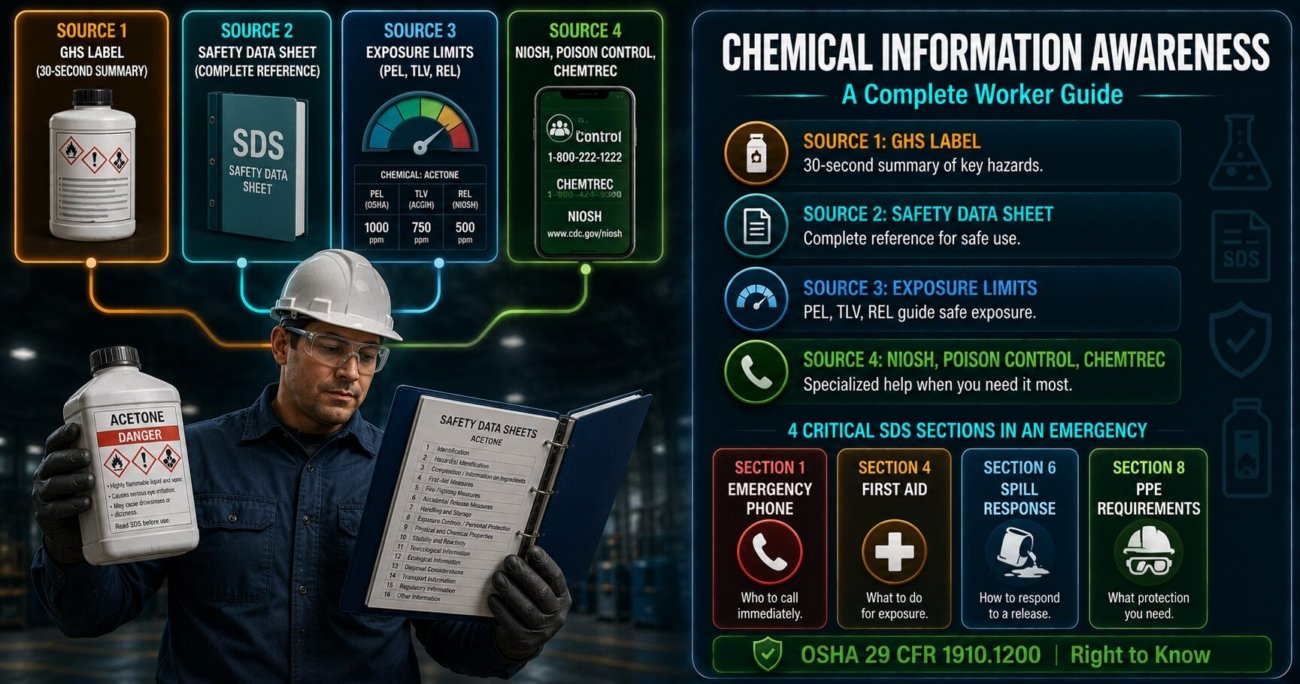
By the end of this guide you will know: the four sources of hazardous chemical information and when to use each; how to navigate a Safety Data Sheet to find what you need in under two minutes; how to read a GHS label as a 30-second hazard summary; how to use exposure limits to assess whether your working conditions are protective; and how to find additional information when the SDS or label is not enough.
Source 1: The GHS Label as Your 30-Second Hazard Summary
The GHS label is the fastest source of hazard information for a chemical you are about to handle. It is designed to communicate critical information in under 30 seconds for a worker who knows how to read it.
The six required elements of a GHS label give you: the product name, the severity of the hazard (signal word), the type and degree of hazard (pictograms and hazard statements), what to do to stay safe (precautionary statements), and who to call if something goes wrong (supplier contact). The label cannot tell you everything, but it tells you enough to make an immediate decision about whether you have the right PPE and whether you are in the right environment to handle the chemical safely.
Use the label before every first use of a chemical and whenever you notice that the label has changed on a familiar product. Suppliers reformulate products and revise labels; a label you read two years ago may not reflect the current formulation or current hazard classification.
Before opening any chemical container: read the signal word (DANGER or WARNING), identify the pictograms, read the precautionary statements to confirm you have the required PPE, and note the supplier emergency number. This sequence takes under 30 seconds for a familiar chemical and under two minutes for an unfamiliar one. It is the single highest-value habit for reducing chemical exposure incidents.
Source 2: The Safety Data Sheet as the Complete Chemical Reference
The Safety Data Sheet is the comprehensive technical document for a hazardous chemical. Every compliant SDS follows the 16-section GHS format required under 29 CFR 1910.1200. The SDS contains information the label cannot fit: detailed health effects for all routes of exposure, specific PPE requirements including glove material and respirator type, engineering control specifications, spill response procedures, disposal requirements, and regulatory information.
Most workers interact with the SDS under two conditions: during training, when they have time to read it fully, and during or after an incident, when they need specific information quickly. The second scenario is the one that matters most for life-safety outcomes, and it requires knowing which sections contain which information before you need it.
The Four Sections to Know by Number
Workers who skim an SDS during onboarding training often remember only the signal word and the most prominent pictogram. Section 8, which specifies the exact type of gloves, respirator, and eye protection required, is rarely read in full. If you use a chemical regularly, open its SDS and read Section 8 in full. You may find that the PPE you have been using is not what the chemical’s hazard profile requires.
Source 3: Exposure Limits as the Benchmark for Protective Conditions
Exposure limits define the airborne concentration of a chemical below which most workers can be exposed without adverse health effects during a normal 8-hour workday. They are the primary quantitative benchmark for assessing whether working conditions are protective.
OSHA PEL (Permissible Exposure Limit) is the legally enforceable maximum under 29 CFR 1910.1000. Many OSHA PELs date from 1971 and are based on data that is now decades old. For many substances, the PEL is less protective than current scientific understanding would support.
ACGIH TLV (Threshold Limit Value) is published annually by the American Conference of Governmental Industrial Hygienists. TLVs are updated more frequently than OSHA PELs and generally reflect more recent toxicological evidence. They are not legally enforceable under OSHA but are widely used as the practical benchmark for occupational health protection.
NIOSH REL (Recommended Exposure Limit) is published by the National Institute for Occupational Safety and Health. RELs are also updated more frequently than OSHA PELs and are used by OSHA as the basis for more recent substance-specific standards.
When SDS Section 8 lists only an OSHA PEL that is significantly higher than the ACGIH TLV for the same substance, workers who stay below the PEL may still be experiencing exposures that current evidence associates with health effects. Comparing all three limits gives the most complete picture of what constitutes a protective exposure level.
Find the OSHA PEL, ACGIH TLV, and NIOSH REL for the three chemicals you work with most frequently. If any TLV or REL is significantly lower than the corresponding PEL, discuss with your safety officer whether your current exposure controls are achieving the more health-protective level. The NIOSH Pocket Guide to Chemical Hazards (available free at cdc.gov/niosh/npg) lists RELs and TLVs alongside PELs for hundreds of substances.
Source 4: Supplementary Resources When the SDS Is Not Enough
NIOSH Pocket Guide to Chemical Hazards
The NIOSH Pocket Guide is a concise, freely available reference covering approximately 700 chemicals. It provides chemical names and synonyms, exposure limits (PEL, REL, and TLV where available), physical and chemical properties, health hazards, and recommended PPE. It is particularly useful when an SDS is incomplete, when an SDS lists only an outdated PEL, or when you need a quick cross-reference for a chemical that may appear under a different name.
OSHA Chemical Sampling Information Database
OSHA’s Chemical Sampling Information database contains sampling and analytical methods for workplace air monitoring, as well as regulatory information and health hazard summaries for chemicals subject to OSHA standards. It is particularly useful for employers conducting air monitoring programmes and for workers who want to understand the monitoring methods used to assess their exposures.
Poison Control Centres and CHEMTREC
For acute chemical exposure emergencies, the US Poison Control network (1-800-222-1222) provides 24-hour medical guidance. CHEMTREC (1-800-424-9300) provides 24-hour emergency response information for chemical spills and exposures involving commercial chemical products. Both services provide guidance beyond what the SDS contains.
Both numbers should be posted in every area where hazardous chemicals are used, alongside the SDS for the specific chemicals in that area.
Putting It Together: A Chemical Information Decision Framework
Step 1: Read the GHS label. Check signal word, pictograms, and precautionary statements. Confirm you have the required PPE.
Step 2: Locate the SDS. Confirm it is the current version (check Section 16 revision date). Read Section 8 in full to verify your PPE selection.
Step 3: Confirm engineering controls are operational. If Section 8 requires local exhaust ventilation, verify it is working before starting the task.
Step 1: Go to the SDS immediately. Open Section 4 for the relevant route: skin, eye, inhalation, or ingestion. Follow the specific first aid instructions.
Step 2: Call the emergency contact in SDS Section 1, or call Poison Control at 1-800-222-1222, or CHEMTREC at 1-800-424-9300, depending on the event.
Step 3: For spills, open SDS Section 6 for containment and cleanup procedures. Wear the PPE specified in Section 6 before approaching the spill area.
Step 1: Find the exposure limits from SDS Section 8. Note whether only the OSHA PEL is listed or whether TLVs and RELs are also included.
Step 2: Cross-reference against the NIOSH Pocket Guide to find the NIOSH REL and ACGIH TLV. Note where these are more protective than the OSHA PEL.
Step 3: Request air monitoring from your employer if you believe your exposures may approach or exceed any of these limits. You have the right to request this information and to receive the results.
Contact the chemical supplier directly using the contact information in SDS Section 1. Suppliers are required under 29 CFR 1910.1200 to provide additional hazard information upon request.
Cross-reference with the NIOSH Pocket Guide or the OSHA Chemical Sampling Information database for additional hazard and monitoring information.
If the SDS for a chemical you work with is incomplete, outdated, or missing required information, report this to your safety officer. The employer is responsible for ensuring that compliant SDS documents are available for all workplace chemicals.
Hazardous Chemical Information Awareness Checklist
✓ I can read a GHS label in sequence: signal word, pictograms, hazard statements, precautionary statements
✓ I know where the SDS for every chemical in my work area is located
✓ I know the four emergency SDS sections by number: 1, 4, 6, and 8
✓ I have read Section 8 of the SDS for my primary chemicals and confirmed my PPE matches the specifications
✓ I know the difference between OSHA PEL, ACGIH TLV, and NIOSH REL
✓ I know the US Poison Control number (1-800-222-1222) and CHEMTREC (1-800-424-9300)
✓ I know how to request additional chemical hazard information from my employer or the supplier
✓ I know I have the right to request air monitoring and to receive the results
✓ I report incomplete or missing SDS documents to my safety officer
✓ I check for label changes on chemicals I use regularly when new shipments arrive