

The Safety Data Sheet is one of the most information-dense documents in occupational safety. A single SDS for a complex industrial chemical can run to 20 or more pages, covering toxicology, physical chemistry, regulatory status across multiple jurisdictions, disposal requirements, and emergency response data. Yet the most common finding when OSHA inspects a workplace for HazCom compliance is not that SDS documents are wrong. It is that workers cannot find them, cannot use them under pressure, or have never seen them outside of a training event.
The gap between the SDS as a compliance document and the SDS as a practical safety tool is one of the defining challenges of chemical hazard communication in US workplaces. This article examines what the data shows about SDS use and misuse, what the most common failure points are, and what separates workplaces where SDS information actually reaches workers from those where it does not.
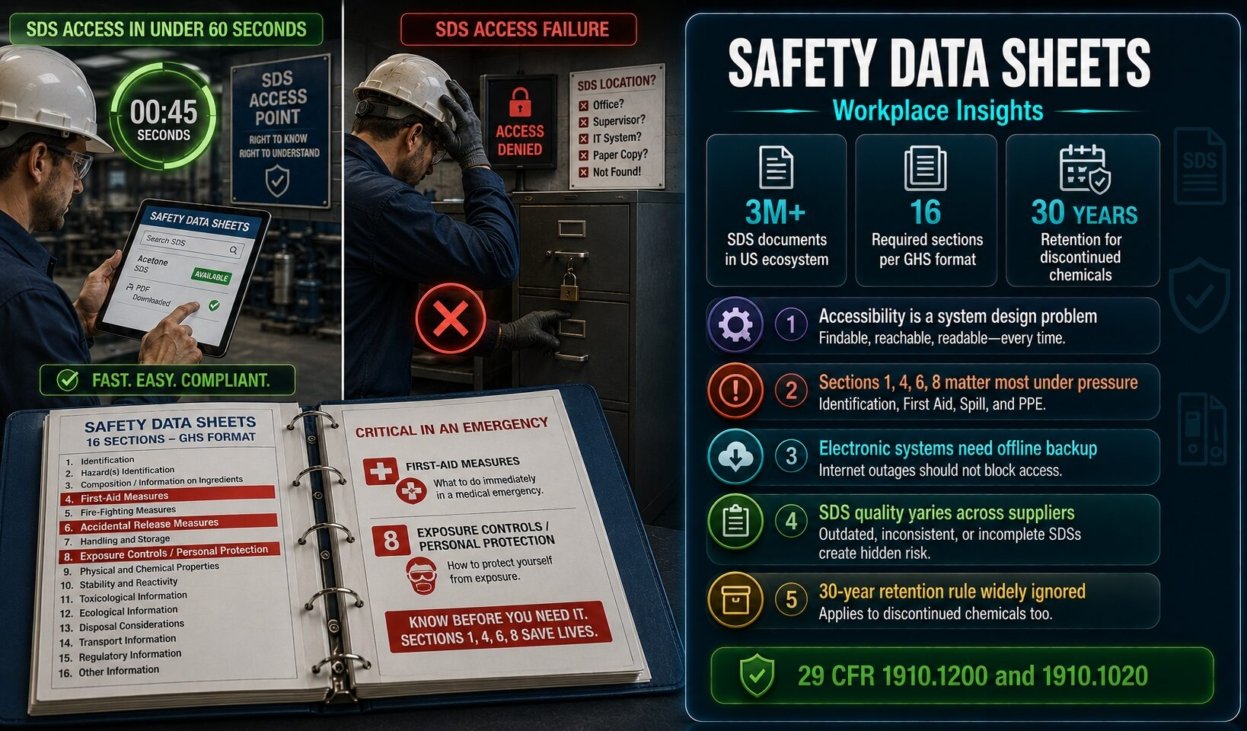
An SDS that workers cannot find in under 60 seconds is functionally absent during a chemical emergency. The compliance question is whether the document exists. The safety question is whether a worker in distress can retrieve Section 4 (First Aid) or Section 1 (Emergency Phone) before the situation deteriorates. Most SDS accessibility failures are system design failures, not document quality failures.
Insight Summary
✅ SDS accessibility failures are the leading HazCom citation type involving SDS documents, ahead of missing SDS and outdated SDS.
✅ Section 4 (First Aid) and Section 8 (PPE) are the two sections workers most need in real workplace situations, yet most workers cannot identify them by number without looking.
✅ Electronic SDS systems reduce document management burden but introduce new accessibility risks: login requirements, internet dependency, and insufficient offline backup.
✅ SDS quality varies significantly across suppliers. Exposure limits in Section 8 are sometimes outdated or incomplete, and employers who rely solely on supplier SDS documents may be working with hazard information that does not reflect current scientific understanding.
✅ The 30-year retention rule for SDS documents of discontinued chemicals is one of the most widely overlooked HazCom recordkeeping obligations in general industry.
Five Insights That Define Effective SDS Programmes
The most common SDS-related HazCom citation is not that documents are missing but that they are not readily accessible to workers in their work areas during their work shifts. This is a system design failure. Whether a facility uses paper binders, electronic terminals, or a mobile app, the test is whether a worker in their work area can retrieve the SDS for any chemical they are working with in under 60 seconds, without requiring a supervisor’s assistance, login credentials they do not have, or a walk to a separate building. Most accessibility failures are identified during inspections when inspectors observe that the access method, however well-intentioned, does not function the way it was designed to in practice.
Section 4 (First Aid), Section 1 (Identification, including emergency phone number), Section 6 (Accidental Release Measures), and Section 8 (Exposure Controls and PPE) are the four sections workers need in emergency and near-emergency situations. Studies of emergency room occupational chemical exposures consistently find that first aid instructions were not followed correctly or at all, partly because workers did not know the SDS existed and partly because they could not locate or navigate it under stress. Training workers to know these four section numbers specifically, and practising retrieval under simulated time pressure, measurably improves emergency response outcomes.
Electronic SDS management systems have largely replaced paper binder systems in large facilities, reducing document management burden and improving version control. However, electronic systems introduce two new accessibility risks that paper systems did not have. The first is login and authentication barriers: workers who need the SDS during a chemical exposure should not be waiting for a password reset. The second is internet dependency: a cloud-based SDS library that is unavailable during a network outage fails precisely when it may be most needed. Effective electronic SDS programmes address both by ensuring workers have authenticated access during all work shifts and maintaining an offline-accessible backup for critical chemicals.
Not all SDS documents are equally accurate or useful. The 16-section GHS format standardises structure but does not guarantee content quality. Exposure limits in Section 8 are sometimes set to OSHA PEL values that date from 1971 and may be significantly less protective than current ACGIH TLVs or NIOSH RELs for the same substance. First aid instructions in Section 4 occasionally reflect generic recommendations rather than chemical-specific guidance. Employers who want workers to have the most protective information should compare Section 8 exposure limits against current ACGIH and NIOSH values, and where supplier SDS documents are missing or inadequate, supplement them with independently sourced chemical health information.
Under 29 CFR 1910.1020, employers must retain SDS documents (and other chemical exposure records) for at least 30 years after the last date of employee exposure to the chemical. This rule applies to chemicals that have since been discontinued, reformulated, or replaced. The rationale is that many occupational diseases caused by chemical exposure, including certain cancers and progressive lung diseases, have long latency periods. A worker diagnosed with mesothelioma 25 years after leaving a facility needs the historical SDS to document occupational asbestos exposure. Employers who discard SDS documents when they stop using a chemical are destroying records that may be critical to future occupational disease claims and are creating potential legal exposure for the organisation.
Executive Takeaway
▶️ Test SDS accessibility right now. Pick any chemical in any work area and time how long it takes a worker to retrieve the SDS without supervisor assistance. If it takes more than 60 seconds, the access system needs redesign.
▶️ Train workers on four section numbers: 1, 4, 6, 8. These are the emergency-use sections. Workers who know these numbers before an incident occurs can act faster and more accurately when it matters.
▶️ Audit your electronic SDS system for offline backup and login barriers. Confirm that workers can access SDS documents during a network outage and without requiring a supervisor to authenticate.
▶️ Compare Section 8 exposure limits against current ACGIH TLVs for your highest-volume chemicals. If your SDS documents list only 1971 OSHA PELs, workers may be operating above currently recommended exposure limits.
▶️ Audit your SDS archive for discontinued chemicals. Any chemical to which employees were exposed must have its SDS retained for 30 years after the last exposure. If those records have been discarded, consult with your legal team about remediation options.
Authoritative References
Regulatory Sources
- 29 CFR 1910.1200 Appendix D: Minimum Information for an SDS
- 29 CFR 1910.1020: Access to Employee Exposure and Medical Records (30-year retention)
- OSHA: Safety Data Sheets Overview
Technical and Research References