
HAZMAT transportation marking is one of those regulatory areas where the requirements are well-documented, the violations are predictable, and the penalties are substantial – and yet non-compliance rates remain high enough that FMCSA recorded over 4,600 roadside inspection HAZMAT violations in 2023, more than 12 per day. The violations are concentrated in the same categories year after year: marking, labeling, placarding, shipping paper documentation, and training records. Each shipment that moves without proper marking and documentation is a first-responder information failure waiting to become an emergency response problem.
PHMSA’s civil penalty framework has become progressively more stringent through annual inflation adjustments. The December 30, 2024 adjustment set the standard maximum at $102,348 per day per violation – a figure that many compliance guides still report incorrectly from older adjustment cycles. The elevated ceiling of $238,809 applies where violations result in death, serious injury, or substantial property damage. At these figures, even a single shipment with multiple marking deficiencies can generate citation exposure that exceeds the cost of a comprehensive compliance program. This article compiles 40+ statistics on the 49 CFR 172 marking framework, PHMSA enforcement patterns, the critical distinction between marking and labeling, the most-cited violation categories, and what effective hazmat marking programs do to close persistent compliance gaps.
Editor's Choice: Key HAZMAT Marking and Enforcement Statistics
1. PHMSA's Enforcement Framework: How Civil Penalties Are Calculated and Applied
- Under the Federal hazmat law, 49 U.S.C. 5123(a), each violation of the Hazardous Materials Regulations (HMR) and each day of a continuing violation is subject to a separate civil penalty. For packaging violations, PHMSA generally treats each shipment or package design as a separate occurrence – meaning 50 mislabeled packages shipped together can constitute 50 separate violations. (49 U.S.C. 5123(a); PHMSA Penalty Guidelines; JJ Keller)
- PHMSA’s enforcement process runs from inspection to exit briefing to Notice of Probable Violation (NPV). The regulated entity may respond by paying the proposed penalty or providing information in defense. If the Chief Counsel determines the penalty should be assessed, an Order is issued making a formal finding of violation. Unresolved penalties trigger debt collection procedures. The enforcement chain from violation identification to final assessment can take months – but the citation exposure is established at the time of inspection. (PHMSA Hazardous Materials Safety FAQ)
- PHMSA’s annual civil penalty reports provide a year-by-year benchmark for enforcement activity: 2021: $1,245,830 collected (83 cases, 314 tickets); 2022: $1,306,711 collected (103 cases, 188 tickets); 2023: $877,013 collected (85 cases, 39 tickets). The year-to-year variation reflects case mix (enforcement cases vs. tickets carry different penalty ranges) and settlement outcomes, not necessarily inspection frequency changes. (PHMSA Annual Civil Penalty Reports 2021-2023)
- The December 30, 2024 Federal Register notice published the latest inflation adjustments under the Federal Civil Penalties Inflation Adjustment Improvements Act of 2015. The December 2024 adjustment set the standard maximum at $102,348 per day per violation and the elevated maximum at $238,809. DOT publishes updated figures in the Federal Register each January; compliance teams should review updated figures annually. The 2026 adjustment was cancelled (OMB memo; federal CPI data not produced due to government funding lapse in Fall 2025). The 2027 figures will be set by DOT in early 2027. (Federal Register December 30, 2024; HazmatRegistry.com June 2026; Lion Technology May 2026)
- HazmatRegistry.com’s June 2026 enforcement analysis identifies that operating under an expired Special Permit or Emergency Response Approval is a violation that can trigger penalties at the elevated “willful” level if the expiration date was clearly visible – because the employer cannot credibly claim ignorance. Special permits authorize deviations from standard packaging or transport requirements; an expired permit means the shipment had no valid deviation authorization. (HazmatRegistry.com, June 2026)
2. Marking vs. Labeling: The Legal Distinction That Generates Separate Citations
- The conflation of marking and labeling is the most fundamental compliance misunderstanding in the HMR community. A package can be properly marked (text-based regulatory information present) and improperly labeled (wrong class diamond) simultaneously, generating two separate violation categories. Each is codified under a different subpart of 49 CFR Part 172 and each generates its own citation. Understanding the two as components of the same “hazard communication” system without distinguishing their legal scope produces programs that satisfy neither requirement completely. (49 CFR Part 172 Subparts D and E; eCFR)
- The function difference matters for first-responders: marking provides specific material identity information (proper shipping name, UN number, quantity) that first responders need to select the correct emergency response procedure. Labeling provides a fast visual indicator of the primary hazard class that emergency teams can read at 50 feet. Placards serve the same visual-warning function at greater distances for bulk transport. All three serve distinct protective functions and all three must be correct simultaneously. (DOT Chart 15; 49 CFR 172)
- FMCSA’s DOT Chart 15 (Hazardous Materials Markings, Labeling and Placarding Guide) remains the reference document for visual format compliance. Key marking durability and specification points: marks must be durable, legible, and sized relative to the package to be readily visible; marks must not be obscured by other marks or labels; and color contrast requirements apply when required background colors conflict. Faded, smeared, or obstructed marks fail the durability standard independently of whether the correct information was originally applied. (49 CFR 172.304; FMCSA DOT Chart 15)
3. The Five Required Marks Under 49 CFR 172.301 and What Each One Must Show
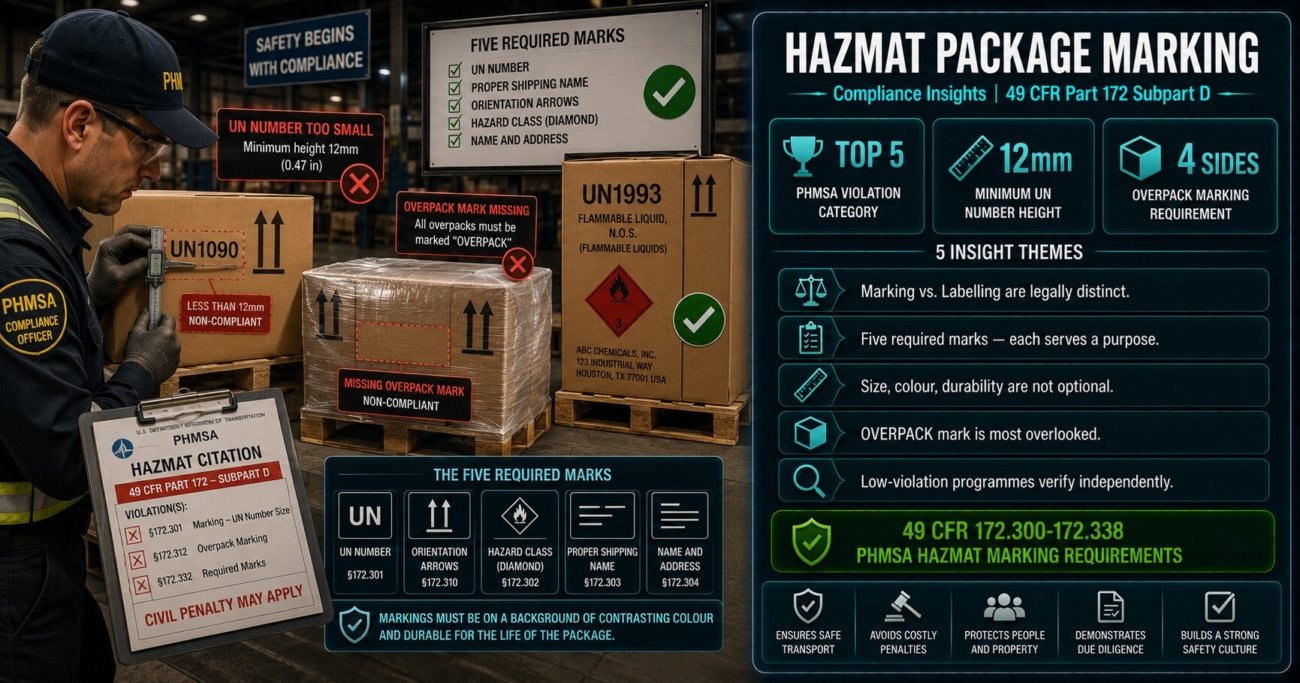
- The five required marks for most non-bulk HAZMAT packages under 49 CFR 172.301 are collectively the minimum regulatory communication package that allows the hazardous material to be transported legally, identified by first responders, and traced by enforcement authorities. A package missing any one of the five required marks is non-compliant independently of whether the others are present. Each absent mark is a separately citable violation. (49 CFR 172.301; Safe Road Compliance, March 2026)
- The proper shipping name requirement is the most commonly misunderstood marking element. “Gasoline” is an acceptable PSN because it appears in the HMT; “automotive fuel” is not – it is a common name, not a regulatory designation. For materials described as “n.o.s.” in the HMT, the shipper must append the technical name of the hazardous constituent in parentheses (e.g., “Flammable liquid, n.o.s. (toluene)”). Using the wrong PSN is a marking violation even if the UN number, label, and shipping paper are otherwise correct. (49 CFR 172.301; 172.101 HMT; HMR guidance)
- Orientation marks – UP arrows indicating the required upright position for liquid-containing packages – are not one of the five primary marks but are a separately required marking for many package types under 172.312. Missing orientation marks on packages containing liquid materials that require upright placement are citable independently of the five primary mark requirements. This is among the most frequently overlooked marking obligation in multi-product shipping environments. (49 CFR 172.312; HMR marking requirements)
4. Placarding Requirements: Table 1, Table 2, and the 1,001-Pound Threshold
- FMCSA recorded over 4,600 roadside inspection HAZMAT violations in 2023 – more than 12 per day – with placarding among the most commonly identified violation categories. These violations occur at scales, weigh stations, and roadside inspections by DOT officers who are specifically trained to identify placard deficiencies in 30-60 seconds of visual inspection. (ICC Council / FMCSA, June 2025)
- The Table 1 vs. Table 2 distinction is critical for placarding decisions: Table 1 materials (including Division 1.1, 1.2, 1.3 explosives; Division 2.3 poisonous gas; Division 4.3 dangerous when wet; Division 5.2 organic peroxide; Division 6.1 poisonous by inhalation; Division 7 radioactive) must be placarded in any quantity. Table 2 materials require placarding only when the aggregate gross weight of all Table 2 materials reaches 1,001 lbs (454 kg). Consolidating LTL freight mid-route that pushes aggregate weight over the 1,001-lb threshold creates a mid-transit placarding obligation. (49 CFR 172.504; DOT Chart 15)
- Placards must be maintained in legible, uncovered, and non-faded condition throughout the transport. ICC Council (June 2025) identifies the most common physical placarding violations: sun-faded colors that no longer meet DOT color tolerance standards (172.519(d)); placards physically obstructed by flap-hinge doors or straps; and dirt or contamination obscuring the hazard class number. These are physical maintenance violations that occur after departure and are caught at roadside inspections. (ICC Council, June 2025; 49 CFR 172.516-172.519)
- For LTL shippers, the 1,001-lb threshold creates a dynamic compliance obligation that can change with load consolidation. A shipper who delivers a half-pallet of Class 3 materials that is then combined with other Class 3 materials from multiple shippers onto one truck may inadvertently create a placarding obligation for the carrier. Understanding which party bears the placarding obligation – shipper or carrier – for each transport configuration is a key compliance management point. (49 CFR 172.506; HMR shipper/carrier responsibility framework)
5. The Most Common HAZMAT Transportation Violation Categories
- Safe Road Compliance (March 2026) identifies the most expensive HAZMAT violation categories at roadside: “Some fines reach over $75,000 per violation and increase if the material poses severe risk.” The materials with the highest inherent risk – lithium batteries, flammable liquids, corrosives, and toxic chemicals – have also seen increased FMCSA enforcement focus due to rising incidents involving these material categories in recent years. (Safe Road Compliance, March 2026)
- The PHMSA 2021 Annual Civil Penalty Report provides an illustrative enforcement pattern: one 2021 ticket cited a company for simultaneously failing to: register as an offeror of hazardous material; create and maintain training records; properly conduct package testing; and fail placarding requirements (172.504). The co-occurrence of multiple violation categories in a single enforcement action is the norm, not the exception – and each category generates a separate penalty. (PHMSA 2021 Annual Civil Penalty Report)
- The overpack marking requirement is specifically identified as the most consistently overlooked obligation in multi-package shipping. Under 49 CFR 172.312, when individual HAZMAT packages are consolidated into an overpack (a protective outer container), the overpack must be marked with the word “OVERPACK” and must either display the same hazard information as the individual packages or allow those marks to remain visible. Overpacks that conceal individual package marks without replacing them are a direct marking violation. (49 CFR 172.312; FMCSA DOT Chart 15)
6. Hazmat Employee Training: 49 CFR 172.700-172.704 Requirements and the Documentation Gap
- Under 49 CFR 172.702, a “hazmat employee” is any person who directly affects hazardous materials transportation safety – including, but not limited to, persons who: package hazardous materials; mark, label, or placard packages; prepare shipping papers; load or unload hazardous materials; operate vehicles transporting hazardous materials; or respond to hazmat incidents. The definition is broad enough to include warehouse workers, shipping clerks, and forklift operators who may not realize they are “hazmat employees” subject to the training requirement. (49 CFR 172.702(a); HMR training guidance)
- HazmatRegistry.com (June 2026) identifies the training documentation gap as the area where the largest discrepancy exists between what companies think they have and what would survive a PHMSA audit: a training log that lists date and topic but omits the trainer’s name, the employee’s job function, or the specific materials covered does not satisfy the HMR’s documentation standard. The content of the training record is as important as the fact that training occurred. (HazmatRegistry.com, June 2026; 49 CFR 172.704(d))
- The five required components of hazmat employee training under 172.704 are: general awareness/familiarization training; function-specific training covering job functions performed; safety training; security awareness training; and in-depth security training for employees with access to security-sensitive materials. General awareness training (what hazardous materials are and why regulations exist) is required for all hazmat employees. Function-specific training must be specific to the functions the employee actually performs. (49 CFR 172.704(a); PHMSA training guidance)
- New hazmat employees may perform hazardous materials functions for up to 90 days before completing formal training, provided they work under the direct supervision of a properly trained hazmat employee during that period. The supervisory requirement is often overlooked – a new employee performing hazmat functions alone before completing training is in violation even during the 90-day window. (49 CFR 172.704(c); PHMSA training requirement framework)
7. What Effective HAZMAT Marking Programs Do to Close Persistent Compliance Gaps
- The four characteristics of HAZMAT shipping programs with consistently low violation rates in PHMSA inspection histories: designated competent person who owns the HMR compliance function with clear accountability; pre-shipment checklist that covers all five required marks and the matching shipping paper in a single review step; training documentation system with role-specific records; and regular (at minimum annual) internal audits modeled on PHMSA’s inspection methodology. Programs that distribute the compliance function across multiple roles without clear ownership consistently produce gaps in documentation and marking consistency. (PHMSA compliance guidance; industry analysis)
- The “Check the Box” initiative referenced on PHMSA’s homepage is specifically designed for shippers uncertain whether their materials qualify as HAZMAT: PHMSA’s “Unsure if you’re shipping Hazmat? DOT’s Check the Box Can Help” resource helps small and medium shippers self-identify whether their materials trigger HMR requirements. This is particularly relevant for shippers of batteries, chemicals, aerosols, and flammable materials who may not realize their shipments are regulated. (PHMSA.dot.gov; PHMSA homepage, 2026)
- The most actionable compliance audit a hazmat shipping team can run is a gap analysis against the December 30, 2024 penalty figures, per HazmatRegistry.com’s June 2026 analysis. The audit process: review training records for all hazmat employees; check all Special Permit expiration dates; verify that shipping papers match package marks and vehicle placards on a sample of recent shipments; and confirm PHMSA registration is current and fee-paid. This four-step audit addresses the most consistently cited violation categories across PHMSA’s enforcement record. (HazmatRegistry.com, June 2026)
Key Takeaways for HAZMAT Shipping Managers and Compliance Teams
Sources
Federal Regulatory Sources
- 49 CFR Part 172 Subpart D – Marking (172.300-172.338): five required marks for non-bulk packages; proper shipping name; UN/NA identification number; quantity; shipper/consignee; orientation marks; overpack marking (172.312); durability requirements (172.304)
- 49 CFR Part 172 Subpart E – Labeling (172.400-172.450): hazard class label requirements; prohibition on labels not matching contents; primary and subsidiary risk labels; exemptions from labeling
- 49 CFR Part 172 – Hazardous Materials Table, Communications, Training: full text including HMT column structure; Subpart A scope; Subpart B shipping papers; Subpart C HMT; Subparts D through H; 172.702 hazmat employee definition; 172.704 training components
- FMCSA DOT Chart 15 – Hazardous Materials Markings, Labeling and Placarding Guide: visual reference for all placards and labels by hazard class; Table 1 and Table 2 placard requirements; 1,001-lb threshold explanation; international equivalency notes
- PHMSA 2022 Annual Civil Penalty Report: 103 enforcement cases, 188 tickets, $1,306,711 collected; company-level violation summaries; violation citation codes
- PHMSA 2023 Annual Civil Penalty Report: 85 enforcement cases, 39 tickets, $877,013 collected; year-over-year enforcement comparison
- PHMSA 2021 Annual Civil Penalty Report: 83 enforcement cases, 314 tickets, $1,245,830 collected; illustrative multi-violation enforcement action (registration, training, marking, placarding)
- PHMSA Hazardous Materials Safety FAQ: enforcement process from inspection to Order; Notice of Probable Violation process; debt collection for unresolved penalties; statistics database links
- PHMSA Incident Statistics: Form 5800.1 incident data; yearly summary reports by type, year, geography, mode; interactive graphs; nightly data updates
- BTS – Hazardous Materials Fatalities, Injuries, Accidents, and Property Damage Data: 1990-2024 BTS table sourced from PHMSA 10-year incident summary reports; highway dominance in fatality data; 2024 data available
Analysis and Compliance Sources
- HazmatRegistry.com (June 2026) – Penalties for HAZMAT Regulation Breaches: December 30, 2024 adjustment sets standard max $102,348 / elevated $238,809; training log documentation gap identified as largest audit-proof compliance gap; Special Permit expiration trigger for willful-level penalties; 2027 update calendar
- ICC Compliance Center (January 2025) – PHMSA Increases Penalties for 2025: $17,062 individual/small business standard maximum; $617 minimum training violation penalty; 2024-2025 CPI adjustment factor 1.02598; December 28, 2024 PHMSA final rule effective December 30, 2024
- JJ Keller – PHMSA 2025 Penalty Final Rule: effective December 30, 2024; maximum standard penalty prior history; per shipment counting methodology under 49 U.S.C. 5123(a); packaging manufacture and qualification exception
- ICC Council (June 2025) – HAZMAT Placards: 4,600+ FMCSA roadside violations 2023 / 12 per day; 250mm minimum placard size; fading, obstruction, and dirt as citable deficiencies; 1,001-lb LTL threshold; shipping paper to placard cross-check best practice
- Safe Road Compliance (March 2026) – Hazardous Materials Violations: FMCSA enforcement escalation for lithium batteries, flammable liquids, corrosives, toxic chemicals; fines exceeding $75,000 per violation; OOS orders; most common violation categories and codes
- ICC Compliance Center / PHMSA Portal Analysis: 2011-2015 60 fatalities / 2016-2020 34 fatalities; highway dominance for fatalities; 164,789 non-bulk vs. 15,743 bulk incidents 2011-2020; portal access instructions