

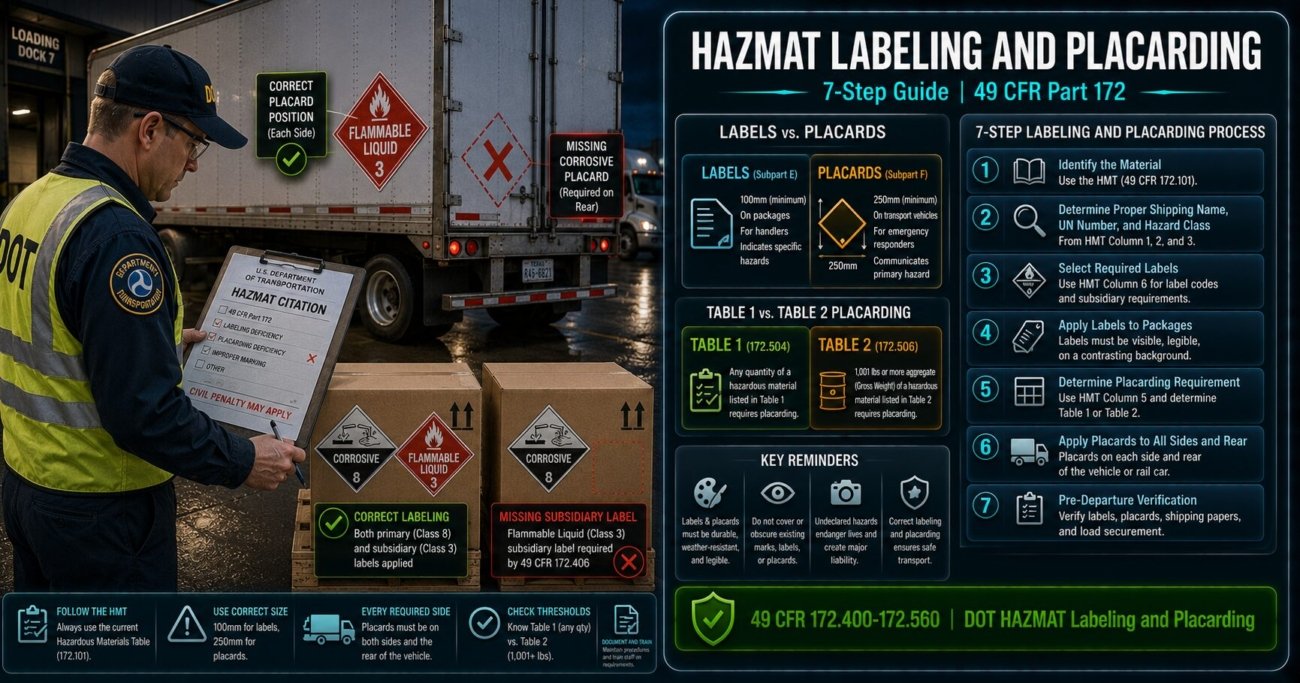
A driver at a loading dock is handed a pallet of packaged corrosive liquids to add to his truck. The packages bear CORROSIVE labels. The existing load on the truck includes packages bearing FLAMMABLE LIQUID labels. He loads the corrosive pallet and departs. The truck is placarded for flammable liquids only.
At a weigh station, a DOT inspector boards the vehicle. He notes the CORROSIVE labels on packages in the cargo area. The truck’s placards do not include a CORROSIVE placard. The inspector cites the carrier for failure to placard under 49 CFR 172.504. He also cites the shipper for tendering a shipment that required additional placarding without notifying the carrier.
Labels communicate to handlers who work directly with individual packages. Placards communicate to everyone outside the vehicle: emergency responders, enforcement officers, other drivers, and the public. Both serve hazard communication functions, but to different audiences at different distances. Getting either wrong creates a compliance failure and, more importantly, an information gap that can cost lives at an incident scene.
This guide covers the complete labelling and placarding requirements for HAZMAT shipments in the United States, step by step.
This guide covers all seven steps of HAZMAT labelling and placarding compliance: understanding labels versus placards and their distinct legal functions, selecting required labels from the Hazardous Materials Table, applying labels correctly to packages, determining placarding requirements for road transport, applying placards to vehicles, handling subsidiary hazards, and the most common violations and how to avoid them.
Step 1: Understand Labels Versus Placards - Two Distinct Legal Requirements
Labels and placards serve the same fundamental purpose – hazard communication – but to entirely different audiences and under entirely different regulatory frameworks. Confusing the two is the starting point for many HAZMAT compliance failures.
Labels are required on individual packages under 49 CFR Part 172 Subpart E (172.400-172.450). They are diamond-shaped, at least 100mm (approximately 4 inches) on each side, and communicate the hazard class of the material to handlers who work directly with the package. They must appear on the package itself, not on the outer packaging of an overpack.
Placards are required on transport vehicles under 49 CFR Part 172 Subpart F (172.500-172.560). They are larger diamonds, at least 250mm (approximately 10 inches) on each side, and communicate the hazard class of the cargo to people outside the vehicle. Emergency responders use placards to make initial identification and response decisions before approaching a vehicle at an incident scene.
A shipment can be correctly labelled and incorrectly placarded. It can also be placarded correctly while individual packages are mislabelled. Each requirement is evaluated independently.
Labelling is the shipper’s responsibility under 49 CFR 172.400. Placarding is primarily the carrier’s responsibility under 49 CFR 172.506, but the shipper must provide the carrier with the required placards or placarding information when tendering a shipment that requires placarding. Both parties carry responsibility in the HAZMAT hazard communication chain, and a failure by either creates enforcement exposure for both.
Step 2: Select Required Labels From the Hazardous Materials Table
Column 6 of the Hazardous Materials Table at 49 CFR 172.101 specifies the label or labels required for each material. The primary hazard label is always listed first. Where subsidiary hazard labels are also required, they appear after the primary label designation.
The nine primary hazard class labels are:
- Class 1: EXPLOSIVES (with division number: 1.1, 1.2, 1.3, 1.4, 1.5, 1.6)
- Class 2.1: FLAMMABLE GAS
- Class 2.2: NON-FLAMMABLE GAS
- Class 2.3: TOXIC GAS (with inhalation hazard zone)
- Class 3: FLAMMABLE LIQUID
- Class 4: FLAMMABLE SOLID, SPONTANEOUSLY COMBUSTIBLE, or DANGEROUS WHEN WET
- Class 5.1: OXIDIZER or Class 5.2: ORGANIC PEROXIDE
- Class 6.1: TOXIC or Class 6.2: INFECTIOUS SUBSTANCE
- Class 7: RADIOACTIVE I, II, or III
- Class 8: CORROSIVE
- Class 9: MISCELLANEOUS
When a material has both a primary and a subsidiary hazard, both labels must appear on the package. A corrosive flammable liquid requires both the FLAMMABLE LIQUID label (primary) and the CORROSIVE label (subsidiary), per the Column 6 entry for that specific material.
Always look up the specific material in the Hazardous Materials Table rather than relying on memory or prior shipment documentation. Column 6 entries change when materials are reclassified, when new subsidiary hazards are identified, or when PHMSA amends the HMT. A label requirement that was correct for a shipment two years ago may no longer be correct for the same material today if the entry has been updated.
Step 3: Apply Labels Correctly to Packages
Under 49 CFR 172.406, labels must be placed on the same surface of the package as the proper shipping name mark, must be clearly visible, and must not be obscured by other labels, marks, or attachments. Where the package surface is too small to accommodate all required labels, labels may be placed on a securely attached tag.
Critical label application requirements:
- Labels must be applied with their vertices (points) up and down in a diamond orientation, not rotated
- Labels may be printed on, or affixed as pre-printed labels to, the package surface
- Where multiple labels are required, they must be placed next to each other
- Labels must not be placed on the bottom of the package
- The label must be at least 100mm on each side; no dimension may be reduced below 100mm unless the package is too small for a full-size label, in which case the label may be reduced to the largest practicable size
Label durability is governed by 49 CFR 172.406(a)(3): labels must be printed on or affixed to the package so as to remain legible and visible for the duration of transport. A label that peels off during transit is non-compliant at the point it becomes unreadable, not only when it was applied.
Test your label adhesion and print durability before a new label material or printing method is used for HAZMAT shipments. A simple test is to apply a label to a sample package surface, expose it to the moisture, temperature, and abrasion conditions likely during transport, and verify legibility after 48 hours. Label failures during transport are a recurring enforcement finding that is entirely preventable through materials testing before first use.
Step 4: Determine Placarding Requirements for the Shipment
Placarding requirements for motor vehicles are governed by 49 CFR 172.504. DOT divides hazardous materials into two tables for placarding purposes:
Table 1 materials require placards regardless of quantity. Any amount of a Table 1 material in a vehicle requires placarding. Table 1 materials include Division 1.1, 1.2, and 1.3 explosives; Division 2.3 toxic gases; Division 4.3 dangerous when wet materials; Division 6.1 Packing Group I inhalation hazards; Division 7 radioactive materials (if a transport index applies); and Class 8 Packing Group I corrosive materials when transported by highway or rail in a cargo tank or portable tank.
Table 2 materials require placards when the aggregate gross weight of the hazardous material in the vehicle reaches 1,001 pounds (approximately 454 kg) or more. Table 2 covers most common hazard classes including Class 3 flammable liquids, Class 4 flammable solids, Class 5.1 oxidisers, Class 6.1 toxic materials not in PG I inhalation hazard category, Class 8 corrosives not in the Table 1 category, and Class 9 miscellaneous.
For a mixed load containing multiple hazard classes, each class must be evaluated independently against both tables. A vehicle carrying 600 pounds of flammable liquid (below the 1,001-pound threshold, no placard required) and 600 pounds of corrosive liquid (also below the threshold individually, but together the vehicle carries 1,200 pounds of Table 2 materials) requires placards for both hazard classes present because the aggregate total exceeds 1,001 pounds.
The 1,001-pound threshold for Table 2 materials applies to the aggregate gross weight of all hazardous materials on the vehicle, not to each hazard class separately. A vehicle carrying multiple Table 2 hazard classes below the threshold individually may still require placarding if the combined total exceeds 1,001 pounds. Evaluate the aggregate before concluding that no placard is required for a mixed HAZMAT load.
Step 5: Apply Placards to the Vehicle Correctly
Under 49 CFR 172.516, placards must be displayed on all four sides of a transport vehicle or freight container. The placard must be:
- At least 250mm on each side (approximately 10 inches)
- Displayed in a diamond orientation with vertices pointing up and down
- Legible from all four sides of the vehicle
- Securely attached or affixed so as not to become dislodged during normal transport
- Located so the entire placard is visible and not obscured by cargo, vehicle equipment, or mud
Placard holders or frames that allow placards to be inserted and removed are acceptable as long as the placard is securely held during transport. Placards taped to the vehicle surface, placards that are partially covered by straps or load bars, or placards oriented sideways are non-compliant.
When a vehicle is unloaded and no longer contains hazardous materials, placards must be removed or covered. An empty vehicle displaying FLAMMABLE LIQUID placards from a previous load is in violation of 49 CFR 172.502(b), which prohibits displaying placards representing hazards not present in the vehicle.
Step 6: Handle Subsidiary Hazards in Labelling and Placarding
Materials with subsidiary hazards require subsidiary hazard labels on the package. However, subsidiary hazards generally do not require separate subsidiary hazard placards on the vehicle unless the subsidiary hazard class is also present in the load as a primary hazard in sufficient quantity to require placarding independently.
For example: a shipment of a toxic material (Class 6.1, primary hazard) that also has a flammable subsidiary hazard requires both a TOXIC label and a FLAMMABLE LIQUID label on each package. However, if the vehicle carries only this single material, only the Class 6.1 TOXIC placard is required on the vehicle, not an additional FLAMMABLE LIQUID placard for the subsidiary hazard.
The exception to this principle applies to subsidiary inhalation hazards. Materials with a Class 2.3 or Class 6.1 inhalation hazard (toxic by inhalation) may require additional marking and documentation beyond what the primary hazard label and placard convey, including inhalation hazard markings on the package and additional emergency response information.
When a material has subsidiary hazards listed in Column 6 of the HMT, look up the specific placarding guidance for that combination in 49 CFR 172.505. The general rule that subsidiary hazards do not require separate placards has specific exceptions. Verifying the placarding requirement for each material individually, rather than applying the general rule without checking, prevents the class of error where a subsidiary hazard that does require placarding is omitted.
Step 7: Verify Compliance Before the Vehicle Departs
The final step in the labelling and placarding process is a pre-departure verification that should be performed by the driver or a designated compliance checker before the vehicle leaves the facility. This verification must confirm:
- All packages in the load bear the correct labels for their hazard class as specified in Column 6 of the HMT
- All required labels are visible and not obscured by other packages, straps, or load bars
- The vehicle displays placards on all four sides for all hazard classes present in sufficient quantity to require placarding
- Placards are correctly oriented and securely attached
- No placards are displayed for hazard classes not present in the load
- The shipping papers accompanying the driver correctly describe the hazardous materials and are accessible in the cab
This verification takes under five minutes for a typical mixed HAZMAT load and is the single most effective intervention point for catching labelling and placarding deficiencies before they become enforcement citations.
Placards can become dislodged, damaged, or obscured during loading, transit stops, or weather events. The pre-departure check at origin is necessary but not sufficient. Drivers should visually check placard condition at every fuel or rest stop. A placard that falls off 200 miles into a journey creates a compliance failure for the entire remaining distance. Many roadside inspection citations for missing placards involve placards that were present at origin but lost during transit.
Knowledge Check
Test your understanding of HAZMAT labelling and placarding requirements.
Yes. Both materials are Table 2 materials. The aggregate gross weight of hazardous materials on the vehicle is 1,200 pounds, which exceeds the 1,001-pound threshold. Placards are required for both Class 3 and Class 8, because both hazard classes are present in the load and the aggregate total triggers the placarding requirement. If the vehicle carried only the 800 pounds of flammable liquid with no other HAZMAT, no placard would be required because the single class is below the threshold. The aggregate rule means the addition of the corrosive triggers placarding for both classes present.
It depends on the aggregate already on the vehicle. If the vehicle’s existing load includes any other Table 2 materials, the new 200 pounds of corrosive, when added to the existing aggregate, may push the total over 1,001 pounds for the vehicle’s combined HAZMAT load, triggering a CORROSIVE placard requirement. If the vehicle’s total HAZMAT aggregate (including all hazard classes) now exceeds 1,001 pounds and the corrosive class is present, a CORROSIVE placard is required. The carrier must evaluate the total aggregate on the vehicle, not just the new addition, before concluding no additional placard is needed.
Yes. Under 49 CFR 172.502(b), a person may not display on a transport vehicle a placard that is not required. An empty vehicle displaying FLAMMABLE LIQUID placards is in violation. Emergency responders approaching an empty placarded vehicle will prepare for flammable liquid hazards that are not present, wasting response resources and potentially delaying response to an actual hazard. Placards must be removed or covered promptly after the vehicle is unloaded.
HAZMAT Labelling and Placarding Compliance Checklist
✓ Column 6 of the HMT has been checked for each material to confirm all required primary and subsidiary labels
✓ All packages bear the correct labels on the same surface as the proper shipping name mark
✓ Labels are correctly oriented (diamond, vertices up and down) and at least 100mm on each side
✓ Labels are visible and not obscured by other labels, straps, or packaging
✓ Each material has been evaluated against Table 1 and Table 2 to determine placarding requirements
✓ The aggregate gross weight of all HAZMAT on the vehicle has been calculated
✓ Placards are displayed on all four sides of the vehicle for all required hazard classes
✓ Placards are correctly oriented, at least 250mm on each side, and securely attached
✓ No placards for hazard classes not present in the load are displayed
✓ Shipping papers are in the cab and accessible to the driver
Sources
- 49 CFR Part 172 Subpart E: Labeling Requirements (172.400-172.450)
- 49 CFR Part 172 Subpart F: Placarding Requirements (172.500-172.560)
- 49 CFR 172.101: Hazardous Materials Table (Column 6: Label Codes)
- PHMSA: Emergency Response Guidebook (placard identification reference)
- PHMSA: HAZMAT Employee Training Requirements (49 CFR 172.700-704)