

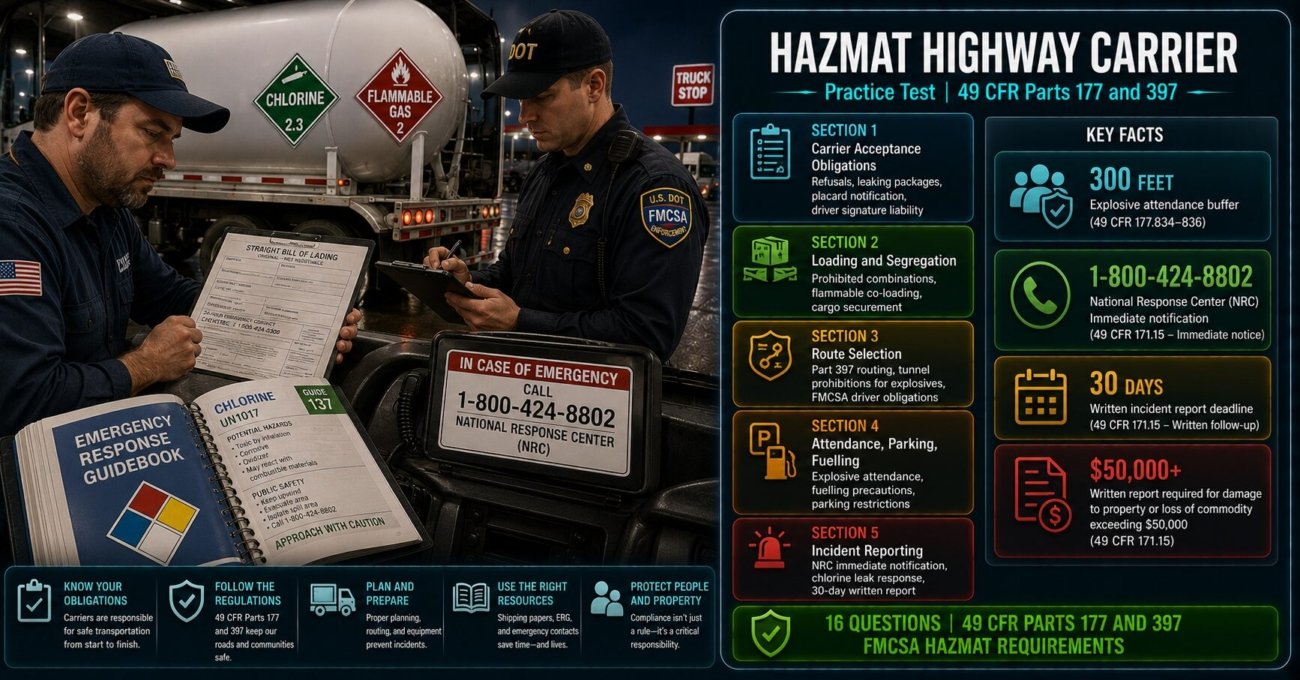
This practice test covers highway carrier requirements for hazardous materials transportation under 49 CFR Part 177 and related regulations. Questions address carrier acceptance obligations, vehicle inspection, loading and segregation, route selection, driver training and certification, attendance requirements, incident reporting, and parking and fuelling restrictions for HAZMAT loads. Each answer includes a detailed explanation referencing the applicable regulatory provision.
Section 1: Carrier Acceptance and Pre-Transport Obligations
Answer: A carrier must refuse to accept a HAZMAT shipment if the shipping papers are not in order, if the packaging is obviously defective or damaged, or if the vehicle or container cannot safely transport the material.
Explanation: 49 CFR 177.817 requires that a carrier not transport HAZMAT unless the shipping papers are in proper order, the packages are not leaking or otherwise defective in a manner that would make transport unsafe, and the vehicle is in condition to safely transport the material. This is a mandatory pre-acceptance inspection obligation. Carriers who accept shipments with defective packaging or incomplete shipping papers share responsibility for the non-compliance. The obligation to refuse is not discretionary when obvious deficiencies are present.
Answer: The driver must not depart. The leaking package must be removed from the vehicle, the area must be cleaned and decontaminated if necessary, and the shipment must not be transported until the defective package is repaired, repacked in compliant packaging, or removed from the shipment.
Explanation: Under 49 CFR 177.854, no person may transport a HAZMAT package that is leaking or that is damaged to the extent that it may leak during transport. If a leak is discovered after loading, the driver must stop before departing, remove the leaking package, and notify the carrier and shipper. If a leak develops during transit, the driver must take the vehicle to the nearest safe location, take reasonable steps to contain the spill, contact the carrier and shipper, and if a reportable quantity is released, contact the National Response Center at 1-800-424-8802.
Answer: Under 49 CFR 172.506, the shipper must provide the carrier with the information needed to placard the vehicle, including the hazard class, the quantity of HAZMAT, and the required placards or the information from which placards can be determined.
Explanation: The shipper’s notification obligation under 49 CFR 172.506 ensures that carriers know what placard requirements apply before the vehicle enters traffic. Shippers may fulfil this obligation by providing the carrier with the actual placards, by including the required information on the shipping papers, or by providing a written notification of the placard requirements. Carriers who receive a shipment without this notification and who are unable to determine the placarding requirements from the shipping papers should not accept the shipment until the information is provided.
Answer: No. The driver’s signature acknowledges receipt of the shipment and the accompanying papers. It does not transfer the shipper’s ongoing compliance obligations, including the requirement that the original packaging and documentation comply with the HMR at the time of tender.
Explanation: Under 49 CFR 171.2, both the offeror (shipper) and the carrier are subject to applicable HMR requirements for their respective functions. The carrier’s acceptance of a shipment does not extinguish the shipper’s liability for non-compliant packaging or documentation prepared by the shipper. In an enforcement action following a release, both the shipper and the carrier may face separate citations based on their respective regulatory obligations. The driver’s signature confirms chain of custody transfer, not a release of shipper liability.
Section 2: Loading, Segregation, and Vehicle Compatibility
Answer: Specific incompatible combinations are prohibited. Key examples include: Class 1 explosives (Divisions 1.1, 1.2, 1.3) may not be loaded with Class 2.3 toxic gases, Class 4.2 spontaneously combustible materials, or Class 5 oxidisers. Chlorine (Division 2.3, toxic gas) may not be loaded with ammonia (Division 2.2). Division 6.2 infectious substances may not be loaded with food or feed for humans or animals.
Explanation: 49 CFR 177.848 contains a compatibility table that specifies prohibited and conditionally permitted combinations of hazard classes in the same vehicle. The table is divided into categories, and combinations marked with an X in the intersection cell are absolutely prohibited. Combinations marked with an asterisk have conditions attached. Carriers must consult this table when loading mixed HAZMAT loads. The segregation requirements exist because certain combinations can react violently if packaging fails or if materials mix during a spill or accident.
Answer: It depends on the specific materials. Class 3 and Class 2.1 are not categorically prohibited from being co-loaded, but the segregation table must be checked for these specific materials. Many flammable liquid and flammable gas combinations are conditionally permitted with separation requirements.
Explanation: Under 49 CFR 177.848, the segregation table does not categorically prohibit loading Class 3 and Class 2.1 together, but specific separation or stowage requirements may apply. If the materials are not incompatible per the table, they may be co-loaded provided the vehicle is properly placarded for both classes and the weight and quantity limits are respected. Carriers should always consult the table for specific material combinations, not rely on general class-level compatibility assumptions.
Answer: Under 49 CFR 177.834, packages of HAZMAT must be loaded and secured to prevent movement during normal transportation conditions. Packages must not be stacked in a manner that could damage the packaging. Containers must be closed, and closures must be tightened before transport.
Explanation: 49 CFR 177.834(a) requires that packages be secured against movement during normal transportation by appropriate means. The specific method of securing (straps, load bars, friction mats, blocking and bracing) is not specified but must be adequate for the package weight and the expected transport conditions. Additionally, 49 CFR 177.834(b) requires that containers of liquids be stowed with closures up in the direction of closing. A drum of flammable liquid transported on its side with the bung down is non-compliant even if the bung is tight.
Section 3: Route Selection and Operational Requirements
Answer: Carriers of certain HAZMAT, particularly Divisions 1.1, 1.2, and 1.3 explosives and certain radioactive materials, must operate over routes designated or pre-approved by the applicable state or locality. Drivers must not deviate from the approved route except in an emergency or as directed by enforcement officials.
Explanation: 49 CFR Part 397 governs transportation of HAZMAT by motor vehicle and includes specific routing requirements. For Class 1 explosives (Divisions 1.1, 1.2, 1.3), the carrier must use routes approved or designated by the relevant state or local authority under 49 CFR 397.9. For spent nuclear fuel and radioactive waste, FMCSA’s Preferred HAZMAT Route designation system under 49 CFR 397.101 governs route selection. For other HAZMAT not subject to specific routing requirements, drivers should select routes that minimise risk, avoiding tunnels, bridges, and populated areas where alternatives exist and time permits.
Answer: The driver must not use the tunnel unless it has been specifically approved for Division 1.1 explosive transport. Division 1.1, 1.2, and 1.3 explosives are typically prohibited from road tunnels. The driver must use an approved alternative route even if it adds significant time and distance.
Explanation: Tunnels present catastrophic risk in the event of an explosion and are generally prohibited for Division 1.1, 1.2, and 1.3 explosives unless specifically approved by the tunnel authority and the relevant state. Under 49 CFR 397.9, drivers of vehicles transporting explosives must obtain a pre-trip routing approval and must carry written evidence of that approval in the vehicle. Deviating from the approved route, including taking a tunnel not approved for explosive transport, is a serious violation. If no tunnel-free route exists, the carrier should contact the relevant state HAZMAT routing authority for guidance before the trip begins.
Answer: Every driver transporting HAZMAT by motor vehicle is required to be familiar with, comply with, and ensure the motor vehicle is operated in compliance with all applicable FMCSA regulations, including the HMR provisions in 49 CFR Parts 100-185 as incorporated by reference.
Explanation: FMCSA regulations at 49 CFR Part 392 govern the operation of commercial motor vehicles and incorporate HAZMAT requirements by reference. A HAZMAT driver is simultaneously subject to the HMR (for hazardous materials handling, documentation, labelling, and placarding) and to FMCSA safety regulations (for vehicle operation, hours of service, driver qualification, and inspection). Non-compliance with either set of regulations during a HAZMAT shipment creates enforcement exposure under both regulatory frameworks. FMCSA-authorised inspectors at roadside inspection stations evaluate compliance with both.
Section 4: Attendance, Parking, and Fuelling Requirements
Answer: A vehicle transporting Division 1.1, 1.2, or 1.3 explosives must be attended at all times by its driver or a qualified representative of the motor carrier. The vehicle may not be left unattended on any public street or highway or within 300 feet of any bridge, tunnel, dwelling, or place where people work or congregate.
Explanation: 49 CFR 397.5 imposes continuous attendance requirements for explosive cargo because of the catastrophic consequences of an unattended explosive vehicle being involved in a fire, theft, or collision. A qualified attendant must be physically present in the vehicle or within 100 feet of the vehicle and must have an unobstructed view of the vehicle at all times. The attendant must understand the nature of the cargo and the proper emergency response actions. These requirements apply even during brief stops such as fuelling or document exchange.
Answer: Under 49 CFR 397.13, the engine must be turned off during fuelling. The driver must be in control of the fuel nozzle at all times. Smoking is absolutely prohibited in or near the vehicle during fuelling. The driver must not leave the vehicle unattended during fuelling.
Explanation: The fuelling requirements for HAZMAT vehicles reflect the elevated ignition risk when a flammable load is present. The engine-off requirement eliminates the vehicle’s ignition source. The requirement that the driver control the nozzle ensures that an ignition event or spill is detected and responded to immediately. Some carriers also require that the vehicle not be fuelled at stations with open-flame heating equipment near the pump area. These requirements apply to all HAZMAT loads, not only flammable ones, because most fuel delivery systems create flammable vapour at the nozzle.
Answer: Under 49 CFR 397.7, a vehicle transporting HAZMAT may not be parked within 300 feet of an open fire or on a public street or highway unless it is attended and is either making deliveries or is in a position where the driver must stop due to a vehicle or traffic emergency.
Explanation: 49 CFR 397.7 restricts HAZMAT vehicle parking to protect the public from the consequences of a release, fire, or theft in a populated area. The preferred parking locations are secured truck stops, motor carrier terminals, and safe havens designated by the carrier. When these are not reasonably available, the driver should park in a location that maximises distance from occupied buildings, fuelling areas, open flames, and concentrated public access. The carrier’s safety plan should specify approved parking locations or criteria along the driver’s regular routes, not leave this decision to driver discretion at the end of a rest cycle.
Section 5: Incident Reporting and Emergency Response
Answer: Immediate telephonic notification to the NRC (1-800-424-8802) is required when a HAZMAT incident results in: a person being killed; a person requiring hospitalisation; an evacuation of the general public; closure of a major transportation artery or facility; alteration of a flight plan or operation of an aircraft; radioactive contamination; or when a situation of such a nature, such as a continuing danger to life, is judged by the carrier to require immediate notification.
Explanation: 49 CFR 171.15 establishes the threshold for immediate NRC notification. The notification must be made as soon as practicable and must include the caller’s name and callback number, the name and address of the carrier, the date, time, and location of the incident, the extent of injuries, a description of the HAZMAT and quantity involved, the type of incident, and the name and UN number of the HAZMAT. This immediate notification obligation is separate from the written incident report requirement under 49 CFR 171.16, which must be filed within 30 days of a reportable incident.
Answer: The driver must stop immediately at the nearest safe location, move upwind of the vehicle, secure the area as best possible without approaching the vehicle, and contact the carrier and emergency services. The driver should use the shipping papers and ERG to provide first responders with chemical identification and response information. The National Response Center must be notified if the leak constitutes a reportable quantity release.
Explanation: Chlorine is a Division 2.3 toxic gas with an IDLH (immediately dangerous to life and health) concentration of 10 ppm. Even a small leak from a chlorine cylinder is a life-threatening emergency. The driver must not attempt to repair the leak or tighten the valve while the gas is releasing. The driver must move upwind immediately, at least 300 feet from the vehicle for a small spill as indicated in the ERG Guide 124 initial isolation distances. Contact with chlorine gas even briefly at elevated concentrations can be fatal. Emergency services should be notified immediately regardless of the current absence of bystanders, because the wind direction, concentration, and proximity to residential areas may change rapidly.
Answer: A written report on DOT Form F 5800.1 must be filed within 30 days of a HAZMAT incident that results in: a person being killed or injured and requiring medical attention beyond first aid; estimated carrier damage of $50,000 or more; an unintended fire, explosion, or discharge of radioactive material; or an event that requires immediate NRC notification under 49 CFR 171.15.
Explanation: The written report under 49 CFR 171.16 provides DOT with a permanent record of HAZMAT incidents for analysis, enforcement, and policy development. The report must be filed by the carrier, not the shipper, even if the incident resulted from a shipper’s non-compliant packaging. Carriers must retain a copy of each incident report for two years. Common reporting errors include late filing, incomplete information about the material quantity released, and failure to file a report for incidents that meet the threshold based on cost of damage or medical treatment provided. Failing to file a required written report is itself a citable violation separate from the underlying incident.
Knowledge Summary
Carriers must refuse HAZMAT shipments with defective packaging or incomplete shipping papers under 49 CFR 177.817.
Segregation requirements under 49 CFR 177.848 prohibit specific hazard class combinations and must be consulted for every mixed HAZMAT load.
Division 1.1, 1.2, and 1.3 explosive loads must be attended at all times and kept at least 300 feet from bridges, tunnels, dwellings, and public gathering places.
Fuelling a HAZMAT vehicle requires engine off, driver control of the nozzle, no smoking, and no unattended vehicle at the pump.
Immediate NRC notification (1-800-424-8802) is required when a HAZMAT incident results in death, hospitalisation, evacuation, or major transportation artery closure.
Written incident reports on DOT Form F 5800.1 must be filed within 30 days of a reportable incident, retained for two years.
Sources
- 49 CFR Part 177: Carriage by Public Highway
- 49 CFR Part 397: Transportation of Hazardous Materials; Driving and Parking Rules
- 49 CFR 171.15: Immediate Notice of Certain Hazardous Materials Incidents
- 49 CFR 171.16: Written Report of Hazardous Materials Incidents (DOT Form F 5800.1)
- PHMSA: Emergency Response Guidebook (ERG 2024)