


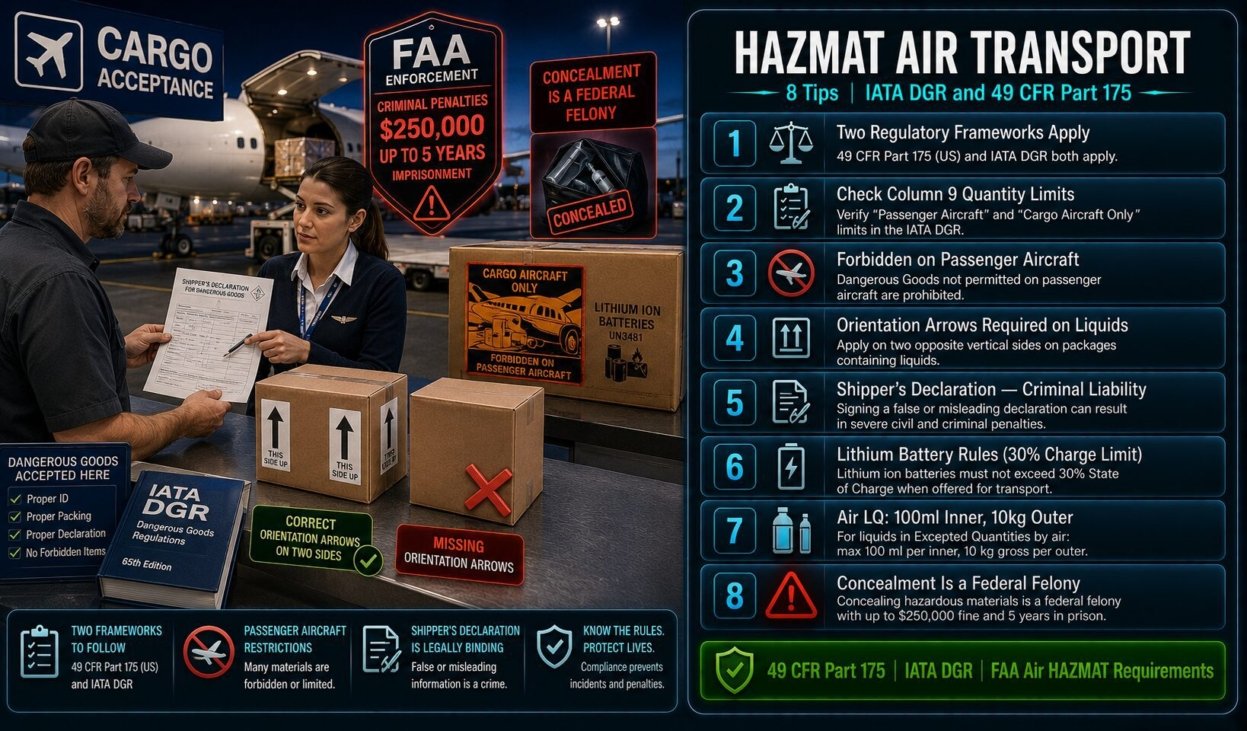
Air transport is the most restrictive mode for hazardous materials in the United States. The consequences of a HAZMAT incident at altitude are categorically different from a highway or maritime incident, and the regulations reflect that reality. Materials that can be shipped freely by road may be forbidden from aircraft altogether. Quantity limits that are routine in highway shipping drop by orders of magnitude for air. A packaging configuration compliant for ground transport may be entirely non-compliant for air.
Many HAZMAT compliance failures in air transport originate with shippers who prepare packages for air without understanding that the regulatory framework changes completely at the terminal. These tips address the most consequential compliance obligations for anyone tendering hazardous materials for air transport in the United States.
Tip 1: Understand That Two Regulatory Frameworks Apply Simultaneously
HAZMAT air transport in the United States is governed by two overlapping frameworks. The first is 49 CFR Part 175, which is DOT’s domestic air transport regulation and incorporates ICAO Technical Instructions by reference. The second is the IATA Dangerous Goods Regulations (DGR), which most airlines use as their operational standard and which may be stricter than the ICAO base requirements.
When shipping HAZMAT by air, the applicable requirements are the stricter of: 49 CFR Part 175 and the IATA DGR for the current edition year (updated annually). Shippers who prepare packages to road transport standards and then tender them for air are applying the wrong regulatory framework from the start. The IATA DGR is the working document for air HAZMAT compliance. Most airlines also publish their own variations, which can be more restrictive than the IATA DGR baseline.
Before preparing any shipment for air transport, confirm whether you are using the current edition of the IATA DGR. The DGR is updated annually on January 1. Quantity limits, packaging specifications, and forbidden material lists change between editions. Using a prior year’s edition for the current shipping year creates compliance exposure on every shipment prepared from it.
Tip 2: Check the Column 9 Quantity Limits Before Selecting Packaging
Column 9 of the Hazardous Materials Table at 49 CFR 172.101 contains two sub-columns: 9A (passenger aircraft or railcar) and 9B (cargo aircraft only). These specify the maximum quantity per package permitted for air transport. When a column shows Forbidden, no quantity of the material is permitted on that aircraft type regardless of packaging.
The quantity limits in Column 9 are dramatically lower than what the same material allows for ground transport. A material permitted in 55-gallon drums for highway transport may be limited to 1 litre per package on passenger aircraft. Shippers who do not check Column 9 before preparing air shipments routinely exceed quantity limits without realising it.
Create a reference list of the Column 9A and 9B limits for the top 10 materials your facility ships by air. Post it at the air freight preparation area. Before any package is prepared for air, the preparer checks the list. This simple control prevents the most common single cause of HAZMAT air compliance violations: packages prepared at ground transport quantities tendered for air.
Tip 3: Never Ship Forbidden Materials on Passenger Aircraft
Materials with a Forbidden designation in Column 9A of the HMT may not be transported on passenger aircraft under any circumstances. This prohibition applies to the shipper regardless of how the airline may categorise a flight. A shipper cannot consent to shipping a Forbidden material on passenger aircraft, and an airline cannot accept such a shipment even if it is properly packaged and documented.
Common materials that are Forbidden on passenger aircraft include: Packing Group I flammable liquids, Division 6.1 PG I toxic liquids, most Division 1 explosives, Division 2.3 toxic gases, and lithium batteries above certain watt-hour ratings. Some of these materials are permitted on cargo aircraft only (CAO shipments). Others are forbidden from all aircraft entirely and must use alternative transport modes.
When a shipper books a passenger aircraft shipment and later learns the flight was changed to a cargo aircraft, or vice versa, the HAZMAT documentation and packaging must be reviewed against the applicable quantity limits for the actual aircraft type before the shipment is tendered. A package prepared for cargo aircraft only (with Column 9B quantities) may not be tendered on a passenger aircraft where the Column 9A limit is lower or the material is Forbidden.
Tip 4: Use Only IATA-Compliant Packaging and Confirm Orientation Marks
Packaging for air transport must meet the performance standards of 49 CFR Part 178 and must be appropriate for the packing group and the maximum quantity permitted for the aircraft type. In addition, all liquid packages for air transport must display orientation arrows (arrows pointing upward) on at least two opposite vertical sides of the package under 49 CFR 172.312 and IATA DGR Section 6.
The orientation arrow requirement exists because aircraft cargo holds are not always level during loading and unloading. A package without orientation arrows may be placed in any orientation by ramp handlers. A liquid package placed on its side or upside down in a cargo hold creates an elevated leak risk due to pressure changes during ascent and descent.
Do: Apply two orientation arrows on opposite vertical sides of every liquid-containing package before tendering for air. Confirm the arrows are applied in the correct direction (pointing up toward the closure end of the package).
Avoid: Applying orientation arrows horizontally or omitting them because the package has a tight closure. The arrows are a regulatory requirement independent of the closure integrity.
Tip 5: Complete the Shipper's Declaration for Dangerous Goods Accurately
The Shipper’s Declaration for Dangerous Goods (the Air Waybill dangerous goods declaration) is the air transport equivalent of the shipping paper for ground transport. It must accompany every HAZMAT air shipment and must contain: the shipper and consignee information, the airport of departure and destination, the aircraft type (passenger or cargo), the proper shipping name and UN number, the hazard class and packing group, the number and type of packages, the net quantity per package, the total net quantity, the packing instructions reference, and the shipper’s signature and certification.
Under 49 CFR 175.30, an air carrier must not accept a HAZMAT shipment unless the Shipper’s Declaration is complete and accurate. An incomplete or inaccurate declaration is grounds for rejection of the shipment. More significantly, a false or fraudulent Shipper’s Declaration constitutes a federal criminal offence under 49 U.S.C. 46312, carrying penalties of up to 5 years imprisonment and fines up to $250,000 per violation.
Before signing any Shipper’s Declaration for Dangerous Goods, read the certification statement at the bottom of the form. It states that the information on the declaration is complete and accurate and that the contents are fully and accurately described. Signing without verifying all fields is not a documentation formality. It is a personal legal certification that carries individual criminal liability if the information is materially false.
Tip 6: Know the Lithium Battery Air Transport Rules Before Every Shipment
Lithium batteries in air transport have been subject to progressively more restrictive regulations following several high-profile cargo hold fires attributed to lithium battery thermal runaway. The current rules under 49 CFR 173.185 and IATA DGR Section 2 distinguish between lithium ion batteries (rechargeable), lithium metal batteries (non-rechargeable), batteries shipped alone, batteries shipped in equipment, and batteries shipped with equipment.
Key current restrictions for lithium battery air shipments include: batteries shipped as cargo must be at no more than 30% state of charge (for ion batteries); spare lithium batteries are prohibited in checked baggage; batteries above certain watt-hour ratings (for ion: over 300 Wh) are forbidden on passenger aircraft; large lithium ion batteries shipped as cargo are limited to cargo aircraft only; and all lithium battery air shipments must comply with UN 38.3 testing requirements documented in the manufacturer’s test summary.
If your facility ships products containing lithium batteries, maintain a reference card showing the battery type (ion or metal), watt-hour rating, and applicable IATA packing instruction (PI 965-970) for each product. Lithium battery rules are the most frequently updated area of air HAZMAT regulations. Verify your reference card against the current IATA DGR edition at the start of each calendar year.
Tip 7: Understand Excepted Quantity and Limited Quantity Provisions for Air
Both the excepted quantity (EQ) and limited quantity (LQ) provisions that apply in ground transport also have air transport equivalents, but with significantly lower quantity limits and different marking and documentation requirements. Not all materials that qualify for EQ or LQ exceptions on the ground qualify for air EQ or LQ.
For air limited quantities under IATA DGR Section 3.4, packages must bear the LQ mark (a diamond with Y) and may not exceed the air LQ inner packaging limit for the material, which is often 100 ml or 100 g per inner package. The outer package gross weight limit for air LQ is 10 kg. These limits are substantially lower than the ground LQ limits. Shippers who prepare LQ shipments for air using ground LQ limits are creating over-quantity violations on every package.
When shipping to international destinations by air, verify whether the destination country applies the ICAO Technical Instructions directly or has issued national variations. Some countries have more restrictive air LQ limits than the IATA DGR baseline. International air HAZMAT shipping requires country-specific variation checking before each new destination country is used, not only a one-time review at the start of a shipping programme.
Tip 8: Never Conceal or Misrepresent HAZMAT When Tendering for Air
The intentional concealment of HAZMAT in air shipments is a federal felony under 49 U.S.C. 46312 and is prosecuted by the FAA and DOJ. It is also one of the leading causes of serious air cargo fires. Fires in undeclared HAZMAT shipments are categorically more dangerous than fires in properly declared HAZMAT shipments because the crew and emergency responders have no information about what is burning or how to suppress it.
Concealment does not require intent to cause harm. It occurs whenever a person knowingly offers a package containing HAZMAT for air transport without declaring it, regardless of the reason. Common concealment situations include: shipping lithium batteries in undeclared equipment, shipping aerosols without declaring the propellant as a flammable gas, shipping paint or solvents as non-hazardous, and shipping medical samples without proper infectious substance documentation. Each of these situations is a federal felony, not a civil violation, when the concealment is knowing.
Do: When uncertain whether a product contains a HAZMAT component, check the SDS, the product label, and the IATA DGR material classification before tendering. If the product contains any component classified as a dangerous good, it must be declared.
Avoid: Relying on the fact that a product has been shipped undeclared before without interception. Prior non-detection is not evidence of compliance. It is evidence that the violation has not yet been discovered. The consequences when it is discovered, particularly following an in-flight incident, include criminal prosecution and permanent loss of air shipper status.
