
On July 6, 2013, a 74-car train carrying crude oil derailed in Lac-Megantic, Quebec. Forty-seven people were killed. The subsequent investigation found multiple contributing factors including a lone operator, insufficient handbrakes, and tank car specifications that failed catastrophically in the derailment. The disaster prompted sweeping regulatory changes to HAZMAT rail transport on both sides of the US-Canada border.
Rail is the dominant mode for bulk HAZMAT in the United States. Approximately 1.7 million carloads of hazardous materials move by rail every year, including crude oil, liquefied petroleum gas, chlorine, anhydrous ammonia, and many other materials whose release in sufficient quantity would be catastrophic. The workers who handle, inspect, and operate rail equipment carrying HAZMAT are the last line of defence between a routine shipment and a community-scale incident.
This guide covers what every railroad worker involved in HAZMAT rail operations needs to understand about their obligations, their rights, and the specific hazards that make rail HAZMAT work categorically different from other HAZMAT transport modes.
HAZMAT rail incidents disproportionately affect communities near rail lines rather than railroad workers directly. A tank car release of chlorine or anhydrous ammonia in a populated area can require evacuation of thousands of residents within hours. Railroad workers who understand the materials they are handling, the reporting obligations that apply when something goes wrong, and the emergency procedures that govern initial response are protecting not only themselves but entire communities along the route.
The Regulatory Framework for HAZMAT Rail Transport
HAZMAT rail transport in the United States is governed by three overlapping regulatory bodies:
Department of Transportation (DOT) / PHMSA: The Pipeline and Hazardous Materials Safety Administration administers the Hazardous Materials Regulations at 49 CFR Parts 100-185. For rail specifically, 49 CFR Part 174 governs carriage by rail, covering acceptance requirements, loading and unloading, car placement, and blocking and bracing of HAZMAT cars.
Federal Railroad Administration (FRA): FRA enforces railroad safety regulations including track safety standards, hours of service, locomotive inspection, and rail worker safety. FRA and PHMSA jointly enforce HAZMAT rail requirements. FRA safety regulations are found in 49 CFR Parts 200-299.
Association of American Railroads (AAR): AAR’s Circular OT-55 governs the handling of hazardous materials on interchange railroads. While AAR is a private industry organisation, Circular OT-55 is incorporated by reference in many rail contracts and is treated as an operational standard by Class I railroads operating in the US interchange network.
For workers, the practical implication is that a single HAZMAT rail car may be subject to DOT packaging and marking requirements (applied by the shipper), FRA track and equipment safety standards (maintained by the railroad), and AAR operating procedures (followed by crews and yard workers).
Rail HAZMAT Hazard 1: Tank Car Identification and Inspection
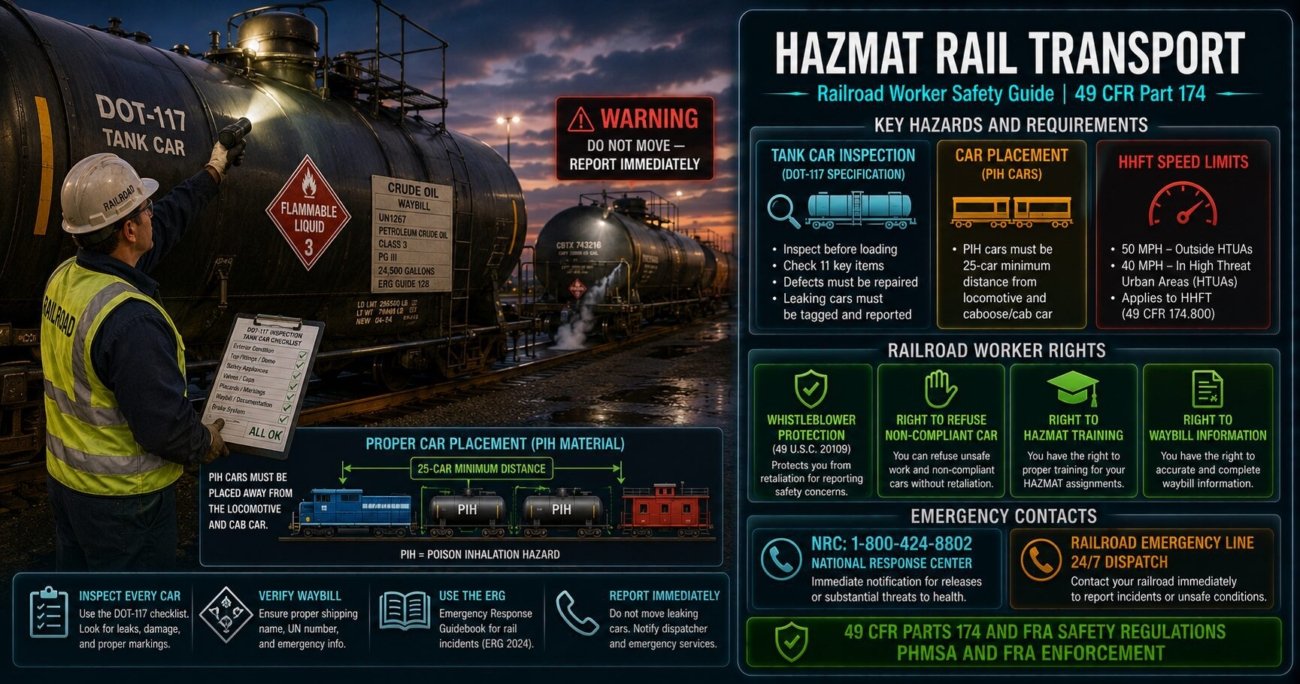
Every DOT-specification tank car used for HAZMAT transport bears a specification marking that identifies its design type, testing pressure, and material classification. The specification marking appears on the car’s side near the top dome area and includes codes such as DOT-111, DOT-117, DOT-112, and DOT-114. These codes are not interchangeable. A DOT-111 tank car, which was the standard for crude oil transport prior to 2015, has significantly lower puncture resistance than a DOT-117, which was required under post-Lac-Megantic regulatory changes for high-hazard flammable train (HHFT) service.
Railroad workers who accept, inspect, or move tank cars carrying HAZMAT must be able to:
- Read and understand the specification marking on a tank car and confirm it is authorised for the material being shipped
- Inspect the car for visible defects including cracks, dents, leaks at fittings or valves, damaged protective housings, and missing or damaged safety relief devices
- Identify the placards on the car and confirm they match the car’s contents as reflected in the waybill
- Recognise when a car should be set out for inspection rather than moved forward in service
Under 49 CFR 174.9, a railroad must not accept a HAZMAT car that is visibly leaking or that has obvious defects in its packaging, fittings, or closures. This pre-acceptance obligation applies to yard workers and train crews who are the first to physically encounter arriving cars.
If you observe a tank car that is leaking, has frost or ice formation indicating a cryogenic or liquefied gas release, has an unusual odour around the dome area or fittings, or has visible damage to the tank shell or fittings, do not move the car. Set it out, report it immediately, and stay upwind. A leak from a tank car carrying chlorine, anhydrous ammonia, or a flammable gas is immediately life-threatening. The correct action is to create distance and report, not to investigate the source of the leak.
Rail HAZMAT Hazard 2: Blocking, Bracing, and Car Placement
The placement of HAZMAT cars within a train consist is regulated under 49 CFR 174.85 to minimise the consequences of a derailment. Key placement requirements include:
- Tank cars containing poison gas (Division 2.3) or poison inhalation hazard (PIH) materials must not be placed within 25 car lengths of a locomotive or occupied caboose
- Certain explosive cars must be placed at specific distances from locomotives, other car types, and from each other
- Cars containing incompatible materials that cannot be in the same vehicle must not be placed adjacent to each other in the train consist
Blocking and bracing requirements under 49 CFR 174.83 govern how HAZMAT packages within boxcars and enclosed cars must be secured to prevent shifting during transit. A package that shifts during an emergency brake application or while traversing curved track can damage other packages, create incompatible material contact, or damage the car itself.
Yard workers who build train consists are responsible for verifying car placement requirements from the switch list and waybill information before the train departs. A consist built in violation of placement requirements creates a violation even if the train never experiences an incident.
Inbound waybills for HAZMAT cars must be checked against placement requirements before the car is built into the outbound consist. When a switch list or computer-generated consist does not reflect the regulatory placement requirements for the HAZMAT cars in the train, the conductor and yardmaster must correct the consist before departure. A consist that meets the train length and weight requirements but violates car placement requirements is not compliant for departure.
Rail HAZMAT Hazard 3: High-Hazard Flammable Train Requirements
Following the Lac-Megantic disaster and several subsequent US crude oil train derailments, DOT and FRA established enhanced requirements for High-Hazard Flammable Trains (HHFTs) under 49 CFR 174.310. An HHFT is defined as a train carrying 20 or more loaded tank cars of a Class 3 flammable liquid in a continuous block, or 35 or more loaded tank cars of a Class 3 flammable liquid distributed throughout the train.
HHFT requirements include:
- Tank car upgrade requirements: most HHFT service requires DOT-117 or equivalent enhanced puncture-resistant tank cars
- Speed restrictions: HHFTs are subject to 50 mph maximum speed limits in all areas, and 40 mph in high-threat urban areas (HTUAs)
- Route analysis requirements: railroads operating HHFTs must conduct annual route risk analyses and select the route that presents the least overall safety and security risk
- Train crew size requirements: HHFTs must be operated by at least two crew members
- Advanced notification: railroads must provide advance notification to state emergency response commissions (SERCs) for states through which HHFT routes pass
Workers on HHFT service must understand the speed restrictions that apply to their specific route and the enhanced emergency response procedures that govern response to an HHFT derailment or release.
Emergency Response Obligations for Rail HAZMAT Workers
Under 49 CFR 174.204 and FRA emergency response regulations, railroad employees who first arrive at the scene of a HAZMAT rail incident have specific initial response obligations:
- Protect the scene: establish an initial isolation perimeter based on the ERG guide for the material involved. Do not enter the hazard zone without appropriate PPE and training.
- Identify the material: use the car’s placard, the waybill or consist sheet carried by the conductor, and the ERG to identify the hazardous material and the appropriate response guide
- Notify the railroad’s emergency line immediately: every Class I railroad maintains a 24-hour emergency line that activates the railroad’s emergency response organisation and initiates notification to CHEMTREC, state emergency management, and local emergency services
- Notify the NRC if a reportable quantity is released: under 49 CFR 171.15, the carrier must notify the National Response Center (1-800-424-8802) immediately when a HAZMAT rail incident results in death, injury requiring hospitalisation, evacuation, or a major transportation artery closure
Railroad workers are not expected to handle a HAZMAT release themselves. Their role is to identify the material, establish isolation, notify the appropriate emergency contacts, and provide information to arriving emergency responders. The information they provide in the first minutes of an incident, specifically the car’s placard class, UN number, and quantity from the waybill, directly determines how emergency responders approach the scene.
At the start of every shift involving HAZMAT car handling, locate the Emergency Response Guidebook in your locomotive cab or yard office and verify the NRC number (1-800-424-8802) and your railroad’s emergency reporting number are posted and accessible. These two numbers, plus the waybill information for the HAZMAT cars in your consist, are what turn a first response observation into an actionable emergency notification in the first 90 seconds of an incident.
Rail HAZMAT Worker Rights and Protections
Railroad workers have specific legal protections relevant to HAZMAT safety obligations:
- FRA whistleblower protections under 49 U.S.C. 20109: Railroad workers who report HAZMAT safety violations, refuse to violate safety regulations, or participate in FRA investigations are protected from retaliation. Retaliatory actions including termination, demotion, suspension, or threats following a safety report are unlawful and may be reported to OSHA for investigation.
- Right to refuse to move a non-compliant car: A worker who has reasonable grounds to believe that a HAZMAT car is leaking, improperly placarded, or otherwise non-compliant with 49 CFR Part 174 requirements has the right to refuse to move that car. This right is protected under the general duty clause principles applicable to HAZMAT workers and under FRA safety regulations.
- Right to HAZMAT training: Under 49 CFR 172.704, all HAZMAT employees, including railroad workers whose job functions involve accepting, handling, or transporting HAZMAT, must receive initial and recurrent HAZMAT training. Employers must provide this training before workers perform HAZMAT functions. Workers who have not received training should not be assigned HAZMAT functions.
- Right to emergency information: Workers have the right to access the waybill information for HAZMAT cars in their consist, including the material name, UN number, and quantity. This information is required for emergency notification and must be accessible to the train crew during transport.
Rail HAZMAT Worker Safety Checklist
✓ The ERG and railroad emergency reporting number are accessible in the cab or yard office
✓ Waybill information for all HAZMAT cars in the consist is reviewed and accessible
✓ Tank car placards match the waybill commodity information for all HAZMAT cars
✓ No visible leaks, frost, unusual odours, or physical damage observed on HAZMAT cars
✓ Car placement requirements for PIH, explosive, and incompatible materials are verified in the consist
✓ HHFT speed restrictions are known for the route if the train qualifies as an HHFT
✓ I know my railroad’s 24-hour emergency reporting number by memory
✓ I know the NRC number (1-800-424-8802) and when to use it
✓ My HAZMAT training is current (initial and recurrent per 49 CFR 172.704)
✓ I know my right to refuse to move a non-compliant or leaking HAZMAT car