SITUATIONAL: HIPAA for Pharmaceutical Sales
HIPAA and Privacy Guidelines for Pharmaceutical Sales Representatives
Pharmaceutical sales representatives operate in clinical environments daily. They attend patient rounds, observe consultations, review prescription data, and receive sample request forms containing prescriber and patient information. Most understand that patient privacy matters. Fewer understand exactly where their HIPAA obligations begin, what constitutes a violation in their specific context, and what happens when something goes wrong. This article examines a scenario that illustrates those gaps.
Note on This Scenario
The scenario below is illustrative, constructed from documented patterns in HHS Office for Civil Rights enforcement records, published HIPAA guidance for pharmaceutical industry representatives, and reported incidents involving PHI exposure in clinical sales contexts. It does not describe a single named individual or enforcement action. All regulatory requirements cited are factual.
18
PHI Identifiers Under HIPAA
HIPAA defines 18 specific categories of individually identifiable health information. Patient name linked to a diagnosis, prescription records tied to a specific individual, and date of birth combined with medical condition all qualify. A pharma rep who records or shares any of these without authorisation has disclosed PHI regardless of intent.
BAA
Business Associate Agreement
Pharmaceutical companies that receive, maintain, or transmit PHI on behalf of covered entities are Business Associates under HIPAA. Representatives operating under a BAA carry HIPAA obligations in the field. If your company has a BAA with a healthcare system, your conduct in that system’s facilities is governed by that agreement.
60d
Breach Notification Window
HIPAA’s Breach Notification Rule requires covered entities to notify affected individuals within 60 days of discovering a breach. Business associates must notify the covered entity without unreasonable delay. A pharma rep who delays reporting an inadvertent PHI disclosure starts the clock running from the moment of discovery.
Situation Overview
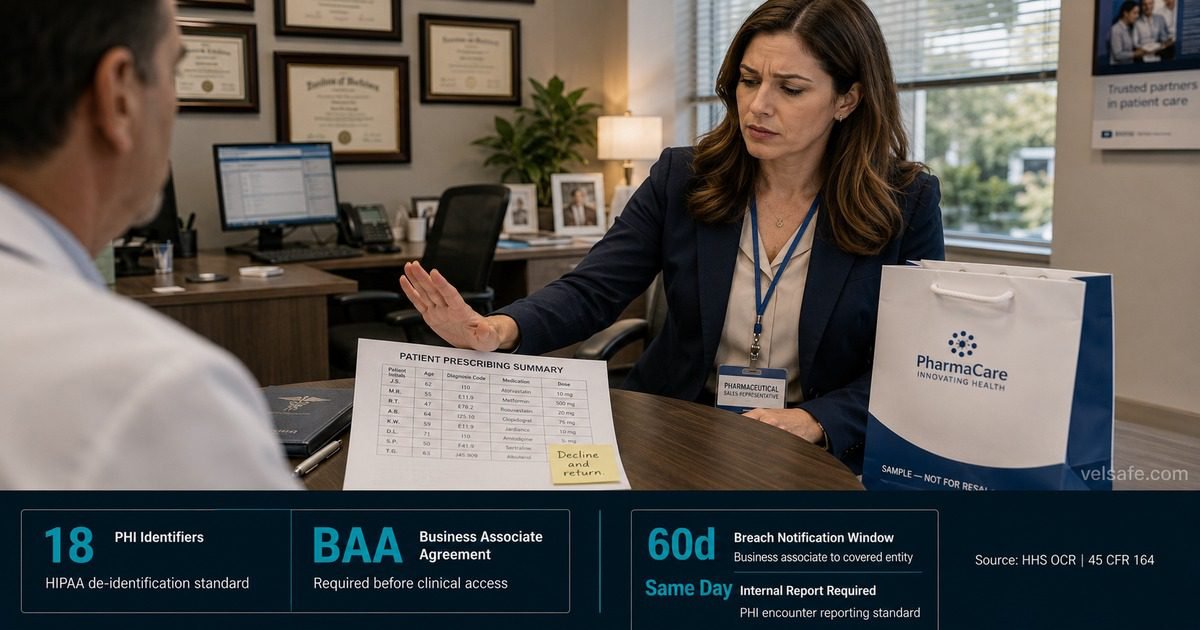
A pharmaceutical sales representative covers a territory that includes a large regional medical centre and several affiliated outpatient clinics. Over the course of a Monday morning, she meets with three physicians in their offices, leaves sample packets at the nurses’ station for two additional physicians, and attends a brief department meeting where a specialist discusses a new prescribing pattern emerging in their patient population for a drug in her portfolio. At the end of the meeting, the specialist hands her a printed list to help her understand the prescribing context. The list contains patient initials, diagnosis codes, and the drug being prescribed for each patient.
She photographs the list with her phone to review later. That evening, she emails a summary of the day’s prescriber conversations to her district manager, attaching a photo of the list as context for a note about the specialist’s feedback on the drug. The district manager, uncertain about the attachment, forwards it to the regional compliance officer. By the following morning, the compliance officer has identified the photograph as a PHI disclosure and opened an internal investigation.
What Occurred
A physician provided a printed patient list containing initials, diagnosis codes, and prescribing information. The representative photographed it, then attached the photograph to an internal email. The attachment was sent to a district manager and subsequently forwarded to the regional compliance officer. Patient information was transmitted outside the covered entity without authorisation.
Why It Was a HIPAA Issue
Patient initials combined with diagnosis codes and a specific drug linked to each patient meet HIPAA’s definition of PHI. The representative was not authorised to receive, retain, or transmit this information. The physician handing over the list did not constitute a valid authorisation. Photographing and emailing it created an unauthorised disclosure that triggered breach notification obligations.
Workplace Background
Pharmaceutical sales representatives occupy an unusual position under HIPAA. They are not healthcare providers. They do not generally have treatment relationships with patients. But they operate daily in environments where PHI is present, where clinical staff discuss patient-specific information openly, and where the boundaries between useful prescriber context and protected patient information are not always obvious in real time.
The representative in this scenario was not trying to misuse patient data. She was trying to give her manager useful context for a positive feedback story about a drug in her portfolio. The specialist who provided the list was trying to be helpful. Neither person made a deliberate decision to violate privacy. What they both lacked was a clear operational understanding of where the line falls between aggregate prescribing data and individually identifiable patient information.
Aggregate, de-identified prescribing information is available to pharmaceutical companies through commercial data vendors under agreements that do not involve HIPAA. Individual patient information, even in abbreviated form, is different. The presence of patient initials or a patient identifier alongside a diagnosis and a drug name creates a combination that is individually identifiable, and therefore PHI, even if the record does not contain a full name. This distinction is not intuitive, and most pharmaceutical sales training programs do not cover it with sufficient specificity for representatives to apply it in real field situations.
Incident Timeline
Monday, 9:15 AM
Representative arrives at the medical centre for scheduled physician meetings. She meets with two prescribers in their offices, has a brief hallway conversation with a third, and leaves samples at the nurses’ station for two physicians who are unavailable. The visits are routine and fully compliant.
Monday, 11:30 AM
The representative attends a brief informal department meeting at the specialist’s invitation. The specialist discusses prescribing trends and mentions the drug in her portfolio favourably. At the end of the meeting, the specialist hands her a printed one-page list, explaining it shows which patients are currently on the drug and how it is performing. The representative accepts it without identifying it as PHI.
Monday, 11:45 AM
Before leaving the meeting room, the representative photographs the list with her work phone. She places the printed list in her bag. She does not return it to the specialist or raise any concern about its content.
Monday, 7:30 PM
The representative emails her daily call notes to her district manager. The email includes a paragraph about the specialist’s positive feedback and attaches the photograph of the patient list as supporting context. She does not identify the attachment as containing patient information and does not flag any compliance concern.
Tuesday, 8:15 AM
The district manager reviews the email and attachment. Uncertain whether the photograph is appropriate to have, he forwards it to the regional compliance officer with a note asking for clarification. The compliance officer immediately recognises the content as PHI: patient initials, diagnosis codes, and drug assignments for identifiable clinic patients. She opens an internal privacy incident investigation and places a litigation hold on the email chain.
Days 2 through 14
The company’s compliance team contacts the medical centre’s privacy officer. The breach risk assessment determines that the disclosure was an impermissible disclosure of PHI. The affected patients cannot be individually identified from initials alone with certainty, which affects the notification determination. Legal and compliance teams work through the notification analysis. The representative and district manager are interviewed. The printed list is retrieved from the representative’s possession and destroyed under documented chain of custody.
What Went Wrong
Representative did not recognise abbreviated patient data as PHI
The list used patient initials rather than full names. In the representative’s understanding, this made it non-identifiable. Under HIPAA, patient initials combined with a diagnosis code and a specific drug create a combination that can identify an individual in a clinical context where other identifying factors are present. Training that covers only obvious identifiers like full names leaves representatives unable to apply the rule in the field situations where it actually matters.
Physician’s offer of the list was treated as authorisation
The specialist handed the list to the representative without any discussion of authorisation or consent. The representative accepted it as a legitimate gesture from a cooperative physician. Under HIPAA, the covered entity’s physician does not have the authority to unilaterally authorise the disclosure of patient information to a pharmaceutical company representative for sales support purposes. The physician’s good intentions did not create a valid HIPAA authorisation.
Photographing and emailing compounded the initial exposure
Receiving the printed list was already a compliance issue. Photographing it and attaching it to an email created a digital record of the disclosure that was transmitted outside the facility’s systems. The email now existed on the company’s servers, on the district manager’s device, and potentially in backup archives. Each transmission and storage location is a separate point of exposure. What began as a single inadvertent acceptance of a document became a documented chain of disclosure.
No real-time decision framework for field PHI encounters
The representative had completed annual HIPAA training. The training covered what PHI is and why it is protected. It did not give her a decision framework for in-the-moment situations, such as what to do when a physician offers you a document that might contain patient information. In the absence of a clear protocol, she defaulted to accepting the gesture and dealing with questions later. By then, the exposure had already occurred.
Investigation Findings
Finding
HIPAA Issue
Severity
Accepted printed patient list from physician
Impermissible receipt of PHI without valid authorisation (45 CFR 164.502)
Serious
Photographed the list
Creation of unauthorised digital copy of PHI on company device
Serious
Emailed photograph to district manager
Unauthorised PHI disclosure via email outside covered entity’s system (45 CFR 164.502)
Serious
Retained printed list overnight
Continued possession of unauthorised PHI beyond the initial encounter
Moderate
Root Cause Analysis
Contributing Factors
Training did not cover abbreviated identifiers as PHI
Primary
Annual HIPAA training covered the 18 identifiers at a conceptual level but did not provide pharmaceutical-specific scenarios showing how abbreviated data combinations qualify as PHI. The representative’s inability to classify the list correctly in real time was a direct training gap.
No in-the-moment decision protocol for offered documents
Primary
The representative had no field-ready protocol for what to do when a physician offers a document that may contain patient information. A clear rule, such as “if a document contains patient data in any form, decline politely and explain you cannot accept it,” would have stopped the chain of events at the first step.
Photography policy not specific to clinical settings
Contributing
Company policy addressed photography in clinical areas at a general level but did not specifically prohibit photographing documents received from clinical staff. The representative did not interpret the general policy as applying to a document a physician had voluntarily provided.
No immediate reporting mechanism the representative felt comfortable using
Contributing
Had the representative recognised the list as potentially problematic and known she could report it immediately to compliance without professional consequences, the disclosure chain would have stopped at the point of receipt rather than extending through photography, email, and overnight retention.
Corrective Actions
1
Scenario-based HIPAA training for field representatives
Replace or supplement the existing annual HIPAA module with scenario-based training specific to pharmaceutical sales situations: physicians offering prescribing data, patient-specific information in waiting room areas, sample request forms with patient identifiers, and overheard clinical conversations. Each scenario should include a decision tree: what to do, what to say, and how to report.
2
Explicit field rule: decline any document containing patient data
Establish and train on a single clear field rule: if a physician, nurse, or clinical staff member offers any document that contains information about specific patients, in any format and at any level of abbreviation, decline politely and explain that company policy does not permit accepting patient-level information. Provide a scripted response so representatives are not improvising in an awkward moment with a physician.
3
Update photography policy with explicit document rule
Revise the clinical photography policy to explicitly prohibit photographing any document, form, screen, whiteboard, or other surface that contains patient information, regardless of who provided the document or in what context. Make the rule absolute: if it has patient data on it, it cannot be photographed. No exceptions for documents voluntarily provided by clinical staff.
4
Create a same-day reporting path with confirmed non-retaliation
Establish a direct, low-friction reporting channel for representatives to report inadvertent PHI encounters the same day they occur. Communicate explicitly and repeatedly that good-faith reports do not generate disciplinary consequences. The value of same-day reporting, which allows the company to limit the scope of the disclosure and begin the breach assessment immediately, is lost if representatives are uncertain whether reporting will harm their standing.
Lessons Learned
The physician’s authority to share information depends on the purpose and the recipient, not the gesture
Clinical staff operate under a different set of HIPAA obligations than pharmaceutical representatives. A physician can share patient information with another treating provider for treatment purposes. That same physician cannot authorise the disclosure of patient information to a pharmaceutical representative for sales support purposes. The source does not determine whether accepting is permissible. The relationship between the parties and the purpose of the disclosure determine that.
What “de-identified” actually requires under HIPAA
HIPAA’s de-identification standard requires removing all 18 identifier categories and having no reasonable basis to believe the remaining information could identify an individual. Patient initials combined with a diagnosis and a drug in a small clinic population do not meet that standard. The combination is identifiable in context even without a full name.
Training programs that teach representatives to identify PHI by looking for full names and dates of birth leave representatives unprepared for the abbreviated formats they actually encounter in the field. A list of initials and diagnosis codes from a physician feels informal and non-specific. Legally it is neither.
How One Decision Became Four Separate Exposure Events
Step
What Happened
What Should Have Happened
1
Accepted the printed patient list from the physician
Declined the document, explained company policy, returned it immediately
2
Photographed the list with work phone before leaving the room
If uncertain, reported to compliance that day rather than creating a digital copy
3
Emailed the photograph to district manager as an attachment
Compliance team would have contained the disclosure before transmission
4
Retained printed list overnight in her bag
Document returned to physician or destroyed under documented procedure
Prevention Checklist
Before the Visit
Confirm BAA status with compliance team before visiting any new healthcare facility
Review facility-specific access and documentation policies
Know the scripted decline response for offered patient documents
Have the same-day compliance reporting contact saved in your phone
During the Visit
Do not accept any document containing patient-level information in any format
Do not photograph documents, screens, or surfaces with patient information
Do not discuss specific patient cases with anyone outside the clinical team
If uncertain whether data is PHI, treat it as PHI and report
If PHI Is Encountered
Do not photograph, copy, forward, or retain the information
Return any physical document to the clinical staff immediately
Report to compliance officer the same day with a factual account
Do not notify the facility yourself without compliance team guidance
Key Takeaways
The field is where HIPAA actually gets tested
Annual compliance modules teach the law. They do not teach representatives what to do in the three seconds after a physician hands them a document and expects them to take it. Pharmaceutical-specific scenario training that rehearses the exact situations representatives encounter, including the social awkwardness of declining a helpful physician’s offer, is what produces compliant behaviour in the field rather than in the training room.
Same-day reporting is the control that limits breach scope
In this scenario, the district manager’s decision to forward the email to compliance rather than simply delete it was the action that started the formal process. Had the representative reported the receipt of the list immediately when she first recognised uncertainty about it, the scope would have been significantly smaller. Creating a reporting culture where good-faith reports are rewarded rather than penalised is the organisational condition that makes same-day reporting happen consistently.
Frequently Asked Questions
Is a pharmaceutical sales representative ever permitted to receive patient-level information from a physician?
Generally no. Narrow exceptions exist for formal research or pharmacovigilance activities conducted under specific written agreements. For routine sales activities, no HIPAA mechanism permits a physician to share individual patient information with a pharmaceutical representative without a valid patient-signed authorisation. Aggregate de-identified data is available through commercial data vendors and does not require authorisation.
What is the difference between aggregate prescribing data and PHI in this context?
Aggregate prescribing data that has been de-identified by removing all 18 HIPAA identifier categories is not PHI and is available through commercial data vendors. Individual prescribing records that identify specific patients, even through abbreviations, in combination with diagnosis and drug information, are PHI if any reasonable combination of the data could identify an individual. A list of patients at a small specialist clinic identified by initials, diagnosis code, and drug assignment does not meet the de-identification standard.
Does it matter that the physician voluntarily provided the information?
No. The physician’s willingness to share does not constitute a valid HIPAA authorisation under 45 CFR 164.508, which requires a written, signed document meeting specific content requirements. A physician handing a document to a representative is not a valid authorisation regardless of intent. It may also create a compliance exposure for the covered entity, which is why medical centre privacy officers treat these incidents seriously when they are reported.
What should a representative do if they are already holding PHI they should not have?
Return any physical document to clinical staff immediately without retaining a copy. If a digital copy exists, do not transmit it. Report to the compliance officer the same day with a factual account of what was received, when, from whom, and what steps were taken. Do not attempt to notify the facility directly — that notification, if required, follows a formal process managed by the compliance team. The representative’s role is to stop the disclosure from extending and provide an accurate account for the breach risk assessment.
Does photographing a patient list with a personal phone constitute a HIPAA breach?
Yes, in most circumstances. Capturing PHI on a personal device that is not covered by a Business Associate Agreement creates an impermissible disclosure. The photograph transfers PHI outside the covered entity’s control onto a device that the company’s HIPAA safeguards do not reach. The fact that the photo was not shared further does not eliminate the breach — the impermissible access occurred at the moment of capture. The representative must report it and delete the image under compliance guidance.
What is a Business Associate Agreement and when does a pharmaceutical company need one?
A Business Associate Agreement (BAA) is a contract required under HIPAA when a covered entity shares PHI with a vendor or third party that performs services on its behalf. A pharmaceutical company that receives PHI from a health system, even inadvertently, may become a business associate and trigger BAA requirements. Companies that conduct clinical trials, provide patient support programmes, or manage specialty pharmacy relationships frequently need BAAs in place before any data sharing begins.
How long does a company have to report a HIPAA breach after it is discovered?
Under the HIPAA Breach Notification Rule, covered entities must notify affected individuals without unreasonable delay and no later than 60 days after discovering the breach. If the breach affects 500 or more residents of a state, the covered entity must also notify the Secretary of HHS and prominent media outlets in that state within 60 days. Business associates must notify the covered entity within 60 days of discovering the breach so the covered entity can meet its own notification obligations.
Sources
- HHS: HIPAA Privacy Rule
- HHS: HIPAA Breach Notification Rule
- HHS: HIPAA De-identification Guidance
- HHS: Business Associate Agreement Guidance
Related VelSafe Articles
Worker Safety
HIPAA Privacy for Medical Device Sales Representatives
How HIPAA applies to medical device reps operating in clinical settings and what PHI exposure looks like in practice.
Tips
HIPAA: The Impact on Clinical Research
Key HIPAA rules that govern how clinical research interacts with patient data, consent, and authorisation requirements.
Law
What Makes a Code of Conduct Legally Enforceable?
The legal elements that distinguish an enforceable code of conduct from a document that provides no real compliance protection.
HIPAA COMPLIANCE
Know the Line Before You Cross It
Pharmaceutical-specific HIPAA training that gives sales representatives the field-ready protocols they need. Find more compliance resources at VelSafe.
Explore More Situational Guides