

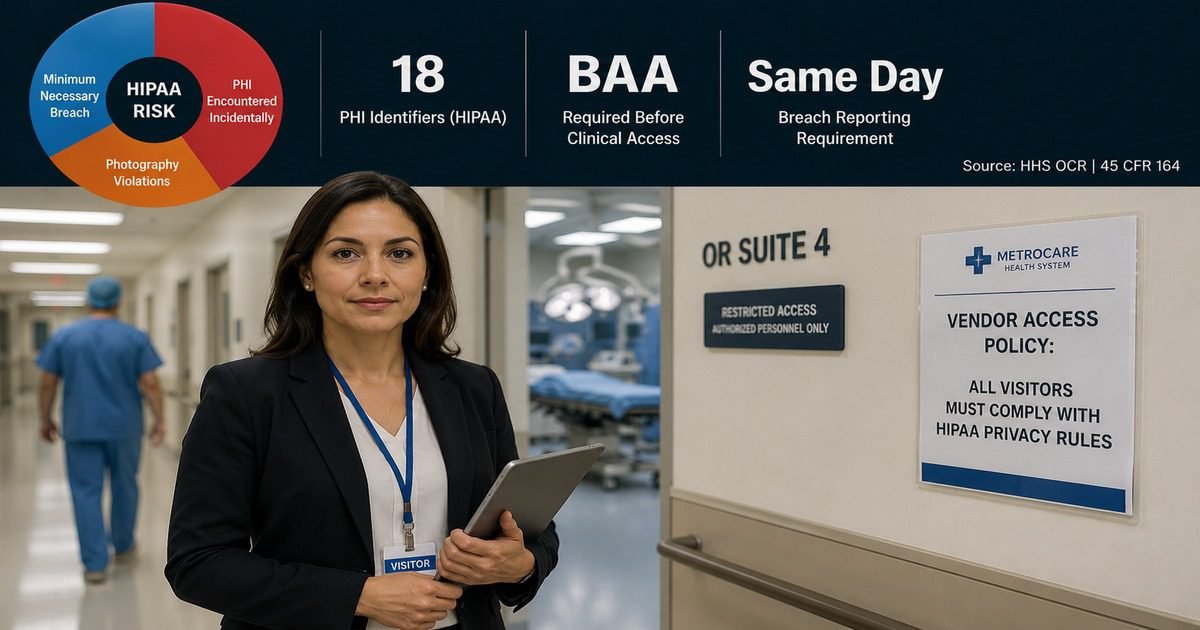
WORKER SAFETY: HIPAA for Medical Device Sales
HIPAA and Privacy Guidelines for Medical Device Sales Representatives
Medical device sales representatives regularly operate in clinical environments where they encounter patient health information, observe procedures, and interact with clinical staff managing PHI. Understanding what HIPAA requires, what is prohibited, and how to protect patient privacy is not optional for anyone working in these settings. This guide covers the rules, the risks, and what to do in practice.
WHY THIS MATTERS: HIPAA Applies to You Even When You Are Not the Provider
Business Associate obligations
If your company has a Business Associate Agreement (BAA) with a covered entity, your actions in that facility carry HIPAA obligations. Violations by sales representatives have resulted in enforcement actions against both the rep’s employer and the covered entity that allowed access.
PHI exposure is often unintentional
In a busy OR, cath lab, or procedure room, patient information appears on monitors, whiteboards, charts, and conversations. A sales rep does not need to actively seek PHI to encounter it. Knowing what to do when it happens is the relevant training, not just knowing what to avoid.
Penalties fall on individuals too
HHS Office for Civil Rights can impose civil penalties on covered entities and their business associates. Criminal penalties under 42 U.S.C. 1320d-6 apply to individuals who knowingly obtain or disclose PHI without authorisation, with fines up to $250,000 and imprisonment up to 10 years for aggravated offences.
$1.93M
Average HIPAA Breach Cost
The average cost of a healthcare data breach reached $1.93 million per incident according to IBM’s Cost of a Data Breach Report. Unauthorised PHI disclosure by vendors and business associates is among the most common breach categories.
Source: HHS OCR | HIPAA Enforcement
18
PHI Identifiers Under HIPAA
HIPAA defines 18 specific identifiers that make health information individually identifiable. Patient name, room number, date of birth, diagnosis visible on a monitor, and device serial numbers linked to a patient all qualify. A sales rep who records or shares any of these without authorisation has disclosed PHI.
Source: HHS | HIPAA De-identification Guidance
BAA
Business Associate Agreement
Medical device companies that create, receive, maintain, or transmit PHI on behalf of covered entities are Business Associates under HIPAA. A BAA is legally required before accessing a facility’s PHI. Reps operating under a BAA are directly subject to HIPAA’s Privacy and Security Rules.
Source: HHS | Business Associate Guidance
What PHI Looks Like in a Clinical Setting
Protected Health Information is any individually identifiable health information held or transmitted by a covered entity or its business associate. In a hospital or surgical setting, a sales rep encounters PHI in forms that are easy to overlook.
PHI You May Encounter Without Seeking It
Patient name on OR schedule board or procedure list
Diagnosis or procedure type visible on monitor or in chart
Device serial number or implant record linked to a patient
Patient age, date of birth, or room number overheard or visible
Images or video of a procedure in which the patient is identifiable
Clinical conversation about a specific patient’s condition or history
Source: HHS | HIPAA Privacy Rule
Signs of a Privacy Risk in Clinical Settings
Taking photos or video in a clinical area
Even a photo of your own product in use can incidentally capture patient identifiers on a monitor, wristband, or whiteboard. Any image taken in a clinical area where patients are present requires explicit facility policy compliance and, in many cases, patient authorisation. The default is: do not photograph unless you have confirmed permission for that specific situation.
Discussing case specifics outside the clinical team
A sales rep who mentions to a colleague or manager that “the patient in Room 4 had a complication with the device” has disclosed PHI. Case-specific information must stay within the clinical team unless the facility has explicitly authorised the disclosure for a specific purpose such as a formal adverse event report.
Accessing records or systems beyond your role
A rep who is granted access to a facility’s electronic system for device tracking purposes should not view patient records, scheduling systems, or clinical documentation beyond the specific scope authorised in the BAA. Accessing more than what is necessary for the stated purpose is a minimum necessary violation even if no information is removed from the facility.
What Medical Device Sales Reps Must and Must Not Do
You Must
You Must Not
Follow all facility policies on clinical access, photography, and PHI handling
Photograph, video, or audio-record in clinical areas without explicit written authorisation
Limit your access to PHI to the minimum necessary for your legitimate purpose
Share patient-identifiable case details with colleagues, managers, or on social media
Report any inadvertent PHI exposure or suspected breach to your compliance team immediately
Access facility electronic systems beyond the scope authorised in your BAA
Confirm BAA status and facility access protocols before entering clinical areas
Use patient information for sales, marketing, or competitive intelligence purposes
Complete your company’s HIPAA training before your first facility visit
Discuss PHI in public spaces such as hallways, elevators, or facility cafeterias
Source: HHS OCR | HIPAA Privacy Rule
Emergency Response: If You Inadvertently Encounter or Disclose PHI
Steps to Take Immediately
1
Stop the disclosure immediately. Do not forward, share, or save any PHI you encountered inadvertently. If you took a photo that incidentally captured patient information, do not send it anywhere and inform your compliance contact.
2
Report to your compliance officer or manager the same day. Do not wait. HIPAA breach notification timelines begin from the date of discovery, not the date of reporting within your company. Your company needs to know immediately to assess whether a reportable breach has occurred.
3
Document what happened. Write down what PHI was involved, how it was encountered, who may have seen it, and what actions you took. Your compliance team will need this for the breach risk assessment.
4
Do not notify the facility yourself without guidance from your compliance team. The formal breach notification process between business associates and covered entities follows a defined protocol. An informal notification from you directly to a nurse or physician is not a substitute and may complicate the formal process.
Supervisor Tips
Verify BAA status before any facility deployment
Do not assume a BAA is in place because the rep has visited before. BAAs can expire, be revoked, or be limited to specific facilities within a health system. Confirm the current BAA status with your legal or compliance team before sending a rep into any clinical area where they will encounter PHI.
Make HIPAA training a condition of clinical access, not an annual checkbox
Annual completion rates on HIPAA modules tell you that the training ran. They do not tell you whether the rep understands what to do when they see patient information on a whiteboard during a case. Supplement module-based training with scenario-specific discussion before reps enter high-exposure environments like ORs and cath labs.
Create a clear and fast internal reporting path
Reps who are uncertain how to report an inadvertent PHI encounter may do nothing, which converts a minor incident into a reportable breach when it surfaces later. Make sure every rep knows exactly who to call and that they will not face professional consequences for reporting in good faith.
Worker Checklist: Before and During Each Clinical Visit
Before the Visit
Confirm BAA is current for this facility
Review facility-specific access and photography policies
Complete required HIPAA training if not current
Know your compliance officer’s contact for this visit
During the Visit
Do not photograph or record in any clinical area
Avoid reading or engaging with patient information visible on monitors, boards, or charts
Keep conversations about cases within the clinical team present
Access only the systems and records your BAA authorises
If PHI Is Encountered
Do not record, save, or share the information
Report to compliance officer the same day
Document what was seen and the circumstances
Wait for compliance guidance before notifying the facility
Key Takeaways
HIPAA applies to what you encounter, not just what you seek
Most PHI encounters in clinical sales settings are unintentional. A rep does not need to look at a chart to see a patient’s name on a whiteboard. Training that focuses only on “do not access records” misses the more common scenario: incidental exposure during normal case support. Understanding what constitutes PHI and what to do when you encounter it is the practical skill that matters.
Same-day reporting of incidents is not optional
HIPAA breach notification requirements run from the date of discovery. A rep who waits a week to mention an inadvertent PHI exposure has already reduced the covered entity’s ability to meet its notification timeline. Your company’s compliance team needs to know immediately to run the required risk assessment and determine whether a reportable breach occurred. The reporting path should be fast, clear, and free of professional risk for the rep who uses it in good faith.
Frequently Asked Questions
Am I personally liable for a HIPAA violation as a medical device sales representative?
Potentially yes. Criminal penalties under 42 U.S.C. 1320d-6 apply to individuals who knowingly obtain, use, or disclose PHI in violation of HIPAA. Civil liability falls primarily on the covered entity and the business associate (your employer), but individual employees have faced enforcement consequences in cases involving intentional or reckless disclosure. Treat your HIPAA obligations as personal obligations, not just your company’s.
Can I photograph a device I implanted or installed for sales records?
Not without explicit authorisation. A photo of a device in use during a procedure almost always captures patient identifiers, either directly (the patient is visible) or indirectly (device serial number linked to a patient, procedure type, date). Facilities have specific policies on clinical photography : check those policies before the case, not during it. Many facilities require a separate patient consent form for any photography involving a device in situ.
What if a surgeon or nurse gives me permission to photograph during a case?
Clinical staff cannot authorise a HIPAA waiver on behalf of the facility or the patient. Only the facility’s privacy officer or an authorised administrator can grant that permission, and the patient’s own authorisation may also be required depending on whether they are identifiable. A surgeon saying “go ahead” is not compliant authorisation and is one of the most common misunderstandings in clinical sales settings.
What is the minimum necessary standard and how does it apply to me?
The minimum necessary standard requires that access to PHI be limited to the least amount needed to accomplish the legitimate purpose. As a device sales rep, your legitimate purpose is supporting use or maintenance of a specific device. Your BAA authorises specific access, and that authorisation does not extend to viewing a patient’s full medical history even if the system technically allows it.
What is a Business Associate Agreement and do I need one?
A BAA is a contract between a covered entity (the health system) and a business associate (your company) that governs how PHI may be used and protected. If your role requires access to patient information to support a device, your company should have a BAA in place with the facility before you enter the clinical environment. Operating without one when PHI access is involved creates regulatory exposure for both your employer and the facility.
What counts as PHI that I might encounter in a clinical setting?
PHI is any health information that can identify a specific individual, including name, date of birth, address, medical record number, device serial number linked to a patient, diagnosis, procedure type, and dates of service. In a clinical setting you may encounter PHI on whiteboards, patient wristbands, scheduling screens, procedure logs, and in conversations around you. Incidental exposure is not a violation; acting on or recording that information without authorisation is.
How quickly must a HIPAA incident be reported after it occurs?
You should report to your compliance officer the same day you become aware of a potential incident, not at the end of the week or after consulting colleagues. The covered entity has 60 days from discovery to notify affected individuals and HHS. Your same-day report gives the compliance team the time they need to investigate, assess breach risk, and meet those deadlines if notification is required.
Sources
- HHS: HIPAA Privacy Rule
- HHS: HIPAA Breach Notification Rule
- HHS: Business Associate Agreement Guidance
- HHS: Minimum Necessary Standard
Related VelSafe Articles
Situational
HIPAA Privacy Guide for Pharmaceutical Sales Reps
How HIPAA applies in pharmaceutical sales settings and what a PHI incident looks like in practice.
Tips
HIPAA: The Impact on Clinical Research
Key HIPAA rules that govern how clinical research interacts with patient data, consent, and authorisation requirements.
Law
Healthcare Compliance Programmes: Legal Requirements
The False Claims Act, Anti-Kickback Statute, OIG seven core elements, and enforcement consequences for healthcare compliance programmes.
HIPAA COMPLIANCE
HIPAA Compliance in Clinical Sales Settings
Practical HIPAA guidance for medical device and pharmaceutical sales professionals who operate in clinical environments. Find more compliance resources at VelSafe.
Explore More Worker Safety Articles