


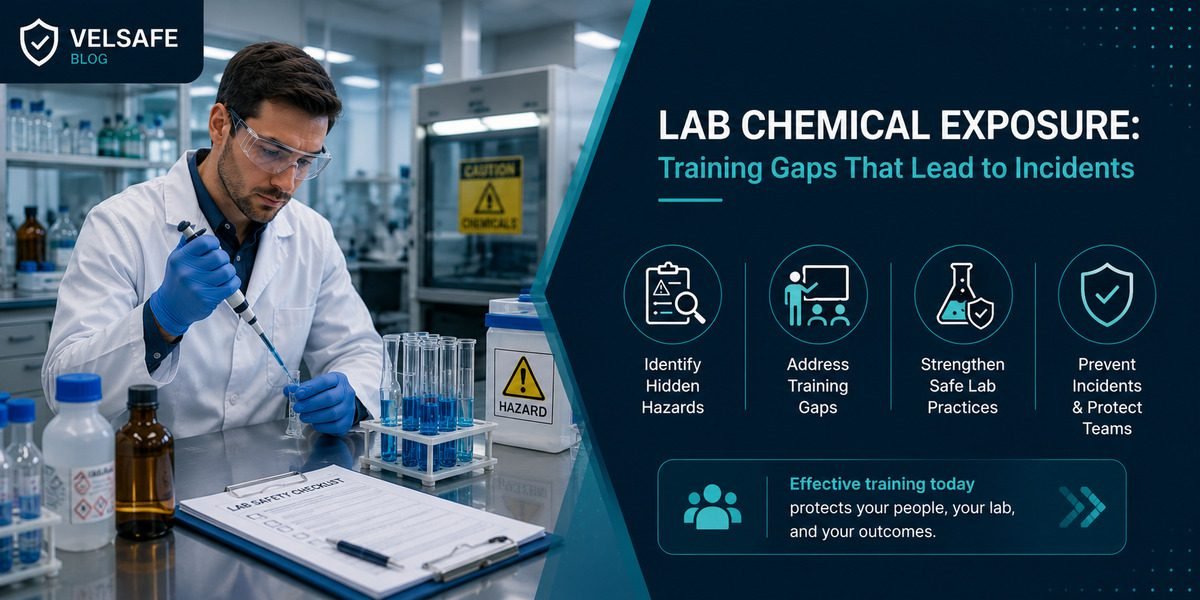
OSHA’s Laboratory Standard at 29 CFR 1910.1450 requires every covered laboratory to maintain a written Chemical Hygiene Plan, provide specific annual training on chemical hazards, and ensure workers can respond to exposure emergencies before they handle hazardous materials. When any of those three requirements is treated as paperwork rather than practice, laboratory safety training fails at the moment it is most needed. This case study examines a realistic acid exposure incident in a pharmaceutical quality control laboratory: what happened, which regulations were violated, and what a compliant training programme would have prevented.
The Situation: A QC Lab, a Missed SOP, and One Hospitalised Worker
The incident did not begin with a dramatic failure. It began with a routine task: pH verification of an in-process pharmaceutical sample. The technician, working alone at a bench, reached across a cluttered work surface to retrieve a volumetric flask. The flask tipped. Approximately 50 mL of 37% hydrochloric acid contacted the worker’s forearm. The PPE worn, nitrile gloves and a standard lab coat, provided no protection against the concentrated acid at that exposure level. Protective sleeves were available in the lab but had not been specified as required for this procedure in the current SOP.
Timeline: From Spill to Citation
What Went Wrong: Three Compounding Failures
Failure 1: The Chemical Hygiene Plan Was Not Current
The lab had added concentrated hydrochloric acid to its reagent inventory four months before the incident, following a new client contract. The Chemical Hygiene Plan (CHP), required under 29 CFR 1910.1450(e), was not updated to reflect the new chemical. The CHP still referenced dilute acid solutions with different PPE requirements. No one had formally triggered the CHP review process when the inventory changed.
OSHA requires that the CHP specify PPE for each class of chemical hazard and that it be reviewed and updated at least annually, or when conditions change. The employer had not designated a Chemical Hygiene Officer to manage these reviews.
Failure 2: Training Was Annual in Name Only
Workers had completed HAZCOM training slides at hire and again twelve months later. The training covered hazard categories, GHS pictograms, and SDS navigation. It did not include a hands-on component for emergency decontamination, did not specify the 20-minute minimum flush duration for strong acids, and did not address clothing removal during decontamination.
Under 29 CFR 1910.1450(f), training must address the specific chemicals present in the laboratory, the symptoms of exposure, and the emergency procedures for the chemicals actually in use. Generic HAZCOM slide decks do not satisfy this requirement when the chemical inventory includes concentrated corrosives.
Failure 3: Emergency Equipment Was Present But Not Maintained
The laboratory had an eyewash station and a drench hose within the same room. Both had been installed correctly at fit-out. The problem was that the eyewash station had not been activated and flushed for six weeks, and equipment had been placed in front of it during a reorganisation exercise. Neither issue had been flagged because the weekly inspection programme had lapsed.
ANSI/ISEA Z358.1 requires eyewash stations to be activated weekly to verify proper operation and to flush the supply line. OSHA references this standard under the General Duty Clause when enforcing emergency equipment requirements. Missing inspection records create a record that the employer knew or should have known equipment was unverified.
Investigation Findings: OSHA Citations and Regulatory Basis
| Citation Type | Standard Violated | OSHA Finding | Proposed Penalty |
|---|---|---|---|
| Willful | 29 CFR 1910.132(a): PPE General Requirements | Employer failed to ensure workers wore protective sleeves when handling concentrated corrosives, despite hazard known from SDS. PPE hazard assessment did not cover the new reagent. | $16,131 |
| Serious | 29 CFR 1910.1450(e): Chemical Hygiene Plan | CHP did not include the concentrated HCl added to the reagent inventory four months prior. Required provisions for PPE selection, spill response, and SDS review were absent for this chemical class. | $16,131 |
| Serious | 29 CFR 1910.1450(f): Employee Training | Training did not address emergency procedures specific to the chemicals present. Workers could not demonstrate the correct decontamination procedure for concentrated acid exposure. No hands-on element had been provided. | $9,131 |
Root Cause Analysis: Where the Safety System Failed
Corrective Actions Required: What a Compliant Lab Must Do
Assign a Chemical Hygiene Officer and Define the Review Trigger
Designate a qualified Chemical Hygiene Officer as required by 29 CFR 1910.1450(b). Define a written process that automatically triggers a CHP review whenever a new chemical class is added to the inventory. The trigger should be embedded in the purchasing process, not left to individual judgement.
Rebuild the Training Programme Around Chemical-Specific Scenarios
Replace generic HAZCOM slide decks with training that addresses each chemical class in the lab’s actual inventory. For concentrated acids and bases, training must include the correct flush duration from the SDS, clothing removal procedure, and a hands-on run-through of the eyewash station. Workers should be able to demonstrate the procedure, not just describe it.
Update the PPE Hazard Assessment for Every Chemical Tier
Conduct a written PPE hazard assessment under 29 CFR 1910.132(d) that differentiates between dilute and concentrated corrosives. Specify protective sleeves, face shields, and acid-resistant aprons where the SDS requires it. Embed the PPE requirement in each SOP, not just in the CHP.
Reinstate the Weekly Eyewash Inspection Programme
Assign a named individual to activate and document each eyewash station weekly, consistent with ANSI/ISEA Z358.1. Define a clear-path requirement around every emergency station. Make the inspection record a required close-out step at the end of each work week. The inspection log should be available for review during any OSHA visit.
Lessons Learned: What Every Laboratory Can Apply
Inventory changes must trigger documentation reviews
The CHP is only as current as the chemicals it describes. A purchasing process that does not automatically flag a new chemical class for CHP review creates a compliance gap that is invisible until an incident reveals it. Build the review trigger into the procurement workflow.
Training must match the actual chemicals in use
Generic HAZCOM training satisfies the GHS awareness requirement but does not satisfy 29 CFR 1910.1450(f)’s requirement for training on the specific chemicals present. If your lab handles concentrated corrosives, workers must be trained on the specific first aid protocol for those chemicals, not on the hazard category in general.
Emergency equipment that is not maintained is not available
An eyewash station that is blocked or untested is not meaningfully available in an emergency. OSHA and ANSI Z358.1 treat the maintenance requirement as part of the provision requirement. Having the hardware is not enough; having records of tested, accessible hardware is what survives an inspection.
IACET CEU programmes require demonstrated competency, not just attendance
An IACET-accredited laboratory safety training suite carries a CEU value because the programme requires documented learning outcomes, not just seat time. Using a 0.2 CEU programme as a vehicle for genuine competency assessment, including hands-on emergency procedure verification, is more defensible than annual attendance at a slide presentation.
Prevention Checklist: Laboratory Safety Training Requirements
Chemical Hygiene Plan
Training Records
PPE Programme
Emergency Equipment
Key Takeaways
The CHP must be updated every time the inventory changes, not just once a year
Annual review is a floor, not a ceiling. Any time a new chemical class enters the laboratory, the Chemical Hygiene Plan must be reviewed and updated before workers handle the new material. A gap between inventory change and CHP update is a Serious citation waiting to happen.
OSHA’s Laboratory Standard requires chemical-specific training, not general HAZCOM awareness
29 CFR 1910.1450(f) requires that training address the chemicals actually present in the lab. If your laboratory holds concentrated corrosives, training must cover the emergency procedures for those chemicals specifically, including flush duration and PPE removal. A generic GHS awareness session does not satisfy this requirement.
A Willful citation requires proof the employer knew the hazard existed and chose not to control it. Your purchasing record and SDS files provide that proof.
When concentrated HCl arrived in your lab, the SDS came with it. OSHA will argue that the employer had constructive knowledge of the chemical’s hazards from the moment it entered the facility. Failure to update the CHP and PPE requirements after that date becomes a deliberate choice in the eyes of an OSHA compliance officer. The path from Serious to Willful is shorter than most labs realise.
Frequently Asked Questions
What does OSHA require for laboratory safety training under 29 CFR 1910.1450?
OSHA requires that training address the specific chemicals present in the laboratory, the physical and health hazards of those chemicals, the methods to detect a release, and the emergency procedures workers should follow if exposed. Training must occur at initial assignment and whenever a new chemical hazard is introduced. Generic GHS awareness training does not satisfy this requirement for laboratories holding concentrated or acutely toxic chemicals.
Who is required to be the Chemical Hygiene Officer in a laboratory?
OSHA defines the Chemical Hygiene Officer as a person who is qualified by training or experience to provide technical guidance in the development and implementation of the Chemical Hygiene Plan. The role does not require a specific credential, but the designated person must be capable of keeping the CHP current, identifying hazards, and advising workers on protective measures. The designation must be in writing and the person must be actively performing the role.
How often must eyewash stations be inspected in a laboratory?
ANSI/ISEA Z358.1, which OSHA references when enforcing emergency eyewash requirements, requires that plumbed eyewash stations be activated weekly to verify operation and flush the supply line. Self-contained units must be checked in accordance with the manufacturer’s instructions, typically weekly or monthly. Inspection records should be retained and available. OSHA has cited employers under the General Duty Clause when emergency eyewash equipment was not tested and documented.
What is the difference between a Serious and a Willful OSHA citation for laboratory violations?
A Serious citation is issued when there is a substantial probability that death or serious physical harm could result from a hazard the employer knew or should have known about. A Willful citation is issued when the employer knew about the hazard and intentionally failed to correct it, or showed indifference to employee safety. In a lab context, having an SDS on file for a chemical but failing to update the CHP or PPE requirements for that chemical is strong evidence of constructive knowledge, which supports a Willful classification.
Does IACET-accredited laboratory safety training satisfy OSHA’s requirements under the Laboratory Standard?
An IACET-accredited programme provides a structured, quality-assured training framework with verified learning outcomes, which aligns with OSHA’s expectation that training be effective rather than just delivered. However, the programme must still cover the specific chemicals and emergency procedures relevant to your laboratory. IACET accreditation alone does not satisfy the requirement if the content does not address the chemicals actually present in your facility. Use IACET-accredited training as the foundation and customise it to your chemical inventory.
What training records must a laboratory keep to satisfy OSHA requirements?
Records should document the date of training, the topics covered, the chemicals addressed, the identity of the trainer, and the names of workers who completed the training. OSHA does not prescribe a specific retention period for laboratory training records in 29 CFR 1910.1450. Civil litigation and good practice standards typically suggest retaining these records for the duration of employment plus several years. Consult your legal counsel for jurisdiction-specific retention guidance.
What should a healthcare or pharmaceutical laboratory do differently compared to a general industrial lab?
Healthcare and pharmaceutical laboratories often hold both OSHA-regulated chemical hazards and biosafety hazards, which are governed by separate standards. The Chemical Hygiene Plan must address both categories. These labs also frequently operate under FDA’s cGMP framework, which requires SOPs for every critical operation, including chemical handling, and documented evidence that workers are trained to those SOPs before they perform the work. An OSHA citation in a regulated pharmaceutical facility can also trigger FDA scrutiny of training documentation.
