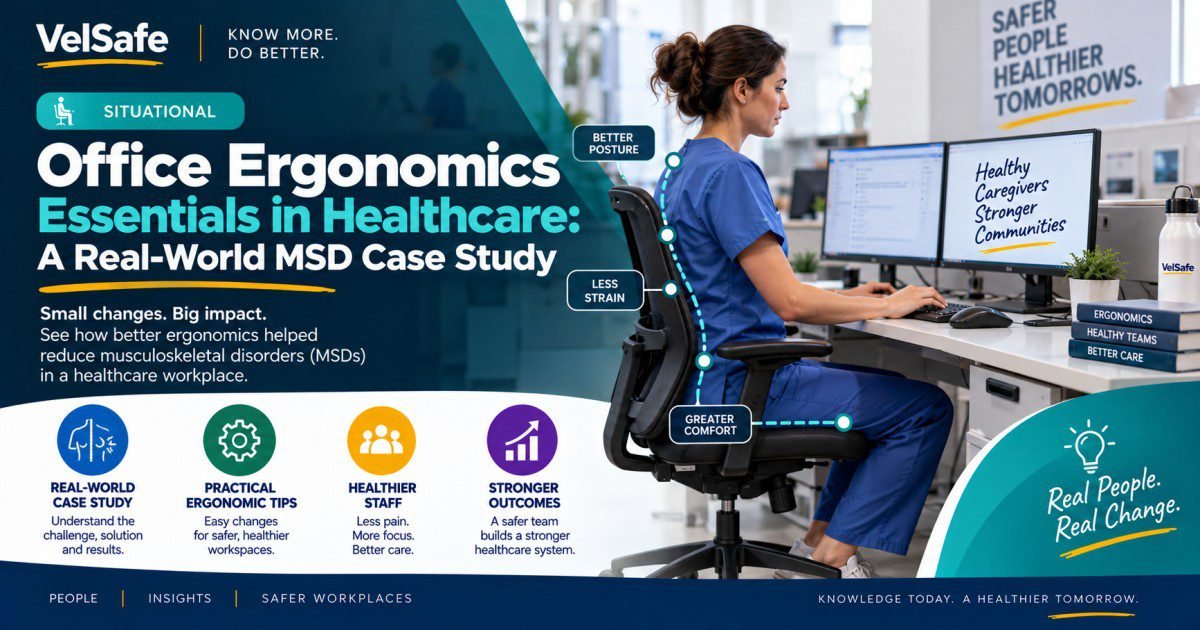
Situational: Healthcare Office Ergonomics Essentials
When Office Ergonomics Essentials Are Ignored: How Four MSD Injuries and an OSHA Citation Could Have Been Prevented
Office ergonomics essentials are basic workstation controls that prevent musculoskeletal disorders in desk-based workers. When healthcare organisations skip them, the cost is not abstract: it shows up as workers’ compensation claims, OSHA General Duty Clause citations, lost productivity, and staff turnover. This case study traces how one healthcare administration team’s failure to implement ergonomics essentials led to four repetitive strain injuries, one formal OSHA complaint, and a settlement that cost far more than the equipment would have.
$20B+
Annual US Cost of Work-Related Musculoskeletal Disorders
OSHA estimates that work-related MSDs cost US employers more than $20 billion annually in direct costs, including workers’ compensation, medical treatment, and lost productivity. Healthcare sector administrative workers are among the highest-affected groups. Source: OSHA: Ergonomics
33%
Of All Workplace Injuries Requiring Lost Time Are Musculoskeletal
The Bureau of Labor Statistics reports that musculoskeletal disorders account for roughly one-third of all occupational injury and illness cases requiring days away from work. Many of these occur in desk-based roles where the hazard is never formally assessed. Source: BLS: Occupational Injuries and Illnesses
Section 5(a)(1)
The OSHA General Duty Clause That Applies When There Is No Specific Ergonomics Standard
OSHA has no specific ergonomics standard for general industry office workers. But Section 5(a)(1) of the OSH Act requires every employer to provide a workplace free from recognised hazards likely to cause death or serious physical harm. Documented MSD hazards that are not corrected are General Duty Clause violations. Source: OSH Act Section 5: Duties
A mid-sized regional healthcare network operating three outpatient facilities had a 24-person administrative team responsible for patient scheduling, billing, records management, and insurance correspondence. These workers spent six to eight hours per day at computer workstations. Most used shared desks in a hot-desk arrangement where different staff occupied the same workstation across morning and afternoon shifts.
The network had never conducted a formal workstation assessment for administrative staff. Chairs were standard fixed-height office models with no lumbar support adjustment. Monitors sat directly on desks with no stands, positioning screens well below eye level for most users. Keyboards were pushed to the back of the desk to make room for paper files, forcing workers to reach forward when typing. No footrests were available. No ergonomics training had been delivered since the facility opened four years earlier.
The office ergonomics essentials that any competent EHS programme would have implemented were absent. This was not an unusual situation. It was the default state that most small-to-medium healthcare organisations operate in until an injury makes the cost visible.
Conditions present before the first injury report
Fixed-height chairs with no lumbar adjustment, shared across workers of different heights and body types
Monitors sitting flat on desks, positioned well below eye level for most users
Keyboards pushed to the far edge of the desk surface, requiring sustained forward reach
No footrests available for shorter workers whose feet did not reach the floor at desk height
No ergonomics training delivered since the facility opened
No formal process for workers to report discomfort before it became a compensable injury
Root Cause 1: No workstation assessment programme existed
The organisation had never assessed whether its administrative workstations posed ergonomics risks. This is not an unusual failure, but it is a consequential one. A workplace hazard that has never been assessed cannot be corrected. The workstations in this case presented multiple recognised ergonomics risk factors: fixed chair height, low monitor position, keyboard reach, and extended work duration without breaks. None of these was ever formally identified as a hazard because no one ever looked for them. When the injuries arrived, the organisation had no evidence that it had exercised due diligence, which is exactly what OSHA’s General Duty Clause analysis requires.
Root Cause 2: Early symptom reports were not treated as hazard reports
Both initial reports of wrist pain and neck pain were received by supervisors and HR. Neither triggered a formal response. This is the most costly mistake in the sequence. Early symptom reports are the signal that a hazard is actively causing harm. When they are received and not acted on, two things happen simultaneously: the worker continues to be harmed, and the organisation creates documented evidence that it knew about the hazard and did nothing. In an OSHA General Duty Clause case, employer knowledge of the hazard is a key element. The Month 1 and Month 2 conversations gave OSHA exactly the knowledge evidence it needed.
Root Cause 3: The first workers’ compensation claim did not trigger a broader review
When the first carpal tunnel diagnosis was filed as a workers’ compensation claim at Month 4, the organisation had a clear opportunity to stop the sequence. A single MSD claim in a desk-based workforce is a signal that the work environment may be causing harm at the population level, not just for one individual. The correct response was to conduct workstation assessments across the entire administrative team immediately. Instead, the organisation treated the claim as an isolated event and took no programmatic action. Three more injuries followed within six weeks.
Root Cause 4: Office ergonomics was treated as a personal preference, not a safety obligation
Throughout the period before the OSHA complaint, the organisation’s implicit operating assumption was that desk setup was a matter of individual comfort rather than a workplace safety obligation. This is a widespread misunderstanding. OSHA’s computer workstation eTool, combined with the General Duty Clause framework, makes clear that ergonomics hazards at workstations are occupational hazards subject to the same employer duty of care as any other recognised hazard. The failure to implement office ergonomics essentials is a compliance failure, not a preference decision.
OSH Act Section 5(a)(1): General Duty Clause
The General Duty Clause requires employers to provide a workplace free from recognised hazards likely to cause death or serious physical harm. OSHA’s citation found that the organisation had: (1) recognised hazards (MSD risk factors at workstations), (2) evidence the hazards were causing harm (documented injury reports), (3) feasible means to correct the hazards (workstation adjustments and ergonomics equipment), and (4) failed to implement those corrections after becoming aware of the hazard. All four elements were met. Source: OSH Act Section 5
OSHA Recordkeeping: 29 CFR 1904
Work-related musculoskeletal disorders that result in days away from work, restricted work activity, or medical treatment beyond first aid must be recorded on the OSHA 300 log under 29 CFR 1904. All four MSD cases in this scenario met the recording threshold. The organisation’s failure to maintain accurate records, including the initial symptom reports that were not documented, created secondary recordkeeping exposure on top of the General Duty Clause citation. Source: 29 CFR Part 1904
Why there is no specific OSHA ergonomics standard for offices: why that does not protect employers
OSHA proposed a comprehensive ergonomics standard in 2000, but Congress rescinded it in 2001 under the Congressional Review Act. No replacement standard was enacted. This is frequently misread as meaning that office ergonomics is not an OSHA enforcement area. That reading is incorrect. The absence of a specific standard does not remove the General Duty Clause obligation. OSHA has consistently cited employers for ergonomics violations using the General Duty Clause when: the hazard is recognised (MSDs from desk work are a well-documented hazard), the hazard is causing or likely to cause serious harm, and feasible corrective measures exist and were not implemented. Source: OSHA: Ergonomics
Before any injuries: Conduct baseline workstation assessments for all desk-based staff
The ergonomics risk factors in this case were present from Day 1. A baseline assessment using OSHA’s computer workstation eTool checklist would have identified fixed-height seating, low monitor positions, extended keyboard reach, and the absence of footrests within the first month of operations. Each finding would have generated a low-cost corrective action: an adjustable chair, a monitor stand, a keyboard tray, or a footrest. The total cost of these items across 24 workstations would have been a fraction of a single workers’ compensation claim.
Month 1: Document and investigate the wrist pain report as a hazard report
When the billing coordinator reported wrist pain in Month 1, the supervisor should have: documented the report in writing on the same day, initiated a workstation assessment for that employee, reviewed whether the workstation configuration had contributed to the complaint, and referred the employee to occupational health for early-stage assessment. This single action, taken immediately, would have broken the sequence. Instead, verbal acknowledgement without documentation became the first brick in the OSHA knowledge-of-hazard evidence chain.
Month 4: Treat the first workers’ compensation claim as a population signal, not an individual event
When the first MSD was compensable, the correct response was a team-wide workstation review, not a claim-specific response. An employer who receives one MSD claim in a homogeneous work population (all doing the same task, at similar workstations, for similar durations) has statistical reason to believe the risk is shared. Waiting for three more injuries before acting is the pattern that most damages an organisation’s legal position. A proactive team-wide assessment at Month 4 would have been evidence of responsible employer conduct. Inaction made it evidence of the opposite.
Programme-level: Build a formal early symptom reporting and response process
The most durable corrective action is a standing process: workers know how to report discomfort (a simple written form or digital submission), supervisors know they must respond within 24 hours, every report triggers a workstation review, and every review is documented with findings and corrective actions. This process costs almost nothing to operate. It creates the documentation trail that demonstrates the organisation is actively managing the hazard, which is the single most important factor in an OSHA General Duty Clause defence.
Unassessed hazards are not absent hazards
A workstation that has never been assessed is not a workstation that has been found safe. It is a workstation that has not been looked at. The ergonomics risk factors in this case were present from the first day the facility opened. The injuries were not caused by a sudden change; they were caused by sustained exposure to a hazard that nobody had ever identified or controlled. Assessment is the starting point of every ergonomics programme.
A verbal response to a symptom report is not a corrective action
Telling a worker to take more breaks is not an investigation of the hazard that caused their symptom. The correct response to any ergonomics-related symptom report is a documented workstation assessment followed by documented corrective actions. If the assessment finds no hazard, document that finding. If it finds a hazard, document the correction. The paper trail is the protection.
The absence of an ergonomics standard does not mean the absence of an ergonomics obligation
Every EHS professional in healthcare needs to understand that the General Duty Clause fills the regulatory gap left by the absence of a specific office ergonomics standard. Recognised hazards, a pattern of MSD injuries, and feasible corrective measures are all OSHA needs to issue a citation. The standard does not have to exist; the hazard does.
The cost of doing nothing is always higher than the cost of the programme
The equipment and training that would have prevented the injuries in this case cost a fraction of the settlement, the workers’ compensation claims, and the programme implementation that followed the citation. Every ergonomics programme delay is a cost deferral, not a cost avoidance. The injuries and the regulatory exposure arrive whether the programme does or not.
Programme Controls
Workstation Controls
Reporting Controls
Baseline workstation assessment for all desk staff
Ergonomics training at hire and annually
Written ergonomics programme on file
Designated point person for ergonomics complaints
OSHA 300 log current and accurate
Annual programme review
Adjustable chairs with lumbar support
Monitor stands to raise screens to eye level
Keyboards positioned at elbow height
Footrests available for shorter workers
Document holders for paper reference tasks
Sufficient desk surface to avoid reach postures
Written process for reporting discomfort
24-hour supervisor response requirement
All reports documented with date and follow-up
Workstation assessment triggered by every report
Corrective actions documented and signed off
No retaliation for ergonomics complaints
An unresolved symptom report is documented employer knowledge of a hazard
Once a worker reports pain or discomfort related to their workstation, the employer has knowledge of a potential hazard. In a General Duty Clause case, this knowledge is what separates a warning from a citation. Document every report. Investigate every report. Document the investigation. This is not bureaucracy; it is your legal defence.
One MSD claim in a desk-based team means the whole team is at risk
When workers do the same tasks, at similar workstations, for similar hours, one MSD claim is a team-level signal. The injury did not happen because one worker was unlucky. It happened because the workstation configuration creates harm over time, and every worker at a similar station faces the same risk. Respond to the population, not just the individual.
Office ergonomics essentials are a compliance obligation, not a facilities preference
This case illustrates what happens when ergonomics is treated as a comfort issue rather than a safety obligation. The regulatory exposure is real. The injuries are real. The cost of the settlement, the workers’ compensation claims, and the delayed programme implementation is real. Healthcare organisations that want to avoid this sequence should implement office ergonomics essentials now, before the first symptom report arrives, because the hazard is present whether it has been recognised or not.
What are office ergonomics essentials and why do they matter in healthcare settings?
Office ergonomics essentials are the basic workstation controls that reduce musculoskeletal disorder risk for desk-based workers: adjustable seating with lumbar support, monitor positioning at eye level, keyboard and mouse placement at elbow height, footrests where needed, and structured micro-break policies. In healthcare settings, administrative staff often work at shared or poorly configured workstations for extended periods. The consequence is a high incidence of neck, shoulder, wrist, and back injuries that result in workers’ compensation claims, lost time, and OSHA General Duty Clause exposure.
Can OSHA cite an employer for ergonomics violations if there is no specific ergonomics standard?
Yes. OSHA uses the General Duty Clause (Section 5(a)(1) of the OSH Act) to cite employers for ergonomics violations when no specific standard applies. The General Duty Clause requires employers to protect workers from recognised hazards likely to cause death or serious physical harm. A documented pattern of MSD injuries in a desk-based workforce, combined with a failure to implement feasible controls, satisfies all four elements OSHA must prove for a General Duty Clause citation. Source: OSH Act Section 5
What should a supervisor do when a worker reports ergonomics-related discomfort?
The supervisor should document the report in writing on the day it is received, noting the worker’s name, the date, and what was reported. They should then initiate a workstation assessment within 24 hours, document the findings, implement corrective actions where a hazard is identified, and follow up with the worker within the week. Verbal acknowledgement without documentation creates employer knowledge of the hazard without creating evidence of a corrective response, which is the worst legal position an employer can be in.
Are musculoskeletal disorders recordable on the OSHA 300 log?
Yes. Work-related MSDs that result in days away from work, restricted work activity, job transfer, or medical treatment beyond first aid must be recorded on the OSHA 300 log under 29 CFR 1904. OSHA 300 logs also include a separate column for musculoskeletal disorders to facilitate trend tracking. An employer whose 300 log shows a pattern of MSD cases in one work area has created a discoverable record that is available to OSHA compliance officers during an inspection. Source: 29 CFR Part 1904
How does a hot-desk arrangement increase ergonomics risk?
Hot-desk arrangements, where multiple workers share the same workstation across shifts, increase ergonomics risk because each worker has a different body type, height, and task requirement. A workstation set up for a 180cm worker sitting in the morning is not correctly configured for a 155cm worker sitting in the afternoon at the same station. Unless workers are trained to adjust their workstation at the start of each session, and unless the equipment is actually adjustable, hot-desk arrangements expose each worker to the same poorly fitting workstation for hours at a time.
What is the minimum an employer must do to have a defensible ergonomics programme?
At a minimum, a defensible ergonomics programme includes: a written ergonomics policy, a baseline workstation assessment for all desk-based workers, a formal process for reporting and documenting discomfort, a 24-hour supervisor response requirement for all ergonomics reports, documented corrective actions for identified hazards, annual ergonomics training for all desk workers, and OSHA 300 log tracking of MSD cases. The documentation is as important as the controls. An employer who implements controls but does not document them cannot demonstrate compliance during an OSHA inspection.
Can a worker be retaliated against for filing an ergonomics complaint with OSHA?
No. Section 11(c) of the OSH Act prohibits employers from retaliating against workers who file complaints with OSHA, report work-related injuries or illnesses, or exercise any other right under the OSH Act. Retaliation includes termination, demotion, reduced hours, reassignment, or any other adverse action. Workers who believe they have experienced retaliation may file a complaint with OSHA within 30 days of the adverse action. Source: OSHA: Whistleblower Protection
Worker Safety
Office Ergonomics Awareness: Healthcare Worker Safety Guide
The practical companion to this case study: how healthcare desk workers can set up their workstation correctly, recognise early MSD symptoms, and act on their OSHA rights before discomfort becomes injury.
Guides
HCIR Credentialing and National Patient Safety Goals Guide
Covers the compliance obligations for healthcare industry representatives entering clinical facilities, demonstrating the same documentation and response-to-report requirements that apply to ergonomics compliance.
Situational
Microlearning Slips Trips and Falls Prevention
A case study in how targeted, cause-specific training interventions reduced STF incidents 71 percent, illustrating the same principle that drives ergonomics programmes: identify the specific hazard, address it directly, and measure the outcome.
Healthcare Workplace Safety Case Studies
More Situational Safety Analysis for Healthcare Professionals
VelSafe’s Situational library covers real-scenario safety case studies, incident analysis, root cause breakdowns, and regulatory exposure assessments for safety professionals, HR managers, and compliance teams in healthcare and general industry.
Explore All Situational Articles