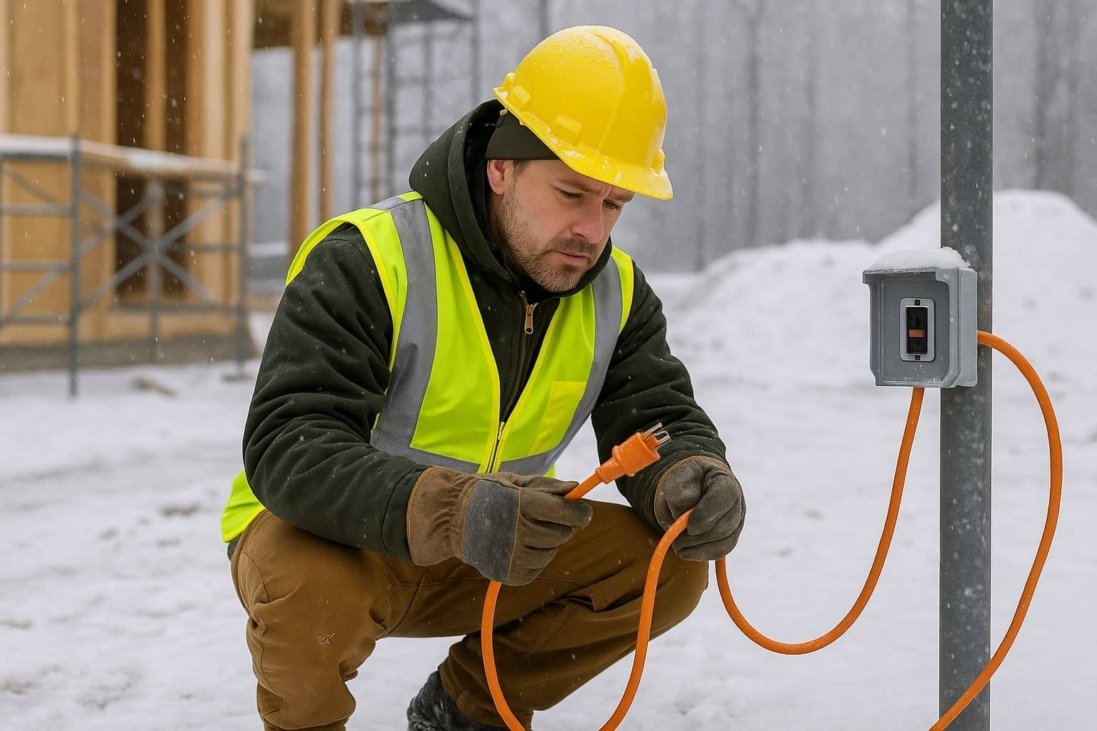
SITUATIONAL: Winter Construction Electrical Incident
The Cord Passed Inspection at 7 AM
By 2 PM It Was Buried Under Six Inches of Slush
A construction electrician on an active winter jobsite connected a 100-foot 12-gauge extension cord to a concrete saw at the start of the morning shift. He checked the cord visually, confirmed the GFCI was operational, and started work. By early afternoon the cord had been covered by snow cleared from a nearby area, was running through standing slush at the low point of the site, and the GFCI had not been re-tested after a temperature drop froze its reset mechanism. When a second worker picked up the saw, the incident began. This is what the post-incident investigation found.
52
Electrocution Deaths, 2023
Construction accounts for more electrocution fatalities than any other US industry. Electrical hazards are consistently in OSHA’s Fatal Four for construction.
BLS Census of Fatal Occupational Injuries
40°F
GFCI Freeze Threshold
GFCI devices can experience internal icing that prevents the trip mechanism from operating correctly at or below 40°F when exposed to moisture. Testing must be repeated as temperatures change.
OSHA 1926.404(b)(1)
$16,550
Per Serious Violation
OSHA maximum civil penalty per serious electrical violation under 29 CFR 1926 Subpart K. Repeat or wilful violations reach $165,514 per citation.
OSHA Penalty Schedule
A mid-size commercial construction contractor is operating on a concrete slab foundation project in the upper Midwest in January. Temperature at the start of the day shift is 28°F with forecast snow developing by noon. The site has two active work areas: concrete cutting on the east slab and form work on the west. Both areas are supplied by temporary power distribution from a generator-fed panel with GFCI protection at the panel.
The electrician assigned to the east slab runs a 100-foot 12-gauge outdoor-rated extension cord from the panel to supply a 15-amp concrete saw. He performs a visual inspection of the cord at setup, tests the GFCI at the panel, and begins work at 7:15 AM. The work plan does not include any re-inspection of the cord or GFCI during the shift.
What the site plan did not account for
Snow removal operations on the adjacent form work area began at approximately 11:30 AM. Snow was cleared toward the low drainage point between the two slabs, directly over the cord routing path. By 1:45 PM, approximately six inches of compacted snow and slush had accumulated over a twenty-foot section of the cord. The cord was no longer visible from either work area. The temperature had dropped to 22°F. The GFCI at the panel had been exposed to dripping meltwater from the panel cover and had not been re-tested after the temperature drop.
7:15 AM
Electrician sets up cord and saw. Visual inspection performed, GFCI tested at panel and confirmed operational. Work begins. Temperature: 28°F, light wind, no precipitation.
11:30 AM
Snow begins. Form work crew begins clearing snow from west slab toward the drainage channel between slabs. No communication with east slab crew about cord routing below the drainage path. Temperature: 24°F.
1:45 PM
Cord is buried under six inches of compacted snow and slush at the drainage low point. A section of outer jacket has been compressed and punctured by equipment crossing over the covered cord. The puncture point is submerged in standing slush. Temperature has dropped to 22°F.
1:52 PM
Second worker picks up the concrete saw. On contact with the tool body, he receives an electrical shock. He is not incapacitated but drops the tool and reports the shock to the supervisor. Work stops. The GFCI did not trip, subsequent testing confirms the trip mechanism is frozen and non-operational.
2:10 PM
Investigation begins. Cord is excavated from slush. Damage is found at the drainage low point, mechanical puncture through the outer jacket and one conductor. The fault path ran through standing meltwater to the tool body. OSHA is notified per reporting requirements.
No mid-shift cord re-inspection when conditions changed
The morning inspection was performed correctly. What the site programme did not require was re-inspection when conditions materially changed, specifically when snow accumulation began and when snow removal operations started adjacent to the cord routing path. A cord inspection conducted at 7 AM on a dry slab has no value for a cord buried in slush at 2 PM. Winter site electrical programmes must require re-inspection triggers, not just shift-start inspections.
GFCI not re-tested after temperature drop and moisture exposure
GFCI devices are required by 29 CFR 1926.404(b)(1) to protect cord-connected equipment at construction sites. What the standard does not explicitly require, but what the incident made necessary, is re-testing after the GFCI has been exposed to conditions that could compromise its trip mechanism. At 22°F with dripping meltwater, the device frozen and failed silently. The fault reached the tool body with no interruption.
No inter-crew communication about cord routing before snow removal
The form work crew did not know the cord routing path. The east slab crew did not know snow removal was being directed toward the drainage channel. Neither crew’s supervisor confirmed cord routing before the snow removal operation began. In a dynamic winter jobsite, electrical cord routing must be documented, communicated across all active work crews, and re-confirmed before any adjacent earthmoving, snow removal, or material handling operation begins.
Equipment crossing over a buried cord was not recognised as a hazard
Once the cord was buried under snow, it became invisible to both crews and to the equipment operators clearing the area. Equipment crossed over the cord routing path at least twice before the fault occurred, with the second pass producing the mechanical puncture. A cord buried under snow on an active construction site is not protected from mechanical damage, it is hidden from the people who could prevent that damage. Elevation or marking are not optional in winter conditions; they are the only mechanism that keeps a cord visible when snow accumulates.
1926.404(b)(1): GFCI Protection
All 120-volt, single-phase 15- and 20-ampere receptacle outlets on construction sites must have GFCI protection. The requirement is for protection to be functional, a GFCI whose trip mechanism is frozen is not providing the required protection. While the standard does not specify re-testing frequency during a shift, a frozen GFCI that fails to trip during a fault is a violation of the protection requirement.
1926.416(e): Damaged Cords
Cords and cables with damaged insulation must be removed from service immediately. A cord buried under snow and mechanically damaged by equipment crossing over it constitutes damaged insulation. The fact that the damage was not visible (because the cord was buried) does not relieve the employer of the obligation to prevent conditions where such damage could occur undetected.
1926.405(a)(2)(ii): Cord Protection
Extension cords must be protected from damage. Running through an area subject to equipment traffic and snow accumulation without elevation, marking, or guarding constitutes failure to protect. The routing plan that was safe at shift start was not safe when conditions changed. Protection is an ongoing obligation, not a one-time installation requirement.
OSH Act Section 5(a)(1): General Duty
The General Duty Clause requires employers to provide a workplace free from recognised hazards likely to cause death or serious harm. The hazard of cords buried under snow in active equipment traffic areas, without inter-crew communication or re-inspection requirements, is a recognised hazard in winter construction. The contractor’s site programme did not address it.
Require re-inspection triggers, not just shift-start inspection
The site electrical programme must define conditions that trigger a mandatory cord and GFCI re-inspection: precipitation beginning, temperature dropping below 35°F, any snow removal or earthmoving operation starting adjacent to cord routing paths, and any shift change. A single morning check does not cover a dynamic winter site. The trigger list must be written into the site electrical safety plan and communicated to all supervisors.
Use GFCI devices rated for cold weather and test them after each temperature change
Specify cold-weather GFCI devices with enclosed housings and heated compartments for jobsites operating below 40°F. Where standard GFCIs are used, test them before work begins, after any precipitation event, and after any temperature drop of 10°F or more since the last test. A GFCI that cannot be confirmed operational must be replaced before the circuit is energised. Keep the test log on-site and available during OSHA inspections.
Mark, elevate, or route all temporary cords in dedicated protected paths
Temporary power cords on winter construction sites must be elevated above the ground surface using cord hangers, mounted at minimum 7 feet above walking surfaces where overhead routing is used, or run through clearly marked conduit or raceways at grade. Where grade-level routing is necessary, cords must be covered with brightly coloured cable protectors that remain visible under snow and are rated for equipment traffic. Any cord that becomes buried must be treated as unprotected and taken out of service until re-routed and re-inspected.
Establish cross-crew communication before any adjacent operations begin
Before any snow removal, earthmoving, or material handling operation begins on a winter construction site, the supervisor of that operation must confirm with all adjacent crew supervisors the location of temporary power cords in the work zone. This must be a documented pre-task communication, not an informal understanding. Where cord routing paths cross between work zones, those paths must be physically marked with warning tape and recorded on a site electrical routing sketch updated each morning.
A compliant setup at 7 AM is not compliant at 2 PM on a winter site
Winter construction sites are dynamic environments. Snow accumulation, temperature drops, adjacent operations, and equipment movement change hazard conditions continuously throughout a shift. Electrical safety programmes designed for static conditions, one inspection at shift start, one GFCI test at setup, are not adequate for winter conditions. The programme must be dynamic by design, with re-inspection triggers built into the written plan rather than left to supervisor judgment.
A GFCI that fails silently is more dangerous than no GFCI, it creates false safety
Workers and supervisors in this incident believed the circuit was GFCI-protected. That belief was accurate in the morning. It was not accurate when the fault occurred. A GFCI whose trip mechanism is frozen does not provide protection, but its presence on the circuit creates the reasonable assumption that protection exists. This false safety condition is more hazardous than the known absence of protection, because known absence would trigger a corrective action. Regular re-testing in cold-weather conditions is not optional; it is the only way to confirm that assumed protection is actual protection.
Cord routing is a multi-crew coordination problem, not a single-crew electrical task
The root cause of the mechanical cord damage was not an electrical failure. It was a coordination failure between two crews operating on the same site without shared awareness of each other’s constraints. Electrical safety on multi-crew winter construction sites requires that cord routing information flow across all crews, not just within the electrical crew. This is a site management issue, not just an electrical trade issue, and it belongs in the daily pre-task meeting agenda rather than in the electrical programme alone.
Before First Use Each Shift
Visually inspect all cords for cracks, stiffness, exposed conductors
Confirm cord jacket is rated for outdoor and cold-weather use
Test GFCI and log result with time and temperature
Document cord routing path on site electrical sketch
Communicate routing to all adjacent crew supervisors
Mid-Shift Re-Inspection Triggers
Precipitation begins (any form)
Temperature drops 10°F or more since last GFCI test
Temperature reaches or drops below 35°F
Any snow removal or earthmoving begins in cord routing area
Any shift change or new worker assigned to equipment
Cord Routing and Protection Standards
Elevate cords minimum 7 feet overhead wherever possible
Use rated cable protectors at grade level in equipment traffic areas
Mark all ground-level cord paths with high-visibility warning tape
Never allow cords to accumulate snow or ice, treat buried cord as out of service
Remove any cord showing stiffness, cracked jacket, or exposed conductor immediately
Store cords indoors or in heated enclosures between shifts
Re-test GFCIs every time temperature drops or moisture exposure occurs
A GFCI tested at 7 AM at 28°F may be frozen and non-operational by 2 PM at 22°F. Testing once per shift in winter is not adequate. Log every test with time and temperature. A GFCI that cannot be confirmed operational must be replaced before the circuit is energised.
Buried cord equals out-of-service cord, no exceptions
A cord buried under snow cannot be inspected, cannot be protected from mechanical damage, and cannot be confirmed undamaged. Any cord that becomes buried during a shift must be treated as out of service and must be excavated, visually inspected, and tested before being returned to use. This is not conservative, it is the only defensible position when the cord is invisible.
Winter electrical safety is a site coordination problem, not just an electrical trade problem
The cord in this incident was damaged by a snow removal crew that did not know it was there. The GFCI failed because nobody re-tested it after conditions changed. Both failures had the same root cause: the site electrical safety programme was designed as a single-crew electrical responsibility rather than a cross-crew site management obligation. On multi-crew winter construction sites, cord routing and GFCI status must be standing agenda items in every daily pre-task meeting, communicated to everyone on the site, not just the electrical crew.
Can a GFCI really freeze and stop working in winter construction conditions?
Yes. Standard GFCI devices rely on a mechanical trip mechanism that can be impaired when moisture enters the device and freezes around the trip components. This is most likely when the GFCI is exposed to dripping meltwater, slush splash, or direct precipitation and temperatures are at or below 32°F. The device may still appear functional, indicator light on, no visible damage, while the trip mechanism is inoperative. The only way to confirm a GFCI is working is to press the test button and verify the reset cycle. If the test button does not produce a trip, the device must be replaced before energising the circuit.
What OSHA standards apply to electrical cord safety on construction sites in winter?
29 CFR 1926 Subpart K governs electrical safety in construction. The key sections are 1926.404(b)(1) for GFCI requirements, 1926.405(a)(2)(ii) for flexible cord protection, and 1926.416(e) for removal of damaged cords from service. Winter does not change these requirements, it makes compliance harder to maintain because conditions change rapidly. Additionally, the General Duty Clause under OSH Act Section 5(a)(1) applies where recognised hazards (such as cords buried under snow in equipment traffic areas) are not addressed by a specific standard.
How often must extension cords be inspected on a winter construction site?
OSHA requires inspection before each use. In winter conditions, before each use means before each use of the cord after any condition change, not just at the start of the shift. If precipitation begins, if temperature drops significantly, if adjacent operations start near the cord routing path, or if a different worker picks up the tool, the cord should be re-inspected. This is not an excessive standard: a cord that is safe at setup on a winter site can be compromised within hours by snow accumulation, mechanical damage from equipment, or insulation embrittlement from cold.
Are there extension cords specifically rated for winter construction use?
Yes. Cords with a “W” suffix in the cord designation (such as SJTW or SJTWB) are rated for outdoor use and are constructed with jacket materials that remain flexible at lower temperatures. For extreme cold, look for cords rated to -40°F or with thermoplastic rubber (TPR) jackets, which remain pliable well below the brittle-point of standard vinyl insulation. Standard indoor-only cords (no W suffix) must not be used on winter construction sites. Even cold-rated cords must be inspected before each use, stored indoors when not in use, and removed from service immediately if the jacket shows cracking or stiffness.
What is the OSHA penalty exposure for electrical cord violations on a construction site?
Under 29 CFR 1926 Subpart K, serious violations carry a maximum civil penalty of $16,550 per violation. Wilful or repeated violations, where the employer knew of or previously been cited for the same condition, carry a maximum of $165,514 per violation. Where a violation results in death or serious injury, OSHA typically issues wilful citations. In the incident described here, the post-incident investigation identified multiple separate violations (GFCI not functional, damaged cord in service, cord not protected from damage), meaning multiple citation counts, not one.
Does de-energising equipment during snow removal eliminate the electrical hazard?
Yes, and it is the most straightforward corrective action available during adjacent operations. Before any snow removal, earthmoving, or material handling operation begins in an area where temporary power cords are routed, the affected cords should be de-energised at the panel, physically moved to a protected location or elevated, and re-routed before work resumes. This takes minutes and eliminates the cord damage risk entirely. Where cord routing cannot be moved, the area must be physically barricaded to prevent equipment from crossing the cord path. De-energising and re-routing is preferable to relying on elevation or marking alone in active equipment traffic areas.
Who is responsible for electrical safety on a multi-crew construction site in winter?
Under the OSH Act, the controlling employer, the general contractor or site owner, is responsible for ensuring that all hazards on the site are identified and controlled, including electrical hazards created by the interaction of multiple subcontractor crews. Each subcontractor is also responsible for the safety of their own crew. In practice, this means the GC or site superintendent must ensure that cross-crew coordination on cord routing is happening, not just that each individual subcontractor’s electrical work is in compliance. An electrical subcontractor who routes cords correctly for their own work is not insulated from the hazard created when the GC’s snow removal crew buries that cord without warning.
Worker Safety
Lockout-Tagout Programs and Procedures
The energy control programme requirements under OSHA 1910.147 that apply when temporary power must be de-energised during construction operations or cord re-routing.
Situational
LOTOTO Incident: How a Skipped Tryout Kills
An incident analysis of how skipping one step in an energy control procedure produces fatal outcomes, the same pattern of assumed-safe conditions that drove this winter electrical incident.
Worker Safety
Fall Protection Awareness: Who Falls and Why
Fall hazards on winter construction sites interact directly with cord routing, buried or poorly marked cords are a leading trip-and-fall source on snow-covered sites, particularly during shift changes and low-visibility conditions.
WINTER CONSTRUCTION ELECTRICAL SAFETY
Winter Changes the Rules. Your Site Programme Needs to Change With Them.
Find more construction safety incident analyses, electrical compliance guides, and OSHA resources at VelSafe.
Explore More Situational Articles