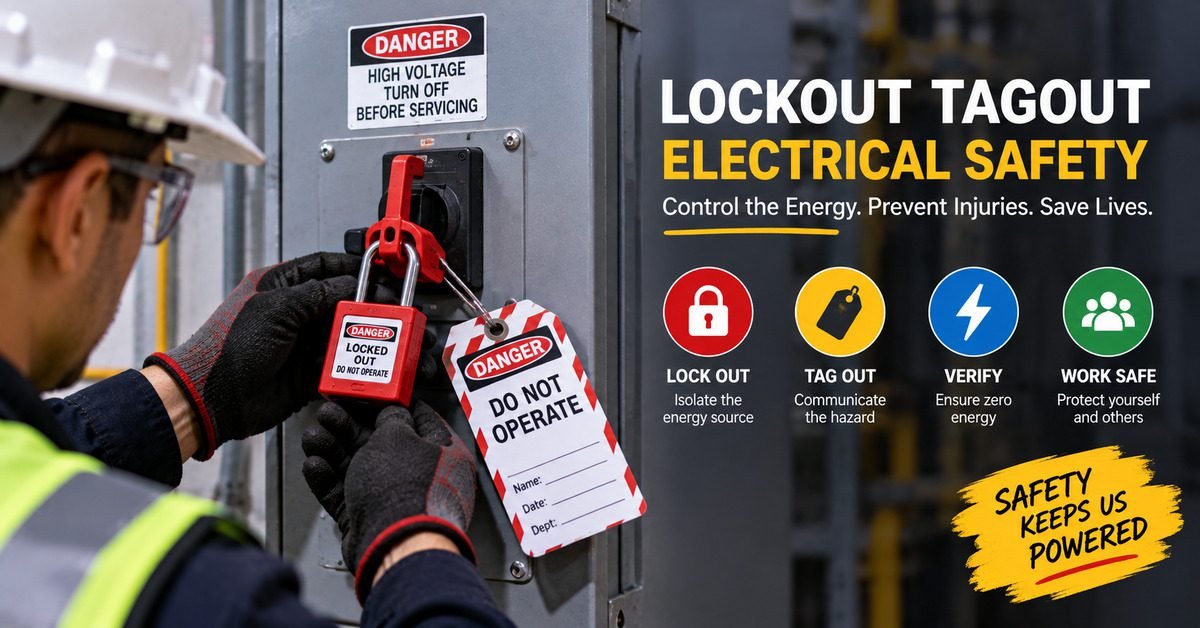
WORKER SAFETY: Electrical and LOTO
Your Lock. Your Life.
The Six Steps That Keep You Safe Under LOTO
A maintenance technician reaches into a conveyor to clear a jam without locking it out. A co-worker restarts the line. He loses two fingers. Lockout/tagout exists because this scenario is predictable and preventable. This guide covers what every worker needs to know before touching any machine.
50K
Injuries Prevented
OSHA estimates that compliance with 29 CFR 1910.147 prevents approximately 50,000 injuries annually in general industry.
OSHA 29 CFR 1910.147
120
Fatalities Prevented
OSHA estimates LOTO compliance prevents approximately 120 fatalities each year. Energisation of equipment during servicing is among the most lethal workplace events.
OSHA 29 CFR 1910.147
#5
Most Cited Standard
LOTO violations (29 CFR 1910.147) are consistently among the top five most cited OSHA standards in general industry inspections year after year.
OSHA Citation Data
Lockout/tagout is a safety procedure that ensures machines and equipment are properly shut off and cannot be re-energised until maintenance or service work is complete. It is governed by OSHA 29 CFR 1910.147 for general industry and 29 CFR 1926.417 for construction. Electrical work falls under both 1910.147 and 29 CFR 1910.333.
Why Electrical Energy Is the Highest-Risk Energy Source
Electricity is invisible, silent, and can be present even when a machine appears completely off. Residual charge in capacitors, back-feed from adjacent circuits, and multiple independent power sources all create exposure that workers cannot detect without instruments. This is why verification of zero energy state (Step 6) is non-negotiable.
Tasks That Require Full LOTO
OSHA 29 CFR 1910.147 requires LOTO whenever you perform servicing or maintenance on machinery and could be exposed to unexpected energisation or release of stored energy. This includes: clearing jams or blockages, cleaning or lubricating, adjusting, inspecting, or any activity where a body part could enter a danger zone.
Tasks Exempt From Full LOTO
Minor tool changes that are routine, repetitive, and integral to production may be performed without full LOTO, but only if alternative protection prevents contact with the hazard. This exception is narrow. If you are unsure, apply the lock. Two minutes of LOTO is always safer than assuming you qualify for an exemption.
Worker Rule: When in Doubt, Lock It Out
If you are ever unsure whether a task requires full LOTO, the answer is lock it out. Applying a lock when it was not strictly required costs two minutes. Not applying a lock when it was required can cost a hand. Never let production pressure determine whether you apply LOTO.
OSHA 29 CFR 1910.147 requires a documented procedure for every machine subject to LOTO. These six steps are the core of every compliant procedure. Follow them in order, every time, without exception.
Step 1: Notify Affected Employees
Before beginning any LOTO, notify all employees who operate or work in the area that the machine will be shut down and locked out. This prevents anyone from starting the machine because they did not know maintenance was in progress. Notification must happen before you touch anything.
Step 2: Identify All Energy Sources
Identify every energy source feeding the machine: electrical circuits, hydraulic lines, pneumatic connections, gravity-loaded components, and stored spring energy. Complex machines often have multiple energy sources. Missing even one creates a residual hazard. Use the written machine-specific LOTO procedure to confirm all sources.
Step 3: Shut Down the Equipment
Turn the machine off using its normal stopping procedure. This does not de-energise the machine. It is the first step before de-energisation. Do not rely on the normal stop procedure as the only control, a machine that is stopped can still be started by another worker or by a control system.
Step 4: Isolate All Energy Sources
Operate every energy isolating device to disconnect the machine from its energy sources. For electrical equipment, this means opening the circuit breaker or disconnecting the disconnect switch. For hydraulic and pneumatic systems, this means closing isolation valves and bleeding residual pressure. Every source identified in Step 2 must be isolated.
Step 5: Apply Your Personal Lock and Tag
Apply your personal lock to each energy isolating device. Each worker performing the task applies their own lock. No two workers share a lock. The tag identifies the lock owner and states that the equipment must not be operated. Only the worker who applied the lock can remove it, no supervisor, no co-worker, no exception.
Step 6: Verify Zero Energy State
Attempt to start the machine using its normal start controls. If it does not start, and instruments confirm zero voltage, zero pressure, and no other stored energy, the machine is in a zero energy state and work can begin. If the machine responds or instruments show stored energy, stop immediately and return to Step 2. Never skip this step. It is the only way to confirm that every energy source was correctly isolated.
Multiple Sources and Back-Feed
Electrical equipment often has more than one power source. A machine may receive power from multiple circuits, or may generate electricity itself during coasting (motors acting as generators). Back-feed from adjacent equipment on the same circuit can energise a locked-out machine. The written LOTO procedure must identify every circuit, not just the primary disconnect.
Stored Energy in Capacitors
Large capacitors in industrial equipment can store enough electrical energy to cause fatal electrocution even after the circuit has been opened and locked out. The discharge time for capacitors must be documented in the machine-specific LOTO procedure. Workers must wait for the documented discharge time to elapse and verify with a calibrated meter before touching any component.
Common Mistake: Using a Non-Contact Tester Instead of a Calibrated Meter
Non-contact voltage testers (pen-style indicators) are useful for initial assessment but are not a substitute for a calibrated multimeter when verifying zero energy state. Non-contact testers can fail to detect low-level charge or certain fault conditions. Always use a calibrated meter for the Step 6 verification, and always verify the meter is working before and after the test.
Do
Apply your own personal lock to every energy isolating device before entering the danger zone.
Use the written machine-specific LOTO procedure, not a generic one.
Verify zero energy state with a calibrated instrument before touching any component.
Notify your supervisor immediately if you discover a machine being serviced without LOTO.
Do Not
Use a tag alone when a lock is available. A tag provides no physical barrier, anyone can remove it or ignore it.
Assume the machine is safe because someone else said so. Apply your own lock.
Remove your lock before confirming all workers are clear and all guards are reinstalled.
Skip LOTO because the task is quick. The speed of the task is never a reason to bypass the procedure.
Under 29 CFR 1910.147, employers must develop, document, and use energy control procedures for each type of machine where LOTO is required. The written procedure must specify: the scope, the rules and techniques for energy control, and the means to enforce compliance. Employers must also provide LOTO equipment (locks, tags, hasps), train all authorised and affected employees, and conduct annual inspections of each energy control procedure.
Supervisor Reminder: Stop the Work
If you observe a worker performing maintenance on a machine without applying LOTO, stop the work immediately. Allowing work to proceed without required LOTO makes the supervisor and employer jointly liable for any resulting injury. A reminder to the worker costs ten seconds. A fatality costs everything.
Before the Task
I have the written LOTO procedure for this specific machine
I have notified all affected employees
I have identified every energy source
I have shut down the machine using its normal stop procedure
I have isolated every energy isolating device
I have applied my personal lock and tag to every device
I have verified zero energy state with a calibrated instrument
Before Restoring Energy
All tools and materials have been removed from the machine
All workers are clear of the danger zone
All machine guards and safety devices are reinstalled
All affected employees have been notified that power will be restored
I have removed only my personal lock (not anyone else’s)
I have confirmed the area is safe before operating the machine
Your lock. Your responsibility.
Each worker in the danger zone applies their own personal lock. No shared locks. No supervisor’s lock covering your work. If your lock is not on the isolating device, your safety depends entirely on someone else’s behaviour, and that is not a system you should accept.
Step 6 is not optional.
The verification step is the one most often skipped in practice. Pressing the start button after applying locks is not a ritual. It is the only way to confirm that every energy source was correctly identified and isolated. Never assume zero energy. Verify it with a calibrated instrument every time.
Speed and LOTO are incompatible.
The speed of the task is never a reason to skip LOTO. A ten-second jam clearance requires the same procedure as a four-hour repair. Injuries happen during quick tasks because the worker decided the task was too short to require the procedure. It was not. Apply LOTO every time, without exception, regardless of how fast you think the job will go.
What is the difference between lockout and tagout?
Lockout uses a physical lock to prevent an energy isolating device from being operated. Tagout uses a warning tag on a device that cannot be locked. OSHA requires lockout whenever the energy isolating device is capable of being locked. Tagout alone is only permitted when the device physically cannot accept a lock, and additional protective measures must compensate for the lesser protection a tag provides.
Can my supervisor remove my lock if I am not available?
Only under strict conditions and never routinely. OSHA’s standard requires that only the employee who applied a lock may remove it under normal circumstances. When a worker is unavailable, the employer’s written procedure must specify the steps required to remove an absent worker’s lock, which typically includes exhaustive efforts to locate the employee, verification the danger zone is clear, and supervisor authorisation. Removal of another worker’s lock without following this procedure is a serious violation.
Does LOTO apply to cord-and-plug connected equipment?
For cord-and-plug equipment, full LOTO under 29 CFR 1910.147 is not required if the plug is under the exclusive control of the worker performing the servicing, meaning the worker unplugs the equipment and keeps the plug in their possession or in sight throughout the work. If the plug is out of sight or accessible to others, LOTO must be applied.
How often must LOTO training be repeated?
OSHA 29 CFR 1910.147 requires retraining when a worker does not demonstrate knowledge or understanding of the energy control programme, when there is reason to believe the worker does not have the required knowledge, or when there are changes in the worker’s job assignments, machines, equipment, or processes that present a new hazard. There is no fixed annual retraining requirement in the standard itself, but the annual inspection of each energy control procedure is required.
What is a group LOTO procedure?
When multiple workers must perform work on the same machine simultaneously, group LOTO procedures allow each worker to apply their own personal lock to a group lockout hasp. The hasp attaches to the energy isolating device, and the device cannot be operated until every lock has been removed. No single worker’s removal of their lock restores energy to the machine while any other worker’s lock remains in place.
What should I do if I find a machine running without LOTO during maintenance?
Stop the work immediately if you can do so safely without putting yourself in the danger zone. Do not attempt to apply LOTO to a machine that is in operation, that must be done following a proper controlled shutdown. Notify your supervisor and safety representative. Document what you observed. OSHA’s 29 CFR 1910.147 requires employers to enforce the energy control programme, and a worker who observes a violation and reports it is protected from retaliation under the OSH Act.
Are contractors required to follow the host employer’s LOTO programme?
Yes, with coordination. When outside contractors perform servicing or maintenance, the host employer must inform them about the facility’s energy control procedures and any machine-specific hazards. The contractor must use their own programme if it is equivalent to the host’s, or follow the host’s programme. Both parties must coordinate if workers from both organisations will be working on the same machine, using group LOTO procedures where necessary.
Law
Legal Consequences of Ignoring Lockout/Tagout in Construction
OSHA citations, wilful violation penalties, and employer liability when LOTO procedures are bypassed on construction and maintenance sites.
Guides
Choosing the Right Materials for Blocking and Cribbing
Material selection, load capacity, the 3:1 height-to-width ratio, and inspection requirements for blocking and cribbing used in stored energy isolation.
Insights
When a Contractor Is Hurt on Your Site, Are You Responsible?
OSHA’s multi-employer worksite policy and what host employers owe contractors on LOTO coordination when both parties work on the same equipment.
ELECTRICAL AND LOTO SAFETY
Six Steps. Your Lock. Zero Injuries.
Find more worker safety guides, LOTO resources, and electrical safety references at VelSafe.
Explore More Worker Safety Guides