

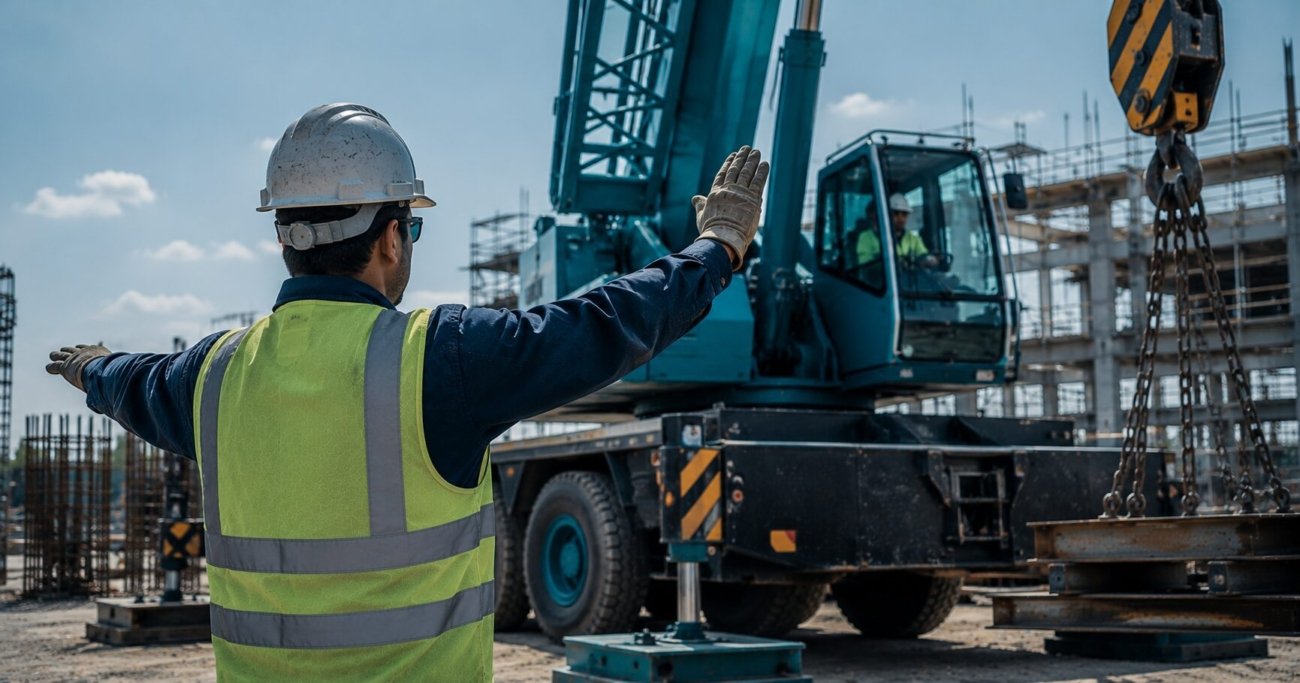
Qualified crane signal person in high-visibility vest giving standard hand signals to a crane operator on a construction site

Crane Hand Signals Every Operator Should Know

TIPS: Crane and Rigging Safety
Crane Hand Signals Every Operator Should Know
The OSHA and ASME B30.5 Standard Signals, Who Must Use Them, and How
There are 19 standard crane hand signals defined under OSHA 29 CFR 1926 Subpart CC Appendix A and ASME B30.5. These are not suggestions or site preferences. They are the federally recognized signal system for crane operations in construction, and every qualified signal person, rigger, and crane operator on a covered worksite is required to know them. This guide covers all 19 signals, OSHA’s signal person qualification requirements, and the operational rules that govern when and how signals must be given.
19
Standard ASME/OSHA Signals
OSHA 29 CFR 1926 Subpart CC Appendix A and ASME B30.5 define 19 standard hand signals covering hoisting, lowering, boom movement, swinging, travel, telescoping, and stopping operations.
OSHA 29 CFR 1926 Subpart CC App A | ASME B30.5
1928
OSHA Signal Person CFR
29 CFR 1926.1428 requires that employers ensure each signal person is qualified before giving any signals. Qualification requires an oral or written test plus a practical demonstration. Employer assessment or third-party certification are both accepted paths.
OSHA, 29 CFR 1926.1428
5yr
NCCCO Certification Validity
Third-party signal person certification through NCCCO (National Commission for the Certification of Crane Operators) is valid for five years. Recertification must be completed in the year before the credential expires.
NCCCO Signal Person Certification

Why Standard Hand Signals Exist and Why Non-Standard Signals Are Dangerous

Crane hand signals are standardized precisely because crane operations involve multiple workers, multiple employers, and often workers who have never lifted together before. A signal person from one company directing an operator from another must share a common signal language without a pre-lift conversation about what each gesture means. ASME B30.5 and OSHA’s Subpart CC Appendix A exist to provide that common language.

Non-standard signals are dangerous not because they are inherently confusing, but because they create the conditions for miscommunication when an operator expects a standard signal and receives something else. In a study of crane-related fatalities, communication failures between signal persons and operators are a recurring contributing factor. An operator who sees an unfamiliar gesture may interpret it as the closest standard signal, which may be a different command entirely.

Employers may establish alternate signal systems under 29 CFR 1926.1419(g), but only if the signal person and operator are the only ones who will be using them, and only after the signal person and operator have agreed on the alternative signals before the lift begins. For all other situations, the OSHA Subpart CC Appendix A signals apply.

Important Note
This guide describes the standard hand signals as defined in OSHA 29 CFR 1926 Subpart CC Appendix A and ASME B30.5. The descriptions below are text representations of physical gestures. Workers must receive hands-on training demonstrating the correct execution of each signal and must practice under qualified supervision. Reading about hand signals is not a substitute for training and qualification under 29 CFR 1926.1428.
Regulatory Framework for Crane Signals
29 CFR 1926.1419
General signal requirements: when a signal person is required, that only one person may signal at a time (except emergency stops), that directions must be given from the operator’s perspective, and the special identification protocol for multi-crane operations.
29 CFR 1926.1422
Hand signal chart requirements: the standard hand signals for controlling crane operations must be posted on the equipment. The signal chart must be conspicuous and visible to operators and signal persons.
29 CFR 1926.1428
Signal person qualifications: employers must ensure signal persons are qualified before giving signals. Qualification requires: knowing standard signals, competence in using them, basic understanding of crane dynamics, knowledge of 1926.1419 through 1428, and passing both oral/written and practical tests.
ASME B30.5 Appendix A
The industry standard for mobile and locomotive cranes that defines the standard hand signals. OSHA’s Subpart CC Appendix A aligns with ASME B30.5. Both define the same 19 standard signals that form the universal signal language for crane operations across US construction sites.

When Is a Signal Person Required?

Under 29 CFR 1926.1419(a), a signal person must be provided in each of the following situations: when the point of operation is not in full and direct view of the operator; when the equipment is traveling and the operator’s view in the direction of travel is obstructed; or when either the operator or the person handling the load determines that a signal person is needed because of site-specific concerns.

Obstructed View
The most common trigger: the operator cannot see the load, the landing zone, or the travel path without obstruction. In construction environments, buildings, scaffolding, site trailers, and stored materials routinely obstruct the operator’s sightlines. When this occurs, a qualified signal person is mandatory, not optional.
29 CFR 1926.1419(a)(1)
Equipment Travel
When a mobile crane is traveling and the operator’s view in the direction of travel is obstructed, a signal person must be provided. This includes travel with or without a suspended load. The signal person directs the operator’s travel movement in addition to any lifting operations.
29 CFR 1926.1419(a)(2)
Site Safety Determination
Either the operator or the person handling the load may determine that a signal person is needed based on site-specific safety concerns, even when the view is technically unobstructed. This is a professional judgment call and either party’s determination is sufficient to require a qualified signal person.
29 CFR 1926.1419(a)(3)

The 19 Standard Hand Signals: Complete Reference

The following signals are the standard set defined in OSHA 29 CFR 1926 Subpart CC Appendix A and ASME B30.5. All signals must be given from the operator’s perspective: left and right directions are relative to the operator, not the signal person. The signal person must position themselves so they are clearly visible to the operator at all times while signaling.

Hoisting and Lowering Signals

1. Hoist
Raise the Load
Execution: Extend arm vertically with index finger pointing upward. Move hand in small horizontal circles.
The standard signal for raising the load or the hook. The circling motion distinguishes this from a static pointing gesture. Maintain the signal until the desired position is reached, then give the Stop signal.
2. Lower
Lower the Load
Execution: Extend arm downward with index finger pointing toward the ground. Move hand in small horizontal circles.
Mirrors the Hoist signal in form but with the arm extended downward. Used to lower the hook and load to the landing point. The circling motion is the same as Hoist; direction of pointing distinguishes the two signals.
3. Use Main Hoist
Designate Main Hoist Line
Execution: Tap fist on head, then use regular Hoist or Lower signals.
Used on cranes with multiple hoist lines to designate that the following signal applies to the main hoist. Must precede the hoisting or lowering signal. Used only when the crane has auxiliary and main hoist options and clarification is needed.
4. Use Whipline
Designate Auxiliary Hoist
Execution: Tap elbow with one hand, then use regular Hoist or Lower signals.
Designates the whipline (auxiliary hoist) as the active hoist for the following signal. The tap-elbow gesture distinguishes this from Use Main Hoist. Must precede the hoisting or lowering signal when the auxiliary line is intended.

Boom Movement Signals

5. Raise Boom
Increase Boom Angle
Execution: Extend arm with closed fist and thumb pointing upward.
Instructs the operator to raise the boom (increase the boom angle from horizontal). Distinct from the Hoist signal: this moves the boom, not the load line. An important distinction because raising the boom while the load is suspended may affect load radius and load line tension.
6. Lower Boom
Decrease Boom Angle
Execution: Extend arm with closed fist and thumb pointing downward.
Instructs the operator to lower the boom (decrease boom angle toward horizontal). As with Raise Boom, this affects the load radius and may alter load capacity. The signal person must be aware of the capacity chart implications of boom angle changes.
7. Raise Boom and Lower Load
Simultaneous Operations
Execution: Thumb points up with finger circling from elbow upward; other hand with index finger pointing down and circling.
Used to instruct simultaneous boom raise and load lowering to maintain the load at a constant height while the boom angle increases. This is a complex compound signal requiring the signal person to give both cues simultaneously in a coordinated way.
8. Lower Boom and Raise Load
Simultaneous Operations
Execution: Thumb points down; other hand with index finger pointing up and circling.
The inverse of signal 7: simultaneous boom lowering and load hoisting to maintain constant load height while decreasing boom angle. Used during precision placement operations where load height must be held constant as boom angle changes.

Swing and Travel Signals

9. Swing
Rotate the Superstructure
Execution: Extend arm horizontally and point with index finger in the direction of swing.
Directs the rotation of the crane superstructure (the upper works including boom) left or right. Direction is given from the operator’s perspective, not the signal person’s. A common source of error: the signal person faces the crane and points, but directions must be the operator’s left and right, not the signal person’s left and right.
10. Travel
Move the Entire Crane
Execution: Extend arm downward and away from body. Circle hand around waist level with arm extended.
Instructs the entire crane to travel (move). Used for mobile cranes traveling to a new position. The circling motion at waist level distinguishes this from hoisting signals. Direction is indicated separately by pointing after giving the Travel signal.
11. Travel (Both Tracks)
Crawler Crane Travel
Execution: Use both fists in front of body, rotating forward to indicate travel direction.
Used specifically for crawler cranes (on tracks), directing both tracks to move forward or backward. Rotating fists forward indicates forward travel; rotating fists rearward indicates reverse travel. Direction of fist rotation determines travel direction.
12. Travel (One Track)
Crawler Crane Turn
Execution: Lock one fist at hip to indicate the stationary track; use other hand in circular motion to indicate the track that moves.
Directs a crawler crane to turn by locking one track and moving the other. The locked fist at the hip indicates which track stays stationary. The circling hand indicates which track moves and in what direction. Used when a tight-radius turn is needed.

Telescoping and Jib Signals

13. Extend Boom (Telescoping Out)
Increase Boom Length
Execution: Hands held together with thumbs pointing outward in opposite directions.
Used on telescoping boom cranes to signal extension of the boom to increase reach. Extending the boom increases the load radius and reduces capacity per the load chart. Signal persons must be aware of the capacity implications before directing boom telescoping under load.
14. Retract Boom (Telescoping In)
Decrease Boom Length
Execution: Hands held apart with thumbs pointing inward toward each other.
The inverse of Extend Boom: directs the operator to retract (shorten) the telescoping boom. Retracting the boom decreases the load radius and increases capacity. Used when the current extension places the crane near or at its capacity limits for the required lift.
15. Extend Boom (One-Hand)
One Section Only
Execution: One hand held with thumb and forefinger nearly touching. Move arm in the direction of extension.
A variation of the Extend Boom signal used to indicate extending only one boom section or a small increment of extension. The “inch” gesture (near-touching thumb and forefinger) communicates small increment. Used for precision positioning where full extension is not intended.
16. Retract Boom (One-Hand)
One Section Only
Execution: One hand held with thumb and forefinger nearly touching. Move arm in the direction of retraction.
The inverse of the one-hand extend signal: indicates retraction of a single boom section or a small increment. Same near-touching thumb and forefinger gesture, with arm movement indicating retraction direction. Used for precision placement and capacity management.

Stop and Emergency Signals

17. Stop
Halt Current Operation
Execution: Extend arm horizontally, palm facing downward. Move arm back and forth laterally.
Halts the current crane operation. The operator must stop all movement controlled by the signal person’s current signal. The load is held in place. The Stop signal ends one movement; operations can resume after the next command signal. This is a normal operational stop, not an emergency.
18. Emergency Stop
STOP ALL MOVEMENT IMMEDIATELY
Execution: Extend BOTH arms horizontally, palms facing downward. Move both arms simultaneously back and forth laterally.
The Emergency Stop signal uses both arms and both hands. The operator must immediately cease all crane movement and hold all loads in place. OSHA 29 CFR 1926.1419(j) requires that anyone who becomes aware of a safety problem alert the operator or signal person by giving the stop or emergency stop signal. Anyone at the worksite may give the emergency stop. Under 1926.1417(y), the operator must obey a stop or emergency stop signal from anyone, not only the designated signal person.
19. Dog Everything
Make Equipment Safe
Execution: Clasp hands together in front of the body.
Instructs the operator to make all crane functions safe: apply brakes, disengage clutches, and secure all moving parts. This is used when work is complete, during a break in operations, or when a hazard requires the crane to be secured before workers approach the area. Distinct from Stop: Dog Everything means the crane is fully secured, not just momentarily halted.

Operational Rules Every Signal Person Must Know

Rule
What It Means in Practice
One signal person at a time
Only one person may give operational signals to a crane at any time, except for Emergency Stop. When signal persons need to be relieved or changed, the operator must be notified before any new person begins signaling. Per 29 CFR 1926.1419(h).
Anyone may give Emergency Stop
The Emergency Stop signal is the exception: anyone at the worksite who recognizes a safety problem may give the emergency stop. Under 29 CFR 1926.1417(y), the operator must obey a stop or emergency stop signal regardless of who gives it. Knowing this rule can save lives. Per 29 CFR 1926.1419(j).
Directions from operator’s perspective
All directional signals (swing left, travel right) are given relative to the operator’s seating position and line of sight, not the signal person’s. A signal person facing the operator must mentally mirror directions. Per 29 CFR 1926.1419(k).
Signal must be clear before operator responds
The operator must not respond to a signal that is not clearly understood. If the operator cannot see or interpret a signal, the default action is to stop all motion and re-establish contact with the signal person. An ambiguous signal is a stop signal by default.
Signal chart must be posted on equipment
29 CFR 1926.1422 requires the standard hand signal chart to be posted conspicuously on the crane equipment. If alternate signals have been agreed upon, those must also be posted. An employer who fails to post the signal chart is in violation of 1926.1422 regardless of whether all workers know the signals.
Multi-crane identification required
When a signal person directs more than one crane, a system must be used to identify which crane each signal is for before giving the function or direction signal. Per 29 CFR 1926.1419(m). This may be a numbered designation, a named identifier, or another agreed-upon system, as long as it is unambiguous.
Source: OSHA | 29 CFR 1926.1419 | 29 CFR 1926.1417(y) | 29 CFR 1926.1422

Signal Person Qualification: What OSHA Requires

Under 29 CFR 1926.1428, employers must ensure each signal person is qualified before giving any signals. This is an employer obligation, not just a worker responsibility. A signal person who has not been assessed for qualification cannot legally direct crane operations, and the employer who allowed them to do so is in violation of 1926.1428.

Signal Person Qualification Requirements Under 29 CFR 1926.1428(c)
Know and understand standard hand signals (or the agreed alternate signal system)
The signal person must know every signal in the OSHA Subpart CC Appendix A standard set, or the site-specific alternate set if one has been established. Partial knowledge is not qualification.
Be competent in the use of and be familiar with the signals
Competence means the ability to give signals correctly and in a manner the operator can see and interpret, not just the ability to describe them verbally. The practical test component assesses this.
Understand crane operations and limitations including crane dynamics
A qualified signal person must understand crane swing radius, boom deflection from hoisting loads, load line angles, and the dynamics of stopping and starting suspended loads. This is why a signal person cannot simply learn signals in isolation from crane operations knowledge.
Know and understand the relevant signal person requirements in 1926.1419 through 1928
The signal person must know the regulatory framework governing their role, including when a signal person is required, the one-signal-person rule, the emergency stop exception, and the directional perspective requirement.
Demonstrate qualification through oral/written test and practical test
Two paths: (1) Third-party qualified evaluator assesses the signal person (NCCCO certification satisfies this, valid for five years), or (2) Employer-based qualification assessment using an equally rigorous oral or written test plus a practical demonstration. Either path must be documented.
Source: OSHA | 29 CFR 1926.1428 | NCCCO Signal Person Certification Program

High-Visibility and Positioning Tips for Signal Persons

Wear High-Visibility Clothing
Signal persons must be clearly visible to the operator at all times. High-visibility vests, gloves, and helmets of a color distinct from general site workers help the operator identify the signal person in a crowded, visually complex environment. A signal that cannot be seen by the operator is the same as no signal at all.
Position for Maximum Visibility
Before signaling begins, confirm the operator can see you clearly from their cab. Move to a position where your signals are fully visible throughout the lift, including during rotation and travel. Never position yourself in the blind spot of the operator’s cab or behind the load.
Establish Contact Before Every Lift
Before each lift, confirm two-way recognition with the operator: the operator acknowledges the signal person’s position and readiness. Never begin a lift where the operator has not acknowledged the signal person’s position. If contact is lost during a lift, give the Stop signal immediately.
Stay Out of the Swing Radius
Signal persons must maintain a safe position outside the swing radius of the crane’s counterweight and superstructure at all times. Being inside the swing radius while giving signals is one of the most common struck-by hazards for signal persons. Mark swing radius boundaries clearly on the ground before operations begin.

Key Takeaways

Anyone Can Give Emergency Stop
This is the most important rule to memorize: the Emergency Stop signal (both arms extended horizontally, both moving back and forth) may be given by anyone on the worksite who sees a safety problem. The operator is legally required to obey it regardless of who gives it. This rule exists to prevent fatalities when the designated signal person is not in position to see the hazard.
Directions Are Always From the Operator’s Perspective
Signal persons who face the operator must think in mirrored directions. The operator’s left is the signal person’s right when they face each other. Getting this wrong can send a load in the wrong direction. Confirming which direction is which before each lift with a brief swing test (give swing signal, verify operator swings the correct direction) prevents this error.
Qualification Is an Employer Responsibility
OSHA 29 CFR 1926.1428 places the qualification obligation on the employer. If an unqualified person directs crane operations, both the worker and the employer face OSHA liability. Employers must assess or obtain third-party documentation of qualification before assigning anyone to signal person duties, and retain that documentation.
The Signal Chart Must Be Posted on the Equipment
29 CFR 1926.1422 requires the standard hand signal chart to be posted conspicuously on the crane. This is a separate compliance requirement from signal person qualification. An employer whose qualified signal person knows all signals but whose crane lacks a posted signal chart is still in violation of 1926.1422.

Frequently Asked Questions

Can the crane operator and signal person agree to use their own signals instead of the standard ones?
Yes, under specific conditions. 29 CFR 1926.1419(g) permits alternate signal systems when the signal person and operator are the only ones who will be using them, and only after they agree on the signals before the lift. The alternate signals must be posted on the equipment as required by 1926.1422. Non-standard signals used without this agreement, or used in situations where other signal persons or operators may be involved, are not compliant.

What is the difference between Stop and Dog Everything?
Stop (one arm extended horizontally, moving back and forth) halts the current crane operation. The crane remains live; operations can resume on the next signal. Dog Everything (hands clasped in front of the body) instructs the operator to make the crane fully safe: apply brakes, disengage clutches, secure all moving parts. Dog Everything is used when workers will approach the area, when operations are ending, or when a hazard requires the crane to be secured rather than simply paused.

If radio communication fails, must the operator stop the lift?
Yes. Under 29 CFR 1926.1419, the operator must have a clear and unambiguous signal before executing any crane movement. If radio communication fails during a lift and hand signals are not available or visible, the operator must stop all motion. The default response to lost communication is Stop, not continuation based on the last signal received. Resume only when communication is re-established.

Government and Regulatory Sources

Industry References

Related VelSafe Articles

Know the Signals Before the Load Goes Up

All 19 standard hand signals, the operational rules that govern how they are given, and the qualification requirements that determine who may give them exist for a single purpose: to prevent the communication failures that cause crane-related fatalities and injuries. Learn them before you are on the ground under a suspended load. Practice them before you are the signal person on a lift. Post the signal chart on the equipment as required. And remember: anyone who sees a hazard can and must give the Emergency Stop. Find more crane and rigging safety resources at velsafe.com.

Add a Comment

Your email address will not be published. Required fields are marked *