
TIPS: LABORATORY SAFETY
Where Most Lab Incidents Start
and What Every Worker Must Know Before Entering
and What Every Worker Must Know Before Entering
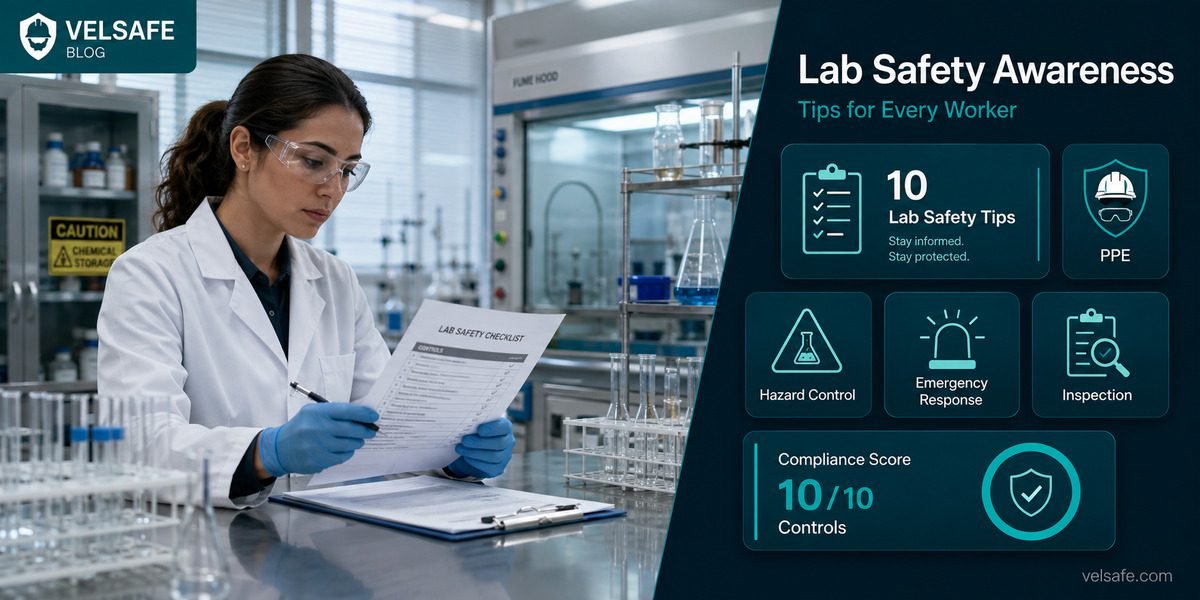
OSHA’s laboratory standard (29 CFR 1910.1450) requires employers to develop a Chemical Hygiene Plan, yet chemical exposures and spills remain among the most reported lab incidents in general industry and healthcare. These 10 lab safety awareness tips cover the habits that prevent the most common laboratory injuries.
29 CFR
OSHA Lab Standard
Section 1910.1450 requires every employer with lab workers to maintain a written Chemical Hygiene Plan covering hazard controls and PPE requirements.
OSHA, 29 CFR 1910.1450
500K+
Workers at Risk
OSHA estimates over 500,000 workers in the United States are employed in laboratories and regularly exposed to hazardous chemical, biological, and physical agents.
OSHA Laboratories
#1
Cause: Training Gaps
Inadequate hazard awareness training is the leading root cause identified in laboratory incident investigations, ahead of equipment failure and procedural errors.
NIOSH, Laboratory Safety
Lab safety awareness is not a compliance checkbox. It is the daily habit of knowing which hazards are present, which controls are in place, and what to do when something goes wrong. OSHA’s laboratory standard at 29 CFR 1910.1450 establishes a minimum framework, but awareness-level training is the foundation every worker needs before any procedure begins. These 10 tips address the behaviours that most frequently lead to preventable laboratory incidents.
This guide applies to laboratory workers in general industry, healthcare, manufacturing quality control, and research environments. Each tip reflects a pattern identified in real incident investigations, not a theoretical concern.
Quick Summary: 10 Lab Safety Awareness Tips
#
Tip
1
Read the Safety Data Sheet before handling any chemical
2
Wear task-specific PPE, not just whatever is nearby
3
Label every container, every time, without exception
4
Never work alone in a lab with active hazards
5
Keep emergency equipment accessible and tested
6
Store chemicals by compatibility, not by convenience
7
Follow proper waste disposal procedures every time
8
Report spills and near-misses the same day they occur
9
Conduct a quick hazard review before starting any new task
10
Keep the lab organised and all passageways clear
The 10 Lab Safety Awareness Tips in Detail
1
Read the Safety Data Sheet Before Handling Any Chemical
Why It Matters
The Safety Data Sheet (SDS) tells you exactly what hazards a chemical presents, what PPE is required, how to respond to a spill or exposure, and what first aid steps to take. Without reading it first, a worker cannot make informed decisions about safe handling.
What To Do
Locate the SDS for every chemical before beginning work. OSHA’s Hazard Communication Standard (29 CFR 1910.1200) requires SDSs to be accessible to all workers at all times. Check Sections 2, 7, 8, and 13 for hazard identification, handling, PPE, and disposal.
Common Mistake
Assuming you know a chemical’s hazards because you have used it before. Formulations change, concentrations vary, and new exposure route data gets added. Always check the current SDS, not memory.
Pro Tip
Keep a printed or digital SDS accessible at the point of use, not filed in a drawer across the lab. The faster a worker can access it during an incident, the better the outcome.
2
Wear Task-Specific PPE, Not Just Whatever Is Nearby
Why It Matters
Not all gloves protect against all chemicals. Not all safety glasses protect against splashes. Using the wrong PPE gives workers a false sense of protection while leaving them fully exposed to the hazard.
What To Do
Consult the SDS Section 8 and your Chemical Hygiene Plan to identify the correct glove material, eye protection type, and respiratory protection for each task. OSHA 29 CFR 1910.132 requires a documented hazard assessment to justify PPE selection.
Common Mistake
Wearing nitrile gloves for every task. Nitrile resists many chemicals but offers poor protection against ketones, strong oxidisers, and some solvents. Always verify glove compatibility before use.
Pro Tip
Post a laminated PPE selection chart at the lab entrance listing common tasks and the correct PPE for each. This eliminates guessing and reduces the time it takes to gear up correctly.
3
Label Every Container, Every Time, Without Exception
Why It Matters
Unlabelled containers are one of the most common OSHA Hazard Communication violations. An unlabelled beaker of clear liquid could be water, a solvent, an acid, or a buffer. Misidentification causes chemical exposures and cross-contamination incidents.
What To Do
Label every secondary container at the moment you fill it. Include the chemical name, concentration, date, and your name. Under 29 CFR 1910.1200(f), secondary containers require at minimum the product identifier and applicable hazard pictograms.
Common Mistake
Leaving containers unlabelled because you “will only be away for a minute.” Shifts change, emergencies happen, and another worker may handle that container with no information about its contents.
Pro Tip
Keep a roll of pre-printed label tape or a marker and blank labels at every bench. If labelling is inconvenient, workers will skip it. Make it the fastest part of any task.
4
Never Work Alone in a Lab With Active Hazards
Why It Matters
A chemical splash to the eyes requires immediate eyewash irrigation and someone to call for help. A worker who loses consciousness due to a toxic exposure cannot self-rescue. Working alone with active hazards turns survivable incidents into fatalities.
What To Do
Establish a lab buddy system for all tasks involving corrosives, flammables, reproductive toxins, and acute toxic agents. At minimum, arrange for check-in calls from another worker if you must work after hours. Document the policy in your Chemical Hygiene Plan.
Common Mistake
Assuming that being in a shared building is the same as having a buddy. If nobody is within earshot or line of sight, you are working alone for all practical emergency purposes.
Pro Tip
Post a sign-in board at the lab entrance so supervisors can confirm who is working, with what materials, and until what time. This also supports emergency responders.
5
Keep Emergency Equipment Accessible and Tested
Why It Matters
An eyewash station that has not been flushed in months will deliver contaminated water. A fire extinguisher blocked by a box cannot be reached in an emergency. Emergency equipment that is not maintained or accessible provides no protection at the moment it is needed most.
What To Do
OSHA standard 29 CFR 1910.151(c) requires that eyewash and emergency shower equipment be accessible and functional. Flush eyewash stations weekly. Keep a 10-second clear path to all emergency equipment. Log every inspection with the date and the inspector’s name.
Common Mistake
Knowing where the eyewash station is but never having activated it. Workers who have never used emergency equipment in a drill take critical seconds finding and operating it during a real incident.
Pro Tip
Include emergency equipment activation in every new worker orientation. Have workers locate, activate, and use each piece of emergency equipment before they handle any hazardous materials.
6
Store Chemicals by Compatibility, Not by Convenience
Why It Matters
Storing incompatible chemicals together creates the conditions for violent reactions, fires, and toxic gas releases if a container fails or leaks. Alphabetical storage routinely places incompatibles side by side.
What To Do
Segregate chemicals into hazard classes: flammables, oxidisers, corrosives, toxics, and reactives stored in separate areas or approved cabinets. Acids and bases must be separated. Check the SDS Section 7 for specific storage incompatibilities for every chemical in your inventory.
Common Mistake
Storing all chemicals alphabetically because it makes them easy to find. Nitric acid (N) stored next to isopropanol (I) because of alphabetical proximity is a fire and toxic gas hazard in a single spill event.
Pro Tip
Use a chemical inventory management system that flags incompatible co-storage. Many labs use colour-coded storage zones displayed on a map posted at the chemical storage entrance.
7
Follow Proper Waste Disposal Procedures Every Time
Why It Matters
Improper chemical waste disposal creates ongoing exposure risk for other lab workers, facilities staff, and waste handlers downstream. It also triggers EPA and state regulatory violations independent of any OSHA exposure incident.
What To Do
Identify the correct waste stream for each material before you generate the waste. Label all waste containers with their contents, concentration, and the date accumulation began. Follow your facility’s Chemical Hygiene Plan procedures for satellite accumulation areas and pickup schedules.
Common Mistake
Pouring small amounts of chemical waste down the drain because the volume seems insignificant. Many regulated chemicals have drain disposal restrictions regardless of volume. When in doubt, treat it as hazardous waste.
Pro Tip
Post a colour-coded waste disposal chart at each bench showing which waste stream each common chemical belongs in. Reduce the number of decisions a worker must make during a busy procedure.
8
Report Spills and Near-Misses the Same Day They Occur
Why It Matters
Near-misses are the clearest signal that a control is about to fail. Delayed reporting means delayed investigation, which means the same hazard condition remains in place until an actual injury occurs. Every unreported near-miss is a missed chance to prevent the next incident.
What To Do
Report any unplanned chemical release, PPE failure, equipment malfunction, or near-exposure event to your supervisor on the same shift it occurs. Complete an incident report before leaving. Verify a corrective action is initiated before starting work the following day.
Common Mistake
Cleaning up a small spill and not reporting it because “nothing happened.” The spill itself is a near-miss. The hazard that caused it is still present. Unreported spills create ongoing exposures for other workers who do not know the area was contaminated.
Pro Tip
Make reporting quick and blame-free. A one-page incident form at every bench, or a digital form on a shared device, removes every barrier to timely reporting. Workers report more when the process is easy and consequences are not punitive.
9
Conduct a Quick Hazard Review Before Starting Any New Task
Why It Matters
Lab tasks rarely proceed exactly as planned. A 60-second review of what chemicals are in use, what could go wrong, and where the nearest emergency equipment is located costs nothing and prevents a significant proportion of incidents caused by unfamiliar conditions or changed setups.
What To Do
Before beginning any new procedure, take 60 seconds to answer three questions: What are the hazards? What controls are in place? What do I do if something goes wrong? This informal task hazard analysis is aligned with OSHA’s General Duty Clause obligation to address recognised hazards.
Common Mistake
Starting a task without reviewing it because you have done something similar before. Each procedure has variables: a different reagent batch, a new piece of equipment, or a modified concentration. Familiarity creates overconfidence, which is a documented accident cause.
Pro Tip
Use a laminated pre-task checklist card at each bench that workers check off before beginning. Three to five questions, 30 seconds, every time. Consistency builds the habit.
10
Keep the Lab Organised and All Passageways Clear
Why It Matters
Cluttered labs have higher slip, trip, and fall rates and slower emergency response times. Blocked aisles mean delayed evacuations. Reagents left on benches without organisation increase the chance of accidental mixing, tipping, or cross-contamination.
What To Do
Keep walkways a minimum of 28 inches wide and free of obstructions at all times per OSHA 29 CFR 1910.37 (means of egress). Return all chemicals to their designated storage after each task. Clear and wipe down every bench at the end of each shift.
Common Mistake
Leaving equipment and materials out because the same procedure will be repeated tomorrow. Overnight accumulation of chemicals on open benches increases vapour exposure for the next shift’s workers before they are ready to work with those materials.
Pro Tip
Assign designated storage locations for every piece of equipment and every reagent class. When everything has a place, disorder is immediately visible and can be corrected before it becomes a hazard.
Pre-Task Lab Safety Checklist
Before You Start
☐ SDS located and reviewed for all chemicals
☐ Correct PPE selected and inspected
☐ All containers labelled
☐ Buddy or check-in arrangement confirmed
☐ Emergency equipment path is clear
☐ Waste containers identified and ready
After You Finish
☐ All chemicals returned to proper storage
☐ Waste containers sealed and labelled
☐ Bench wiped down and cleared
☐ Any spills or near-misses reported
☐ PPE inspected and stored or disposed of
☐ Passageways clear before leaving
Key Takeaways
Awareness Comes Before Procedure
Knowing the hazards present in a task is the precondition for every other safety step. SDS review, task hazard checks, and labelling all happen before work begins, not after a problem occurs. Build awareness into the start of every task.
Most Lab Incidents Are Preventable
Training gap investigations consistently show that the knowledge to prevent an incident was available, but not applied consistently. These 10 tips are habits, not one-time actions. Consistency is the difference between a safe lab and one that relies on luck.
OSHA 29 CFR 1910.1450 Sets the Minimum
The OSHA laboratory standard requires a Chemical Hygiene Plan covering hazard controls, PPE, and emergency procedures. But compliance with the standard is a floor, not a ceiling. Labs that exceed the minimum requirements by training workers in awareness-level hazard recognition have measurably fewer incidents. Review your Chemical Hygiene Plan annually and confirm every worker has received documented training on its contents.
Frequently Asked Questions
What does OSHA require for lab safety under 29 CFR 1910.1450?
OSHA’s laboratory standard requires employers to develop and implement a written Chemical Hygiene Plan (CHP) that covers standard operating procedures for chemical handling, criteria for using control measures, PPE requirements, employee information and training, circumstances requiring prior approval, provisions for medical consultation, and designation of a Chemical Hygiene Officer. The CHP must be reviewed and updated annually.
Which gloves protect against the widest range of laboratory chemicals?
No single glove material protects against all chemicals. Nitrile gloves offer good resistance to oils, greases, and many solvents but degrade quickly with ketones and some esters. Neoprene provides broader chemical resistance. Butyl rubber is preferred for ketones and esters. Silver Shield or 4H laminate gloves offer the broadest spectrum protection. Always verify compatibility with your specific chemical using a permeation data chart or the SDS before selecting gloves.
How often should eyewash stations be flushed in a lab?
OSHA does not specify a flush interval in 29 CFR 1910.151, but ANSI Z358.1 (the industry standard) recommends activating and flushing plumbed eyewash stations weekly to remove stagnant water and verify function. Self-contained units should be inspected monthly and water replaced according to the manufacturer’s schedule. Weekly flushing prevents microbial growth and ensures consistent water flow pressure during a real emergency.
What chemicals should never be stored together in a laboratory?
Key incompatible pairs in most laboratories include: oxidising acids (nitric, perchloric) with flammables or organic compounds; chlorine-based oxidisers with ammonia compounds; concentrated acids with concentrated bases; and peroxide-forming solvents stored beyond their safe use date. The SDS Section 7 for each chemical lists specific incompatibilities. Use a chemical incompatibility chart as a quick reference at your storage area, and review it whenever a new chemical is added to the inventory.
What information must be on a secondary container label in a lab?
Under OSHA’s Hazard Communication Standard (29 CFR 1910.1200), secondary containers must include at minimum the product identifier (the chemical name as it appears on the SDS) and applicable hazard pictograms or words. Many Chemical Hygiene Plans require additional information: concentration, date of transfer, and the name of the worker who created the container. Containers used immediately and by the person who prepared them are exempt, but any container that passes out of that worker’s control must be labelled.
Can a lab worker work alone after hours if they are careful?
Being careful does not eliminate the risk that makes solo work dangerous: the inability to summon help if you are incapacitated. OSHA does not specifically ban solo lab work, but working alone with acutely toxic agents, flammables, or reactive chemicals without a check-in system in place conflicts with the General Duty Clause requirement to provide a workplace free of recognised serious hazards. Most Chemical Hygiene Plans restrict or prohibit solo work with these materials and require supervisory approval for after-hours procedures.
What should a worker do immediately after a chemical splash to the eyes?
Immediately flush the eyes at the nearest eyewash station for a minimum of 15 minutes with a continuous, gentle flow of water. Do not rub the eyes. Remove contact lenses only if they can be removed without interrupting flushing. Have another person call for emergency medical assistance during the flush. After flushing, seek medical evaluation regardless of whether symptoms seem mild, because some chemical injuries do not present full damage until hours later.
Sources
Government and Regulatory Sources
- OSHA. 29 CFR 1910.1450: Occupational Exposure to Hazardous Chemicals in Laboratories — the standard requiring Chemical Hygiene Plans for laboratory employers.
- OSHA. 29 CFR 1910.1200: Hazard Communication Standard — governing SDS access, container labelling, and worker training requirements.
- OSHA. 29 CFR 1910.151: Medical Services and First Aid — eyewash and emergency shower requirements for workplaces using corrosive materials.
- OSHA. 29 CFR 1910.37: Maintenance, Safeguards, and Operational Features for Exit Routes — minimum aisle width and egress requirements.
- NIOSH. Laboratory Safety — guidance on hazard recognition and control for laboratory workers across industries.
Research and Industry Sources
- American Chemical Society. Chemical Safety — industry guidance on chemical hygiene, PPE selection, and incident prevention in research and industrial labs.
- National Academies of Sciences. Prudent Practices in the Laboratory — comprehensive framework for laboratory safety management used as a reference standard in academic and industrial settings.
Related VelSafe Articles
Insights
Industrial Hygiene Awareness: A Complete Overview
How industrial hygiene principles apply to chemical exposure assessment, sampling, and control across lab and manufacturing environments.
Tips
10 Incident Investigation Tips for Safety Managers
Practical tips for conducting effective incident investigations after a lab or workplace injury, including root cause analysis and corrective action documentation.
Worker Safety
Injury and Illness Prevention Program: IIPP Guide for Workers
What every worker should know about IIPP requirements, their rights under the programme, and how it connects to daily lab safety practices.
LABORATORY SAFETY
Build a Safer Lab With VelSafe
Find more practical safety tips, OSHA compliance guides, and laboratory safety resources at VelSafe.
Explore More Tips