

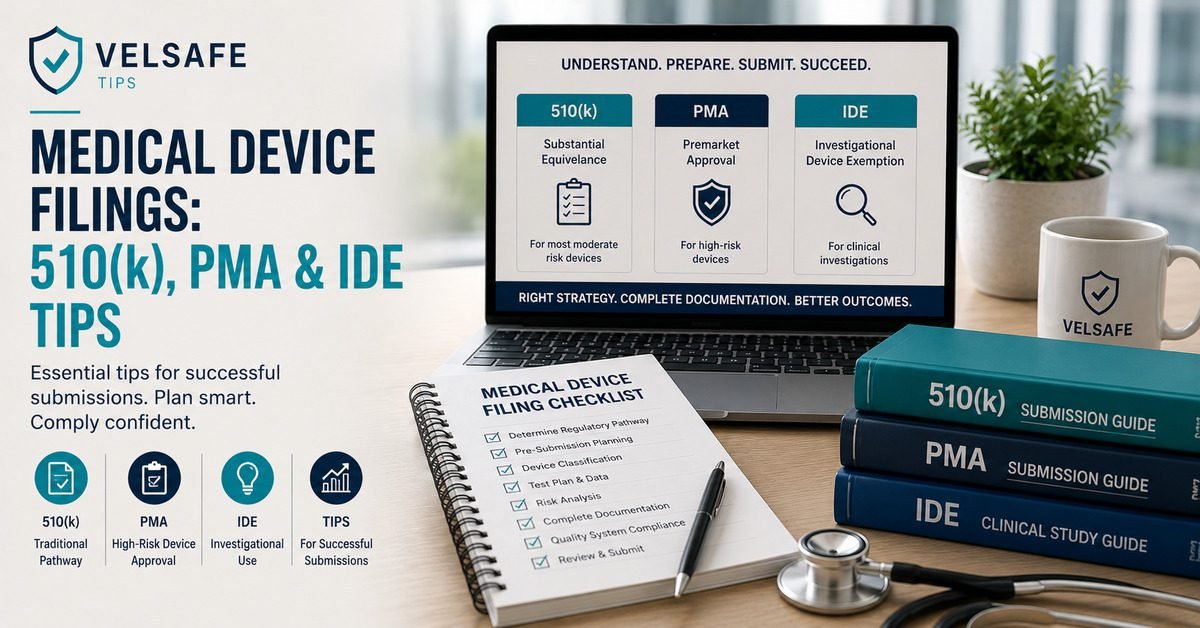
TIPS: Medical Device Filings
7 Medical Device Filing Tips:
510(k), PMA, and IDE Done Right
510(k), PMA, and IDE Done Right
Choosing the wrong FDA submission pathway costs months and sometimes millions. Whether you are preparing a 510(k) for a substantially equivalent device, a Premarket Approval (PMA) for a Class III product, or an Investigational Device Exemption (IDE) to run a clinical study, the decisions made before the first document is drafted determine how the review goes. These seven tips cover the most critical points in medical device filings, ordered from the mistakes that sink submissions to the preparation habits that accelerate them.
46%
510(k)s Refused to Accept
FDA data shows nearly half of all 510(k) submissions that receive a Refuse to Accept (RTA) decision are rejected for administrative deficiencies, missing information that should have been caught before submission. Correct pathway selection and pre-submission meetings prevent most RTAs.
FDA: RTA Policy for 510(k)s
180 days
FDA PMA Review Clock
FDA has 180 days to review a PMA application after filing. The clock stops every time FDA issues a Major Deficiency letter and restarts when the applicant responds. Submissions that receive multiple deficiency letters can take three or more years from filing to approval.
FDA: PMA Review Process
Q-Sub
Pre-Submission Meeting with FDA
A Q-Submission (Pre-Sub) allows manufacturers to ask FDA specific questions about submission content, study design, and predicate selection before filing. FDA provides written feedback. Applicants who use Pre-Subs consistently report faster review times and fewer deficiency letters.
FDA: Q-Submission Program Guidance
Quick Summary: 7 Medical Device Filings Tips
1
Confirm your device class and pathway before drafting anything
2
Use a Pre-Submission (Q-Sub) meeting for any novel device or uncertain pathway
3
Select your 510(k) predicate carefully, it defines your whole submission
4
Build your IDE clinical study around FDA’s Significant Risk determination
5
Structure your PMA clinical data to answer FDA’s substantial evidence standard
6
Complete the RTA checklist before every submission, not after
7
Track your FDA review clock and respond to deficiencies in full, every time
The 7 Tips in Full
Tip 1: Confirm Your Device Class and Filing Pathway Before Drafting Anything
Why It Matters
The wrong pathway wastes months. A device classified as Class II may clear through a 510(k). A Class III device requires a PMA unless it was on the market before 1976 (pre-amendment device) or has received an exemption. Misclassifying a device, or selecting a 510(k) when a De Novo is the correct pathway, means a submission that FDA will either reject or route to the wrong review division.
What To Do
Search the FDA product classification database using the device’s intended use. Confirm the regulation number (21 CFR Part 8xx), classification panel, and review pathway. If the device does not match an existing product code, a De Novo classification request may be required rather than a 510(k). Document the classification decision with the product code and regulation number before any submission work begins. Source: FDA Product Classification Database
Common Mistake
Selecting a 510(k) pathway based on the product’s physical appearance rather than its intended use. Two visually similar devices with different intended uses can have different classifications. A wound contact device intended for chronic wounds may be Class III even if an acute wound equivalent is Class II.
Pro Tip
Request a Pre-Sub meeting specifically to confirm classification before investing in testing or clinical data. FDA will confirm or correct the classification in writing, this written response is the most defensible starting point for any submission.
Tip 2: Use a Pre-Submission Meeting for Any Novel Device or Uncertain Pathway
Why It Matters
A Q-Submission (Pre-Sub) gives you FDA’s written opinion on submission strategy, study design, and testing protocols before you commit resources. For novel devices, combination products, or any situation where the appropriate predicate or clinical standard is unclear, a Pre-Sub prevents the most expensive kind of submission failure: complete redesign of the evidence package after the initial filing is rejected.
What To Do
Submit a Pre-Sub request through eSTAR or CDRH eSubmitter at least 60 days before you need the meeting. Include specific questions, not general ones. Ask about predicate acceptability, specific performance testing requirements, and the acceptability of your proposed clinical study design if applicable. FDA’s written response to your Pre-Sub is not binding, but it is a strong indicator of how the actual submission will be reviewed. Source: FDA Q-Submission Program Guidance (2023)
Common Mistake
Submitting vague questions in a Pre-Sub, such as “Is a 510(k) appropriate for our device?” without specifying the intended use, proposed predicate, and proposed test methods. FDA’s response to vague questions is predictably vague. The quality of the Pre-Sub response depends entirely on the specificity of the questions asked.
Pro Tip
Include a draft comparison table of your device vs. the proposed predicate in the Pre-Sub package. Showing FDA your predicate selection logic upfront gets you a targeted response on predicate acceptability, the single most useful piece of feedback a Pre-Sub can return for a 510(k) submission.
Tip 3: Select Your 510(k) Predicate Carefully, It Defines Your Whole Submission
Why It Matters
Your predicate device defines the intended use and technological characteristics your submission must match or explain. A predicate that is cleared for a narrower intended use than your device forces you to argue differences, which FDA scrutinises. A predicate with a known performance standard defines the testing you must complete. Predicate selection is not administrative, it is the strategic foundation of the 510(k).
What To Do
Search the 510(k) database for cleared devices with the same intended use and device type. Evaluate predicate candidates for: matching intended use, similar technological characteristics, existing recognised test standards, and absence of post-clearance adverse event history. Use a split predicate (two predicates: one for intended use, one for technological characteristics) only when one predicate cannot establish both. Document the predicate selection rationale before submission. Source: FDA 510(k) Database and Search Tool
Common Mistake
Selecting the most recently cleared device with a similar product name as the predicate, without verifying that its intended use and technological characteristics actually match your device. Recently cleared predicates are not automatically the best predicates, an older cleared device with a stronger performance standard and identical intended use is often preferable.
Pro Tip
Pull the actual 510(k) summary or decision memo for your candidate predicate from the 510(k) database. Read the FDA reviewer’s summary of technological characteristics and intended use, not just the device name. The reviewer’s language from the predicate’s clearance should inform how you describe your device in your own submission.
Tip 4: Build Your IDE Clinical Study Around FDA’s Significant Risk Determination
Why It Matters
An IDE allows you to study an investigational device in human subjects. If FDA determines the device poses a Significant Risk (SR), an IDE application must be approved before the study begins. If FDA determines the device is Non-Significant Risk (NSR), the study may proceed with IRB approval only, no FDA submission required. Getting this determination wrong adds months of unnecessary regulatory review or, worse, starts a study without required FDA clearance.
What To Do
Use FDA’s SR/NSR guidance to evaluate your device against the four Significant Risk categories: implants, devices that support or sustain human life, devices that present potential for serious risk to health, and devices of substantial importance in diagnosing, curing, mitigating, or treating disease or otherwise preventing impairment of human health. Document the SR/NSR determination with a written rationale. If the determination is borderline, submit a Pre-Sub to FDA specifically requesting written concurrence on the SR/NSR decision before enrolling subjects. Source: FDA: Significant Risk and Nonsignificant Risk Medical Device Studies (2006)
Common Mistake
Relying on IRB review alone to determine SR/NSR without a sponsor-level written determination. IRBs make SR/NSR decisions, but if FDA later disagrees and finds that the device was SR, the study must stop and an IDE must be filed retroactively, which may invalidate data already collected.
Pro Tip
Even for NSR studies, maintain IDE-equivalent records: protocols, IRB approvals, consent forms, adverse event reports, and device accountability records. If the device is later reclassified as SR, or if the study data is used in a subsequent PMA, having IDE-quality records from the outset protects the data’s usability for regulatory purposes.
Tip 5: Structure Your PMA Clinical Data to Answer FDA’s Substantial Evidence Standard
Why It Matters
A PMA requires clinical data demonstrating that the device is safe and effective for its intended use under the substantial evidence standard, meaning valid scientific evidence from well-controlled investigations. A clinical dataset that is scientifically sound but not structured to directly answer FDA’s pre-specified hypotheses will generate Major Deficiency letters that restart the review clock and can add years to the approval timeline.
What To Do
Before designing the pivotal clinical study, agree with FDA (via Pre-Sub) on: the primary endpoint, the statistical hypothesis (superiority, non-inferiority, or equivalence), the control condition, the patient population, the follow-up period, and the pre-specified success criteria. Get these confirmed in writing before enrolling a single subject. Structure the PMA clinical section to directly map each element of FDA’s pre-specified requirements to the study data. Source: FDA: PMA Review Process and Clinical Evidence Requirements
Common Mistake
Designing the pivotal study to demonstrate the device works clinically, without consulting FDA on whether the study design satisfies the substantial evidence standard for that specific device type. A study that reaches statistical significance on its primary endpoint may still fail to meet FDA’s evidentiary standard if the endpoint itself does not map to a clinically meaningful outcome for the indicated population.
Pro Tip
Review the FDA Summary of Safety and Effectiveness Data (SSED) for similar approved PMAs. The SSED describes what clinical evidence FDA found adequate for comparable devices, it is the clearest signal available of what your PMA’s clinical package must include and at what statistical threshold.
Tip 6: Complete the RTA Checklist Before Every Submission, Not After
Why It Matters
FDA’s Refuse to Accept (RTA) review occurs within 15 days of receiving a 510(k). If the submission fails RTA, it is returned without a substantive review, and the submission fee may not be refunded. RTA failures are almost entirely preventable: they result from missing administrative elements, not from scientific disagreement. Nearly half of all 510(k)s that receive an RTA are rejected for issues that a checklist review would have caught in one hour.
What To Do
Download FDA’s current RTA checklist for the relevant submission type (510(k), De Novo, or PMA) and complete it as a formal pre-submission review step. Assign a team member who was not involved in drafting the submission to conduct the RTA check independently. Common RTA failure points include: missing cover letter elements, incorrect applicant name or address, missing device description, missing proposed labelling, and incomplete performance testing summary. Source: FDA: Refuse to Accept Policy for 510(k)s
Common Mistake
Treating the RTA checklist as a formality completed by the same person who drafted the submission. Internal review by the drafter does not catch errors the drafter introduced, the RTA check must be conducted by someone reviewing the submission package fresh, against the checklist line by line.
Pro Tip
Use eSTAR (electronic Submission Template and Resource) to prepare 510(k) submissions, it enforces the required sections and formatting automatically and flags incomplete fields before submission. eSTAR-prepared submissions have a lower RTA rate than manually formatted submissions according to FDA data.
Tip 7: Track Your FDA Review Clock and Respond to Deficiencies in Full, Every Time
Why It Matters
The FDA review clock for a 510(k) is 90 days from filing acceptance. For a PMA, it is 180 days. Both clocks stop when FDA issues a deficiency letter (Major or Minor) and restart when the applicant responds. Applicants who provide incomplete or partial responses to deficiency letters receive a second deficiency letter, stopping the clock again and extending the review by months. Thorough deficiency responses are the single most effective timeline management tool available during active review.
What To Do
Assign a single submission manager to track the review clock from acceptance through clearance or approval. When a deficiency letter arrives, address every question completely before responding, do not respond to some questions while reserving others. Request a teleconference with FDA before submitting a complex deficiency response if any question is ambiguous. Structure deficiency responses to mirror the question numbering and language in FDA’s letter exactly, so the reviewer can confirm each issue has been addressed. Source: FDA: PMA Review Process, Deficiency Letters and Response Requirements
Common Mistake
Responding quickly to a deficiency letter without fully answering every question. Speed is less important than completeness. An incomplete response that returns in one week stops the clock for another deficiency cycle; a complete response that takes three weeks closes the deficiency and restarts the clock toward final decision.
Pro Tip
After submitting a deficiency response, request written confirmation that FDA has received and accepted the response as complete. If FDA’s next communication is another deficiency letter rather than a decision, the acceptance confirmation establishes the restart date for the review clock, critical for tracking PDUFA-equivalent goal dates.
Pre-Submission Checklist: Before You File
510(k) Checklist
Device classification confirmed with product code
Predicate selected with documented rationale
RTA checklist completed by independent reviewer
Performance testing complete against applicable standards
Substantial equivalence comparison table complete
PMA Checklist
Pivotal study design agreed with FDA via Pre-Sub
Primary endpoint and success criteria pre-specified
SSED reviewed for comparable approved PMAs
All PMA modules complete and cross-referenced
Review clock tracker assigned to submission manager
IDE Checklist
SR/NSR determination documented with written rationale
IRB approval obtained before subject enrollment
IDE-quality records maintained regardless of SR/NSR status
Adverse event reporting plan in place per 21 CFR 812
Device accountability records system established
Key Takeaways
Pathway selection and predicate choice are the two decisions that shape every other aspect of a 510(k)
Get the classification and the predicate right before drafting anything. Every downstream testing, labelling, and performance decision follows from these two choices. A misclassified device or a weak predicate cannot be corrected by better documentation, it requires restarting the pathway analysis and, in most cases, the submission.
FDA written feedback before filing is worth more than any internal preparation
Pre-Submission meetings are underused by first-time filers and overused as a delay mechanism by experienced teams that should already know the answer. For novel devices, uncertain pathways, first PMA pivotal studies, and borderline SR/NSR decisions, the written FDA response from a well-structured Pre-Sub is the most risk-reducing action available before the filing clock starts.
Deficiency response completeness determines timeline, not speed
The most common cause of multi-year 510(k) and PMA timelines is not the complexity of the device or the science, it is the cycle of partial deficiency responses generating new deficiency letters. Each cycle stops the review clock and resets it. An applicant who addresses every question completely in the first response, even if it takes three months, finishes faster than one who responds partially in three weeks and generates a second round of deficiencies. Build the deficiency response as if it is the last chance to answer, because it should be.
Frequently Asked Questions
What is the difference between a 510(k), a PMA, and an IDE?
A 510(k) is a premarket notification submitted to demonstrate that a device is substantially equivalent to a legally marketed predicate device, required for most Class II devices. A PMA (Premarket Approval) is required for Class III devices and must demonstrate safety and effectiveness through valid scientific evidence, typically from a pivotal clinical study. An IDE (Investigational Device Exemption) is not a marketing clearance, it is permission to study an investigational device in human subjects during clinical trials. IDE approval is required before beginning a Significant Risk device study; Non-Significant Risk studies may proceed with IRB approval only. Source: FDA: Overview of Device Regulation
When is a De Novo classification request needed instead of a 510(k)?
A De Novo request is used when a device is novel, it does not have a suitable predicate for a 510(k), but the risk profile is low to moderate enough that PMA-level clinical evidence is not required. FDA evaluates De Novo requests and, if approved, creates a new device classification that then becomes available as a predicate for future 510(k) submissions. A De Novo is not a shortcut, it requires detailed risk-benefit analysis and proposed special controls. It is the correct pathway for first-of-type Class II devices. Source: FDA: De Novo Classification Request
How long does a 510(k) review take?
FDA’s goal for a standard 510(k) is 90 total days from acceptance. FDA’s goal for an Abbreviated 510(k) is also 90 days. The Special 510(k) pathway targets 30 days. These timelines represent FDA’s performance goals, actual review times vary based on submission complexity, the number of deficiency letters issued, and applicant response times. FDA publishes annual performance data showing median total time to decision for each 510(k) type, which can be used to calibrate planning timelines. Source: FDA: 510(k) Clearances and Performance Data
What happens if FDA refuses to accept a 510(k)?
If FDA issues a Refuse to Accept (RTA) decision, the submission is returned to the applicant. The applicant can correct the deficiencies and resubmit. The submission fee for the original filing is not applied to the resubmission, the full fee applies again. An RTA decision is not a scientific rejection; it means the submission package was administratively incomplete. Most RTAs are avoidable through a pre-submission RTA checklist review. Source: FDA: Refuse to Accept Policy for 510(k)s
Can a 510(k)-cleared device be used to support an IDE clinical study?
A 510(k)-cleared device being used within its cleared indications in a clinical study does not require an IDE, it is already legally marketed and can be studied without investigational use exemption. However, if the study uses the cleared device outside its cleared indications (expanded use), or if the device is being modified for the study, an IDE may be required. The key test is whether the device is being used as part of an investigation of its safety and effectiveness for a use not already covered by the clearance. Consult FDA via Pre-Sub if the boundary is unclear. Source: FDA: Investigational Device Exemption (IDE) Overview
What is a split predicate in a 510(k) and when is it used?
A split predicate approach uses two different legally marketed devices as predicates: one to establish the intended use and a second to establish the technological characteristics. It is used when no single predicate device has both the same intended use and substantially equivalent technological characteristics as the subject device. Split predicates are permitted under FDA 510(k) guidance but require careful justification, FDA scrutinises split predicate submissions more closely because the lack of a direct single predicate indicates the device may be more novel than a straightforward 510(k) can accommodate. Source: FDA: Guidance on Predicate Device Selection for 510(k)
Does FDA require clinical data for a 510(k)?
Not always. Many 510(k) submissions are cleared based on bench testing, performance testing, and biocompatibility data alone, without human clinical data. Clinical data is required for a 510(k) when: the device has a new technological characteristic that could raise new safety questions that cannot be resolved by non-clinical testing, or when the intended use has patient safety implications that bench testing alone cannot address. For software as a medical device (SaMD), diagnostic devices, and implantable devices, clinical evidence is more frequently required. The decision is case-by-case, and a Pre-Sub is the best way to confirm what FDA expects for a specific device. Source: FDA: Clinical Data in 510(k) Submissions
Sources
FDA Regulatory Sources
- FDA: Overview of Device Regulation: primary reference for device classification structure (Class I, II, III), the 510(k), PMA, and De Novo pathways, and the regulatory framework governing premarket submissions under the Federal Food, Drug, and Cosmetic Act.
- FDA: Refuse to Accept Policy for 510(k)s: source for RTA decision criteria, the 15-day RTA review window, the RTA checklist, and the data showing the proportion of 510(k)s rejected for administrative deficiencies at the RTA stage.
- FDA: PMA Review Process: source for the 180-day PMA review clock, the Major and Minor Deficiency letter process, clock-stop and clock-restart rules, and the substantial evidence standard for PMA clinical data.
- FDA: Requests for Feedback and Meetings for Medical Device Submissions: The Q-Submission Program (2023): authoritative guidance on the Pre-Submission (Q-Sub) programme, including submission format, timing (60 days lead time), meeting types, and the non-binding nature of FDA written responses.
- FDA: Significant Risk and Nonsignificant Risk Medical Device Studies (2006): guidance defining the four Significant Risk device categories, the sponsor’s SR/NSR determination obligation, IRB role in SR/NSR decisions, and the consequences of an incorrect NSR determination.
- FDA: Investigational Device Exemption (IDE) Overview: source for IDE application requirements, the distinction between SR and NSR studies, and the record-keeping obligations under 21 CFR Part 812 for all IDE studies.
Related VelSafe Articles
Guides
21 CFR Part 803: Medical Device Reporting Requirements
The complete MDR reporting guide, covering the post-market adverse event obligations that apply after a device receives 510(k) clearance or PMA approval and enters distribution.
Insights
EU MDR 2017/745: What Articles 1 and 2 Mean for Compliance
Evidence-based analysis of EU MDR scope, the parallel regulatory pathway for manufacturers seeking to distribute devices in the European market alongside a US 510(k) or PMA clearance.
Law
MDSAP Design and Development: Legal Requirements
The Chapter 5 law explainer covering the 17 design and development audit tasks, directly relevant to device manufacturers preparing 510(k), PMA, or De Novo submissions, where design history and design control records are subject to MDSAP audit scrutiny.
MEDICAL DEVICE COMPLIANCE LIBRARY
More Regulatory Tips and Compliance Guidance
Explore VelSafe’s medical device regulatory library for tips, guides, law explainers, and evidence-based insights covering FDA submissions, MDSAP audits, and global compliance requirements.
Explore All Tips