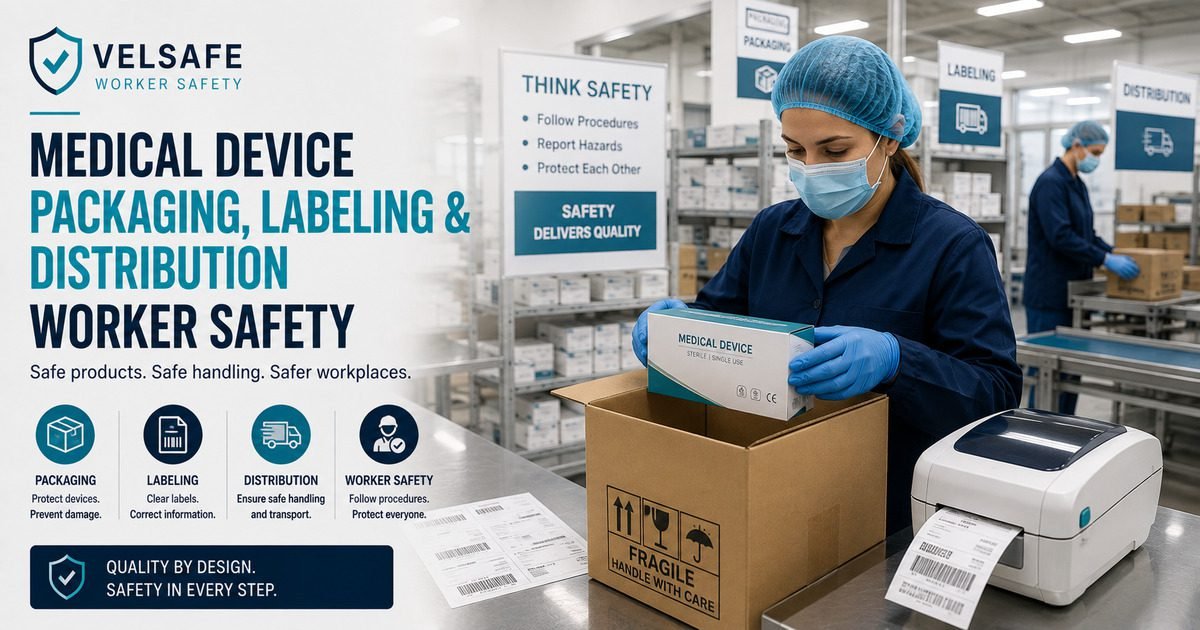
WORKER SAFETY: Medical Device Packaging
Medical Device Packaging, Labeling,
and Distribution: Worker Safety Guide
Every person who touches a medical device package before it reaches a hospital or clinic is part of the quality system. A torn seal, a wrong label, a box stored at the wrong temperature, any of these can cause a device to fail, a patient to be harmed, and a product to be recalled. This guide tells you what to check, what to do, and what never to do when you are working in medical device packaging, labeling, or distribution.
10%
of Device Recalls from Packaging Failures
One in ten medical device recalls is caused by a packaging problem. Of those, 31% happen because of a hole or breach in the packaging system. Packaging is not a secondary task, it is a patient safety function.
Greenlight Guru: Medical Device Packaging (2024)
820.120
FDA Regulation for Device Labeling
21 CFR 820.120 requires that every label be inspected for accuracy before release, and that the inspection be recorded in the Device History Record. A label applied without a documented check is a regulatory violation, even if the label is correct.
21 CFR Part 820 (QMSR)
ISO 11607
Global Packaging Standard for Sterile Devices
ISO 11607 is the international standard for packaging of terminally sterilized medical devices. It defines the sterile barrier system and requires validated sealing processes. Any worker handling sterile device packages must understand what a compromised sterile barrier looks like.
ISO 11607-1:2019
Medical device packaging protects the device from damage and, for sterile devices, maintains sterility from the point of manufacture to the point of use. When packaging fails, the device may be contaminated, damaged, or mislabeled before it reaches a patient. A hospital that opens a sterile pack and finds a breach has no choice but to discard the device. A mislabeled device used in surgery could harm a patient.
The most common causes of packaging failure in the medical device industry are worker error, process drift, and environmental damage during distribution. Most of these failures are preventable. The key is understanding what a correct package looks like, what a compromised package looks like, and what to do when something is wrong.
Packaging Hazards
Seal failure or incomplete sealing on sterile packages; holes, tears, or punctures in the sterile barrier; moisture damage to packaging materials; packaging dropped or crushed during handling; wrong packaging size applied to the wrong device.
Labeling Hazards
Wrong label applied to device or outer box; expired device shipped without expiry date check; UDI barcode damaged or unreadable; label peeling or illegible after application; two different product labels mixed in one labeling run.
Distribution Hazards
Temperature-sensitive devices shipped without cold chain; boxes stacked beyond the maximum stacking height; product stored in a non-designated area; incorrect lot number recorded in the distribution record; product released before quality hold is cleared.
Regulatory Hazards
Label checked but inspection not documented in DHR; product released without authorised signature; non-conforming product mixed with conforming stock; Device History Record missing packaging and labeling entries; packaging line clearance not completed between product changeovers.
Stop work and report to your supervisor immediately if you see any of the following. Do not attempt to fix the problem yourself. Do not continue packaging or labeling. Document the time and what you observed.
!
Any visible hole, tear, pinhole, or breach in a sterile package, including at the seal edge, the peel tab, the pouch face, or the tray lid.
!
A seal that does not look right, incomplete, wrinkled, separated at a corner, or with visible channels through the seal line.
!
A label that does not match the device in front of you, different product name, lot number, or expiry date on the label vs. the accompanying paperwork.
!
An expiry date that has passed on any device, label, or packaging component.
!
Temperature monitoring data showing an out-of-range excursion for any product requiring controlled storage or shipping conditions.
!
Product on a quality hold that has been moved or is missing hold tags, do not touch hold-tagged product and report the missing tag immediately.
Wrong label applied to a batch
Stop the labeling run immediately. Do not label any more units. Quarantine all units from the current run. Notify your supervisor. Do not remove labels yourself, the supervisor and quality team will determine the scope of the problem, whether any units were already distributed, and what regulatory reporting may be required. This is a nonconforming product event and must be entered into the quality system.
Sterile package with a breach found in stock or during picking
Do not send the unit. Quarantine it immediately with a hold tag. Record the lot number, location, and what you observed. Notify your supervisor. The quality team will need to determine whether other units in the same lot are affected and whether any units from the lot have already been distributed. Do not dispose of the damaged package until the investigation is complete, it is evidence.
Temperature excursion discovered for distributed product
Report to your supervisor immediately. Do not contact customers directly. Provide the temperature monitoring data, the lot number, the distribution record, and the dates affected. The quality and regulatory teams will determine whether a customer notification, advisory notice, or MDR report is required. Your job is to provide accurate information quickly.
Hold-tagged product found missing its hold tag
Do not move or handle the product. Report immediately. A missing hold tag means the product may have been picked or shipped in error. The quality team needs to verify that no hold product left the facility, and if it did, initiate an investigation. Time matters here, the faster this is reported, the faster it can be caught before reaching a customer.
Ensure line clearance is signed before every run, not assumed
Label mix-ups are the leading cause of labeling-related nonconforming product events. They almost always happen when line clearance is skipped or not fully completed. Make signed line clearance a non-negotiable step. If a batch started without a signed line clearance record, stop it and complete the clearance before proceeding.
Train new workers on DHR entries before they touch a packaging line
DHR entries have legal weight. A worker who does not know how to make a correct DHR entry, or how to make a correction, can invalidate a batch record. Train every new worker on DHR requirements before they perform any packaging or labeling operation. Check their first few entries yourself.
Create a culture where workers report problems without fear
Packaging problems that are caught and reported are nonconforming product events that can be investigated and corrected. Packaging problems that are hidden become recalls. If workers are afraid to report a mistake, the problem gets bigger. Respond to reports with problem-solving, not blame. The worker who reports a labeling error before the batch is released has done exactly the right thing.
Verify that only released product leaves the building
Distribution of unreleased or hold product is a regulatory violation. FDA warning letters have cited exactly this failure. Make release status verification a required step in the shipping process, not an optional check. No shipment goes out without a confirmed released status in the system.
Packaging is a patient safety function, not a finishing step
One in ten device recalls starts with a packaging failure. The worker at the packaging line is the last line of defence before a device reaches a hospital. A breach in a sterile seal, a wrong label, a missed expiry date, each of these can reach a patient. The steps in this guide exist because they prevent these failures.
Report every problem, caught early, a mistake becomes a correction; caught late, it becomes a recall
A labeling error found on the packaging line is a nonconforming product event that can be contained in minutes. The same error found after distribution can affect thousands of units across multiple markets and require a field action. The biggest difference between those two outcomes is whether the person who noticed it reported it immediately.
The DHR is the legal record that the device was packaged correctly, every entry matters
When an FDA investigator audits a device manufacturer, the Device History Record is what they read to confirm the packaging process was followed. An incomplete DHR, an erased entry, or a record filled in at the end of the shift instead of in real time can result in a warning letter, not because the packaging was wrong, but because the record does not prove it was right. Fill in the DHR correctly, every time, at the time you do the work.
What is a line clearance and why is it required before every batch?
A line clearance is a physical check of the packaging or labeling work area to confirm that all materials, labels, and product from the previous batch have been completely removed before the next batch begins. It is required because the most common cause of labeling mix-ups is leftover labels or product from a previous run contaminating the current run. Under 21 CFR 820.120, labeling and packaging operations must be controlled to prevent labeling mix-ups, line clearance is the primary control for this requirement. Source: 21 CFR Part 820 (QMSR)
What should I do if I notice a sterile package has a hole or breach?
Stop immediately. Do not send or use the package. Quarantine it with a hold tag and record the lot number, location, and your observation. Report to your supervisor right away. Do not try to patch or repair the package. The quality team will need to determine whether other units in the same lot are affected and whether any units have already been distributed. Keep the damaged package as evidence until the investigation is complete.
How do I make a correction to a Device History Record entry?
Draw a single line through the incorrect entry so the original is still readable. Write the correct information next to or above it. Add your initials and the date of the correction. Never erase, use white-out, or overwrite any DHR entry. These records are legal documents, an entry that is erased or concealed looks like a falsification to a regulatory auditor, even if the correction itself was honest. If you are unsure how to correct a specific type of entry, ask your supervisor before making the change. Source: FDA Guide to Inspections of Medical Device Manufacturers
What is a UDI and why does it matter for device labeling?
A Unique Device Identifier (UDI) is a code that identifies the specific version or model of a medical device and the specific production unit (lot, batch, or serial number). UDIs are required by FDA on the label of most medical devices distributed in the United States. They allow hospitals and regulators to trace a device from the manufacturer to the point of use, and to rapidly identify all affected units in a recall. A damaged or unreadable UDI barcode means the device cannot be traced, it must be reported and may need to be re-labeled under the correct procedure. Source: FDA: UDI Basics
What does it mean when a product is on quality hold?
A quality hold means the product cannot be shipped, used, or released until the quality team has reviewed and resolved a specific concern. Hold tags or inventory system status flags identify hold product. Do not pick, ship, move, or disturb hold-tagged product for any reason. If someone tells you verbally that the hold has been lifted, do not act on that verbal instruction alone, wait until the hold tag is removed and the system status is updated to released. Distributing hold product is a regulatory violation regardless of the reason.
Can I re-apply a label that has fallen off a device?
No. If a label has come off a device, do not re-apply it yourself. Report the situation to your supervisor. The quality team needs to verify that the correct label is being re-applied to the correct device, that the re-labeling is authorised, and that the action is documented in the Device History Record. Re-labeling without authorisation and documentation is a violation of labeling control procedures and could result in the wrong label being applied to the wrong device.
What temperature conditions apply to medical device storage?
Temperature requirements vary by device and are specified on the product label and in the product specifications. Common requirements include controlled room temperature (15 to 30 degrees Celsius), refrigerated storage (2 to 8 degrees Celsius), and frozen storage (minus 20 degrees Celsius or colder). FDA has issued warning letters to manufacturers who shipped temperature-sensitive products outside the required range without documented justification. Check the product label and the storage specification before placing any product in a storage area. If you are unsure of the requirement, ask your supervisor before storing the product. Source: MedTech Intelligence: 21 CFR 820 Subpart L Guidance
Guides
MDSAP Production and Service Controls: Chapter 6 Part II
The Chapter 6 Part II compliance guide covering Device History Records, nonconforming product control, and CAPA, the audit tasks that directly examine packaging, labeling, and distribution records.
Tips
7 Medical Device Filings Tips: 510(k), PMA, and IDE
The upstream companion to this guide, covering 510(k), PMA, and IDE submission strategy for the device that workers eventually package and distribute.
Guides
21 CFR Part 803: Medical Device Reporting Requirements
What to do when a packaging or labeling failure reaches the market, covering the MDR reporting obligations that may be triggered when nonconforming product has been distributed to patients or facilities.
MEDICAL DEVICE WORKER SAFETY LIBRARY
More Safety Guidance for Device Workers
Explore VelSafe’s medical device worker safety library for practical guides, step-by-step procedures, and compliance references designed for the people doing the work on the production floor.
Explore Worker Safety Articles