

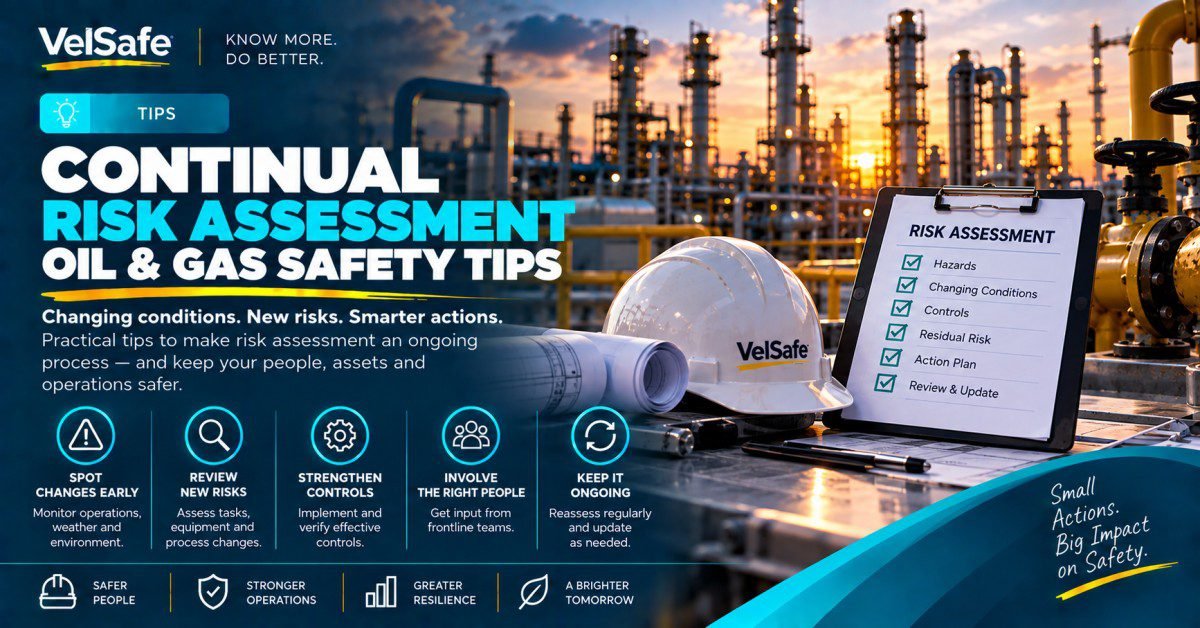
for Oil and Gas Operations
Continual risk assessment (CRA) is the practice of identifying, evaluating, and acting on hazards as they evolve throughout a task, not just before work begins. In oil and gas operations, conditions change quickly: pressure readings shift, weather moves in, equipment status changes, and adjacent work introduces new hazards. A risk assessment completed at 06:00 may be meaningless by 08:30.
These 8 tips address the most common failures in how oil and gas teams practise CRA. They are ordered from the most frequently cited failure pattern to the least, based on OSHA inspection findings and process safety incident data. Each tip includes a specific action, the common mistake to avoid, and a pro tip from established industry practice.
8 Continual Risk Assessment Tips at a Glance
The 8 Tips: Full Detail
Reassess when conditions change, not on a fixed schedule
Common Mistake
Pro Tip
Make the stop-work authority real and practised
Common Mistake
Pro Tip
Conduct mid-task reassessments at defined trigger points
Common Mistake
Pro Tip
Use SIMOPS reviews before work begins and when scope changes
Common Mistake
Pro Tip
Tie CRA to your permit-to-work system
Common Mistake
Pro Tip
Document what changed, not just what was assessed
Common Mistake
Pro Tip
Train for the unexpected, not the planned scenario
Common Mistake
Pro Tip
Close the loop: debrief every CRA that identified a hazard
Common Mistake
Pro Tip
Pre-Task CRA Checklist for Oil and Gas Operations
Key Takeaways
Frequently Asked Questions
What is continual risk assessment in oil and gas?
Is continual risk assessment required by OSHA?
How is CRA different from a job hazard analysis?
What triggers a mid-task CRA reassessment?
How should CRA be documented for OSHA PSM purposes?
What is the most common failure in CRA practice?
How do we integrate CRA with our permit-to-work system?
Sources
Government and Regulatory Sources
- OSHA. (2024). 29 CFR 1910.119: Process Safety Management of Highly Hazardous Chemicals – PSM operating procedure and training requirements for dynamic hazard management.
- OSHA. (2000). Process Safety Management Guidelines for Compliance, OSHA 3132 – compliance guidance on operating procedures, employee training, and documentation.
- OSHA. (2024). 29 CFR 1910.132: Personal Protective Equipment – PPE hazard assessment requirements applicable to CRA in oil and gas operations.
Research and Industry Sources
- Energy Institute. (2023). Process Safety: Lessons from High-Consequence Events – analysis of major incidents citing failure to reassess changing conditions as a primary causal factor.
- Energy Institute. (2022). Process Safety Competency Framework – role-based competency standards for CRA in oil and gas operations.
- Energy Institute. (2021). Guidance on Permit-to-Work Systems – PTW-CRA integration requirements and SIMOPS review standards.
- Center for Chemical Process Safety (CCPS). (2007). Guidelines for Risk-Based Process Safety – industry guidance on continual hazard management and near-miss reduction data.