
Tips: Computerized Systems Validation Project
Starting a computerized systems validation project without a clear scope, a risk assessment, and the right cross-functional team is the fastest way to produce a validation package that does not survive an FDA inspection.
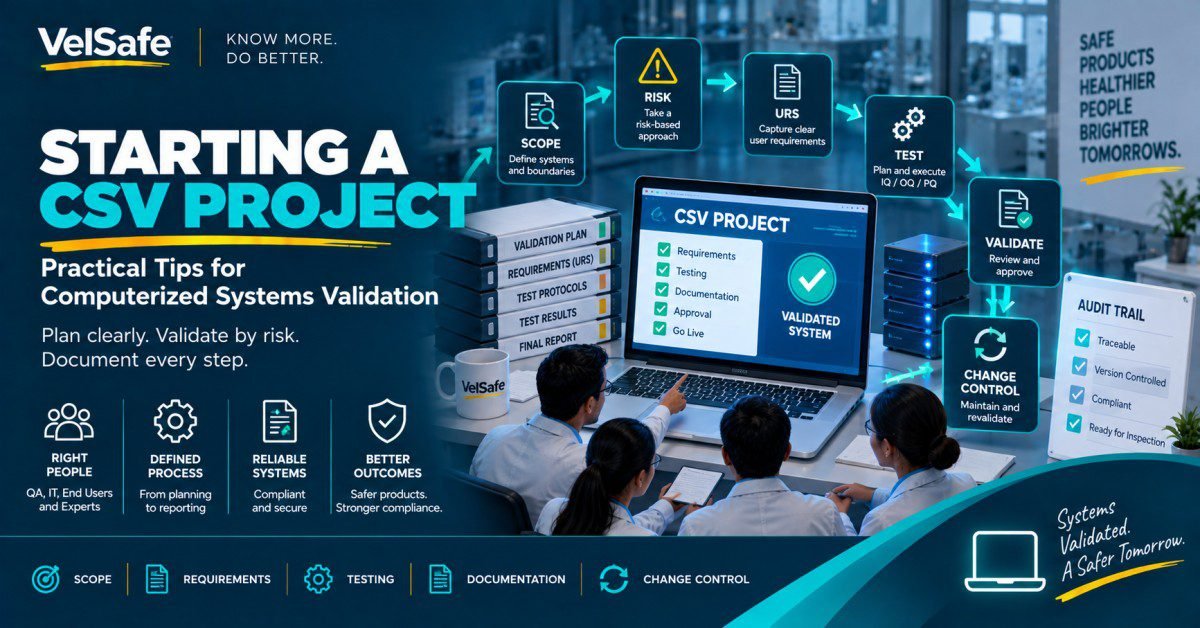
Computerized systems validation (CSV) is the documented process of demonstrating that a software system or computer-controlled equipment performs consistently and as intended in a regulated environment. FDA, EU GMP Annex 11, and GAMP 5 all require that systems impacting product quality, patient safety, or data integrity be validated before they are used in GxP operations. Starting a CSV project correctly is the single most important factor in whether the validation delivers regulatory assurance or becomes a remediation project after an inspection finding. These seven tips cover what to do from project initiation through to validation report, with the decisions and documentation that most commonly determine whether a CSV project holds up under regulatory scrutiny.
GAMP 5
The ISPE Framework for CSV: Risk-Based Approach to Computerized Systems in GxP Environments
GAMP 5 (Good Automated Manufacturing Practice, 5th Edition) is the industry standard framework for CSV in pharmaceutical, biotech, and medical device manufacturing. It classifies software into categories based on complexity and customisation, each requiring proportionate validation effort. FDA references GAMP 5 principles in its guidance on computerized systems in clinical investigations and process validation. Source: ISPE: GAMP 5
21 CFR
Part 11
Part 11
Electronic Records and Signatures: Every Validated System Must Meet These Requirements Before Going Live
21 CFR Part 11 requires that electronic records used in FDA-regulated activities be generated by validated systems with secure, unalterable audit trails; individual user access controls; and electronic signatures that uniquely identify the signer. CSV is the mechanism by which a system demonstrates Part 11 compliance. A system put into GxP use without validation is a Part 11 violation regardless of how accurately it performs. Source: 21 CFR Part 11
IQ OQ PQ
The Three-Phase Qualification Structure: Each Must Be Documented, Approved, and Completed Before the Next Begins
Installation Qualification (IQ) confirms the system is installed correctly. Operational Qualification (OQ) verifies that system functions perform as designed. Performance Qualification (PQ) confirms that the system performs as intended by actual users under real process conditions. Each phase requires approved protocols, executed test scripts with evidence, and a summary report signed off before proceeding. Skipping or merging phases without documented justification is a common inspection finding. Source: FDA: Process Validation Principles
7 Computerized Systems Validation Project Tips: Quick Summary
What to get right before the first test script is written
1
Determine whether the system needs validation before committing any validation resources to it
2
Write a Validation Plan that defines scope, responsibilities, phases, and the acceptance criteria before any testing begins
3
Build your cross-functional team before writing requirements: QA, IT, process owners, and end users all have non-negotiable roles
4
Conduct a risk assessment and use it to determine testing depth: not every function requires the same validation rigour
5
Write specific, testable User Requirements Specifications before you write a single test script
6
Evaluate your vendor’s documentation before deciding how much validation work you need to do yourself
7
Build change control into the validation programme from day one: re-validation triggers must be defined before the system goes live
Computerized Systems Validation Project Tips in Full
Tip 1: Determine Whether the System Needs Validation Before Committing Resources
Why It Matters
Not every computer system in a regulated facility requires the same level of validation, or any validation at all. Applying full IQ/OQ/PQ protocols to office productivity software wastes resources that should be directed at systems that genuinely impact patient safety, product quality, or data integrity. Applying insufficient validation to a manufacturing execution system or an electronic batch record system is a regulatory compliance failure. The first decision in any CSV project must be whether the system falls within the regulatory scope that requires validation, and if so, at what level. GAMP 5 provides the software category framework (Categories 1 through 5) that most regulated organisations use to make this determination, with categories ranging from infrastructure software requiring only configuration records to custom-developed applications requiring full lifecycle validation. Source: ISPE: GAMP 5
What To Do
For each system under consideration, document a formal GxP impact assessment before any validation work begins. The assessment should answer: does this system generate, process, store, or transmit data used to make quality or safety decisions? Does a failure in this system affect product quality, patient safety, or regulatory compliance? Is this system used in activities covered by GMP, GLP, GCP, or pharmacovigilance regulations? If the answer to any question is yes, the system requires validation. The depth of validation is then determined by the system’s GAMP category and the criticality of its GxP functions. Document the impact assessment and its conclusion in the Validation Plan. A QA signature on the impact assessment is the formal determination that triggers the validation programme.
Common Mistake
Assuming that a system used in a regulated facility automatically requires the same level of validation as a GxP-critical system, or conversely, that a GxP-critical system does not need validation because it was “always used that way.” A system inherited from a legacy operation, a commercial application deployed without formal qualification, or a spreadsheet used to calculate dosing calculations in a manufacturing process may each require retrospective validation. The absence of a historical validation package is a finding, not an exemption. The starting point is always the GxP impact assessment, not the system’s history or familiarity.
Pro Tip
Maintain a validated systems inventory that covers every computerised system in the facility, with each system’s GAMP category, GxP impact assessment status, current validation status, and next periodic review date. An up-to-date inventory is the first document an FDA investigator will request when inspecting a facility’s CSV programme. Organisations without a comprehensive systems inventory are unable to demonstrate that they know what they have validated, which immediately raises questions about what else has not been validated.
Tip 2: Write a Validation Plan That Defines Scope, Phases, Responsibilities, and Acceptance Criteria First
Why It Matters
The Validation Plan is the governing document for the entire CSV project. Without it, individual team members will make independent assumptions about what is in scope, who owns each deliverable, what level of testing is required, and what the acceptance criteria are. These misalignments compound through the project and typically surface at the review and approval stage, when resolving them is most expensive. FDA inspectors expect to see a Validation Plan that was approved before testing began, not a retrospective plan drafted after the validation package was assembled. A Validation Plan signed after testing is completed is a documentation integrity issue, not a formality. Source: FDA: Investigations Operations Manual
What To Do
The Validation Plan must be approved by QA before any qualification activity begins and must contain: a description of the system being validated and its GxP impact; the GAMP software category assigned; the validation phases planned (URS, FS, DS, IQ, OQ, PQ) and the rationale for any phases that are combined or omitted; the roles and responsibilities for each validation deliverable including authors, reviewers, and approvers; the acceptance criteria that determine whether the validation is successful; the deviation handling procedure; and the document retention plan. The plan does not need to anticipate every test script, but it must establish the framework within which every subsequent document is produced and assessed. Any change to scope, phases, or acceptance criteria after the plan is approved requires a formal amendment.
Common Mistake
Writing a Validation Plan that describes what was done rather than what will be done, or that is generic enough to apply to any system. An inspector reviewing a Validation Plan that does not name the specific system, version, and GxP scope will treat it as a document that provides no validation assurance. The plan must be specific to this system and this installation, not a template with the system name substituted in. Template-based plans that have not been tailored to the specific system and project are a frequent observation in CSV inspection findings.
Pro Tip
Include a traceability matrix structure in the Validation Plan. The matrix should define how every User Requirement will be traced through to a test case, and every test case will be traced back to a User Requirement, so that the final validation report can demonstrate that all requirements have been tested. If the Validation Plan does not establish this traceability structure, the validation team will typically not maintain it consistently throughout the project, and the final report will lack the requirement-to-test linkage that demonstrates complete validation coverage.
Tip 3: Build the Cross-Functional Team Before Writing Requirements
Why It Matters
User Requirements Specifications written by IT or validation specialists without process owner and end user input consistently fail to capture the functional requirements that actually matter for the GxP use case. Requirements that are missing, ambiguous, or technically specified rather than process-specified lead to test scripts that pass in a test environment but cannot be executed by the real users under real process conditions. The failure appears during PQ, at the most expensive stage of the project to remediate. Involving end users from the start is not a stakeholder management nicety; it is the mechanism by which requirements reflect the actual intended use of the system. Source: ISPE: GAMP 5 Section 5
What To Do
The core CSV project team must be assembled and have its roles formally defined in the Validation Plan before URS drafting begins. At minimum the team requires: a QA representative who owns the validation programme, approves all validation deliverables, and is the liaison to regulatory bodies; an IT representative who owns the technical architecture, system configuration, and access controls; one or more process owners who own the business processes the system supports and who will confirm that the URS reflects those processes accurately; end user representatives who will author or review test scripts and execute PQ testing under real working conditions; and a project lead who coordinates deliverables and escalates blockers. Document each person’s role, responsibilities, and approval authority in the Validation Plan.
Common Mistake
Running the CSV project as an IT or quality project without meaningful process owner engagement until the PQ stage, when process owners are presented with test scripts for systems they have never reviewed and asked to sign off on validation documents they do not understand. Process owners who are brought in late have no basis for assessing whether the validation is adequate for the GxP use case, so they either sign without review (a documentation integrity issue) or raise concerns that require rework at the most expensive stage of the project.
Pro Tip
Hold a project kick-off meeting with the full cross-functional team before any deliverable is drafted. Use the kick-off to walk through the Validation Plan, confirm that every team member understands their role and deliverables, discuss the timeline and dependencies, and identify risks to the project. Record the meeting with an attendance log and action item list. This meeting also functions as a training event: team members who have not participated in a CSV project before leave with a clear understanding of the process, reducing the rework caused by documents that do not meet the format or content requirements of a regulated validation package.
Tip 4: Conduct a Risk Assessment and Use It to Determine Testing Depth
Why It Matters
A risk-based approach to CSV is not an option; it is what GAMP 5, FDA, and EU GMP Annex 11 all require. The principle is straightforward: validation effort should be proportionate to risk. Functions that directly affect patient safety, product quality, or data integrity require rigorous testing with detailed test scripts, multiple testers, witnessed execution, and full deviation investigation. Functions that are non-GxP-critical require lighter documentation. A CSV project that applies the same testing depth to every system function wastes resources on low-risk functions while the validation team learns nothing new about them, and may under-test high-risk functions because the resource budget is exhausted. Source: EU GMP Annex 11: Computerised Systems
What To Do
Conduct a formal risk assessment at the start of the project, before the URS is finalised, so that risk ratings can inform how requirements are written and tested. For each system function, assess: the likelihood that the function could fail; the detectability of a failure before it reaches the next process step or the patient; and the severity of the impact if the failure is not detected. Score each function on each dimension and combine to produce an overall risk rating. High-risk functions require more detailed requirements, more comprehensive test scripts, multiple independent executions, and full deviation reporting for any test failure. Low-risk functions may be handled with simpler test scripts and a lower evidence threshold. Document the risk assessment as a standalone deliverable, cross-reference it in the URS and test protocols, and review it if the system scope changes.
Common Mistake
Conducting the risk assessment after the test protocols are written and using it retrospectively to justify the testing that was already planned. A risk assessment must precede and inform the test strategy; it cannot be used to validate a test strategy that was developed without it. An inspector who reviews a risk assessment dated after the test protocols will treat the risk assessment as a documentation exercise rather than a project management tool, and will scrutinise the test coverage more carefully to determine whether high-risk functions were actually tested to an appropriate depth.
Pro Tip
Prioritise the audit trail, access controls, and data integrity functions in the risk assessment as high-risk regardless of how simple they may appear. These functions are the top targets for FDA inspection scrutiny under 21 CFR Part 11, and a failure in any of them calls the integrity of the entire dataset into question. Even if the system performs its primary function flawlessly, a failing audit trail or a shared user account will result in a data integrity finding that can invalidate the study or batch records produced by the system.
Tip 5: Write Specific, Testable User Requirements Before Any Test Script Is Written
Why It Matters
A User Requirements Specification is the foundation of the entire validation. Every test script, every design specification, and every qualification protocol should trace back to a requirement in the URS. If the URS contains vague requirements, the test scripts will be vague. If it is missing requirements, the testing will be incomplete. If requirements are technical specifications rather than process statements, the PQ tests will be executable in a test environment but will fail to reflect how the system actually performs in the GxP process context. The URS is the document against which an inspector will assess whether the system was validated for its actual intended use, not its theoretical capabilities. Source: ISPE: GAMP 5 Appendix M3
What To Do
Write each URS requirement as a specific, testable statement of what the system must do: “The system shall record all user logins with the user ID, date, and timestamp” is a testable requirement. “The system shall be secure” is not. Apply the following test to every requirement: can you write a specific test case that produces an unambiguous pass or fail result for this requirement? If not, rewrite the requirement until you can. The URS must also include all regulatory requirements relevant to the GxP use case: audit trail requirements, electronic signature requirements, access control specifications, and data backup and recovery requirements. These are not optional features; they are baseline validation requirements for any GxP system. Number every requirement uniquely for traceability, and obtain formal review and approval from QA, process owners, and IT before any design or testing activity begins.
Common Mistake
Writing the URS by reviewing the vendor’s feature list and converting features into requirements. A vendor feature is what the system can do. A user requirement is what the system must do in this GxP context for this process. A system may have 200 features of which 40 are relevant to the GxP use case. The URS should contain the 40 requirements for those GxP-relevant features, not a paraphrase of the vendor’s marketing documentation. Requirements based on vendor features will test what the vendor built, not whether what the vendor built meets the actual process and compliance needs of the organisation.
Pro Tip
Conduct a URS review workshop with the full cross-functional team before the document is formally approved. Walk through each requirement and ask process owners to confirm it reflects the real process, end users to confirm they can execute the corresponding test, and QA to confirm it is specific enough to support a clear pass/fail determination. Requirements that three different team members interpret differently are not testable requirements; they need to be rewritten before testing begins. The hour spent in this review will save weeks of rework when ambiguous requirements produce disputed test results.
Tip 6: Evaluate Vendor Documentation Before Deciding How Much Work You Need to Do
Why It Matters
Vendors of commercial off-the-shelf (COTS) software for regulated environments often provide validation documentation packages: IQ protocols, OQ protocols, validation test scripts, audit trail specifications, and software lifecycle documentation. If these are assessed as adequate and applicable to your specific configuration, they can significantly reduce the documentation burden on your organisation. If they are accepted without assessment, they create a false sense of validation assurance: vendor documentation that has not been reviewed for applicability to your system configuration and GxP context is not evidence of your system’s validation. The responsibility for validation remains with the regulated organisation, not the vendor. Source: EU GMP Annex 11, Section 3
What To Do
Request the vendor’s validation documentation package early in the project, before the Validation Plan is finalised. Conduct a formal vendor documentation review that assesses: does the documentation cover the specific software version being implemented? Does it cover the specific modules and configurations being deployed, not just the base product? Does it address the GxP functions identified in your URS? Is the documentation complete, controlled, and consistent with the installed software? Document the assessment and its conclusions. For functions and configurations covered by adequate vendor documentation, reference that documentation in your validation protocols as supporting evidence. For functions not covered, create your own test protocols. This gap analysis determines the actual validation effort required and prevents both under-validation (accepting inadequate vendor docs) and over-validation (recreating tests the vendor has already completed adequately).
Common Mistake
Accepting vendor documentation as complete validation evidence without conducting the gap assessment. A vendor who states that their system is “validated to 21 CFR Part 11” has provided information about their development process, not about whether your specific implementation meets Part 11 requirements. Your implementation may have configurations, custom fields, or interface connections that the vendor’s generic validation documentation does not cover. Accepting vendor claims without independent assessment has been cited by FDA inspectors as evidence that the regulated organisation does not have a functioning validation programme.
Pro Tip
Conduct a supplier audit or request audit reports for any vendor providing GxP-critical software before the system is deployed. EU GMP Annex 11 specifically requires that the regulated user assess and select suppliers of computerised systems through a formal supplier qualification process. Ask vendors for their software development lifecycle (SDLC) documentation, their quality management system certification, their previous regulatory inspection history, and any known deficiencies in their validation support documentation. A vendor who cannot provide these documents for a GxP-critical application is a vendor that introduces regulatory risk into your validation programme.
Tip 7: Define Re-Validation Triggers and Change Control Before the System Goes Live
Why It Matters
Validation is not a one-time event. EU GMP Annex 11 and FDA expect that validated systems remain in a validated state for their entire operational life. Any change to the system, including software updates, configuration changes, hardware migrations, operating system patches, and changes to integrated systems, may affect the validated functions and require re-validation before the change is implemented. Without a change control procedure defined in the Validation Plan, changes will be made informally, their impact on validated functions will not be assessed, and the system will gradually drift from its validated state. When this is discovered during an inspection, every batch record, study data set, or quality record produced by the system during the unvalidated period is called into question. Source: EU GMP Annex 11, Section 10
What To Do
Before the system goes live, define in the Validation Plan or a dedicated Validated State Maintenance SOP: the categories of changes that trigger a formal change control assessment; the process for assessing whether a proposed change affects validated functions; the re-validation activities required for different change categories; the QA approval gate before any change is implemented; and the periodic validation review schedule (typically annual) that confirms the system remains in a validated state even if no formal changes have been made. Every system change after go-live must be routed through this process. IT must not implement software updates, configuration changes, or infrastructure changes to GxP systems without QA review and sign-off on the validation impact assessment.
Common Mistake
Treating vendor-supplied software patches and security updates as routine IT maintenance that does not require change control assessment. A software patch that modifies the codebase of a validated application may affect validated functions, alter the audit trail behaviour, change the user interface in ways that affect how test scripts would be executed, or modify the access control logic. Applying a patch without a change control assessment is applying an unvalidated change to a validated system. This is a finding regardless of whether the patch changed anything that affected the GxP functions in practice.
Pro Tip
Establish a validated system periodic review cycle, with an annual review scheduled in the QA calendar for every GxP-critical system. The review should confirm: the system is still performing as described in the validation documentation; no changes have been made since the last review without going through change control; the validation documentation is current and matches the installed system; and the system’s GxP scope has not changed in ways that require the URS or risk assessment to be updated. An annual validation review is a straightforward QA activity that prevents the gradual drift from validated state that is the most common root cause of major CSV inspection findings.
CSV Project Readiness Checklist
Before Testing Begins
Before Go-Live
GxP impact assessment completed and QA-signed
System added to validated systems inventory
GAMP software category assigned with justification
Validation Plan approved by QA before any testing
Cross-functional team assembled with roles documented
Risk assessment completed and cross-referenced in URS
URS approved with all requirements specific and testable
Vendor documentation gap assessment completed
Traceability matrix structure defined
System added to validated systems inventory
GAMP software category assigned with justification
Validation Plan approved by QA before any testing
Cross-functional team assembled with roles documented
Risk assessment completed and cross-referenced in URS
URS approved with all requirements specific and testable
Vendor documentation gap assessment completed
Traceability matrix structure defined
IQ/OQ/PQ protocols executed, reviewed, and approved
All test deviations formally closed with QA sign-off
Audit trail function verified as enabled and unalterable
Individual user accounts confirmed for all system users
Validation Report approved by QA
Change control procedure defined for post-go-live changes
Annual periodic review date scheduled in QA calendar
User training completed and documented
System SOPs approved and accessible to all users
All test deviations formally closed with QA sign-off
Audit trail function verified as enabled and unalterable
Individual user accounts confirmed for all system users
Validation Report approved by QA
Change control procedure defined for post-go-live changes
Annual periodic review date scheduled in QA calendar
User training completed and documented
System SOPs approved and accessible to all users
Sources: ISPE GAMP 5 | EU GMP Annex 11 | 21 CFR Part 11
Key Takeaways
Every document in a CSV package must be approved before the activity it governs, not after
A Validation Plan approved after testing, a risk assessment dated after the test protocols, or a URS approved after the design specification are each documentation integrity failures that undermine the regulatory assurance the entire validation was designed to provide. The sequence matters as much as the content. Getting the sequence right requires discipline from the start, not remediation at the end.
Validation is not complete at go-live: it must be maintained for the operational life of the system
The most common long-term CSV failure is a validated system that gradually drifts from its validated state through uncontrolled changes and unmaintained documentation. Treating validation as a project that ends at go-live and a change control programme that begins the next day is the correct model. Annual periodic reviews and a functioning change control procedure are not optional add-ons; they are what keep a system in a validated state between go-live and the next inspection.
A CSV project that starts with vague requirements, skipped risk assessment, and an absent process owner will produce a validation package that fails inspection at the requirements-to-test traceability review
FDA inspectors reviewing a CSV package consistently examine whether every URS requirement traces to a test case, and whether every test case traces back to a URS requirement. Gaps in this traceability indicate that the system was not fully validated against its requirements, or that there are requirements that were never tested. Vague requirements, missing risk assessments, and absent process owner input all produce exactly these gaps. The way to pass a CSV inspection is to start the project correctly: with specific requirements, a documented risk-based test strategy, and a cross-functional team engaged from the beginning.
Frequently Asked Questions
What is computerized systems validation (CSV) and which systems require it?
Computerized systems validation (CSV) is the documented process of demonstrating that a software system or computer-controlled equipment consistently performs as intended and meets regulatory requirements for GxP use. Systems that require CSV are those that impact product quality, patient safety, or data integrity in regulated environments, including pharmaceutical manufacturing, clinical research, medical device production, and laboratory operations. Examples include electronic batch records, laboratory information management systems (LIMS), manufacturing execution systems (MES), electronic data capture (EDC) systems, and any software used to generate, process, or store data that supports a regulatory submission. GAMP 5 provides the framework for determining which systems require validation and at what depth. Source: ISPE: GAMP 5
What is the difference between IQ, OQ, and PQ in a CSV project?
Installation Qualification (IQ) confirms that the system has been installed correctly: that the hardware and software components match the approved design specifications, that the system is installed in the correct environment, and that all installation documentation is complete. Operational Qualification (OQ) verifies that the system functions as specified in the design documentation: test scripts exercise each system function against the design specification and confirm that it produces the expected output. Performance Qualification (PQ) confirms that the system performs as intended for the actual GxP use case under real process conditions, typically executed by end users using real (or representative) process data. Each phase requires approved protocols, executed and witnessed test scripts, and a summary report that must be approved before the next phase begins. No phase may be skipped without documented justification reviewed by QA.
What is a User Requirements Specification (URS) in CSV?
A User Requirements Specification (URS) is the document that defines what a system must do to satisfy the intended GxP use case and the regulatory requirements that apply to that use. It is written from the user’s perspective, not the technical perspective: requirements describe what the system must accomplish, not how it accomplishes it. The URS is the foundational document in the CSV lifecycle: it is written before the design specification, and every subsequent design decision, test protocol, and qualification result is evaluated against the URS. A good URS is specific (every requirement can be tested), complete (all GxP-critical functions are covered), approved (reviewed by QA, process owners, and IT before use), and numbered (every requirement has a unique identifier for traceability). Source: ISPE: GAMP 5 Appendix M3
What is GAMP 5 and how does it apply to a CSV project?
GAMP 5 (Good Automated Manufacturing Practice, 5th Edition) is the ISPE guidance document that provides a risk-based framework for CSV in regulated industries. It classifies software into five categories based on their complexity and degree of customisation, from Category 1 (infrastructure software such as operating systems) through to Category 5 (custom-developed software). Each category is associated with a proportionate validation approach: Category 1 requires configuration records; Category 3 (configurable software) requires moderate validation with IQ, OQ, and PQ; Category 5 requires full lifecycle validation. GAMP 5 also provides guidance on supplier assessment, risk management, testing strategies, data integrity, and system retirement. It is referenced by FDA, MHRA, and EU GMP authorities as the accepted framework for pharmaceutical CSV programmes. Source: ISPE: GAMP 5
When does a validated system need to be re-validated?
A validated system must go through a change control impact assessment and, if required, re-validation whenever a change is made that may affect the validated functions. Trigger events include: software version updates or patches; changes to system configuration or settings; modifications to interfaces with other systems or equipment; changes to the operating environment (hardware, network infrastructure, hosting); changes to the GxP processes the system supports; and migration of the system to a new platform or hosting environment. The change control assessment determines whether the change affects validated functions and, if so, what re-validation activities are required before the change is implemented. Even in the absence of formal changes, a periodic review (typically annual) should confirm that the system remains in its validated state. Source: EU GMP Annex 11, Section 10
Can a vendor’s validation package substitute for your own CSV documentation?
Vendor validation documentation can be used as supporting evidence within your organisation’s validation package, but it cannot substitute for the organisation’s own validation programme. The regulated organisation remains responsible for demonstrating that the system as configured and deployed in its specific environment meets its GxP requirements. This means conducting a gap assessment of the vendor’s documentation to identify what is covered and what is not, and producing your own validation deliverables for any gaps. A vendor who states their system is “pre-validated” has provided information about their development process, not about your implementation’s compliance with your specific GxP requirements. EU GMP Annex 11 and FDA expect to see evidence that the organisation assessed the vendor and the vendor’s documentation, not simply accepted it. Source: EU GMP Annex 11, Section 3
What happens if a GxP system is used without validation?
Using a GxP-critical system without validation is a regulatory violation that can result in FDA warning letters, import alerts, consent decrees, or rejection of regulatory submissions. Data produced by an unvalidated system may be considered unreliable for regulatory purposes, which can invalidate batch records, clinical study data, or quality control results produced during the unvalidated period. When discovered during inspection, an unvalidated GxP system typically results in a critical observation that requires immediate remediation and may trigger a broader inspection of the facility’s CSV programme. Retrospective validation, while possible for some systems, is more resource-intensive than prospective validation and may not be accepted by regulatory authorities for all system types or data uses.
Sources
Government and Regulatory Sources
- 21 CFR Part 11: Electronic Records and Electronic Signatures: the FDA regulation requiring validated systems for electronic records used in FDA-regulated activities, with specifications for audit trails, access controls, and electronic signatures.
- EU GMP Annex 11: Computerised Systems: the EU Good Manufacturing Practice requirement for CSV in pharmaceutical manufacturing, including supplier qualification, validation lifecycle, data integrity, and change control for computerised systems.
- FDA: Process Validation: General Principles and Practices: source for IQ/OQ/PQ qualification structure and the lifecycle approach to validation referenced throughout this article.
- FDA: Investigations Operations Manual: source for understanding what FDA investigators examine during CSV programme inspections and the documentation expectations for Validation Plans and qualification packages.
Standards and Industry Sources
- ISPE: GAMP 5: A Risk-Based Approach to Compliant GxP Computerized Systems: the primary industry standard for CSV in pharmaceutical, biotech, and medical device environments, providing the software category framework, risk-based validation approach, URS guidance, supplier qualification requirements, and change control principles referenced throughout this article.
Related VelSafe Articles
Situational
Equipment Qualification Failure: A GMP Case Study
A case study of how an equipment qualification failure in a GMP environment generated a data integrity gap and CAPA obligation, demonstrating exactly what happens when qualification activities are inadequate or not performed before system use.
Guides
Process Validation: A Complete Guide for GMP Manufacturers
The complete framework for process validation in GMP manufacturing: Stage 1 (process design), Stage 2 (process qualification), and Stage 3 (continued process verification), with the lifecycle approach that mirrors the CSV validation model.
Tips
Quality Assurance Supports Data Integrity: 7 Tips
The companion article to this CSV guide: how QA protects data integrity at every phase of the data lifecycle in clinical research and GMP environments, covering the ALCOA+ framework, audit trail verification, CAPA, and archiving requirements that validated systems must support.
GMP Compliance and Validation Resources
More Validation and Compliance Tips for GMP and Clinical Quality Teams
VelSafe covers CSV, GMP process validation, data integrity, CAPA management, FDA inspection readiness, and quality systems compliance for validation engineers, quality professionals, and regulatory affairs teams in pharmaceutical, biotech, and medical device organisations.
Browse All Compliance Tips