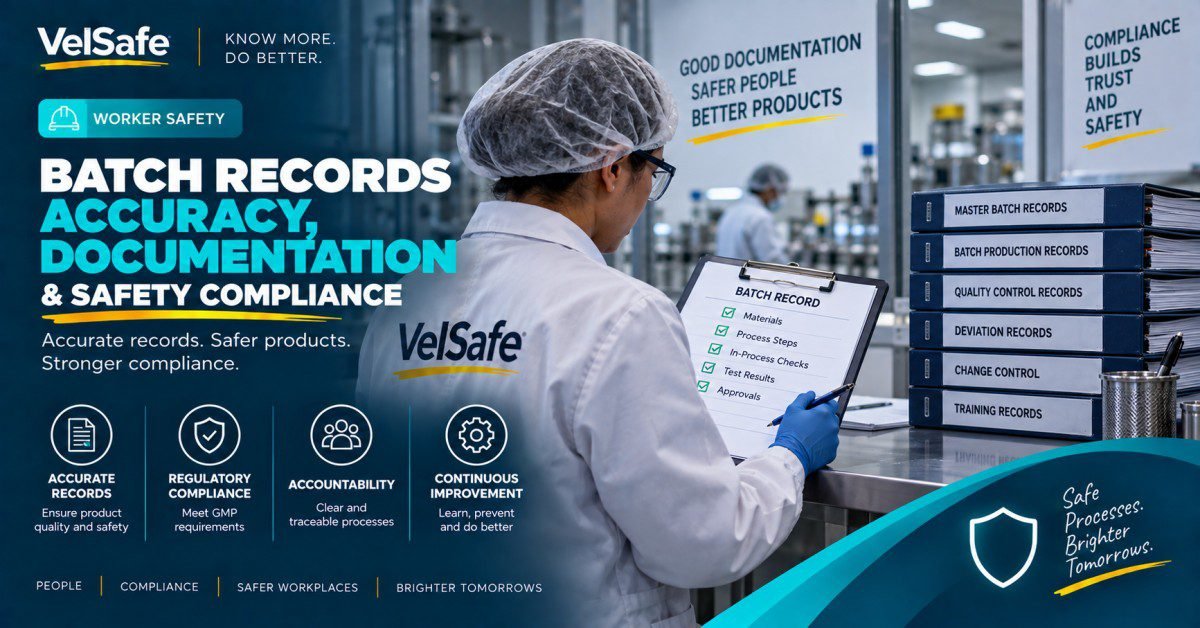
Worker Safety: Batch Records Accuracy and Documentation
Batch records accuracy is not a paperwork requirement. It is the defence system that catches errors before they reach a patient, protects workers from blame for problems they did not cause, and keeps facilities running when an FDA investigator walks in the door.
In pharmaceutical and medical device manufacturing, batch records are the complete written account of how a product was made. Every material, every measurement, every operator signature, and every deviation from the process becomes part of that record. When batch records accuracy fails, the consequences reach beyond regulatory citations: products are recalled, investigations are opened, and workers who followed the process correctly cannot prove it. This guide covers what batch records accuracy means at the operator level, what the hazards of poor documentation are, how to do it right every shift, and what supervisors must do to support an accurate documentation culture.
21 CFR
211.188
The FDA Regulation Requiring Complete Batch Records for Every Production Run in a GMP Facility
21 CFR 211.188 requires that batch production and control records be prepared for each batch of drug product and include complete information relating to every step in the production. Records must be made at the time each step is performed and must be signed and dated by the person performing each significant step. A gap in the record is a GMP violation regardless of what actually happened on the floor. Source: 21 CFR 211.188
At the Time
GMP Requires Records to Be Made When the Step Is Performed: Retrospective Entry Is a Data Integrity Violation
FDA’s data integrity guidance requires that entries in batch records be Contemporaneous: recorded at the time the activity occurs, not reconstructed afterward. A record completed at end of shift from memory, or filled in to match what “should” have happened rather than what did happen, is a falsification finding under FDA’s ALCOA+ framework. Investigators specifically look for timing patterns that indicate batch-end entry. Source: FDA: Data Integrity Guidance
Single Line
The Only Permitted Way to Correct a Paper Batch Record Entry: Strike Through, Initial, Date, and Reason
When a paper batch record entry is incorrect, draw a single line through the error so the original entry remains readable, then write the correct value, your initials, the date, and the reason for the correction beside it. Never use white-out, never scribble over an entry, and never erase or overwrite. A correction that makes the original unreadable is treated the same as a falsification. Source: 21 CFR Part 211
In a pharmaceutical or medical device manufacturing facility, the batch record is not a summary of what happened. It is the legal and regulatory proof that the product was made correctly. When a batch record is inaccurate, incomplete, or falsified, the hazard is not only to the patient who receives the product. It is also a hazard to every worker whose name is on that record, and to the facility whose continued operation depends on the integrity of its documentation.
Patient Safety Hazard
An inaccurate batch record can allow a defective product to pass quality review and reach patients. Missing environmental readings, undocumented equipment failures, or incorrect material quantities that are not captured in the record cannot be caught by QA review. The batch record is the only information QA has about how the batch was actually made. If that information is wrong, QA approval does not protect the patient.
Worker Protection Hazard
A worker who shortcuts documentation because “nothing went wrong” has no protection if something does go wrong later. If an investigation opens and the batch record shows incomplete or inconsistent entries, the worker whose initials are on the record becomes the subject of the investigation, regardless of what actually happened on the floor. Accurate, complete documentation at the time of the activity is the worker’s own protection.
Compliance Hazard
FDA investigators reviewing batch records look for specific patterns: entries made at times inconsistent with the recorded activity, corrections that obscure original values, blank fields, and inconsistencies between batch records and other facility records. Any of these is a GMP citation. Multiple citations can escalate to warning letters, consent decrees, or import alerts that shut down production for months.
Recall and Investigation Hazard
When a product quality problem is identified after release, the batch record is the primary tool for determining whether other batches are affected and whether a recall is needed. Incomplete or inaccurate records make this determination impossible or inaccurate. A recall triggered by a documentation gap is always larger and more expensive than one identified by a clear, complete record that isolates the problem precisely.
You must not sign or initial a batch record entry you cannot personally verify. Your signature is your attestation that the step was performed correctly. Signing for something you did not do or cannot confirm is a falsification, regardless of your intention.
Step 1: Review the batch record instructions before you start the process, not during it
Read the step, understand what it requires, and confirm you have everything you need before you begin: the correct materials, the right equipment, and a working pen or stylus for the recording method in use. Do not start the step and read the documentation instructions partway through. If anything is unclear, ask your supervisor before you begin. A step that starts with a misunderstanding of the requirement is a step that is likely to produce either an incorrect record or a deviation that could have been avoided.
Step 2: Record each value immediately after you observe it, not at the end of the step
GMP requires contemporaneous entry. This means you record the measurement, observation, or confirmation at the moment you make it, not after the step is complete and not at the end of the shift. If the SOP requires you to record temperature at 15-minute intervals, record it at each interval, not once at the end. If you observe a reading and then become distracted before recording it, do not write what you think the reading was. If you cannot verify the value, you have a deviation to document, not an entry to estimate. Source: FDA: Data Integrity Guidance
Step 3: Write legibly, use the correct units, and fill every required field
Every entry in a batch record must be legible to another person reviewing the record during QA review, an investigation, or an FDA inspection. Use the units specified in the SOP or batch record form. If the record requires grams and you measured in milligrams, convert before you enter. Do not leave any required field blank. If a step is not applicable to this specific batch, write “N/A” and initial it. A blank field is treated the same as a missing record: the reviewer cannot determine whether the step was performed or simply not documented. Source: 21 CFR 211.188
Step 4: Correct errors using the single-line strike-through method only
If you make an error in a paper batch record entry, correct it by drawing a single horizontal line through the incorrect value so the original is still readable. Write the correct value adjacent to it. Write your initials and the date. Write a brief reason for the correction such as “transcription error” or “incorrect unit recorded.” You are not permitted to use white-out, correction tape, erasure, or overwriting in any form on a GMP batch record. For electronic batch records, the system must record the correction in the audit trail automatically, and you must enter a reason for the change when prompted.
Step 5: Document every deviation immediately and completely, not just the result
A deviation is any departure from the batch record instructions, the SOP, or the process specifications. When you observe a deviation, open a deviation report immediately. Do not wait until you see the outcome of the deviation. The documentation must capture: what you observed, when you observed it, what the specification was, what the actual condition was, and what action you took. “The outcome was acceptable” is not a substitute for documenting the deviation. The deviation record is what allows QA to assess whether the batch should still be released, regardless of your view of the outcome.
Step 6: Sign only for steps you personally performed or directly observed
Your signature or initials on a batch record entry is your personal attestation that the step was performed as described. You may not sign for a step that was performed by another person, a step you cannot verify was completed, or a step that was completed before you arrived on shift. If you are asked to provide a second-person verification signature, you may only do so if you personally witnessed the step or can independently verify the result. Countersigning a record you did not verify makes you equally responsible for the accuracy of the entry. Source: 21 CFR 211.188
Do
Record values at the time you observe them
Fill every required field, including N/A where applicable
Use the single-line correction method with initials, date, and reason
Open a deviation report the moment you observe an out-of-spec condition
Sign only for steps you personally performed or witnessed
Ask your supervisor if a step, form, or instruction is unclear
Keep your pen with you throughout the batch, not at a central station
Report pressure to falsify or backdate to QA or compliance immediately
Do Not
Complete records from memory at end of shift
Use white-out, erasure, or overwriting on any paper record
Leave any required field blank
Sign for a step you did not perform or cannot verify
Decide on your own that a deviation does not need to be documented
Backdate any entry or correction
Share login credentials for any electronic batch recording system
Countersign a verification entry without independently checking the result
You discover an error in a record you completed earlier in the shift
Correct it using the single-line method immediately: draw a line through the incorrect entry, write the correct value, initial, date, and state the reason. Do not wait until the end of shift and do not ask someone else to make the correction on your behalf. The correction must be made by the person who made the original entry, or if that is not possible, by another authorised person who documents why they are making the correction on behalf of the original recorder.
You discover an entry that you suspect was falsified by someone else
Do not attempt to correct it yourself. Report it to QA or your facility’s compliance reporting channel immediately. Do not alter the record in any way, including adding notes. The record in its current state is the evidence. Any modification by an unauthorised party is itself a documentation integrity issue. If you are uncertain whether what you observed constitutes falsification, report it and let QA make that determination.
An FDA investigator or external auditor asks you about a batch record
Answer only what you directly know. Do not speculate, guess, or speak on behalf of other workers. If you do not know the answer to a question, say so. Do not attempt to explain what you think the record means or what you believe happened. Answer based only on your own direct observations and actions. Notify your supervisor or QA representative that an investigator has asked you questions before providing extensive information on record systems, processes, or other personnel.
Review batch records during the shift, not after it closes
Errors caught mid-batch can be corrected with a compliant single-line correction. Errors caught after the batch is closed require a much more involved documentation process and may require a batch record amendment or investigation. In-shift review is both a GMP requirement and an efficiency tool: it catches problems while the process context is still fresh and the people who made the entries are still available to clarify them.
Never ask a worker to sign for a step they did not perform
This is a falsification request, regardless of intention. If a step was genuinely completed but not recorded at the time, the correct response is to open a deviation investigation, not to ask someone to provide a signature that makes the record appear complete. Supervisors who instruct workers to provide false signatures create personal liability for themselves and for the workers they instruct.
Create time and space for documentation as part of the production plan
Documentation shortcuts happen when workers feel that recording data competes with meeting production targets. The production schedule must include time for contemporaneous recording. A batch record completed under pressure to finish fast is a batch record at risk. Supervisors who communicate that documentation quality is as important as throughput have facilities with better documentation practices and fewer GMP citations.
Protect workers who report documentation concerns
A worker who raises a concern about a batch record, reports a falsification, or refuses to sign for a step they cannot verify is doing exactly what GMP requires. Retaliating against that worker is both a management failure and a GMP violation. Supervisors must actively protect reporting workers and treat documentation concerns as quality events that require investigation, not disciplinary responses to the person who raised the alarm.
Before the Batch
During the Batch
At Batch Close
Read all steps before starting
Confirm correct batch record version
Check all required materials are available
Confirm your login or pen is ready
Clarify any unclear instructions with supervisor
Record each value immediately after observation
Use correct units throughout
Leave no required field blank (N/A if not applicable)
Correct errors with single-line method only
Open deviation immediately if out-of-spec observed
Sign only for what you personally performed
Review all fields are complete before signing off
Confirm all deviations are formally opened
Check all corrections include initials, date, reason
Do not backdate any entries or corrections
Hand the record to supervisor for in-shift review
The batch record is the only evidence of how a product was made: if the record is wrong, everything else is wrong
QA review, batch release, investigation, and recall determination all rely on the batch record as the primary evidence of what happened during production. A batch record that is complete, accurate, and legible allows every downstream process to function correctly. A batch record that is missing data, contains errors that were not properly corrected, or includes entries that were not made contemporaneously undermines every conclusion drawn from it, including the decision to release the product to patients.
Your signature on a batch record is your personal protection: it shows you did your job correctly
When an investigation opens for a product quality failure, investigators go to the batch record first. Workers whose entries are complete, correctly timed, and properly corrected are identifiable as having done their part correctly. Workers whose entries show blank fields, inconsistent timing, or corrections that lack the required information become the focus of the investigation, regardless of what actually happened. The batch record you complete accurately and completely today is the evidence that protects you in any future investigation.
Pressure to skip, backdate, or falsify is a compliance emergency that must be reported: saying nothing makes you part of the problem
If a supervisor, colleague, or manager asks you to sign for something you did not do, complete a record from memory, backdate an entry, or hide a deviation, that is not a grey area. It is a request to falsify a GMP record, which is a regulatory violation and in serious cases a criminal act. GMP regulations explicitly protect workers who report falsification from retaliation. Reporting through your facility’s quality or compliance channel, or through the FDA’s MedWatch or Safety Reporting programmes if internal channels fail, is the correct action. A worker who stays silent when asked to falsify records is legally and professionally exposed when the falsification is eventually discovered, as it always is.
What is a batch record and what does it have to contain?
A batch record (also called a batch production and control record) is the complete written account of how a specific batch of pharmaceutical or medical device product was manufactured. Under 21 CFR 211.188, it must include the dates of manufacture, the identity and quantity of materials used, description of containers, weights and measures, in-process and laboratory controls, and the signatures and dates of persons performing each significant manufacturing step. It must also include documentation of any deviations from the master production record and the results of all tests performed. The batch record is the primary regulatory document for demonstrating that the product was manufactured in compliance with the approved process. Source: 21 CFR 211.188
What is the correct way to correct a mistake in a paper batch record?
Draw a single horizontal line through the incorrect entry so that the original value remains clearly readable. Write the correct value adjacent to the crossed-out entry. Add your initials, the date, and a brief reason for the correction. You may not use white-out, correction tape, erasure, or any form of overwriting that makes the original entry unreadable. The original entry must always remain visible because it is part of the record. A correction that obscures the original value is treated the same as a falsification: it suggests an attempt to hide what was originally recorded.
What is contemporaneous entry and why does it matter?
Contemporaneous entry means recording a value, measurement, or observation at the time it occurs, not after the step is complete and not at the end of the shift. FDA’s data integrity framework (ALCOA+) requires that all GMP records meet the “Contemporaneous” criterion. Records completed from memory after the fact are considered retroactive and do not meet this standard, even if the values recorded are accurate. FDA investigators look for patterns in entry timing that indicate batch-end or end-of-shift data entry, which is one of the most frequently cited data integrity findings in GMP inspections. Source: FDA: Data Integrity Guidance
Can I sign a batch record for a step I did not personally perform?
No. Your signature on a batch record entry is your personal attestation that the step was performed as described. Under 21 CFR 211.188, records must be signed and dated by the person performing each significant step. Signing for someone else’s work, even with their knowledge and consent, constitutes falsification of a GMP record. If a step was performed by someone who is no longer available to sign, the correct approach is to document the situation as a deviation and notify QA, not to provide a proxy signature.
What happens if a deviation from the batch record is not documented?
An undocumented deviation is a falsification: the batch record shows the process was performed as specified when it was not. QA cannot assess the impact of an undocumented deviation on the batch. If the batch is released and the undocumented deviation later becomes known through an investigation, a recall, or an FDA inspection, the batch may need to be recalled even if the deviation had no actual impact on the product, because the documentation cannot be trusted. The correct response to any deviation, however minor it seems at the time, is to document it immediately and let QA determine its significance.
What should I do if my supervisor asks me to falsify or backdate a batch record entry?
Refuse to make the entry. Explain that you are not able to sign for something you did not do or to enter a date that does not reflect when the action occurred. Report the request to QA or your facility’s compliance or hotline channel as a data integrity concern. GMP regulations protect employees who report compliance concerns from retaliation. Document the request and your response in writing for your own records, noting the date, time, and what was asked. If internal reporting channels are not available or not safe to use, FDA’s Safety Reporting portal accepts reports from workers at regulated facilities.
How long must batch records be retained?
Under 21 CFR 211.180, records required under GMP regulations must be retained for at least one year after the expiration date of the batch, or for at least three years after distribution of the batch if the product has no expiration date. Some product types and some regulatory markets have longer retention requirements. Records must be accessible for review by FDA investigators during the retention period. This means batch records must be stored in a way that keeps them legible, complete, and retrievable. Electronic records must remain readable in a format that does not require proprietary software that may no longer be available. Source: 21 CFR 211.180
Worker Safety
ICH Q7 Materials Management: Worker Safety Guide
The worker safety obligations for materials management under ICH Q7, including how incoming material documentation, sampling procedures, and storage records connect to the batch record system and worker protection in API manufacturing.
Situational
Equipment Qualification Failure: A GMP Case Study
A case study of how an equipment qualification failure in a GMP environment generated a data integrity gap and CAPA obligation, demonstrating the consequences when equipment records and batch documentation are inadequate.
Tips
Quality Assurance Supports Data Integrity: 7 Tips
The QA perspective on data integrity that complements this worker-level batch records guide: how QA validates systems, conducts in-process audits, manages CAPA, and maintains inspection readiness to support the documentation accuracy that frontline workers build into every batch record.
GMP Worker Safety and Documentation Resources
More Worker Safety Guides for Pharmaceutical and Medical Device Manufacturing
VelSafe covers GMP documentation, batch record accuracy, data integrity, OSHA compliance, and worker safety for frontline manufacturing workers, production supervisors, and safety trainers in pharmaceutical, biotech, and medical device facilities.
Browse Worker Safety Guides