TIPS: Pharmaceutical Industry Compliance and HCP Engagement
PhRMA Code Guidelines: Gifts and Interactions with Healthcare Professionals
What Is Permitted, What Is Prohibited, and What Changed in 2022
The PhRMA Code on Interactions with Health Care Professionals is the pharmaceutical industry’s voluntary ethical standard governing how companies may interact with physicians, nurses, pharmacists, and other HCPs. Updated in 2022 with significant new restrictions on speaker programs and meals, the Code has been in effect since January 1, 2022. These tips cover what is permitted, what has been prohibited since 2009 (and still is), what the 2022 update added, and the legal landscape that makes this Code more than voluntary in many states.
2009
Non-Educational Items Banned
Branded pens, coffee mugs, notepads, and other non-educational items of any value have been prohibited under the PhRMA Code since 2009. The “$100 limit on promotional items” sometimes cited in older materials does not reflect the current or recent Code.
PhRMA Code, 2009 revision
2022
Most Recent Code Update
The 2022 revision (effective January 1, 2022) added explicit prohibitions on alcohol at speaker programs, restricted events to venues conducive to informational communication, and tightened repeat attendance rules. It was triggered by the OIG’s November 2020 Special Fraud Alert on speaker programs.
PhRMA Code, 2022 revision
Multiple
States Require Code Compliance
Several states including California, Connecticut, Nevada, and others either require compliance with the PhRMA Code by statute, tie their gift reporting requirements to the Code, or incorporate Code principles directly into state law. The Code is voluntary at the federal level but legally binding in those states.
State marketing compliance statutes
What the PhRMA Code Is and Why It Matters Beyond Voluntary
The PhRMA Code on Interactions with Health Care Professionals is a voluntary code of ethics published by the Pharmaceutical Research and Manufacturers of America. First published in 2002, it has been revised multiple times, most recently with an update effective January 1, 2022. While it is technically a voluntary self-regulatory standard, its practical and legal reach extends well beyond what “voluntary” implies.
First, most PhRMA member companies and many non-member companies publicly commit to following the Code and certify annually to PhRMA that they have policies and procedures in place to foster compliance. These certifications make Code compliance a contractual and governance commitment, not merely an aspiration. Second, the Code incorporates and reflects OIG guidance on Anti-Kickback Statute risk. Interactions that violate the Code are, in many cases, interactions that create Anti-Kickback Statute exposure: the Code is designed to set the industry floor above the legal minimum, not to create a separate voluntary regime unconnected to legal risk. Third, several states have incorporated Code requirements into statute or regulation, making compliance mandatory in those jurisdictions regardless of whether a company has certified to PhRMA.
Companies that follow the PhRMA Code because it is the right thing to do are also, in most cases, reducing their legal risk. Companies that treat it as optional are frequently mistaken about what optional means in this context.
Important Note
This guide provides educational information about the PhRMA Code on Interactions with Health Care Professionals. It is not legal advice. Companies should consult qualified healthcare regulatory counsel and compliance professionals to develop policies that meet all applicable legal and ethical requirements. The PhRMA Code does not preempt applicable federal or state law, including the Anti-Kickback Statute, False Claims Act, Sunshine Act, and state gift reporting and marketing compliance statutes.
Key Regulatory and Compliance Context
PhRMA Code (2022)
The voluntary industry standard for pharmaceutical company interactions with US healthcare professionals. Effective January 1, 2022. Covers meals, educational support, speaker programs, consulting arrangements, and gifts. Available at phrma.org.
Anti-Kickback Statute (42 USC 1320a-7b)
The federal law prohibiting remuneration intended to induce or reward referrals of federally reimbursable healthcare. Gifts, meals, and payments to HCPs that could influence prescribing decisions can create AKS exposure regardless of whether a PhRMA Code violation also exists.
OIG Special Fraud Alert (November 2020)
The HHS Office of Inspector General’s November 2020 alert on pharmaceutical speaker programs that directly triggered the 2022 PhRMA Code revisions. Identified speaker program compensation and meals as creating significant AKS risk when not structured appropriately.
Sunshine Act (42 USC 1320a-7h)
Requires applicable manufacturers to report to CMS all payments and transfers of value to physicians (and other covered recipients) above $10. Reported under the Open Payments program. Compliant PhRMA Code activities may still require Sunshine Act reporting.
Tip 1: Non-Educational Items of Any Value Have Been Prohibited Since 2009
1
No Branded Pens, Mugs, or Promotional Items Regardless of Value
WHAT THE CODE SAYS
The PhRMA Code has prohibited pharmaceutical companies from providing gifts of any kind to healthcare professionals, including items of minimal value such as branded pens, coffee mugs, notepads, and similar promotional items, since the 2009 revision. There is no longer any dollar threshold under which a non-educational gift is permitted. The prior “$100 limit” on promotional items referenced in older versions of the Code and in many secondary sources has not been in effect for over fifteen years.
WHAT IS PERMITTED AS AN EXCEPTION
Educational materials and items that primarily benefit patients (patient education materials, anatomical models used for patient education) may be provided if they are of minimal value, primarily benefit patients, and are not intended as gifts to the HCP personally. Items that primarily benefit the HCP’s practice rather than patients do not meet this exception.
Tip 2: Meals at Informational Presentations Must Be Modest and Incidental
2
Meals Must Be Modest, Incidental, and Tied to a Genuine Educational Interaction
WHAT THE CODE SAYS
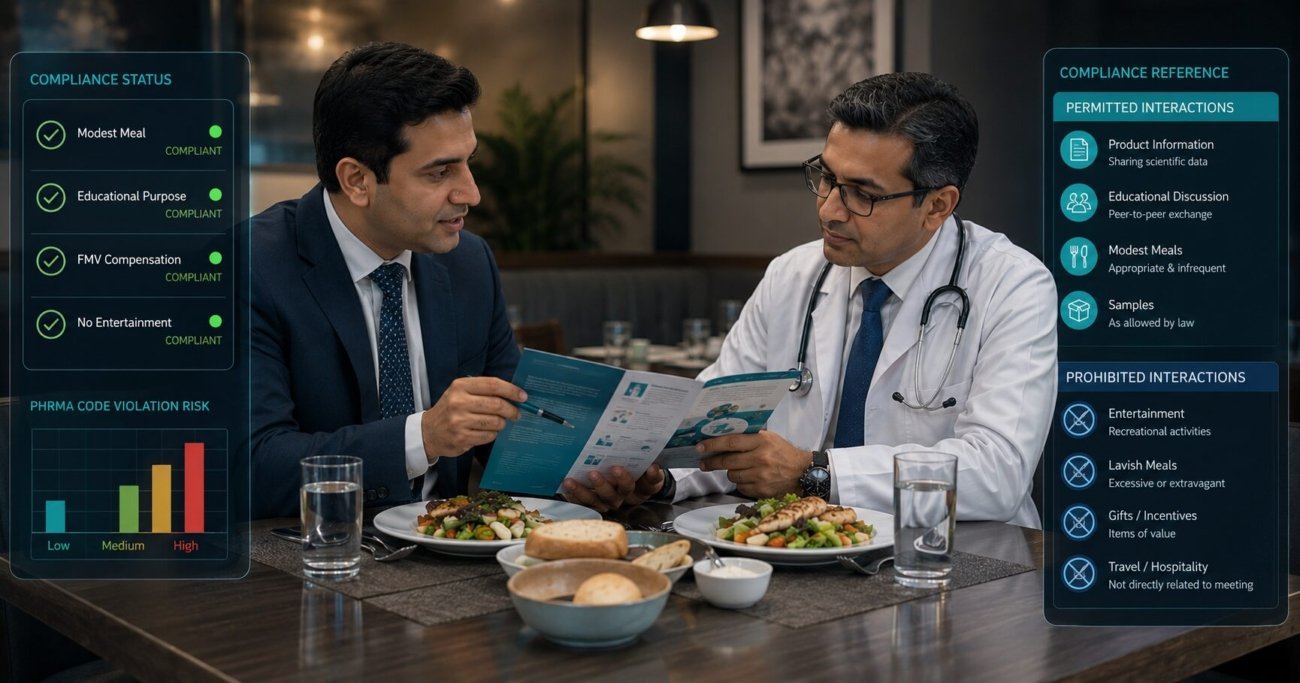
When pharmaceutical company personnel conduct informational presentations for HCPs, a meal may be provided, but it must satisfy two independent criteria: it must be modest as judged by local standards, and it must be incidental to the educational purpose (meaning the educational interaction is the primary purpose and the meal is subordinate and supportive, not the draw). Neither criterion alone is sufficient. A modest meal at a lavishly decorated private dining room that signals entertainment is not compliant. An expensive meal at a working lunch where genuine educational content is delivered is not compliant.
2022 UPDATE
The 2022 revision added the explicit requirement that the company must have a reasonable expectation, and take reasonable steps to confirm, that each attendee will have a substantive interaction with the company representative related to the informational presentation. A meal at which HCPs are present but do not engage with the educational content does not satisfy the interaction requirement.
COMMON MISTAKE
Providing meals to office staff who are not the target of the educational presentation. The Code permits meals to HCPs who receive the informational presentation. Administrative staff and other non-HCP personnel are generally not appropriate meal recipients under the Code. Companies should have processes to confirm attendee HCP status before meals are provided.
Tip 3: Alcohol Is Prohibited at Speaker Programs
3
No Alcohol at Speaker Programs (Added in 2022)
WHAT THE CODE SAYS
The 2022 revision explicitly prohibits pharmaceutical companies from paying for or providing alcohol in connection with company-sponsored speaker programs. This applies regardless of how the alcohol is framed (included in a meal price, provided as a separate offering, offered at a reception before or after the educational session). The prohibition is categorical: no alcohol at speaker programs.
WHY THIS CHANGED
The OIG’s November 2020 Special Fraud Alert specifically identified meals and alcohol at speaker programs as features associated with programs that may not constitute bona fide educational activities. The 2022 Code revision incorporated this concern directly. Providing alcohol was identified as a marker of entertainment rather than education, which is a distinction with significant Anti-Kickback Statute implications.
PRACTICAL NOTE
This prohibition applies specifically to company-sponsored speaker programs. The broader Code principle against entertainment applies across all HCP interactions. A company dinner at which alcohol is served and no educational content is presented is not salvaged by the absence of a formal speaker. The Anti-Kickback Statute analysis is driven by the substance of the interaction, not its label.
Tip 4: High-End Restaurants and Entertainment Venues Are Not Appropriate
4
Venues Must Be Conducive to Educational Communication
WHAT THE CODE SAYS
The 2022 revision specifies that speaker programs and informational presentations must be held in venues that are conducive to the communication of medical information. High-end restaurants, entertainment venues, sports venues, and similar settings that send a signal of entertainment rather than education are not appropriate venues for events supported by pharmaceutical company funding, regardless of whether educational content is actually delivered at the event.
THE UNDERLYING PRINCIPLE
Venue selection signals intent. An event at a conference room, a medical center, or a mid-range restaurant private room is consistent with an educational purpose. An event at a Michelin-starred restaurant, a luxury hotel suite, a sports stadium, or a resort is not, regardless of what happens inside. The 2022 Code makes explicit what the “modest” meal standard already implied: the setting of an HCP interaction is part of the compliance analysis, not just the content.
Tip 5: Entertainment Is Prohibited Regardless of Educational Content
5
No Tickets, Outings, or Entertainment of Any Kind
WHAT THE CODE SAYS
The PhRMA Code prohibits providing entertainment or recreational benefits to healthcare professionals under any circumstances. This includes sports tickets, concert tickets, golf outings, resort trips, spa treatments, and any other item or activity that constitutes personal entertainment rather than professional or educational value. There is no dollar threshold below which entertainment is permitted and no educational context that transforms entertainment into an appropriate interaction.
WHY COMPANIES GET THIS WRONG
Companies sometimes attempt to characterize entertainment as team-building, networking, or education. The Code’s prohibition on entertainment is categorical: the form of the activity determines whether it is entertainment, not the label applied to it or the business purpose cited for organizing it. If HCPs are attending a sporting event on a company’s tickets, that is prohibited entertainment regardless of what conversations occur during the game.
Tip 6: Speaker Program Attendance Rules Tightened in 2022
6
Repeat Attendance, Speaker Attendance, and Guest Attendance Rules
WHAT CHANGED IN 2022
The 2022 revision added explicit rules on who may attend speaker programs and under what circumstances repeat attendance is appropriate. These rules clarify situations that were previously gray areas.
Repeat Attendance
Repeat attendance at a speaker program on the same or substantially similar topic where a meal is provided is generally not appropriate unless the attendee has a bona fide educational need to receive the information again. An HCP who attended a program on Drug X two months ago should not attend another identical program primarily because a meal is served.
Speakers as Attendees
An HCP who previously presented as a speaker on a topic at a company program generally should not attend as a participant at a substantially similar program. This rule prevents a revolving circuit of speakers and attendees who are primarily attending each other’s programs rather than genuinely sharing and receiving new educational content.
Guests and Family
Friends, family members, significant others, and other guests of speakers or invited attendees should not attend company-sponsored programs unless they are themselves healthcare professionals with an independent, bona fide educational need for the information presented. The Code has long restricted spouse attendance; the 2022 revision clarified that this extends to all non-HCP guests.
Tip 7: Consulting Arrangements Must Reflect Genuine Need and Fair Market Value
7
HCP Consultants Must Be Compensated at Fair Market Value for Real Work
WHAT THE CODE SAYS
Pharmaceutical companies may engage HCPs as paid consultants for legitimate services: advisory board participation, clinical research, medical education, speaking on company-sponsored programs, and other genuine professional activities. Three conditions must be satisfied: (1) a legitimate need for the services must be identified before the consultant is selected, (2) the selection of the HCP must be based on their qualifications to meet the identified need, and (3) the compensation must be at fair market value and must not take into account the HCP’s past or potential future product usage or prescribing volume.
THE ANTI-KICKBACK RISK
Consulting arrangements that do not reflect genuine needs, that compensate HCPs above fair market value, or that involve HCPs selected based on their prescribing history rather than their expertise are among the highest-risk interactions in pharmaceutical marketing compliance. OIG enforcement actions have consistently included consulting arrangements structured to reward prescribing under the guise of legitimate consulting relationships. Compensation that cannot be justified by documented services at documented fair market value rates is a significant AKS red flag.
Tip 8: Educational Grants Must Be Independent of Marketing
8
Independent Medical Education Grants Must Not Be Influenced by Sales or Marketing
WHAT THE CODE SAYS
Pharmaceutical companies may support independent medical education (CME/CE programs) through educational grants. For a grant to be appropriate under the Code, the educational activity must be independent: the company may not control or influence the content, faculty selection, or attendee selection. Grant funding decisions must be made by personnel whose responsibilities are independent of sales and marketing, and grant requests from providers should not be initiated, encouraged, or evaluated by sales personnel.
WHAT MAKES A GRANT PROBLEMATIC
Educational grant programs routed through or evaluated by the sales organization, grants conditioned on the inclusion of specific products in the curriculum, or grants to providers who always deliver programming aligned with the company’s marketing messages are not truly independent educational activities. ACCME (the Accreditation Council for Continuing Medical Education) standards and PhRMA Code requirements both require genuine independence. A CME program funded by Company A that exclusively features positive content about Company A’s products fails both tests.
Tip 9: The Sunshine Act Reporting Obligation Applies Regardless of Code Compliance
9
PhRMA Code Compliance Does Not Satisfy Sunshine Act Reporting
WHAT THIS MEANS IN PRACTICE
The Physician Payments Sunshine Act (42 USC 1320a-7h), implemented through CMS’s Open Payments program, requires applicable manufacturers to report all payments and transfers of value to covered recipients (physicians, certain non-physician practitioners, and teaching hospitals) above $10 in a calendar year. The fact that a payment or transfer of value complies with the PhRMA Code does not eliminate the Sunshine Act reporting obligation. A modest meal at a compliant educational presentation must still be reported if it exceeds $10 and the recipient is a covered recipient.
PRACTICAL IMPLICATION
Companies must maintain tracking systems that capture all payments and transfers of value to covered HCPs, including meals provided during promotional presentations. Compliance with the PhRMA Code tells you whether you should have made the payment. The Sunshine Act tells you whether you must report it. The two are separate analyses with different thresholds and different consequences for non-compliance.
Tip 10: State Law May Add Requirements That Go Beyond the PhRMA Code
10
Several States Mandate Code Compliance or Impose Stricter Requirements
WHAT STATES HAVE DONE
Several states have enacted pharmaceutical marketing compliance requirements that reference or exceed the PhRMA Code. California, Connecticut, Nevada, and several others require pharmaceutical companies marketing in those states to adopt policies consistent with the Code, to report HCP marketing expenditures, or both. Some states impose per-HCP spending caps that are lower than what the PhRMA Code would permit. Companies with HCP engagement in these states must conduct a state-by-state compliance analysis and cannot rely solely on PhRMA Code compliance as their legal framework.
PRACTICAL IMPLICATION
A national PhRMA Code compliance program is a necessary foundation. It is not sufficient for companies with significant HCP engagement in high-regulation states. Companies should work with healthcare regulatory counsel to conduct a state-law review and build state-specific requirements into their compliance programs, policies, and training. A meal that is compliant under the PhRMA Code may still violate a state’s per-HCP spending cap or reporting requirement.
PhRMA Code Quick Reference: Permitted vs Prohibited
Activity
Status
Key Condition
Modest meal at educational presentation
Permitted
Must be modest, incidental, and paired with genuine substantive educational interaction
Alcohol at speaker programs
Prohibited (2022)
No exceptions at company-sponsored speaker programs
Educational materials of minimal value for patient benefit
Permitted
Must primarily benefit patients; minimal value; not a personal gift to the HCP
Branded pens, mugs, notepads, promotional items
Prohibited (since 2009)
No dollar threshold; non-educational gifts of any value are prohibited
HCP consulting at fair market value for genuine services
Permitted
Genuine need, qualified consultant selection, FMV compensation not tied to prescribing
Sports tickets, golf outings, concert tickets
Prohibited
Entertainment is categorically prohibited regardless of context or dollar value
Independent CME/CE educational grants
Permitted
Must be genuinely independent; company may not control content, faculty, or attendee selection
Speaker programs at high-end restaurants or luxury venues
Not Appropriate (2022)
Venues must be conducive to educational communication, not signal entertainment
Repeat attendance at same-topic program for meal
Generally Not Appropriate (2022)
Exception: bona fide educational need for the same content
Source: PhRMA Code on Interactions with Health Care Professionals (2022) | phrma.org
Key Takeaways
The $100 Gift Limit No Longer Exists
Branded pens, mugs, and similar promotional items of any value have been prohibited since the 2009 Code revision. Any compliance training, policy, or guidance that still references a dollar threshold for non-educational promotional items is outdated by more than fifteen years and must be corrected.
The 2022 Update Directly Addresses OIG Enforcement Priorities
The 2022 Code revisions were not routine updates. They were a direct response to the OIG’s November 2020 Special Fraud Alert identifying speaker programs and associated meals and hospitality as Anti-Kickback Statute risk areas. Companies that have not reviewed their speaker program practices against the 2022 Code are operating under outdated compliance guidance with elevated legal exposure.
PhRMA Code Compliance and Sunshine Act Reporting Are Separate Obligations
A payment that complies with the PhRMA Code may still require Sunshine Act reporting. A payment that violates the PhRMA Code requires both reporting and remediation. Tracking systems must capture all transfers of value to covered HCPs for Sunshine Act purposes, regardless of whether the underlying interaction was PhRMA-compliant.
State Law Can Make This Mandatory
The PhRMA Code is voluntary at the federal level but not in all states. Companies marketing to HCPs in California, Connecticut, and other states with pharmaceutical marketing compliance requirements must comply with state law and cannot rely solely on voluntary Code compliance as their legal framework.
Frequently Asked Questions
Can pharmaceutical companies still provide pens and notepads to physicians?
No. The PhRMA Code has prohibited branded promotional items, including pens, notepads, coffee mugs, and similar items, since the 2009 Code revision. There is no dollar threshold below which these items are permitted. The only items that may be provided are educational materials and items of minimal value that primarily benefit patients, not the HCP personally.
Can a company take a physician to dinner without a formal educational presentation?
No. A meal may only be provided in connection with an informational presentation or educational interaction. A purely social dinner, even at a modest restaurant, is not appropriate under the PhRMA Code because there is no educational purpose that makes the meal incidental rather than the primary event. If there is no educational presentation, there is no basis for providing a meal.
Does the PhRMA Code apply to device companies?
No. The PhRMA Code applies to pharmaceutical manufacturers. Medical device companies are covered by a separate voluntary code published by AdvaMed (the Advanced Medical Technology Association). Both codes share similar principles, but they are separate documents with different member organizations and different specific provisions.
If a physician who attended a speaker program last month asks to attend the same program again, is that acceptable?
Generally no, under the 2022 Code. Repeat attendance at a speaker program on the same or substantially similar topic where a meal is provided is generally not appropriate unless the attendee has a documented, bona fide educational need to receive the information again. A company cannot accommodate the repeat attendance request solely because the HCP expresses interest in attending. The attendee must have an articulable educational reason for needing the same content a second time.
Primary Sources
Industry References
Related VelSafe Articles
Build HCP Interactions That Survive Scrutiny
The PhRMA Code exists because the consequences of getting HCP interactions wrong extend well beyond compliance violations. They include DOJ investigations, OIG settlement agreements, corporate integrity agreements, reputational damage, and patient harm when prescribing decisions are influenced by something other than clinical evidence. The Code’s restrictions are not bureaucratic obstacles to effective marketing. They are the guardrails that keep pharmaceutical companies on the right side of the Anti-Kickback Statute, the Sunshine Act, and their own commitments to ethical conduct. Find more pharmaceutical and healthcare compliance resources at velsafe.com.