LAW: Pharmaceutical Manufacturing and Sterile Product Compliance
Cleanroom Compliance Under FDA and EU GMP Regulations
What the Law Requires for Sterile Drug Manufacturing
Cleanroom compliance sits at the intersection of three frameworks: FDA 21 CFR Parts 210 and 211, EU GMP Annex 1 (revised 2022, effective August 2023), and ISO 14644-1. For any facility producing sterile medicinal products, these are not optional guidelines. They are the legal and regulatory floor for facility design, environmental monitoring, personnel control, and documentation.
2023
EU GMP Annex 1 Effective
The revised EU GMP Annex 1 for sterile medicinal products became effective in August 2023. It introduced mandatory Contamination Control Strategy requirements and updated classification standards globally.
EMA, EU GMP Annex 1, 2022 Revision
4
EU GMP Cleanroom Grades
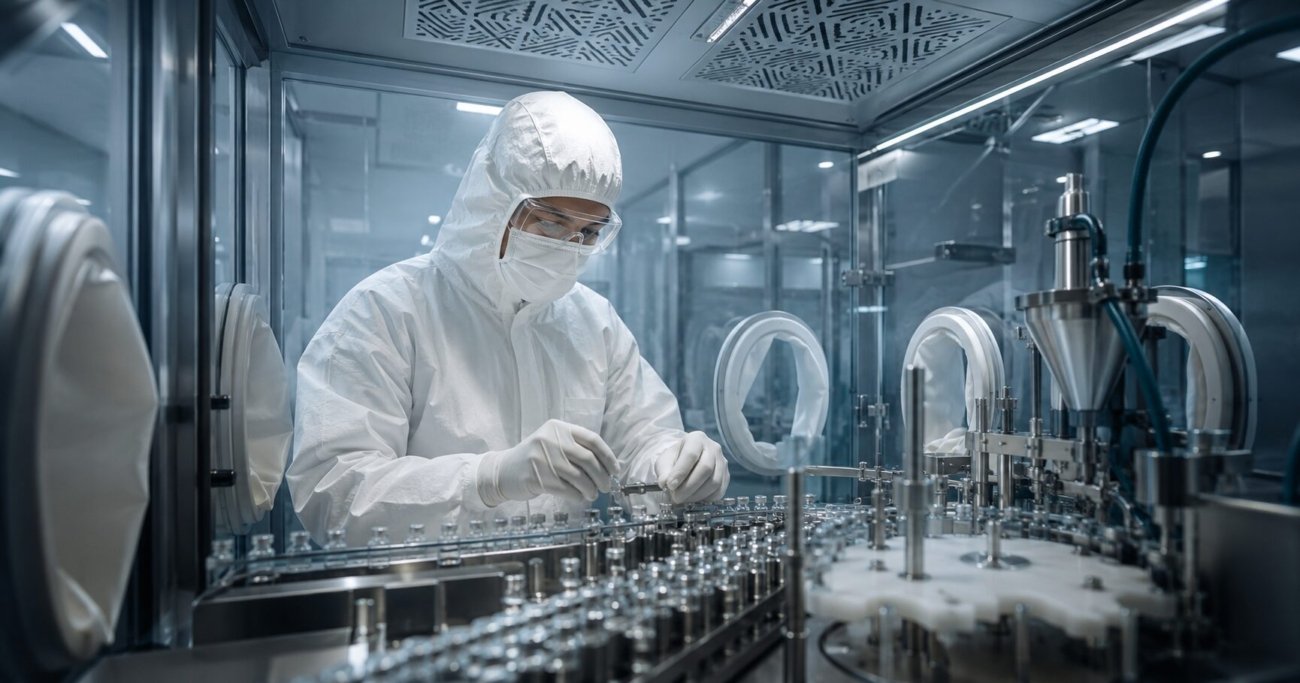
EU GMP Annex 1 defines Grades A through D for sterile manufacturing. Grade A is the most stringent, used for critical aseptic operations. Any recovered CFU in Grade A is a deviation requiring investigation.
EU GMP Annex 1, 2022
211.42
Most Cited FDA Section
21 CFR 211.42 (facility design and construction) and 211.113 (microbiological contamination control) were the two most frequently cited FDA provisions in 2024 inspections of sterile drug manufacturers.
FDA, 21 CFR Part 211
What These Regulations Cover and Who Must Comply
Cleanroom regulations apply to any manufacturer producing sterile drug products for the US or EU markets. Under the FDA, this means compliance with 21 CFR Parts 210 and 211 as well as the FDA’s Guidance for Industry on Sterile Drug Products Produced by Aseptic Processing. Under EU GMP, it means Annex 1, which was substantially revised in 2022 and took effect in August 2023 with one section (8.123) phased in through August 2024.
Both regulatory systems converge on the same outcome: documented, continuous proof that a manufacturing environment meets defined cleanliness limits at all times, not just during scheduled qualification events. ISO 14644-1:2015 provides the classification methodology that both the FDA and EU reference for airborne particle concentration limits, but EU GMP Annex 1 goes further by adding operational state distinctions (at rest versus in operation) and microbial contamination limits that ISO does not address.
Failure to maintain compliant cleanrooms has serious consequences. Regulatory inspections can result in FDA Form 483 observations, warning letters, import alerts, consent decrees, or facility shutdowns. EU inspections can result in GMP non-compliance statements that block market access for the entire facility, not just individual products.
Legal Disclaimer
This article provides educational information about FDA and EU GMP cleanroom requirements. It is not legal or regulatory advice. Manufacturers should consult qualified regulatory affairs and quality professionals to ensure their programs meet all applicable requirements. Requirements vary by product type, market, and facility configuration.
Key Regulatory Reference Points
21 CFR 211.42 and 211.113
The two most cited FDA sections for sterile drug manufacturers in 2024 inspections. 211.42 covers facility design and construction requirements. 211.113 covers control of microbiological contamination. Together they set the US baseline for cleanroom design and operation.
FDA, 21 CFR Parts 210 and 211
EU GMP Annex 1 (2022)
The revised EU guideline for the manufacture of sterile medicinal products. Effective August 2023. Introduced mandatory Contamination Control Strategy (CCS) requirements, updated Grade A through D particle and microbial limits, and stronger emphasis on barrier technologies and Quality Risk Management.
EMA, European Medicines Agency
ISO 14644-1:2015
The international standard defining cleanroom classification methodology based on airborne particle concentration. Defines ISO Classes 1 through 9. FDA inspectors expect facilities to justify and document classification consistently with ISO 14644-1. EU GMP Annex 1 explicitly references ISO 14644-1 for particle counts.
International Organization for Standardization
PIC/S and WHO TRS 961
PIC/S has published an aligned version of Annex 1 principles affecting over 50 regulatory authorities worldwide. WHO TRS 961 Annex 6 provides cleanroom guidance for global public health manufacturers. CCS principles are now a global expectation regardless of primary market.
Pharmaceutical Inspection Convention / World Health Organization
1. Cleanroom Classification: FDA, EU GMP, and ISO Frameworks Side by Side
The FDA does not publish its own proprietary cleanroom grading system. Instead, FDA guidance for sterile drug manufacturing uses ISO 14644-1 classes directly. ISO Class 5 corresponds to the critical aseptic processing zone, ISO Class 7 to the surrounding background environment, and ISO Class 8 to less critical clean areas. FDA inspectors expect facilities to scientifically justify and document their classification using ISO 14644-1 methodology, even though the standard is not mandated by name in the regulation itself.
EU GMP Annex 1 defines four grades (A through D) for pharmaceutical cleanrooms. These grades reference ISO 14644-1 particle counts but add operational state distinctions and microbial contamination limits that ISO does not address. The comparison between the two systems is important for any facility operating across both markets.
EU Grade
ISO Equivalent
Typical Operations
Microbial Limit (Air)
Grade A
ISO 5 (at rest and in operation)
Aseptic filling, compounding, open transfer of sterile product
Less than 1 CFU/m3 (zero tolerance: any recovery is a deviation)
Grade B
ISO 5 (at rest) / ISO 7 (in operation)
Background environment for Grade A aseptic operations
10 CFU/m3
Grade C
ISO 7 (at rest) / ISO 8 (in operation)
Less critical stages: preparation of solutions, filling closed systems
100 CFU/m3
Grade D
ISO 8 (at rest); in-operation defined by manufacturer
Support and preparation zones for non-critical steps
200 CFU/m3
Source: EU GMP Annex 1, 2022 | ISO 14644-1:2015 | Note: microbial limits are recommended values; facilities must establish their own alert and action limits based on historical data and CCS.
Reclassification frequency under the 2022 Annex 1 is now prescribed: Grade A and B areas must be reclassified every six months, and Grade C and D areas at least annually. This replaced the previous, more flexible approach and represents one of the significant practical changes introduced by the 2022 revision.
2. Contamination Control Strategy: The Core of Annex 1 (2022)
The most significant change introduced by the 2022 EU GMP Annex 1 revision was the mandatory Contamination Control Strategy. A CCS is a documented, site-specific plan that identifies all contamination risks (microbial, particulate, and pyrogenic) and describes the control measures applied across the product lifecycle.
The CCS is not a single document filed at qualification. It is a living system that must be reviewed and updated as processes, equipment, or risk profiles change. It must cover facility design and air classification, personnel and gowning controls, equipment design and cleaning, environmental monitoring, disinfection and decontamination, process controls and barrier technologies, and deviations and trend analysis.
Risk Identification
CCS Component 1
Map all contamination risks across the facility: microbial, particulate, and endotoxin/pyrogen sources. Personnel, air, equipment, water, and materials are all potential vectors. The CCS must address each one explicitly.
Control Measures
CCS Component 2
Document every control applied: facility design, pressure cascades, HEPA filtration, gowning procedures, cleaning and disinfection, barrier technologies (RABS, isolators), and process design to minimize human intervention.
Monitoring Program
CCS Component 3
Define the environmental monitoring program, including sampling locations, methods, frequencies, alert and action limits, and trend analysis. Continuous particle monitoring is mandatory in Grade A zones under the 2022 revision.
Review and Update
CCS Component 4
The CCS is reviewed when processes change, after deviations, after trend alerts, and on a scheduled periodic basis. It must reflect current site conditions at all times and be referenced in quality risk management activities.
Regulatory Note: The CCS requirement under EU GMP Annex 1 (2022) is now effectively a global expectation. PIC/S, which aligns with Annex 1 and covers over 50 regulatory authorities worldwide, has adopted the same framework. Facilities exporting to multiple markets should build their CCS to satisfy Annex 1 regardless of their primary regulatory jurisdiction.
3. Facility Design and HVAC Requirements
Both FDA and EU GMP require that cleanroom design actively prevents contamination rather than simply reacting to it. Facility layout, airflow direction, pressure differentials, and surface specifications are all legally mandated elements of compliant cleanroom design.
Key Facility Design Requirements: FDA vs EU GMP
Pressure differentials between zones
Min. 10-15 Pa
Both FDA (21 CFR 211.46) and EU GMP require validated pressure cascades from cleaner to dirtier areas. Air must flow from higher to lower classification zones to prevent contamination ingress.
Unidirectional airflow in Grade A zones
0.36-0.54 m/s
EU GMP Annex 1 requires unidirectional (laminar) airflow in Grade A critical zones at 0.36 to 0.54 m/s. Airflow visualization (smoke studies) must confirm laminar flow and absence of turbulence around critical process areas.
HEPA filtration
H14 filter efficiency required
Both FDA and EU GMP require HEPA filtration in clean areas. Terminal HEPA filters must be integrity tested at installation and periodically thereafter. Filter failure is a critical compliance event.
Surface specifications
Smooth, impervious, unbroken
21 CFR 211.42 requires floors, walls, and ceilings of smooth, hard surfaces that are easily cleanable. EU GMP Annex 1 states all exposed surfaces in cleanrooms and critical zones should be smooth, impervious, and unbroken to minimize particle shedding.
Source: FDA 21 CFR 211.42, 211.46 | EU GMP Annex 1, 2022 | ISO 14644-1:2015
4. Personnel Controls and Gowning Requirements
People are the primary source of microbial contamination in cleanrooms. Skin, hair, breath, clothing, and movement all shed particles and viable organisms into a controlled environment. Both FDA and EU GMP impose strict requirements on personnel access, gowning, behavior, and training.
Requirement
FDA (21 CFR 211)
EU GMP Annex 1 (2022)
Gowning for aseptic areas
Sterile gowns, gloves, masks required. Written gowning SOP mandatory.
Grade A and B require sterile, non-shedding gowns. Gowning qualification and monitoring (glove and gown surface sampling) required.
Training and qualification
Training on aseptic technique and gowning required before cleanroom access.
Formal gowning qualification with practical assessment. Refresher training required. Media fill participation is part of personnel qualification.
Personnel behavior
Avoid rapid movements, unnecessary talking. Follow defined entry/exit sequence.
Explicit behavioral rules: no quick movements, no unnecessary talking, minimize personnel in Grade A zones, written behavioral SOPs required.
Personnel monitoring
Periodic monitoring during aseptic operations required.
Glove and gown contact plates required at defined frequencies. Results form part of environmental monitoring trend analysis.
Barrier technologies
Encouraged for critical operations to minimize human intervention.
Strong preference for isolators and RABS. Annex 1 (2022) requires justification when open Grade A/B operations are used instead of barrier technologies.
Source: FDA 21 CFR 211 | EU GMP Annex 1, 2022
5. Environmental Monitoring Requirements
Environmental monitoring (EM) is how facilities prove, on an ongoing basis, that their cleanrooms remain within classification limits during actual manufacturing operations. Both FDA and EU GMP require formal EM programs with defined sampling locations, methods, frequencies, and response procedures. The 2022 EU GMP Annex 1 revision strengthened these requirements significantly.
Continuous Particle Monitoring (Grade A)
Annex 1 (2022) requires continuous particle monitoring in Grade A zones throughout production. The previous requirement for “frequent” monitoring has been replaced with a clear continuous monitoring mandate. Active air sampling is the only method that can quantitatively verify a Grade A zone is free of viable particulate.
EU GMP Annex 1, 2022 | FDA Guidance on Aseptic Processing
Microbial Monitoring Methods
Viable air monitoring uses active impaction samplers. Settle plates provide passive supplementary data. Surface contact plates monitor equipment and personnel. Glove and gown prints are required for personnel in Grade A and B areas. Each method provides different information; programs should use multiple methods in combination.
EU GMP Annex 1, 2022 | FDA 21 CFR 211.113
Alert and Action Limits
Both FDA and EU GMP require facilities to define alert and action limits based on historical data and process knowledge. Alert limits signal a trend requiring investigation. Action limits require immediate response including production hold, investigation, root cause analysis, and corrective action. Annex 1 specifies that Grade A microbial recovery above zero CFU is always an action-level event requiring investigation.
EU GMP Annex 1, 2022 | FDA 21 CFR 211.192
6. Cleaning, Disinfection, and Decontamination
Written cleaning and disinfection procedures are mandatory under both FDA and EU GMP. These procedures must be validated, followed on a documented schedule, and capable of preventing microbial buildup over time.
- Validated cleaning agents and disinfectants. Both FDA and EU GMP require that cleaning agents and disinfectants be validated for efficacy against the range of microorganisms likely to be found in the facility environment.
- Rotation of disinfectants. EU GMP Annex 1 requires that disinfectants be rotated to prevent the development of resistant organisms. A typical program uses at least two chemically distinct agents on a defined rotation schedule, with a sporicide used periodically.
- Sterile disinfectants in Grade A and B areas. Disinfectants used in Grade A and B areas must be sterile. Non-sterile disinfectants are not acceptable in critical zones regardless of their microbial count.
- Cleaning logs and records. Every cleaning activity must be logged with the date, time, agent used, area cleaned, and personnel responsible. These records are subject to inspection and must be retained per your quality system requirements.
- Immediate response to spills. EU GMP Annex 1 explicitly requires immediate cleaning of spills to prevent contamination spread. A procedure for emergency spill response must be part of the cleaning program.
- Periodic re-qualification of cleaning procedures. As microorganism profiles change over time, cleaning and disinfection procedures should be periodically re-validated or re-assessed as part of the CCS review cycle.
7. Qualification and Validation Requirements
No cleanroom may be used for pharmaceutical manufacturing before it has been qualified. Both FDA and EU GMP require a structured qualification sequence before production begins, and ongoing requalification at defined intervals thereafter.
Phase
Abbreviation
What It Verifies
Design Qualification
DQ
The cleanroom design meets regulatory requirements and user requirement specifications (URS) before construction begins.
Installation Qualification
IQ
All systems and equipment are installed correctly per approved specifications and manufacturer requirements.
Operational Qualification
OQ
All systems operate within defined parameters: HVAC, pressure differentials, airflow velocity, HEPA integrity, and particle counts at rest.
Performance Qualification
PQ
Consistent performance is demonstrated under actual production conditions, including in-operation particle counts and microbial monitoring.
Ongoing Requalification
Periodic
Grade A and B: every 6 months. Grade C and D: at least annually. Also triggered by changes to equipment, processes, or personnel, or after significant deviations.
Source: FDA cGMP Guidance | EU GMP Annex 1, 2022 | ISO 14644-2
Key Takeaways
The CCS Is Now Mandatory, Not Optional
The 2022 EU GMP Annex 1 revision made the Contamination Control Strategy a formal regulatory requirement. It is not a best practice document. Facilities without a current, documented CCS are non-compliant with EU GMP regardless of how well their individual controls perform.
Grade A Zero Tolerance Is Absolute
Any viable organism recovered in a Grade A zone is a deviation requiring investigation under EU GMP Annex 1. There is no acceptable threshold above zero. Continuous viable monitoring in Grade A is required, not periodic sampling.
Reclassification Is Now Time-Bound
The 2022 Annex 1 sets explicit reclassification intervals: every six months for Grade A and B, annually for Grade C and D. This replaced the previous flexible approach and is a direct inspection checkpoint that will be verified by EU auditors.
Documentation Is the Foundation of Both Frameworks
Both FDA and EU GMP inspectors focus heavily on environmental monitoring records, deviation investigations, and HVAC validation protocols. A well-controlled cleanroom with poor documentation is a compliance failure. Records must be time-stamped, audit-trailed, and protected from modification under 21 CFR Part 11 for electronic systems.
Frequently Asked Questions
What is the difference between FDA cleanroom requirements and EU GMP Annex 1?
The FDA uses ISO 14644-1 classes (ISO 5 through 8) referenced in aseptic processing guidance. EU GMP Annex 1 defines Grades A through D with specific particle limits for both at-rest and in-operation conditions, plus microbial limits that ISO does not cover. The 2022 Annex 1 also added the mandatory Contamination Control Strategy requirement and explicit reclassification intervals. Facilities exporting to both markets must satisfy both frameworks simultaneously.
Is a Contamination Control Strategy required for FDA inspections as well?
The CCS is an explicit EU GMP Annex 1 requirement. While the FDA does not use the term CCS specifically, the underlying principles (documented risk-based contamination control across facility design, monitoring, personnel, and cleaning) are embedded in 21 CFR 211 requirements and FDA inspection expectations for sterile manufacturers. Building a CCS that satisfies Annex 1 will generally satisfy FDA expectations as well.
What triggered the 2022 revision to EU GMP Annex 1?
The 2022 revision was the first major update to Annex 1 since 2008. Key drivers included advances in barrier technology (isolators and RABS), the widespread adoption of quality risk management principles under ICH Q9, alignment with ISO 14644 updates, and the need to address contamination control more comprehensively across the product lifecycle. The revision took effect August 2023, with section 8.123 phased in through August 2024.
What are the most frequently cited FDA cleanroom violations?
In 2024 inspections of sterile drug manufacturers, 21 CFR 211.113 (control of microbiological contamination) and 211.42 (facility design and construction) were the two most cited provisions. Common findings include inadequate environmental monitoring records, failure to investigate EM excursions, inadequate HVAC validation documentation, and deficiencies in aseptic technique training records.
Does Annex 1 require isolators or RABS?
Annex 1 (2022) does not mandate isolators or RABS for all operations, but it strongly favors barrier technologies for critical aseptic operations and requires justification when open Grade A/B operations are used instead. This represents a significant shift in regulatory expectation from the previous version.
Government and Regulatory Sources
Industry and Technical References
Related VelSafe Articles
Stay Current with Evolving Cleanroom Regulations
Cleanroom compliance is not a one-time qualification event. The 2022 EU GMP Annex 1 revision made that clear: the Contamination Control Strategy must be a living system, reclassification intervals are mandatory, and Grade A monitoring is continuous. Both FDA and EU GMP expect proof of ongoing control, not historical qualification alone. Find more pharmaceutical and regulatory compliance resources at velsafe.com.