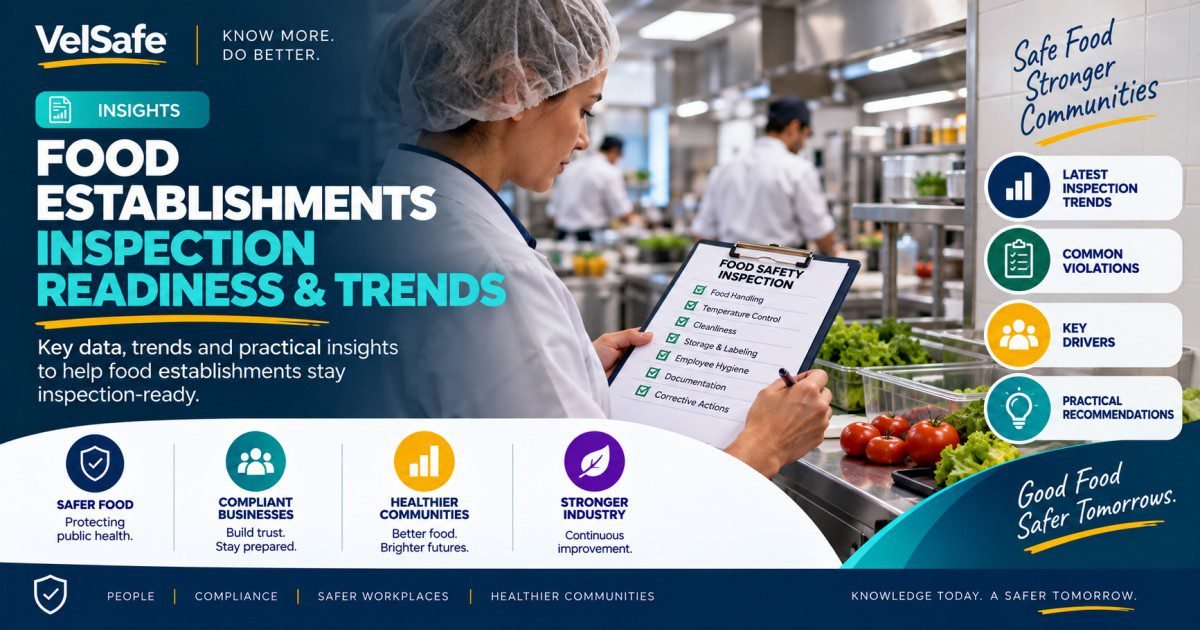
INSIGHTS: Food Establishment Inspection Readiness
Food Establishment Inspection Readiness: Trends and Gaps
Inspection readiness at food establishments varies dramatically by facility type, size, and ownership model. While food safety regulations have become more rigorous under FSMA, inspection finding data reveals persistent gaps in temperature control, allergen management, sanitation documentation, and food safety planning across both retail food service and food manufacturing. This article examines what current inspection data, FDA enforcement records, and industry research reveal about where food establishment preparedness falls short and why the gaps persist despite regulatory pressure.
84%
Retail Food Inspections Yielding At Least One Violation
FDA and state health department data consistently show that approximately 84% of retail food establishment inspections identify at least one violation. Critical violations are present in roughly half of all inspections conducted. This is not a rare-event problem: most food establishments have active compliance gaps at any point in time. Source: FDA, FSMA Inspection Data, 2024
#1
Undisclosed Allergen: Leading Cause of FDA Food Recalls Year Over Year
Undisclosed allergens remain the leading cause of FDA food recalls ahead of microbial contamination and foreign material, accounting for approximately 40% of all food recalls. The persistent top-ranking of allergen failures despite widespread training reveals a systemic rather than a knowledge problem. Source: FDA Food Recall Database, 2024
57%
FSMA-Covered Facilities With a Fully Current Food Safety Plan at Inspection
FDA audit data indicates that fewer than 60% of FSMA-covered food manufacturing facilities had a fully current, reviewed food safety plan at the time of their most recent inspection. A plan that does not reflect current operations is both a regulatory violation under 21 CFR Part 117 and a functionally ineffective food safety tool. Source: FDA, FSMA Compliance Data, 2024
Insight Summary
Approximately 84% of retail food establishment inspections yield at least one violation. This is not a tail-risk scenario: most food establishments have active compliance gaps at the time of any given inspection, concentrated in the same four categories that have dominated inspection data for years.
Temperature control violations have not declined meaningfully despite decades of regulatory attention. The gap is not a knowledge problem: it is an operational implementation problem in which monitoring policies exist but the verification steps that would catch deviations before an inspector does are absent or inconsistently applied.
Allergen recalls are the leading FDA food recall cause despite widespread allergen awareness training. The failure mode is systemic: labelling processes that do not include an allergen review step, supplier agreements that do not require allergen change notification, and shared equipment without current cleaning validation. Training does not close these gaps.
Fewer than 60% of FSMA-covered manufacturers had a fully current food safety plan at their most recent inspection. The most common deficiency is a plan prepared at initial FSMA compliance that has not been updated when processes, products, or ingredients changed, as 21 CFR 117.170 requires.
The primary differentiator between high-readiness and low-readiness food establishments is not size, ownership, or regulatory experience. It is the presence of an internal verification system that operates on the same schedule as the inspection would, catching failures before the regulator does.
Key Insight
The food establishments that perform best under inspection do not do anything unusual before the inspection arrives. They operate an internal verification function on the same schedule as the inspection would: temperature logs reviewed daily, sanitation verified before operations begin, food safety plans updated when processes change. The gap between ready and not ready is the gap between having a policy and verifying that it is being followed. Most food safety failures during inspection are not knowledge failures. They are verification failures.
What Food Establishment Inspection Readiness Data Actually Measures
Inspection readiness in food establishments is not a binary condition. A facility is not simply ready or not ready for an inspection. Readiness exists on a spectrum that reflects the maturity of the facility’s food safety management system, the consistency with which that system is implemented in daily operations, and the degree to which documentation accurately reflects actual practice.
The inspection data examined in this report comes from FDA food facility inspection records, state health department enforcement data, FSMA compliance assessments, and industry survey research on food safety management practices. The findings reveal a consistent pattern: the gaps in food establishment inspection readiness are not primarily driven by facilities that ignore food safety. They are driven by facilities that have food safety policies in place but fail to implement them consistently in the operational environment where the risk is actually created.
Top Inspection Finding Categories (Frequency)
Temperature control (TCS foods)
Most frequent critical
Allergen control and labelling
#1 recall driver
FSMA food safety plan currency
43% non-current at inspection
Sanitation records and verification
Top 5 consistently
Employee training documentation
Top 5 consistently
Source: FDA FSMA Inspection Data 2024 | CDC Foodborne Illness Surveillance
Allergen Failure Mode Frequency (Recall Root Cause)
Labelling error: allergen present but not declared
Ingredient substitution without label review; incorrect label version used in production
Cross-contact from shared equipment
Allergen cleaning validation absent or not current for the specific allergen-product combination
Ingredient substitution without allergen assessment
Supplier changes formulation; no notification requirement in supplier agreement
Incorrect product in packaging
Inadequate line clearance verification; no label-product reconciliation at packaging
Source: FDA Food Recall Database | FALCPA and FASTER Act
What the Data Shows: Four Persistent Readiness Gaps
Gap 1: Temperature Control Has Not Improved Despite Regulatory Focus
Temperature control for safety (TCS) violations appear in inspection records at rates that have not meaningfully declined despite increased regulatory focus. Cold holding, hot holding, and cooling violations are the three most consistently cited temperature categories across both food service and food manufacturing inspections. The FDA Food Code requires cooling from 135°F to 70°F within 2 hours and from 70°F to 41°F within an additional 4 hours. Many establishments monitor hot holding and cold holding temperatures routinely but have no equivalent monitoring process for cooling in progress, leaving the highest-risk temperature category the least observed. Source: FDA Food Code 2022, Sections 3-501.14 and 3-501.16
What this means: Temperature violations are not a knowledge gap. Facilities know the requirements. The problem is operational implementation: monitoring logs are completed from memory rather than at the time of measurement, equipment deficiencies are detected by inspection rather than by the facility’s own programme, and monitoring frequency calibrated for average operating volume fails under peak demand. The pattern suggests that the control in place is a documentation exercise rather than a real-time operational process. Source: CDC Foodborne Illness Surveillance Data
Gap 2: Allergen Recalls Remain the Leading Category Despite Training Investment
Allergen recalls account for approximately 40% of all FDA food recalls and have ranked first among recall causes for consecutive years. Under FALCPA and the FASTER Act of 2021, nine major food allergens must be declared on US food labels: milk, eggs, fish, crustacean shellfish, tree nuts, peanuts, wheat, soybeans, and sesame. Sesame was added effective January 1, 2023. Voluntary “may contain” advisory statements are not a substitute for required declarations when the allergen is actually present. Source: FDA: Food Allergen Labelling (FALCPA and FASTER Act)
What this means: Most allergen recalls occur not because employees were unaware that allergens require control. They occur because the operational system was inadequate: the label review process, the supplier agreement, the cleaning validation, and the line clearance procedure. Employee training on allergen awareness is a prerequisite for allergen safety, not a substitute for the systems that prevent allergen incidents. A facility is inspection-ready on allergen controls when it can produce current allergen cleaning validation records for shared equipment, a supplier notification agreement requiring allergen disclosure for any ingredient change, a documented allergen review step in its label approval process, and evidence that line clearance verification was completed before each allergen changeover.
Gap 3: FSMA Food Safety Plans Are Frequently Stale and Non-Reflective of Current Operations
21 CFR Part 117.170 requires covered food manufacturers to review the food safety plan at least every three years and when significant changes occur in the facility’s operations, products, or ingredients. FDA inspection data shows that the food safety plan is among the most frequently cited FSMA deficiency categories. The most common finding is that the written plan does not reflect the facility’s current processes. Facilities that prepared a plan at initial FSMA compliance and did not update it when processes changed, new products were added, or new ingredients were sourced have a plan that is technically present but not functionally compliant. Source: 21 CFR Part 117.170
What this means: FDA inspectors evaluate not just whether a hazard analysis exists but whether its conclusions are scientifically supported. A hazard analysis that concludes a hazard is not reasonably foreseeable without documented scientific justification fails the requirement. A plan that does not match current operations fails on both the regulatory and the practical food safety level: if the plan does not reflect actual hazards, the controls it requires may not be the controls the facility actually needs. A stale food safety plan is evidence of a stale food safety management system.
Gap 4: Sanitation and Hygiene Documentation Gaps Signal Operational Failures
Sanitation violations in food establishments are among the most visible findings because many are observable in real time: an employee who does not wash hands, a food contact surface with visible residue, a sanitiser solution at insufficient concentration. The deeper readiness issue is the management system that allowed the condition to develop without internal detection. Inspection findings routinely identify sanitiser solutions at incorrect concentrations despite the establishment having test strips available. The test strips are present; the testing is not occurring. Source: FDA Food Code 2022, Sections 2-201 and 4-501.116
What this means: Missing or incomplete monitoring records, unsigned sanitation logs, and absent corrective action documentation are not just record-keeping violations. They are evidence that the operational control was not consistently executed. When documentation is absent, the conclusion is that the monitoring did not occur at the required frequency, regardless of what the facility reports verbally. Pre-operational sanitation inspection records, which document verification rather than just cleaning task completion, are the evidence that readiness requires. Source: 21 CFR Part 117.135, Sanitation Controls
What Is Driving the Inspection Readiness Gap
The underlying driver of poor inspection readiness is not ignorance of food safety requirements. It is the gap between policy design and operational execution, and the absence of an internal verification system that would close that gap before an inspector arrives. The pattern emerges clearly from inspection data: violations are concentrated in facilities that have written policies for the cited control area but lack the operational discipline or the verification mechanism to ensure the policy is being followed in practice.
Readiness Element
Low-Readiness Facilities
High-Readiness Facilities
Conducted when remembered; logs completed from memory; no corrective action trigger
Scheduled, documented in real time, calibrated equipment, corrective action procedure activated at deviation
Employee allergen awareness training only; no cleaning validation; no supplier notification requirement
Current allergen cleaning validation, supplier allergen disclosure agreement, label allergen review step, pre-run line clearance verification
Cleaning schedule signed off; no independent verification that surfaces actually meet sanitation standard
Pre-operational sanitation inspection before each production day; results recorded; exceptions corrected before food contact
Prepared at initial FSMA compliance; not reviewed since; does not reflect current operations or products
Reviewed at least every three years; updated at significant change; monitoring records maintained for all preventive controls
Applied to immediate problem; no root cause investigation; no recurrence verification
Root cause documented for every critical finding; systemic fix implemented; effectiveness verified at defined interval
Source: FDA FSMA Preventive Controls Framework, 21 CFR Part 117
What This Means for Food Safety Leaders
A clean inspection record is not proof of a robust food safety system
An 84% inspection violation rate means that facilities that passed their last inspection may simply have had an inspector arrive during a period when compliance conditions happened to be met. Low inspection frequency combined with targeted inspection review means that many compliance gaps are never observed during an inspection. Internal audit data and near-miss reporting are more reliable leading indicators of food safety system performance than external inspection outcomes.
The corrective action problem is systemic, not incident-specific
Inspection findings that are addressed by correcting the immediate observation (the out-of-temperature product is discarded, the sanitiser solution is remade, the missing record is completed) without identifying and fixing the underlying system failure create a predictable recurrence pattern. Facilities with multiple repeat findings in the same category across consecutive inspections have a corrective action programme that treats symptoms rather than causes. Root cause analysis applied to every critical finding changes this pattern.
Allergen compliance requires system redesign, not more training
Allergen recalls at 40% of total FDA recalls despite widespread training investment is strong evidence that training is not the limiting factor. The limiting factor is system design: labelling processes without allergen review checkpoints, supplier agreements without allergen change notification requirements, and shared equipment without current cleaning validation for the specific allergen-product combination in use. These are programme design failures, not training failures.
FSMA plan currency is a programme management obligation, not a one-time task
43% of FSMA-covered facilities having a non-current food safety plan at inspection reflects a specific management failure: there is no trigger mechanism that initiates a plan review when operations change. The requirement at 21 CFR 117.170 is explicit: review upon significant change and at least every three years. A food safety plan management schedule that ties review to operational change triggers (new product, new ingredient, process modification, new equipment) would close this gap at low cost relative to the citation exposure a stale plan creates.
Practical Implications: Three Programme Priorities
Priority 1: Build a self-inspection programme that operates on the same schedule as the external inspection would
The most consistent finding in inspection performance analysis is that high-readiness facilities operate an internal verification function on the same cycle as external regulatory review. For retail food service, this means monthly self-inspections using the applicable state Food Code inspection form, conducted by someone other than the person responsible for the area. For FSMA manufacturers, it means scheduled internal audits of each preventive control at the same frequency the food safety plan specifies for monitoring, plus an annual system-level food safety plan review. Self-inspection findings must be documented, corrective actions must be tracked to closure, and recurrence must be verified.
Priority 2: Redesign allergen controls as a system, not as a training programme
If your allergen programme consists primarily of allergen awareness training for employees, it is not an allergen control system. The control system requires four documented components: a supplier notification agreement that requires disclosure of any ingredient formulation or substitution change; an allergen review step in the label approval process that is executed by a named person for every label version; current allergen cleaning validation for every shared equipment allergen-product combination; and a pre-run line clearance verification record for every allergen changeover. Each of these is documentable, auditable, and inspectable. None is replaced by employee training alone.
Priority 3: Create a change management trigger that initiates food safety plan review at each operational change
The FSMA plan currency gap is primarily a management system failure: there is no mechanism that connects operational change to food safety plan review. The fix is a formal change management trigger: a step in the process for adding a new product, changing a process, modifying a recipe, sourcing a new ingredient, or acquiring new equipment that requires food safety plan review as a gate before the change is implemented. This does not require a full plan rewrite at every change. It requires documenting that the responsible person reviewed the relevant hazard analysis section, confirmed whether the change affects existing hazards or creates new ones, and updated the plan where required. A one-page change assessment form with a PCQI sign-off is sufficient for most change events. Source: 21 CFR Part 117.170
Executive Takeaway
The 84% violation rate is a management system finding, not a knowledge finding
The facilities found in violation at 84% of inspections are not facilities that do not know the requirements. They are facilities that have policies that are not being implemented consistently. The inspection finding is the evidence; the management system gap is the cause. Addressing the root cause rather than the observable violation is what produces durable readiness.
Inspection readiness is not what you do before the inspection. It is what you do every day.
Food establishments that achieve consistent high performance under inspection do not have special preparation routines. They have operational systems that produce the documented evidence of compliance as a natural output of daily operations. Temperature logs reviewed in real time. Pre-operational sanitation inspections. Allergen line clearance records. Food safety plan reviews tied to change events. These are not inspection preparation activities. They are the operational discipline that produces inspection readiness as a byproduct.
The gap between a passed inspection and a recall-free operation is not the same gap
Passing an inspection and operating a food safety system that prevents recalls are related but not identical outcomes. Allergen recalls at 40% of total FDA recalls occur at facilities that have passed food safety inspections. The inspection checks whether systems exist and whether they were operating at the moment of the inspection. The recall happens when a system failure, possibly one the inspection did not observe, produces a contaminated or mislabelled product in commerce. The highest-readiness standard is the one that catches failures before either the inspector or the consumer does. That standard requires internal verification, not inspection performance.
Frequently Asked Questions
How often are food establishments inspected by FDA and state health departments?
Inspection frequency varies by establishment type, risk category, and jurisdiction. Under FSMA, FDA inspects domestic human food facilities on a risk-based schedule: high-risk facilities at least every three years, and non-high-risk facilities at least every five years. State health departments typically inspect retail food service establishments annually or more frequently for higher-risk facilities serving highly susceptible populations or with prior violation histories. Source: FDA FSMA Inspection Frequency Requirements
What is a Preventive Controls Qualified Individual and is one required?
A Preventive Controls Qualified Individual (PCQI) is a person who has successfully completed training in the development and application of risk-based preventive controls, or who is otherwise qualified through job experience, as defined under 21 CFR Part 117. Under FSMA, a PCQI must prepare or oversee the food safety plan, conduct hazard analysis reviews, verify preventive control effectiveness, and document corrective actions. Every FSMA-covered food manufacturing facility is required to have a PCQI. FDA-recognised PCQI training is available through FSPCA (Food Safety Preventive Controls Alliance). Source: 21 CFR Part 117
Which food allergens must be declared on food labels under US law?
Under FALCPA and the FASTER Act of 2021, nine major food allergens must be declared: milk, eggs, fish, crustacean shellfish, tree nuts, peanuts, wheat, soybeans, and sesame. Sesame was added effective January 1, 2023. Each allergen must be declared in the ingredient list using the common or usual name, or in a “Contains” statement following the ingredient list. Voluntary “may contain” advisory statements are not a substitute for the required declaration when the allergen is actually present in the product. Source: FDA: Food Allergen Labelling
What is the FDA Food Code and who does it apply to?
The FDA Food Code is a model code published by FDA every four years as a basis for regulation of food service by state and local governments. The Food Code itself is not a federal regulation. Most states adopt it or a modified version as the basis for retail food service regulations, making it the de facto national standard for restaurants, cafeterias, delis, and supermarkets. The most current version is the 2022 Food Code. Food manufacturers subject to FSMA are governed by 21 CFR Part 117, not the Food Code. Source: FDA: 2022 Food Code
What happens if an FDA inspection reveals that a facility does not have a required food safety plan?
Failure to have a required food safety plan under 21 CFR Part 117 is a significant FSMA violation. An inspector who finds that a covered facility has no food safety plan, or has a plan not prepared by or under the oversight of a PCQI, will document a serious compliance finding. The absence of a food safety plan typically results in an FDA Form 483 observation and, if not corrected promptly, can escalate to a Warning Letter. FDA may also classify the inspection outcome as Official Action Indicated (OAI), which can affect the facility’s standing and trigger a follow-up inspection on a compressed timeline. Source: FDA: Inspection Guides
How can a food establishment assess its own inspection readiness?
A food establishment can assess inspection readiness through a self-inspection using the inspection criteria the applicable regulatory agency applies. For retail food service, this means the applicable state Food Code inspection form, evaluated as an inspector would. For FSMA-covered manufacturers, FDA provides a model food safety plan and checklist resources through the FSMA Technical Assistance Network. Self-inspections are most useful when conducted by someone other than the person responsible for the area, when findings are documented and corrective actions tracked to closure, and when conducted at the same frequency as the external inspection schedule. Source: FDA: FSMA Technical Assistance
What is the relationship between inspection findings and food recalls?
Inspection findings and food recalls are related but distinct regulatory outcomes. An inspection finding identifies a condition that violates food safety requirements; a recall occurs when a product posing a health risk has already reached distribution. Many inspection findings, if unaddressed at the system level, create the conditions from which recalls originate: an allergen control gap becomes a recall when a product with an undisclosed allergen reaches consumers. Facilities that address findings with genuine root cause corrective actions reduce their recall probability. Facilities that correct the immediate observation without fixing the underlying system are more likely to experience a recall that traces back to the same root cause as a prior inspection finding. Source: FDA Food Recall Database
Sources
Government and Regulatory Sources
- 21 CFR Part 117: Current Good Manufacturing Practice, Hazard Analysis, and Risk-Based Preventive Controls for Human Food: the FSMA Preventive Controls Rule governing food safety plan requirements, PCQI obligations, monitoring records, and corrective actions for FSMA-covered food manufacturers. eCFR.gov.
- FDA Food Code 2022: the model code for retail food service regulation adopted by most state and local food safety programmes; source for temperature control requirements at Sections 3-501.14 and 3-501.16, ill employee policy at Section 2-201, and sanitiser concentration requirements at Section 4-501.116.
- FDA Food Recall Database: searchable records of all FDA food recalls, including cause category (allergen, microbial, foreign material), product type, and distribution scope; primary source for allergen recall frequency data.
- FDA: Food Allergen Labelling (FALCPA and FASTER Act): the nine major allergen declaration requirements, the January 2023 sesame addition, and guidance on required label declarations and voluntary advisory statements.
- FDA: FSMA Final Rules: full rule text, guidance documents, and compliance resources for the Preventive Controls for Human Food, Produce Safety, and Foreign Supplier Verification rules.
Research and Industry Sources
- CDC: Foodborne Illness Surveillance (FoodNet): FoodNet surveillance estimates, outbreak investigation data, and pathogen-specific illness burden statistics; source for foodborne illness incidence patterns and their relationship to temperature and sanitation failures.
- FDA: FSMA Technical Assistance Network: model food safety plans, implementation guides, and self-assessment checklist resources for FSMA-covered facilities conducting internal readiness reviews.
Related VelSafe Articles
Tips
FDA Inspection Interviewing Techniques: 10 GMP Compliance Tips
Practical guidance on how food facility personnel should prepare for and conduct themselves during FDA inspector interviews, directly complementing the inspection readiness evidence in this article.
Guides
FDA Inspection Preparation Guide for Drug Manufacturers
The step-by-step inspection preparation framework that food manufacturers can adapt for FSMA inspections: documentation readiness, staff preparation, and corrective action verification before the inspector arrives.
Law
Microlearning Safety Training Legal Requirements Explained
The four legal tests for effective safety training (content, comprehension, timing, documentation) that apply to food safety training programmes, including the FSMA training documentation requirements that inspection data shows are frequently absent.
Food Safety Inspection Readiness Insights
Inspection Readiness Is Not What You Do Before an Inspection. It Is What You Do Every Day.
VelSafe covers food safety regulation, FSMA compliance, and inspection readiness for quality and operations professionals. Explore the Insights library for evidence-based analysis of food safety enforcement trends, recall data, and programme effectiveness research.
Browse Food Safety Insights