

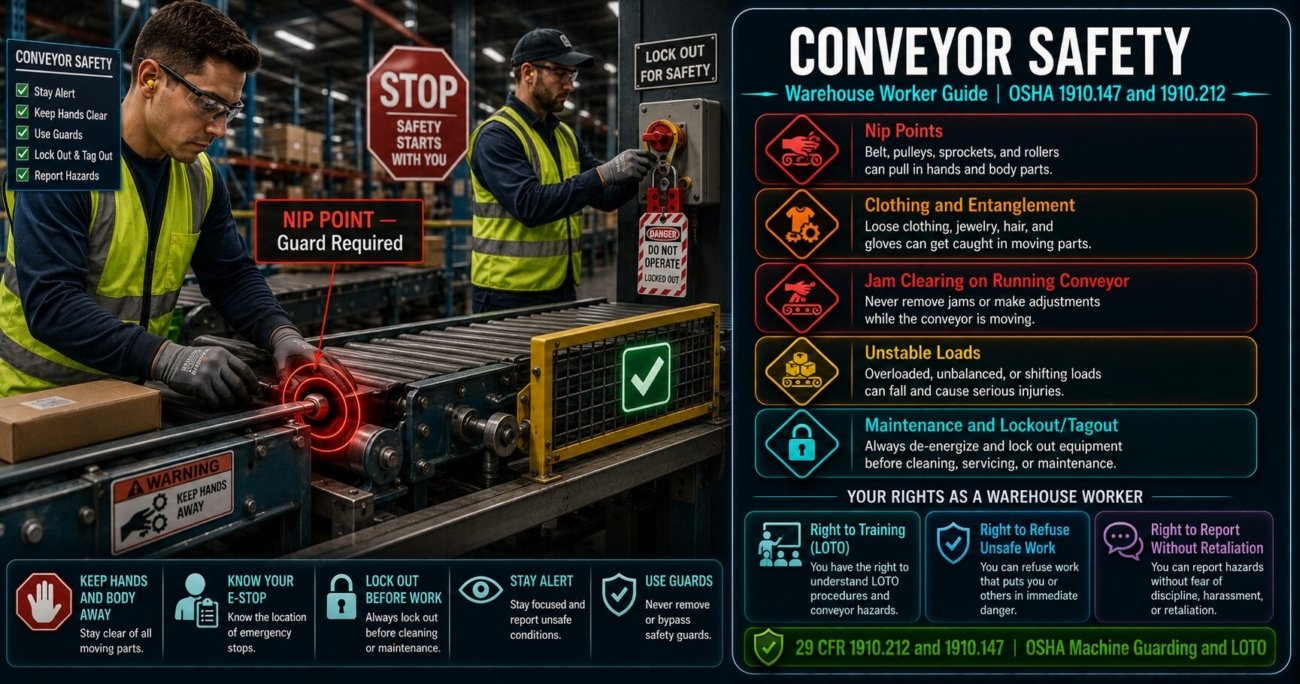
A 27-year-old picker at a fulfilment centre was clearing a small package that had shifted sideways on a moving belt conveyor. He reached in from the side while the conveyor was still running. His glove caught on the belt-to-roller nip point. The conveyor pulled his hand in before he could react.
He suffered a degloving injury to three fingers and required surgery. The investigation found that the conveyor had no nip point guarding at that location, the worker had not been trained on the specific hazards of belt-to-roller contact points, and the task of clearing jams while the system was running was an informal practice that supervisors had tolerated for years because stopping the line cost time.
This incident is not unusual. The Bureau of Labor Statistics consistently identifies conveyors as one of the leading sources of serious injury in warehousing and distribution, with caught-in and caught-between injuries accounting for the majority of conveyor-related amputations and hospitalisations. Most of these incidents share the same features: a recognised hazard, a bypassed control, and insufficient training on why the control exists.
This guide covers what every picker, packer, sorter, and warehouse worker needs to know to work safely around conveyor systems and understand the OSHA standards that govern them.
OSHA’s general industry machinery and machine guarding standards at 29 CFR 1910.212 and 1910.217 require that every machine have guards to protect operators from hazardous moving parts. OSHA’s lockout/tagout standard at 29 CFR 1910.147 governs how conveyors must be de-energised before any servicing or maintenance. These are not suggestions. Citations for conveyor-related machine guarding violations are among the most common in warehouse inspections.
Conveyor Hazard 1: Nip Points and Pinch Points
Nip points are the most dangerous locations on a conveyor. A nip point forms wherever a moving belt, chain, or cable meets a rotating component such as a pulley, roller, sprocket, or gear. The geometry of a nip point creates a zone where material, and anything near it, is drawn inward with force that increases the faster the belt moves.
Human tissue cannot resist the force of a nip point at normal conveyor operating speeds. By the time a worker feels the pull, the injury has already begun. The reaction time required to withdraw a hand from a nip point that has made contact is physically impossible at typical belt speeds.
Under 29 CFR 1910.212(a)(1), all moving parts of machinery that may cause injury must be guarded. For conveyors, this means nip points at drive pulleys, tail pulleys, take-up pulleys, and any location where the belt contacts a roller must be guarded with physical barriers that prevent worker contact with the nip zone.
If any guard is missing from a nip point on the conveyor you work near, report it immediately. Do not assume the guard was removed for a reason. Do not operate the conveyor without the guard. A missing guard is a citable OSHA violation and a predictable serious injury waiting to occur. Tag the machine and notify your supervisor before the next shift begins.
Conveyor Hazard 2: Caught-In Hazards from Clothing, Hair, and Gloves
Loose clothing, drawstrings, dangling accessories, unrestrained hair, and improperly fitted gloves represent a secondary entanglement pathway. Unlike nip points, which require contact with a specific mechanical location, entanglement can occur anywhere along a moving belt or conveyor surface where loose material makes contact.
The mechanism of entanglement injury is rapid and escalating. A loose sleeve that contacts a moving belt is pulled at the speed of the belt. The worker’s arm follows immediately. The distance from initial contact to serious injury is measured in fractions of a second. Workers who have experienced entanglement consistently report that they had no time to react before the injury occurred.
Proper dress requirements for conveyor work are not arbitrary uniform policies. They are engineering substitutes for the physical guarding that cannot reach every point of a moving belt along its entire length. Workers must:
- Wear close-fitting clothing with no loose hems, drawstrings, or untucked layers
- Remove or secure jewellery, lanyards, and ID badge lanyards before approaching conveyors
- Tie back or cover long hair completely before beginning work near moving conveyors
- Wear properly fitted gloves that are appropriate for the task, with no loose fingers or cuffs that could catch on a moving surface
Dress code enforcement near conveyors is a safety obligation, not a style preference. Supervisors who observe workers with loose clothing, dangling lanyards, or uncovered long hair near operating conveyors must correct the hazard before the worker returns to the belt. A supervisor who notices a loose sleeve and does nothing has accepted ownership of whatever injury follows.
Conveyor Hazard 3: Clearing Jams on a Running Conveyor
Jam clearing is the single most dangerous routine task performed by conveyor workers. It is also the task most consistently performed incorrectly. The correct procedure is unambiguous: stop the conveyor, de-energise it under lockout/tagout, clear the jam, verify the area is clear, and restart through the proper authorised procedure.
The informal practice in many warehouses is to clear jams while the conveyor runs, reaching in from the side or top to reposition a shifted package or free a stuck item. This practice is present in almost every conveyor incident investigation involving caught-in injuries. It persists because stopping the line costs production time, supervisors tolerate it because it maintains throughput, and workers do it because it appears to be faster and nothing bad has happened yet.
OSHA’s lockout/tagout standard at 29 CFR 1910.147 requires that energy-isolating devices be applied whenever workers perform servicing or maintenance on machinery where the unexpected startup or release of stored energy could cause injury. Reaching into a conveyor to clear a jam is servicing. The conveyor must be stopped and locked out before this task begins, every time.
You are not required to clear a conveyor jam while it is running. No production target, no supervisor instruction, and no time pressure creates a legal or safe basis for reaching into a running conveyor. If you are expected to clear jams as part of your job, you must be trained in lockout/tagout, provided with the necessary lockout devices, and authorised to apply them. If you have not been trained and equipped for lockout/tagout, you should not be clearing jams at all.
Conveyor Hazard 4: Unstable Loads and Falling Objects
Conveyors are designed to transport items within specific weight, size, and orientation parameters. When loads exceed these parameters, shift during transport, or are placed incorrectly, they can fall from the conveyor, strike workers below elevated sections, create jam conditions that prompt unsafe clearing responses, or damage the conveyor system itself.
Struck-by injuries from falling conveyor loads are a recognised hazard in warehouses with elevated conveyor sections, mezzanines, and multi-level pick systems. Under 29 CFR 1910.176, material storage and handling must protect workers from falling objects. For elevated conveyors, this requires toe boards, side barriers, or netting below elevated sections where workers may be present.
Workers can reduce load instability risk by:
- Placing items squarely on the belt within the conveyor’s rated capacity, not balanced on edges or corners
- Not placing items on conveyors that are visibly damaged, misaligned, or running at incorrect speeds
- Never stacking items above the clearance height of the conveyor path
- Reporting damaged packaging that may cause items to break open during transport
Conveyor Hazard 5: Maintenance and Service Activities
Conveyor-related fatalities and amputations are disproportionately concentrated during maintenance, cleaning, and adjustment activities rather than during normal operation. The reason is that these activities require workers to be in close proximity to parts of the conveyor that are normally guarded or inaccessible during operation, and the hazardous energy present in the system is not always visibly apparent.
Stored energy in a conveyor system includes electrical energy in motors and controls, gravitational energy in elevated sections and weighted take-up assemblies, mechanical energy in tensioned belts and springs, and pneumatic energy in air-powered components. De-energising a conveyor for maintenance means identifying and isolating all of these energy sources, not simply turning off the power switch.
Under 29 CFR 1910.147, authorised workers performing lockout/tagout must:
- Notify affected employees before beginning the lockout procedure
- Shut down the conveyor using the normal stopping procedure
- Isolate all energy sources using the appropriate energy-isolating devices
- Apply their own personal padlock to each energy-isolating device
- Release or restrain all stored energy
- Verify that the conveyor is de-energised by attempting to start it before beginning work
Workers who are not authorised and trained for lockout/tagout must never perform conveyor maintenance, even minor adjustments, and must never remove guards to inspect or clean conveyor components while the system is energised.
On conveyors serviced by multiple workers simultaneously, each worker must apply their own personal lock to the energy-isolating device. A single supervisor’s lock covering a multi-person maintenance crew does not satisfy 29 CFR 1910.147(f)(3). If the supervisor finishes and removes their lock before a crew member is clear, the conveyor can be re-energised while workers are still in contact with it. Every worker on the crew must hold their own lock. The conveyor cannot be restarted until every individual lock has been removed by its owner.
Emergency Stops and Entrapment Response
Every conveyor must have accessible emergency stop devices at intervals along its length. Under ASME B20.1 (the American Society of Mechanical Engineers conveyor safety standard, referenced in OSHA general industry guidance) and OSHA general industry requirements, emergency stop devices must be accessible from the worker’s normal working position and must be clearly identified.
Workers must know the location of every emergency stop device along the conveyor sections they work near before their first shift. This is not information to learn during an emergency. Workers who have to search for an emergency stop during an entrapment event will not find it in time.
In the event of an entrapment:
- Activate the emergency stop immediately. Do not attempt to pull the person free while the conveyor is running. The pulling force will increase, not decrease, with manual resistance.
- Call for help immediately. Entrapment injuries require emergency medical response, not first aid.
- Do not attempt to reverse the conveyor without specific training and authorisation to do so. Reversing a conveyor during an entrapment can cause additional injury.
- Keep the area clear for emergency responders. Do not crowd the injured worker.
At the start of every shift, walk your section of the conveyor line and locate every emergency stop device. Confirm they are unobstructed and accessible. Confirm that no boxes, carts, or other materials are blocking the pull cords or push buttons. This takes under two minutes and ensures that if you need an emergency stop, you will find it without searching.
Your Rights as a Conveyor Worker
Under OSHA’s General Duty Clause and specific machinery standards, workers have established rights that apply directly to conveyor safety:
- Right to a safe workplace: Your employer is required to provide conveyors with all required guards, properly maintained emergency stop systems, and a hazard-free working environment around conveyor lines.
- Right to training: Under 29 CFR 1910.147(c)(7), all workers must be trained in lockout/tagout if their work may expose them to hazardous energy during service or maintenance. Workers who clear jams must receive this training.
- Right to refuse unsafe work: Under OSHA’s Worker Rights provisions, you have the right to refuse work that you reasonably believe poses imminent danger. Clearing a jam on a running conveyor without lockout/tagout is a recognised imminent danger. You are not required to perform this task.
- Right to report: You can report conveyor safety violations to OSHA without fear of retaliation. OSHA’s anti-retaliation provisions at Section 11(c) of the OSH Act protect workers who report safety hazards in good faith.
Conveyor Safety Daily Checklist
✓ Clothing is close-fitting with no loose hems, drawstrings, or untucked layers
✓ Hair is tied back or covered
✓ Jewellery, lanyards, and ID badge strings are removed or secured
✓ Gloves are properly fitted with no loose fingers or cuffs
✓ All nip point guards are in place along my work section
✓ Emergency stop devices are located and unobstructed along my work section
✓ I know the procedure for stopping the conveyor before clearing any jam
✓ I know who to contact if I observe a missing guard or damaged equipment
✓ I will not reach into or over a running conveyor under any circumstances
✓ I will report any observed conveyor hazard before the end of my shift