

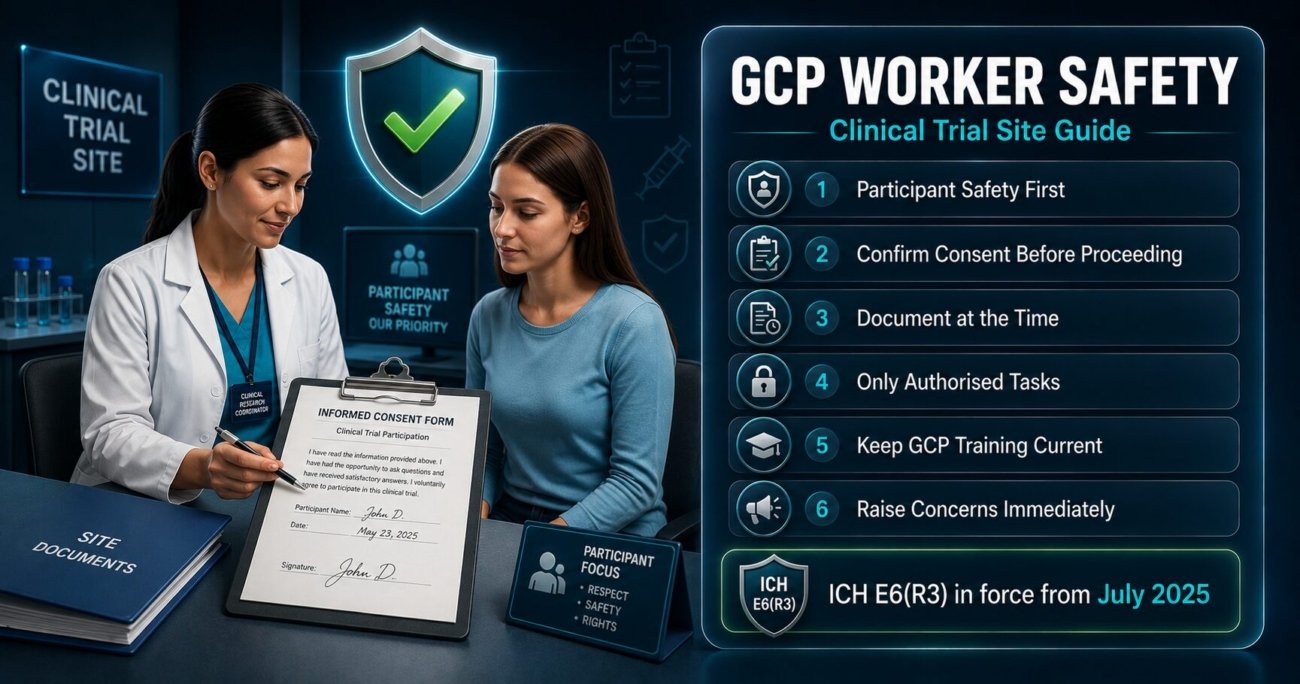
You have been assigned to work on a clinical trial investigating a new drug or medical device. You may be a nurse, a coordinator, a pharmacist, a data entry specialist, or a laboratory technician. Whatever your role, the same set of principles governs how the work must be done.
These principles are called Good Clinical Practices, or GCP. They exist for one reason: to protect the people who agree to participate in clinical research, and to make sure the data collected from those trials is trustworthy enough to support decisions about patient care.
This guide explains what GCP means for you in practical terms, starting with your daily responsibilities and the situations where your actions have the most impact.
Why GCP Is Your Responsibility Too
A common misunderstanding at clinical trial sites is that GCP compliance is the investigator’s job. The investigator does carry ultimate responsibility for the conduct of the trial. But GCP obligations extend to every member of the site team who performs a trial-related duty.
If you collect a blood sample, your documentation must meet GCP standards. If you administer a study medication, your record of that administration must be complete and contemporaneous. If you enter data into a case report form, that entry must accurately reflect the source document. If you notice something that looks like a safety concern, you have an obligation to report it.
GCP is not a management concern. It is a working standard that applies to every task, performed by every person, on every day a trial is running.
Clinical trials test treatments that have not yet been proven safe and effective in the general population. The people who participate are taking a risk for the benefit of future patients. The protections built into GCP exist because of historical cases where trial participants were harmed when those protections were absent. Every GCP requirement traces back to a real lesson learned from a real failure.
Participant Safety Comes Before Data Collection
The most important GCP principle for frontline staff is this: if you observe something that could indicate a participant is experiencing a medical problem, participant safety takes priority over trial procedures.
This means stopping a procedure if the participant shows signs of distress. It means notifying the investigator immediately when a participant reports a new symptom or side effect. It means not delaying a safety report because you are uncertain whether the event is related to the study drug.
The investigator decides whether an event meets the definition of an adverse event or a serious adverse event. Your job is to identify and report any change in a participant’s condition, not to pre-screen it.
If you are ever unsure whether something you observed in a participant should be reported, report it anyway. It is always easier to review a report that turns out to be non-significant than to reconstruct an event that was not reported at the time it occurred.
Never Perform a Trial Procedure Before Consent Is Confirmed
Informed consent must be obtained and documented before any trial procedure is performed on a participant. This rule has no exceptions for convenience or scheduling.
As a trial staff member, you may not perform any study-related procedure, including collecting a pre-screening blood sample, administering a questionnaire, or reviewing medical records for eligibility, until the investigator or a delegated, trained team member has confirmed that a valid, signed consent form is on file for that participant.
If you are asked to perform a procedure and you are unsure whether consent has been obtained, stop and check before proceeding. A procedure performed before consent is a protocol deviation and potentially a violation of the participant’s rights.
Build a consent verification step into your site’s workflow before any participant contact occurs. This can be as simple as a checkbox on your visit preparation checklist. Inspectors review consent dates against procedure dates, and discrepancies are among the most common inspection findings at clinical trial sites.
Document What You Did, When You Did It
GCP documentation follows the ALCOA+ standard: Attributable, Legible, Contemporaneous, Original, and Accurate. Of these, contemporaneous documentation causes the most problems in practice.
Contemporaneous means you record the activity at the time you perform it, not at the end of the shift, not during the monitoring visit, and not when you are asked about it during an audit. The date and time you record must reflect when the activity actually happened.
If you realise you missed a documentation step, you can make a late entry. Write the entry, add the current date and time, note that it is a late entry, and briefly explain why it was not recorded at the time. Do not alter the original record to make it appear contemporaneous. That is data falsification, a serious regulatory violation with significant personal consequences.
Do: Record observations, measurements, and activities at the time they occur. Use the date and time format specified by your trial procedures.
Avoid: Completing records from memory at the end of the day. Backdating entries. Correcting an original entry by overwriting it. Always use a single line strikethrough, initial, date, and provide a reason when correcting a record.
Only Perform Tasks You Are Authorised and Trained to Perform
Every task performed on a clinical trial must be assigned to a specific staff member through a document called the Delegation of Authority log, also known as the delegation log or signature log. If your name is not on the delegation log for a specific task, you are not authorised to perform that task under GCP, regardless of your qualifications.
Before performing any trial-related activity for the first time, confirm that you are listed on the delegation log for that task, that you have received and documented training on the relevant protocol and procedures, and that your training was completed before you perform the task, not after.
If your role at the site changes, your delegation authorisation must be updated to reflect your new responsibilities. An undocumented change in responsibilities is a GCP finding.
Ask to see the delegation log for the trial you are working on. Confirm your name is listed and that the tasks listed match what you are actually doing. If there is a gap, notify the investigator or study coordinator so it can be corrected before an inspection identifies it.
Keep Your GCP Training Current
ICH GCP E6(R3) became effective on 23 July 2025 and represents the most significant update to the GCP standard in a decade. The FDA published its final guidance on ICH E6(R3) in October 2025. The UK implemented the updated standard on 28 April 2026 alongside revised national clinical trial regulations.
If your GCP certification was obtained under the previous version of the standard, ICH E6(R2), most sponsors now require you to complete updated training before participating in a new trial. TransCelerate BioPharma member sponsors, which include the major pharmaceutical companies, require current R3-compliant GCP documentation for all trial personnel as a condition of site activation.
GCP certification is typically valid for two years. If your certification is approaching its expiry date, initiate renewal before it lapses. Working on a trial with an expired GCP certificate is a compliance gap that inspectors and sponsors identify during qualification visits.
Maintain a training matrix for all trial staff that tracks GCP certification expiry dates alongside protocol-specific training completion. Set renewal reminders 60 days before expiry to avoid gaps. Staff with lapsed certifications may need to be removed from delegation logs until renewal is complete.
Raise Safety and Quality Concerns Without Hesitation
GCP requires that sites maintain an environment where staff can raise concerns about participant safety or protocol compliance without fear of retaliation. If you observe a practice that appears inconsistent with the protocol, a documentation approach that does not meet GCP standards, or a situation that raises concerns about participant welfare, you have both the right and the obligation to raise it.
Raise concerns with the principal investigator or study coordinator in the first instance. If the concern involves the investigator, or if raising it internally does not result in action, clinical trial sites typically have access to the sponsor’s medical monitor and the IRB/IEC as additional reporting channels.
Inspectors during FDA and IRB/IEC audits frequently interview frontline staff specifically to understand whether the site culture supports open reporting of concerns. Sites where staff are hesitant to raise issues tend to have more compliance problems, not fewer.
At the end of each day working on a trial, ask yourself one question: did anything happen today that I was uncertain about or that seemed inconsistent with the protocol? If the answer is yes, raise it before your next shift. Issues that are raised immediately are easier to address than issues that surface weeks later during a monitoring visit.
GCP Daily Checklist for Trial Site Staff
✓ Confirm participant consent is documented and current before any trial procedure
✓ Verify you are listed on the delegation log for the tasks you will perform today
✓ Record all observations, measurements, and activities at the time they occur
✓ Use single-line strikethrough with initials, date, and reason for any corrections
✓ Report any change in a participant’s condition to the investigator immediately
✓ Do not perform any trial procedure that is not in the approved protocol
✓ Confirm your GCP training and protocol training are current
✓ Store investigational product according to the specified conditions
✓ Raise any compliance or safety concerns before your next shift
Sources
- ICH E6(R3): Guideline for Good Clinical Practice, Step 4 (January 2025)
- UCSF: ICH GCP E6(R3) Guidelines and Training Requirements (2025)
- Health and Care Research Wales: New UK Clinical Trial Regulations, effective April 28, 2026
- FDA: ICH E6 Good Clinical Practice Guidance
- PharmaeduCenter: Good Clinical Practice Certification Guide 2026