
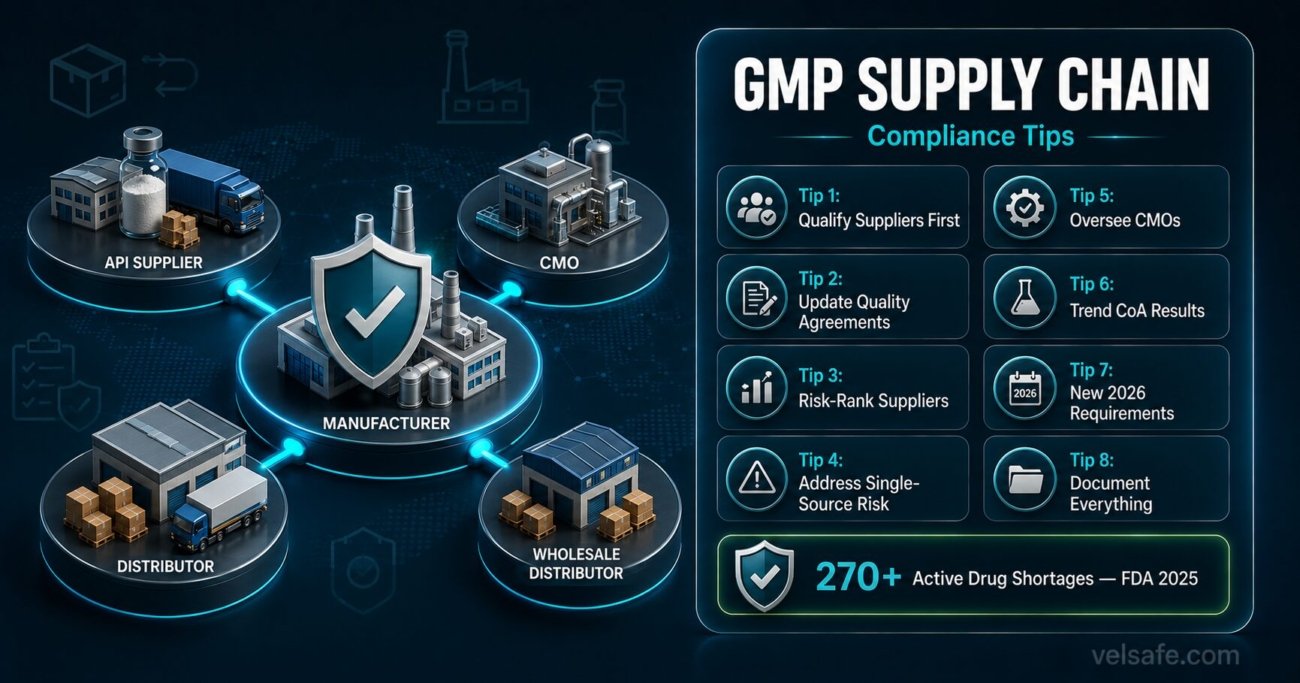
Supply chain quality is no longer a background compliance function. As of mid-2025, the FDA reported approximately 270 active drug shortages in the United States, many traceable directly to supplier qualification gaps, single-source API dependencies, and inadequate oversight of contract manufacturers. Inspectors are asking harder questions about supplier controls than they were five years ago.
These tips address the compliance concerns appearing most frequently in current GMP inspections and regulatory guidance across pharmaceutical and medical device manufacturing.
Tip 1: Qualify Suppliers Before the First Order, Not After
Supplier qualification is a pre-condition for GMP-compliant procurement, not a retrospective paperwork exercise. Before placing a first order with any critical material supplier, complete a documented qualification that includes quality agreement execution, questionnaire review, and risk-based decision on whether an audit is required.
FDA inspectors frequently request supplier qualification records during inspections. The most common finding is that suppliers have been used for months or years without a completed qualification on file. This is particularly problematic for API suppliers and critical excipient manufacturers.
Create a supplier qualification checklist that must be completed and approved by your quality unit before any new supplier is added to your approved supplier list. Gate procurement against this approval, not just the first purchase order.
Tip 2: Update Quality Agreements When Suppliers Change Processes
A quality agreement executed at supplier qualification becomes outdated the moment the supplier makes an undisclosed process change. Under GMP regulations, the quality agreement must specify what changes the supplier is required to notify you about before implementation.
A recurring inspection finding involves manufacturers discovering that a contract manufacturer or API supplier changed a process, site, or raw material without notifying the finished-product manufacturer. If the change is significant and was not communicated, the manufacturer may have released product that was not manufactured according to the approved process.
Do: Include a specific change notification clause in every quality agreement that lists the types of changes requiring advance notification and the minimum lead time required.
Avoid: Generic quality agreements that do not specify change notification requirements. A template agreement without supplier-specific detail provides limited protection during inspections or supply disruptions.
Tip 3: Risk-Rank Your Supplier List and Audit Accordingly
Not all suppliers carry equal compliance risk. API manufacturers, contract manufacturers, and suppliers of critical components require more intensive oversight than suppliers of non-contact packaging materials. A risk-ranking system allows your quality team to allocate audit resources proportionately rather than applying the same oversight to every supplier on the approved list.
Risk factors to consider include: criticality of the material to product quality and patient safety; regulatory history of the supplier; geographic location and applicable regulatory framework; single-source status; and history of deviations or complaints from the supplier.
Review your supplier risk rankings annually, or whenever a significant change occurs at the supplier or in your own product portfolio. A supplier that was low-risk for one product may be critical for another. Risk ranking should be product-specific, not supplier-wide.
Tip 4: Treat Single-Source Dependencies as a Quality Risk
Single-source API and critical component dependencies are now explicitly on the FDA’s radar as supply chain vulnerability factors. The connection between single-source dependence and drug shortages is well-documented, and inspectors are increasingly evaluating whether manufacturers have assessed and mitigated this risk.
A single-source dependency is not automatically non-compliant, but it requires documented risk assessment and contingency planning. If your only API supplier cannot supply, what is your plan? How long is your safety stock? How long would it take to qualify an alternative supplier?
Map every critical material in your products to its supply source. Identify single-source dependencies and document a risk assessment and contingency plan for each. Store this in your quality management system where it can be retrieved during an inspection.
Tip 5: Extend GMP Oversight to Contract Manufacturers
Under 21 CFR Part 211 and the QMSR (effective February 2, 2026 for medical devices), the finished-product manufacturer retains GMP responsibility for product manufactured under contract. Outsourcing production does not transfer regulatory accountability.
This means your quality agreement with a contract manufacturer must address which GMP responsibilities belong to each party, that your quality unit must have sufficient access to review and approve the contract manufacturer’s relevant procedures and batch records, and that you must have a mechanism to be notified of deviations, OOS results, and other quality events at the contract site.
FDA inspectors may request to review quality agreements with contract manufacturers and ask whether your quality unit reviews batch records from the contract site before product release. If your release procedure does not include review of CMO documentation, this is a gap that inspectors will flag.
Tip 6: Monitor Certificate of Analysis Results Over Time
Reviewing a Certificate of Analysis at receipt confirms the material meets specification for that lot. Trending CoA results across multiple lots from the same supplier reveals whether the supplier’s process is drifting, even when individual lots still pass.
A supplier whose CoA results are consistently near the specification limit on a critical attribute is a risk, even if no lots have failed. Trend monitoring allows your quality team to escalate supplier oversight or initiate requalification before an out-of-specification result occurs.
Include CoA trend analysis as a standing agenda item in your annual product review or annual quality review. This review should cover all critical material suppliers and flag any attributes showing directional trends toward specification limits.
Tip 7: Prepare for Emerging Regulatory Requirements Now
Several supply chain-related regulatory changes are either newly effective or approaching implementation.
FDA QMSR (effective February 2, 2026): Medical device manufacturers must now demonstrate supplier controls aligned with ISO 13485:2016 Section 7.4. Supplier evaluation, selection, and monitoring requirements are more explicit than under the legacy 21 CFR Part 820.
China NMPA GMP for Medical Devices (effective November 1, 2026): The revised Chinese GMP, issued November 4, 2025, brings outsourced R&D, contract manufacturing, and entrusted testing fully into scope of the quality management system. Overseas manufacturers supplying the Chinese market need to assess the impact on their supplier control systems.
Drug Supply Chain Security Act (DSCSA): FDA has issued exemptions for small dispensers until November 27, 2026, but full implementation of enhanced drug distribution security requirements is approaching. Track serialisation and traceability obligations relevant to your supply chain role.
EU GMP Annex 1: Fully effective since August 2024, the revised Annex 1 requirements for sterile product manufacturing include enhanced expectations for supplier controls related to contamination control strategy components.
Do: Assign ownership for monitoring each applicable regulatory update and build supplier control implications into your quality planning calendar.
Avoid: Waiting for inspection findings to identify gaps in your supplier oversight system relative to new regulatory requirements. By the time an inspector identifies the gap, product may already have been released under non-compliant supplier controls.
Tip 8: Document Your Supplier Oversight Activities
Supplier oversight that is not documented did not happen from a GMP perspective. This includes supplier audits, questionnaire reviews, CoA trend analyses, quality agreement reviews, change notifications received and evaluated, and corrective actions requested from suppliers.
A robust supplier oversight programme that exists only in the memories of your quality team will not satisfy an inspector. Every significant supplier oversight activity must generate a record that can be retrieved during an inspection and that demonstrates the quality unit’s ongoing control of the supply chain.
Review your approved supplier list and confirm that a documented oversight activity exists in your quality management system for every critical supplier in the past 12 months. If any critical supplier has no documented oversight activity on file, schedule one now and document it.
Supply Chain GMP Compliance Checklist
✓ Approved supplier list is current and all critical suppliers are qualified
✓ Quality agreements are in place with all critical material suppliers and CMOs
✓ Quality agreements include specific change notification requirements
✓ Supplier risk rankings are documented and reviewed annually
✓ Single-source dependencies are identified with documented contingency plans
✓ CoA results are trended across lots, not only reviewed at receipt
✓ Contract manufacturer batch records are reviewed before product release
✓ Supplier oversight activities are documented in the QMS
✓ QMSR and China NMPA GMP supplier control implications have been assessed
✓ DSCSA compliance timeline is tracked for your supply chain role
Sources
- Zamann Pharma: Pharmaceutical Supply Chain Issues in 2026: GMP and Regulatory Findings (March 2026)
- Cisema: China NMPA Issues New GMP for Medical Devices, effective November 1, 2026
- FDA: Quality Management System Regulation (QMSR), effective February 2, 2026
- 21 CFR Part 211: Current Good Manufacturing Practice for Finished Pharmaceuticals
- IntuitionLabs: GMP Pharmaceutical Quality Compliance Guide 2026