

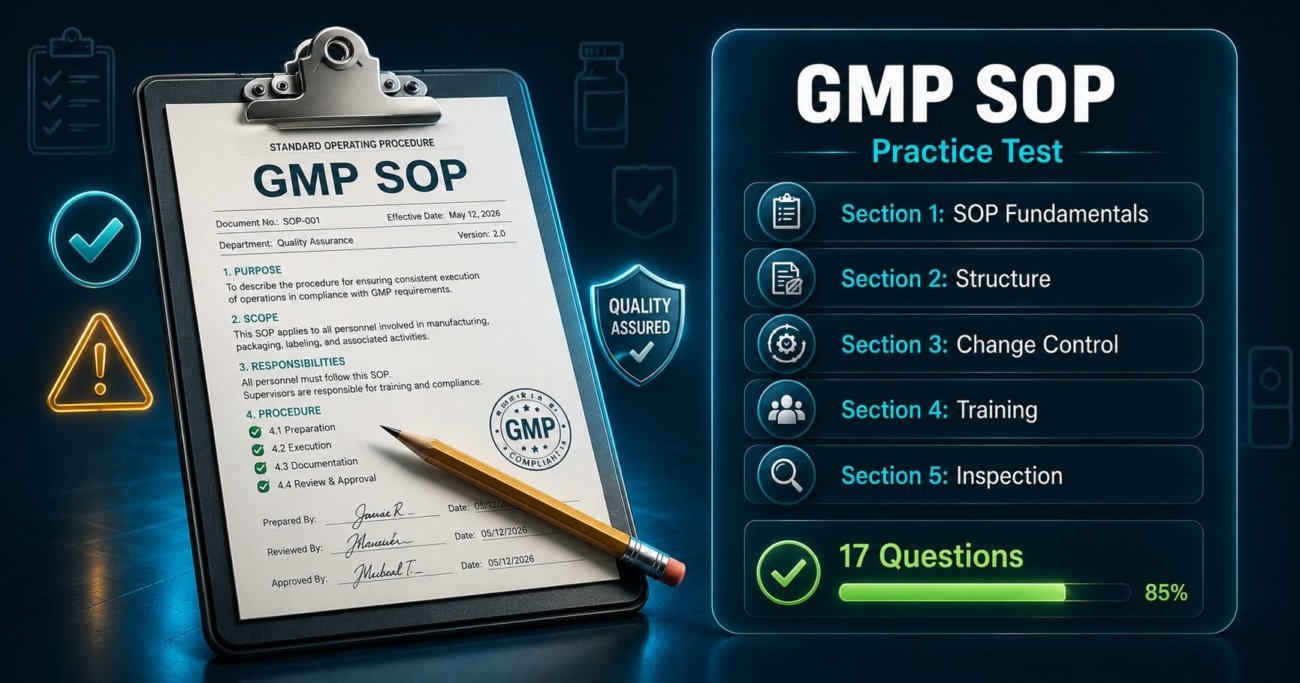
This practice test assesses your knowledge of GMP SOP principles across pharmaceutical and medical device manufacturing. Questions cover SOP structure, regulatory requirements, change control, training obligations, and inspection readiness. Each answer includes an explanation to reinforce understanding.
Applicable regulations: 21 CFR Part 211 (Pharmaceuticals), 21 CFR Part 820 / QMSR (Medical Devices, effective February 2, 2026), ISO 13485:2016.
Section 1: SOP Fundamentals
Answer: To provide written instructions that ensure a process is performed consistently and in compliance with regulatory requirements.
Explanation: Under 21 CFR Part 211.100 and Part 820, manufacturers must establish and maintain written procedures for all operations that could affect product quality. SOPs are regulatory requirements, not internal preferences. An SOP that exists but is not followed is itself a finding during FDA inspection.
Answer: The cost of the process being described.
Explanation: Required SOP elements under GMP include purpose, scope, responsibilities, materials and equipment, step-by-step procedure, acceptance criteria, and references. Financial or cost information is not a GMP requirement. Common additions include revision history and definitions, but these are driven by quality system design rather than regulatory mandate.
Answer: A deviation from an approved SOP has occurred, and the product may have been released without completing a required quality step.
Explanation: Under 21 CFR Part 211.100, written procedures are required and must be followed. An operator’s personal judgment does not override an approved SOP. The deviation must be documented, investigated, and assessed for impact on product quality before batch release. Releasing product without this assessment is a significant GMP violation and could constitute adulteration under the FD&C Act.
Answer: FDA GMP regulations do not specify a fixed review interval. The manufacturer must define a review frequency appropriate to their quality system.
Explanation: While FDA does not mandate annual reviews, most quality systems establish periodic review cycles of one to two years. ISO 13485:2016 similarly requires documents to be reviewed and updated as necessary. An SOP that does not reflect current practice is a documentation deficiency that inspectors frequently identify.
Section 2: SOP Development and Structure
Answer: The purpose statement.
Explanation: GMP SOPs typically follow this structure: Purpose, Scope, Responsibilities, Definitions, Materials and Equipment, Procedure, Acceptance Criteria, References, and Revision History. The purpose statement defines why the SOP exists. Inspectors reviewing SOPs look for clarity of purpose before evaluating procedural detail.
Answer: The deviation must be documented and investigated. Either the SOP must be updated through change control, or the 10-location plan must be reinstated.
Explanation: When practice diverges from a written SOP, either the SOP is wrong (requiring change control to update) or the practice is wrong (requiring correction). The response is never to ignore the gap. This scenario is a classic inspection finding: written procedure and actual practice are inconsistent.
Answer: Documents must be reviewed and approved prior to issue. Changes must be reviewed and approved by the same or other designated functions with access to pertinent background information.
Explanation: ISO 13485:2016 Section 4.2.4 requires documents to be approved before use, changes and current revision status to be identified, relevant versions to be available at points of use, and obsolete documents to be prevented from unintended use. The QMSR, effective February 2, 2026, incorporates ISO 13485:2016 by reference, making these requirements directly applicable to FDA-regulated device manufacturers.
Answer: The late verification is a deviation that must be documented. The verification signature should reflect when the verification actually occurred.
Explanation: Under ALCOA+ data integrity principles, entries must be attributable and contemporaneous. A verifier signing for a step they did not observe at the time it occurred is not true verification. The correct approach documents the late entry with the actual date and time, explains the reason, and assesses whether a product quality risk exists.
Section 3: Change Control and Version Management
Answer: The revised SOP must be reviewed, approved through formal change control, and all affected personnel must be trained on the new version before it is placed into use.
Explanation: Change control is a fundamental GMP requirement. Revising an SOP and placing it into production use without change control approval and confirmed training is a GMP violation. Under 21 CFR Part 211.100 and ISO 13485:2016, procedures must be approved before use.
Answer: The obsolete version must be removed from all points of use and either archived or destroyed according to the document control procedure. It must be clearly identified as obsolete.
Explanation: A common inspection finding is an old SOP version still posted at a workstation or accessible alongside the current version. The document control system must ensure only current approved versions are available at points of use.
Answer: A documented risk assessment is required to determine whether the change is within the validated range. Revalidation is required if the change could affect product quality outside the existing validated space.
Explanation: Under 21 CFR Part 211.100 and FDA process validation guidance, changes to manufacturing processes require evaluation of their impact on product quality and validated state. A 5% compression force change may or may not require revalidation depending on the original validation range. The risk assessment and any required validation studies must be completed before the new SOP is approved.
Section 4: Training Requirements
Answer: Before performing any task covered by the SOP for the first time, and whenever the SOP is revised in a way that affects their role.
Explanation: Under 21 CFR Part 211.68 and Part 820, employees must be trained to perform their assigned functions. Training must be documented and must occur before the employee performs the task independently. When an SOP is revised, affected employees must be retrained before the new version takes effect.
Answer: The site may not be fully compliant. If the 2 untrained employees have performed the relevant tasks without training, a deviation exists. If they have not performed the tasks, a risk assessment may be sufficient.
Explanation: GMP training requirements do not permit exceptions based on convenience. Employees on leave should be trained upon return before resuming relevant duties. Training records must document the specific SOP version on which each employee was trained.
Answer: Training confirms that an employee has been exposed to and understands the procedure. Effectiveness verification confirms that the employee can correctly perform the procedure in practice.
Explanation: Reading an SOP and signing a training record demonstrates exposure, not competency. Many quality systems require effectiveness checks: direct observation, written assessments, or practical demonstrations. FDA inspectors increasingly ask not just whether training occurred, but whether it was effective.
Section 5: Inspection Scenarios
Answer: The site must acknowledge the deviation. The operator’s personal judgment does not override the approved SOP. The site must document the observation, assess product quality impact, and either retrain the operator or initiate change control to revise the SOP.
Explanation: This is one of the most common FDA 483 observations: employees not following written procedures. The response that it produces the same result is not a GMP defence. The SOP specifies the approved, validated procedure. Inspectors view this finding as indicative of a systemic training or culture problem.
Answer: An observation for failing to follow the company’s own written procedures, which is itself a GMP violation.
Explanation: FDA inspectors evaluate compliance with both regulatory requirements and the company’s own quality system commitments. A company that establishes a procedure and then fails to follow it has violated its quality system. This finding is typically cited as a failure of the quality unit to fulfil its oversight responsibilities.
Answer: Document a deviation covering the three-month period, conduct a retrospective risk assessment of all product sterilised during that period, initiate change control to update the SOP, and validate the new autoclave before resuming production.
Explanation: This is a serious GMP finding involving production under an unapproved procedure for an extended period. The retrospective assessment must determine whether affected product meets specifications and whether quarantine or recall is required. Three months of uncontrolled deviation requires thorough investigation and CAPA.
Knowledge Summary
SOPs must be followed exactly as written. Personal judgment does not override an approved procedure.
All deviations from SOPs must be documented, investigated, and assessed for product quality impact.
Training must occur before an employee performs a task and must be repeated when an SOP is revised.
Change control is required before any SOP revision is placed into use.
Obsolete SOP versions must be controlled and removed from all points of use.
Failure to follow your own quality system procedures is itself a GMP violation.
Recommended Study Areas
If any questions were challenging, focus your review on these areas.
SOP Structure: 21 CFR Part 211.100 and ISO 13485:2016 Section 4.2.4 define documentation requirements.
Change Control: Understand the full workflow: proposal, risk assessment, approval, validation, training, implementation, and effectiveness verification.
ALCOA+ Principles: Attributable, Legible, Contemporaneous, Original, Accurate. All GMP records must satisfy these criteria.
QMSR: Effective February 2, 2026, the FDA replaced 21 CFR Part 820 with the Quality Management System Regulation, which incorporates ISO 13485:2016 by reference.
Sources
- 21 CFR Part 211: Current Good Manufacturing Practice for Finished Pharmaceuticals (FDA)
- FDA Quality Management System Regulation (QMSR), effective February 2, 2026
- ISO 13485:2016: Medical Devices Quality Management Systems
- FDA Guidance: Process Validation: General Principles and Practices
- FDA Guidance: Data Integrity and Compliance with Drug cGMP