

Source: Pharmaceutical Online, March 2026
Source: RAPS / Certainty Software, 2026. Note: FDA electronic tool data only; excludes manual 483s.
Source: IJMPR / Certainty Software, 2026
FDA Form 483 data is one of the clearest windows available into where pharmaceutical and medical device quality systems actually fail. Not where companies say they are compliant – but where inspectors standing in manufacturing floors and quality offices found conditions that, in their judgment, may constitute violations of federal requirements. The FY2024 and FY2025 enforcement data makes several things unmistakably clear.
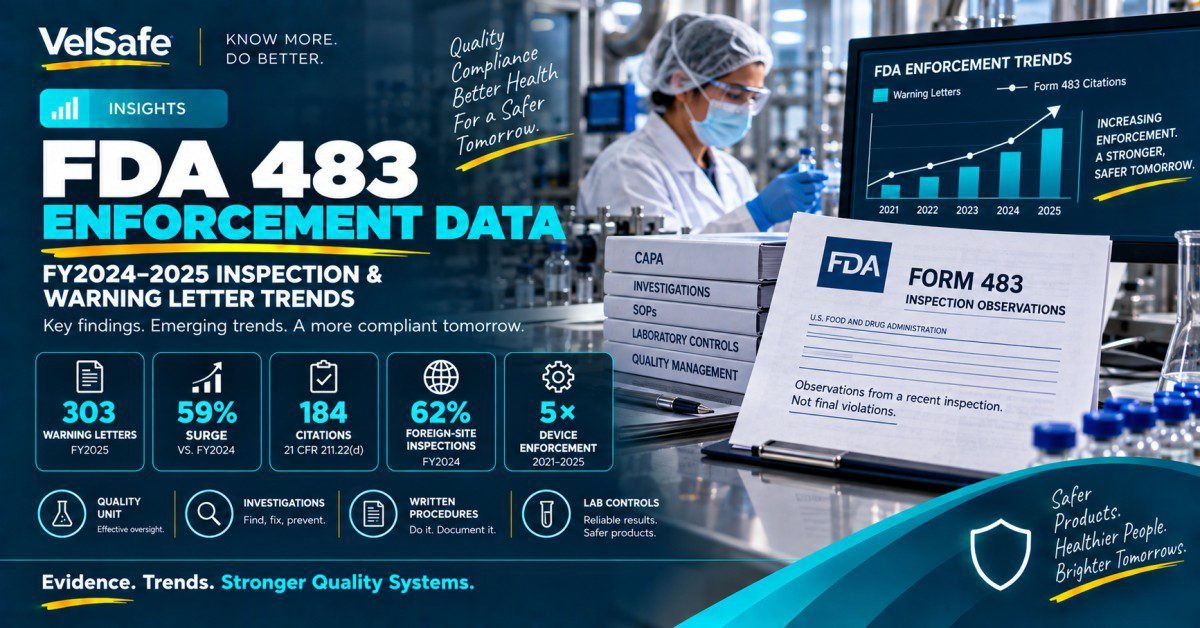
First, warning letter volume has surged: 303 drug and biologics letters in FY2025, up 59% from 190 in FY2024. Second, the finding categories at the top of the 483 list have not meaningfully changed across four consecutive years. 21 CFR 211.22(d) – Quality Unit responsibilities – was cited 184 times in FY2024 and remains the top citation in FY2025. Third, the regulatory landscape shifted materially in 2026: FDA’s March 2026 draft guidance on 483 responses raised the bar on what constitutes an adequate reply, and FDA’s April 2, 2026 Purolea warning letter appears to be the first warning letter to expressly identify inappropriate use of AI in pharmaceutical CGMP documentation. This article compiles 40+ statistics from FY2024-2025 inspection data and 2026 enforcement developments.
- Drug and biologics warning letters surged 59% to 303 in FY2025 – the highest in at least five years, driven partly by a single-day enforcement action on September 9, 2025.
- The same four 21 CFR citations have led pharmaceutical 483 rankings for four consecutive years since 2021: 211.22(d), 211.192, 211.100(a), and 211.160(b) – a structural signal, not a cyclical one.
- An inadequate Form 483 response can contribute to escalation to a warning letter – FDA’s March 2026 draft guidance recommends timely, well-supported corrective actions and notes that responses can be relevant to subsequent regulatory decisions.
- FDA’s April 2, 2026 Purolea warning letter appears to be the first warning letter to expressly identify inappropriate use of AI in pharmaceutical CGMP documentation – other FDA warning letters had already mentioned AI in other contexts.
- Device-specific quality enforcement letters increased five-fold from 6 in 2021 to 30 in 2025. QMSR did not become effective until February 2, 2026, so this enforcement trend predates the regulation.
Editor's Choice: Key FDA 483 and Enforcement Statistics for 2024-26
1. FY2025 FDA Warning Letters: 59% Surge and What Drove It
- The FDA issued 303 drug and biologics warning letters in FY2025 – a 59% increase from 190 in FY2024, which was itself a five-year high. Of those 303 letters, 135 were inspection-based (44.6%), 73 were for unapproved drug products, and 16 were issued following BIMO (Bioresearch Monitoring) program inspections of clinical investigators or sponsors. (Pharmaceutical Online, March 2026)
- A significant driver of the FY2025 surge was a concentrated enforcement action on September 9, 2025, when FDA launched a crackdown on deceptive drug advertising, issuing over 60 warning letters in a single day. The drug industry recorded 82 more warning letters than the prior year. (Reed Smith, December 2025)
- Total warning letters across all FDA-regulated products reached 695 in 2025, according to RegulatoryIQ’s analysis of 2,804 deduplicated warning letters spanning January 2021 through March 2026. Approximately 54 of those (8%) were directed at medical device manufacturers – a 17% increase from 46 device letters in 2024. (Cloudtheapp, June 2026)
- Of the 470 warning letters analyzed by qBench across all regulated lab environments in 2025, 47% were issued in just three months: July, August, and September. The dataset includes letters directed at both U.S.-based companies and international manufacturers. (qBench, May 2026)
- Device-specific quality system enforcement letters increased from 6 in 2021 to 30 in 2025 – a five-fold increase over four years. This increase occurred before QMSR became effective on February 2, 2026, and should be viewed as a pre-QMSR enforcement trend rather than evidence of QMSR’s effect. (Cloudtheapp, June 2026)
2. Top FDA 483 Citation Categories: FY2024 and FY2025 Data
- 21 CFR 211.22(d) – Quality Unit responsibilities – was cited 184 times in FY2024, making it the most-cited pharmaceutical 483 observation for four consecutive years, based on FDA’s electronic inspection tool data. FDA notes that its annual observation spreadsheets cover its electronic inspection tools and do not constitute a comprehensive listing of all Form 483 observations, as some 483s are prepared manually. (RAPS; GMP Insiders, February 2026; Certainty Software, 2026; FDA observation data caveat)
- 21 CFR 211.192 – failure to investigate discrepancies – was cited 116 times in FY2024, the second most cited observation. In lab-directed warning letters for 2025, OOS investigation failure appeared in 34% of letters (50 of 148), making it the top single citation category in lab enforcement. (RAPS; qBench, May 2026)
- The FY2025 inspection data from GMP Insiders’ analysis shows the same four citation categories dominating: 211.22(d), 211.192, 211.100(a), and 211.160(b). These four provisions have been unchanged at the top of pharmaceutical 483 rankings since 2021, representing persistent structural deficiencies rather than cyclical inspection priorities. (GMP Insiders, February 2026)
- In lab-directed 2025 warning letters analyzed by qBench: missing or inadequate written procedures appeared in 43 letters (29%); method or process validation failures in 40 letters (27%); CAPA not initiated or inadequate in 19 letters (13%) – confirming the same underlying quality system gaps that dominate 483 data. (qBench, May 2026)
- The consistency of top citations reflects a structural dynamic: these are governance and procedure failures, not technical failures. A 21 CFR 211.22(d) citation means the quality function is not exercising the independence and oversight that regulation requires. A 211.192 citation means investigations are not being completed – or not being initiated at all. These are management system failures, not isolated quality events. (GMP Insiders, 2026; Scilife.io, April 2026)
3. The Quality Control Unit Finding: Why the Same Citation Leads for Four Years
- The four-year consecutive run of QCU responsibilities as the top pharmaceutical citation means that across hundreds of inspections annually, FDA investigators are consistently finding that the quality function is not operating as the check on manufacturing operations that regulation requires. This is not a finding about a single regulation or activity. It is a finding about governance. (GMP Insiders, February 2026; Scilife.io, April 2026)
- Quality units at many manufacturers – particularly mid-sized companies and contract manufacturing organizations – are chronically under-resourced relative to production volumes. The pressure to release product under commercial and supply chain constraints places the QCU in a position where independence is compromised in practice even when it exists on paper. (Scilife.io; regulatory compliance literature)
- A warning letter cited in Pharmaceutical Online identified FDA explicitly noting the ineffectiveness of the executive management team in addressing quality system failures – signaling that FDA now traces QCU deficiencies upward to senior leadership accountability, not just the quality department. (Pharmaceutical Online; Scilife.io, April 2026)
- FDA’s approach to repeat citations has evolved: where historically a corrective action plan and adequate 483 response would close the loop, inspectors now look for evidence that root cause was correctly identified and that systemic corrective actions are actually implemented and sustained – not just documented. (GMP Insiders, 2026)
4. Data Integrity: The Four Recurring Failure Modes
- Data integrity failures consistently appear in the top pharmaceutical 483 citation categories under 21 CFR 211.68 (automated data systems), 211.180 (record completeness and retention), and 211.194 (laboratory records). The four recurring failure modes – attribution, legibility, accuracy, and transformation – are systemic gaps, each requiring system-level remediation rather than individual retraining. (IntuitionLabs analysis; existing article data)
- In April 2026, FDA’s Purolea warning letter appears to be the first warning letter to expressly identify inappropriate use of AI in pharmaceutical CGMP documentation – though other FDA warning letters had already mentioned AI in other contexts. The Purolea letter cited principally 21 CFR 211.22(c), with related references to 21 CFR 211.22 and 211.100. (FDA Purolea Warning Letter, April 2, 2026)
- The AI warning letter represents a new compliance frontier: the use of generative AI in writing batch records, deviation reports, SOPs, or CAPA documents creates records that must be reviewed and authorized by a qualified human before they enter the quality management system. Organizations that have not yet addressed AI use in quality documentation workflows should treat this warning letter as a de facto enforcement signal. (Certainty Software, 2026)
- A Springer Nature Biologics inspection study (2025) analyzing FDA Form 483 observations from 2010 to 2025 found that data governance failures have been a persistent area of regulatory concern across the full 15-year window – predating electronic batch record adoption, surviving the COVID-19 period, and continuing through 2025 with no indication of structural improvement. (Journal of Pharmaceutical Innovation, January 2026)
5. Foreign Site Enforcement: Geography of FDA Inspection Pressure
- Foreign sites now account for more than 62% of drug quality inspections – an all-time high in FY2024, driven by FDA clearing pandemic-era backlogs and intensifying international manufacturing oversight. Inspection volume rose 27% from 776 in FY2023 to 989 in FY2024. (FDA FY2024 State of Pharmaceutical Quality Report)
- Despite the high inspection volume, As of FY2024, 93% of sites in CDER’s Site Catalog with inspection classifications had NAI (No Action Indicated) or VAI (Voluntary Action Indicated) as their most recent classification, meaning enforcement action was recommended in a minority of inspected sites. (FDA FY2024 State of Pharmaceutical Quality Report)
- Of the 470 warning letters in the qBench 2025 dataset, the analysis identified letters directed at international manufacturers including sites in India and China, which are among the most frequently cited foreign manufacturing jurisdictions in enforcement data. (qBench, May 2026)
- FDA’s ORA (Office of Regulatory Affairs) reorganized into the Office of Inspections and Investigations (OII) on October 1, 2024 – a structural change specifically designed to sharpen focus on inspections, investigations, and import oversight, signaling continued or intensified inspection pressure through 2025 and 2026. (Pharmaceutical Online, March 2026)
- All four regulated industries – drugs, devices, biologics, food and cosmetics – experienced heightened FDA oversight in 2025 whether through increased warning letters, expanded inspection activity, or both. The food and cosmetics industries recorded 1,540 more inspections from 2024 to 2025. (Reed Smith, December 2025)
6. The 483 Response Challenge: March 2026 Draft Guidance and the 50% Warning Letter Risk
- An inadequate Form 483 response can contribute to escalation to a warning letter – FDA itself states that responses can be relevant to subsequent regulatory decisions. From an open warning letter, the escalation path includes consent decrees, import alerts, or injunctions. (FDA March 2026 draft guidance; Certainty Software, 2026)
- FDA issued draft guidance on Form 483 responses in March 2026, recommending timely responses with specific root cause identification, risk assessment framing, and effective CAPA. The guidance is non-binding and explicitly refers to manufacturers who choose to respond, but notes that responses can be relevant to subsequent regulatory decisions. (FDA March 2026 draft guidance; GMP Insiders, 2026)
- The pattern documented across multiple 2025 warning letters is that companies with known, identified quality issues that were “quietly allowed to stall” without resolution are a primary enforcement target. Having SOPs is not sufficient – FDA expects documented evidence that known issues are being actively driven to closure. (The FDA Group, December 2025)
- 2026 warning letters to Signature Formulations, Bio-Medical, OraLabs, and Cohance all reflect failures that internal audits and CAPA programs should have identified and remediated before an inspection – reinforcing that the 483 citation is rarely a surprise to the quality team; the failure is typically in the corrective action system rather than the detection system. (Certainty Software, 2026)
7. 2026 Enforcement Outlook: AI Documentation, QMSR, and Biologics Inspection Trends
- The April 2, 2026 Purolea warning letter is an early enforcement signal that FDA is monitoring how AI tools are used in CGMP quality systems. Organizations using generative AI to draft SOPs, batch records, deviation reports, or CAPA documentation without a documented human review and authorization step are at risk of the same citation. (Certainty Software, 2026)
- The QMSR (Quality Management System Regulation) for medical devices became effective on February 2, 2026, harmonising FDA’s device quality requirements with ISO 13485. The five-fold increase in device-specific enforcement letters between 2021 and 2025 predates QMSR’s effective date. Into Q1 2026, CAPA deficiencies, complaint handling failures, and supplier control gaps remain the top three device 483 citation categories. (Cloudtheapp, June 2026)
- A Springer Nature study analyzing 15 years of biologics Form 483 data (2010-2025) found that contamination prevention, process validation, and sterility assurance have been persistent areas of regulatory concern across the full study period, with no sustained improvement trend despite regulatory pressure and industry investment. (Journal of Pharmaceutical Innovation, January 2026)
- The pace of enforcement in early 2026 shows no sign of deceleration, according to Cloudtheapp’s analysis. With the OII reorganization sharpening inspection focus, the March 2026 draft guidance raising 483 response standards, and the AI enforcement signal from April 2026, the risk environment for quality teams is materially higher than it was in FY2024. (Cloudtheapp, June 2026; Reed Smith, December 2025)
Key Takeaways for Pharmaceutical and Device Quality Teams
10 Important FDA 483 Enforcement Facts
Ten findings from FY2024-2025 FDA inspection and enforcement data that quality and compliance teams need to know.
Drug and biologics warning letters rose from 190 in FY2024 to 303 in FY2025, the highest in at least five years. Source: Pharmaceutical Online, March 2026
21 CFR 211.22(d) has been the most-cited pharmaceutical 483 observation for four consecutive years since 2021. Source: GMP Insiders, February 2026
Failure to investigate discrepancies was cited 116 times in FY2024, making it the second most-cited pharmaceutical observation. Source: RAPS / Certainty Software, 2026
Foreign sites accounted for 62% of all drug quality inspections in FY2024, an all-time high. Source: FDA FY2024 State of Pharmaceutical Quality Report
Total drug quality inspections rose 27% from 776 in FY2023 to 989 in FY2024, as FDA cleared its pandemic backlog. Source: FDA FY2024 Quality Report
Device-specific quality enforcement letters increased five-fold from 6 in 2021 to 30 in 2025. Source: Cloudtheapp, June 2026
Total warning letters across all FDA-regulated products reached 695 in 2025, per RegulatoryIQ analysis of 2,804 deduplicated letters. Source: Cloudtheapp, June 2026
As of FY2024, 93% of sites in CDER’s Site Catalog with inspection classifications had NAI or VAI as their most recent classification. Source: FDA FY2024 State of Pharmaceutical Quality Report
= AI CITED Purolea AI Warning Letter
FDA’s April 2, 2026 Purolea warning letter appears to be the first to expressly identify inappropriate AI use in pharmaceutical CGMP documentation, citing principally 21 CFR 211.22(c). Source: FDA Purolea Warning Letter, April 2, 2026
QUALITY MATTERS A Controllable Factor in Post-Inspection Outcomes
An inadequate Form 483 response can contribute to escalation to a warning letter. FDA’s March 2026 draft guidance recommends timely responses with specific root cause identification, measurable CAPA plans, and risk assessment framing. Source: FDA March 2026 draft guidance
5 Myths About FDA 483 Inspections
A 483 observation is the same as a violation finding.
A Form 483 records conditions an investigator observed that may constitute violations. It is not a final enforcement finding. The firm has the opportunity to respond, and many 483s are closed without further action when an adequate response is submitted.
If you have written procedures, you will not be cited for 21 CFR 211.22(d).
The most common reason 211.22(d) is cited is not the absence of procedures but failure to follow them. FDA investigators look for evidence that QCU procedures are implemented in practice, not just documented on paper.
Committing to training in your 483 response is sufficient to close the observation.
FDA’s March 2026 draft guidance (non-binding) recommends specific root cause identification, a measurable CAPA plan with timelines, interim controls, and risk assessment framing. It notes responses can be relevant to subsequent regulatory decisions, and signals that training-only commitments without root cause analysis may not be viewed as adequate.
Foreign manufacturers face stricter inspections than domestic sites.
FDA applies equivalent standards to domestic and foreign sites. The higher proportion of foreign inspections in FY2024 (62%) reflects the global distribution of pharmaceutical manufacturing, not a stricter foreign enforcement posture. The 93% NAI/VAI compliance rate applied across all sites.
The QMSR transition reduced device enforcement pressure.
Device-specific quality enforcement letters increased five-fold between 2021 and 2025. QMSR did not become effective until February 2, 2026, so this enforcement trend predates the regulation. The same top three device violation categories (CAPA deficiencies, complaint handling failures, supplier control gaps) persist into Q1 2026.
Impact on Pharmaceutical and Device Businesses
Enforcement Escalation Risk
An inadequate Form 483 response can contribute to escalation to a warning letter; FDA notes responses can be relevant to subsequent regulatory decisions. Warning letters can trigger import alerts, consent decrees, and injunctions that halt production and distribution.
Quality System Remediation Cost
The same four citation categories have persisted for four years, indicating that one-off corrections are not resolving the root causes. Systemic remediation of QCU governance, investigation discipline, and laboratory controls represents a significant resource commitment.
AI Documentation Liability
The April 2026 AI warning letter established that generative AI use in CGMP documentation without a documented human review gate should assess exposure under 21 CFR 211.22(c), 211.22, and 211.100, as cited in the Purolea warning letter. Organisations using AI tools in quality records should establish a formal human review and authorisation step.
Executive Accountability Exposure
FDA is now explicitly tracing QCU deficiencies to executive management in warning letters. Board-level accountability for quality system adequacy is increasingly part of how FDA frames persistent noncompliance, shifting risk beyond the quality department.
How to Reduce FDA 483 Observation Risk
Strengthen QCU Independence
Ensure QCU authority is exercised in practice, not only on paper. Document every QCU decision and rejection with evidence of independent review.
Fix OOS Investigation Discipline
21 CFR 211.192 requires thorough investigation of every unexplained discrepancy and OOS result. Every investigation must reach a documented root cause conclusion, not a closure by default.
Respond to 483s With Root Cause
Submit responses with specific root cause identification, a measurable CAPA plan with timelines, interim controls, and risk assessment. Avoid training-only commitments without systemic analysis.
Establish an AI Review Gate
Any AI-generated content entering a controlled quality document requires a documented human review and authorisation step before it becomes a record. Establish this gate before the next inspection.
Address Data Integrity Systemically
Attribution, legibility, accuracy, and transformation failures each require system-level controls, not retraining. Audit 21 CFR 211.68, 211.180, and 211.194 compliance across all automated data systems.
Monitor Foreign Site Compliance
With 62% of drug quality inspections now at foreign sites, supply chain quality oversight must include proactive monitoring of foreign manufacturing partners, not only audit-on-request.
What is an FDA Form 483?
An FDA Form 483 is a document issued at the conclusion of an inspection when investigators observed conditions that, in their judgment, may constitute violations of the FD&C Act or related requirements. A Form 483 is not a final agency determination or enforcement action. Firms commonly submit written responses describing corrective actions, and FDA’s March 2026 draft guidance provides recommendations for drug manufacturers that choose to respond.
Why has 21 CFR 211.22(d) been the top citation for four consecutive years?
21 CFR 211.22(d) requires quality control units to have written procedures and to follow them. FDA consistently finds that QCU functions exist on paper but not in practice – procedures are established but not followed, or independence is compromised by commercial production pressure. This is a governance failure that repeats because it requires organisational commitment to fix, not just a documentation update.
What does a 59% increase in FDA warning letters mean for manufacturers?
The surge from 190 to 303 drug and biologics warning letters in FY2025 signals that FDA enforcement resumed at pace after the early 2025 enforcement pause. Manufacturers who used the pause window to defer quality system remediation are now at elevated risk. The FY2025 figure should be treated as the new enforcement baseline for planning purposes, not as an anomaly.
What makes a 483 response adequate under FDA’s March 2026 draft guidance?
FDA’s March 2026 draft guidance on 483 responses recommends specific root cause identification (not general acknowledgement), a CAPA plan with measurable outcomes, interim controls where appropriate, and a risk assessment framing. The guidance is non-binding and explicitly refers to manufacturers who choose to respond, but notes that responses can be relevant to subsequent regulatory decisions.
How does the April 2026 AI warning letter affect quality teams?
The April 2026 warning letter is the first FDA enforcement action citing AI misuse in CGMP documentation. It establishes that AI-generated content used in controlled quality documents – SOPs, batch records, deviation reports, CAPA documentation – requires a documented human review and authorisation step before it enters the quality management system. Organisations without a documented human review and authorisation step should assess their exposure under 21 CFR 211.22(c), 211.22, and 211.100, as cited in the Purolea warning letter.
Why are foreign manufacturing sites receiving more FDA inspections?
Foreign sites accounted for 62% of all drug quality inspections in FY2024, an all-time high, as FDA cleared a pandemic-era inspection backlog and intensified international manufacturing oversight. Inspection volume rose 27% from 776 in FY2023 to 989 in FY2024. India and China remain the most frequently cited foreign manufacturing jurisdictions in enforcement data, reflecting their dominant share of API and generic drug production for the US market.
What is the QMSR and how has it affected device enforcement?
The Quality Management System Regulation (QMSR) harmonised FDA’s device quality requirements with ISO 13485. However, the transition did not reduce enforcement pressure – device-specific quality enforcement letters increased five-fold from 6 in 2021 to 30 in 2025. CAPA deficiencies, complaint handling failures, and supplier control gaps remain the top three device 483 categories into Q1 2026, unchanged by the regulatory language shift.
Analysis of OSHA inspection volumes, citation patterns, and penalty data for safety and compliance leaders.
Read moreEvidence-based review of compliance programme performance and where safety systems most commonly fail.
Read moreSources
Government and Regulatory Sources
- FDA FY2024 State of Pharmaceutical Quality (CDER OPQ): 989 drug quality inspections (+27%), 62% at foreign sites; 93% of sites in CDER’s Site Catalog with classifications had NAI/VAI as most recent classification.
- 21 CFR 211.22 – Responsibilities of quality control unit (eCFR): Regulatory basis for QCU authority and independence requirements.
Standards and Industry Sources
- Pharmaceutical Online, March 2026: FY2025 drug warning letter trends, 303 total, 135 inspection-based, single-day crackdown September 9 2025.
- Certainty Software, 2026: FY2024-2025 citation data, 184x 211.22(d), top 4 unchanged since 2021, AI CGMP documentation cited in Purolea warning letter April 2, 2026; FDA notes responses can be relevant to subsequent regulatory decisions.
- GMP Insiders, February 2026: FY2025 inspection observations, system vs. individual failure framing.
- Cloudtheapp, June 2026: Q1 2026 enforcement data, 695 total letters, device enforcement five-fold increase, CAPA and supplier top device citations.
- qBench, May 2026: 470 warning letters analysed, 148 lab-directed, OOS failures in 34%, missing procedures in 29%.
- Reed Smith, December 2025: FDA inspection trends 2025, heightened rigor, advertising crackdown of 60+ letters in one day.
- Scilife.io, April 2026: QCU governance failures, executive management accountability in warning letters.
Research Sources
- Journal of Pharmaceutical Innovation / Springer Nature, January 2026: 15-year biologics Form 483 analysis (2010-2025), persistent contamination, validation, and data governance concerns.
- International Journal of Medical and Pharmaceutical Research: Study on 483 response outcomes; FDA notes responses can be relevant to subsequent regulatory decisions.