

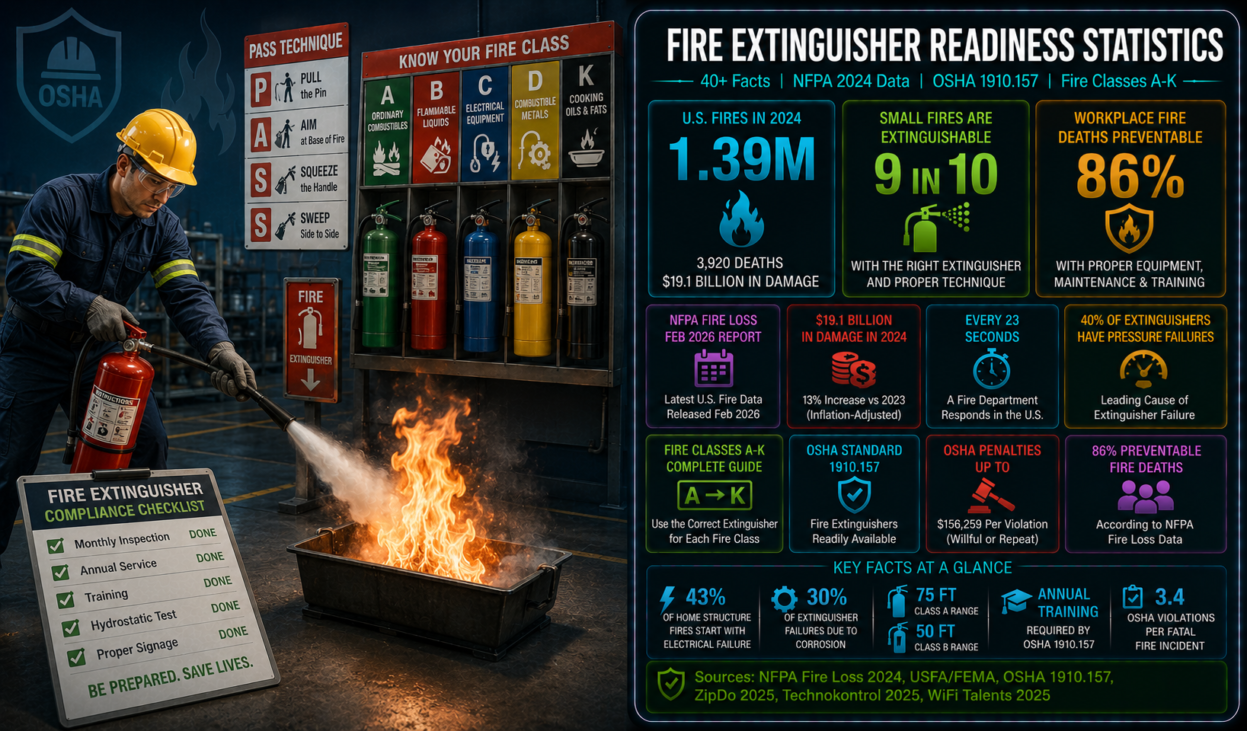
Source: NFPA: Fire Loss in the United States, 2024
Source: OSHA: Top 10 Most Cited Standards, FY2025
Source: NFPA Fire Research
Insight Summary
What the Data Shows: Fire Extinguisher Readiness by the Numbers
Source: NFPA 2024
Source: NFPA 2024
Source: NFPA 2024
The 2024 Fire Death Increase: What the Trend Means
The 6.8% rise in civilian fire deaths from 2023 to 2024 is the continuation of a multi-year reversal. The 2024 figure of 3,920 represents a 37% increase from NFPA’s 2012 record low of 2,855 deaths. That low point was achieved through decades of improvement in smoke alarm adoption, building codes, and suppression systems. The data now shows that improvement is not self-sustaining. Deaths per fire, deaths per 1,000 fires, and absolute fatality counts have all moved in the wrong direction in recent years.
For workplace safety professionals, this matters because it resets the baseline assumption. An employer who designed their fire response programme in 2015 against a downward trend in fire deaths is now operating against an upward one. The risk picture has changed and fire extinguisher readiness is part of that picture because the first 30 seconds of a small fire are when a correctly selected, in-service extinguisher makes the difference between an incident and a disaster.
The 1910.157 Citation Pattern: Same Failures, Every Year
OSHA 1910.157 violations appear on the top 10 list regularly. The most frequent issues are missing monthly inspection records, no documentation of annual training, extinguishers that are overdue for annual maintenance, and units that are blocked or mounted too high. What the enforcement data shows is that this pattern has not changed meaningfully from year to year. The same programme gaps generate the same citations because the root cause is not awareness of the requirements but execution of the documentation and inspection cadence.
The more important finding here is structural: each extinguisher that is overdue for maintenance, missing its tag, or improperly mounted can be cited separately. A facility with 30 extinguishers where half have lapsed maintenance records is not a single violation. It is 15 separate violations at up to $16,550 each. This is why fire extinguisher compliance failures can generate disproportionate penalty totals relative to the perceived severity of the underlying gap.
1910.157 Compliance Requirements: What Inspectors Examine
| Requirement | CFR Citation | What Inspectors Check | Citation Risk |
|---|---|---|---|
| Monthly visual inspection | 1910.157(e)(2) | Documentation that every unit was checked every month. Missing a single month is a citable violation per unit. | Very High |
| Annual maintenance record | 1910.157(e)(3) | Documented professional service within the past 12 months. Record retained for 1 year after last entry or life of shell. | Very High |
| Accessible placement | 1910.157(c)(1) | Not obstructed by equipment, storage, or closed doors. An extinguisher behind a door employees would not think to open is not compliant. | Very High |
| Mounting height | 1910.157(c)(6) | Handle max 5 ft from floor (3.5 ft for units over 40 lbs). Bottom of unit at least 4 inches off floor. Each non-compliant unit is separate. | High |
| Travel distance | 1910.157(d)(2) | Max 75 ft travel distance for Class A hazards. Max 50 ft for Class B hazards. Layout must be mapped against these limits. | High |
| Annual training / education | 1910.157(g)(1-2) | General education for all employees plus hands-on training for designated responders. No written record required by the standard, but an inspector who asks will not accept verbal assurance. | High |
| Written policy (evacuation exemption) | 1910.157(b)(1) | If claiming total-evacuation exemption: written policy, EAP under 1910.38, and fire prevention plan under 1910.39 all required. Extinguishers still required in some areas. | Moderate |
Source: 29 CFR 1910.157 | OSHA 1910.157 Standard
The Three Programme Gaps That Drive Almost Every Citation
Missing inspection records. Inaccessible or obstructed placement. No documented training programme. An employer can have a fully charged, correctly classified extinguisher on every wall and still receive serious citations for all three of these gaps simultaneously.
Missing Monthly Inspection Records
The standard requires monthly visual checks. OSHA treats a missing record as a missed inspection. Each unit with a gap in its inspection log is a separate citation. Source: 29 CFR 1910.157(e)(2)
Inaccessible or Obstructed Placement
Storage creep is the most common cause: boxes, pallets, and equipment gradually block extinguisher access. An extinguisher behind a closed door employees would not think to open fails the accessibility requirement. Source: 29 CFR 1910.157(c)(1)
Absent or Undocumented Training Programme
“We trained everyone” is not an answer an OSHA inspector will accept. Sign-in sheets, training logs, and a documented annual cadence are the only way to demonstrate compliance. Source: 29 CFR 1910.157(g)
Penalty Exposure: What Non-Compliance Costs
Applied per unit for each non-compliant extinguisher. Each missing inspection record, each obstructed unit, each overdue maintenance tag is a separate violation. A facility with 20 non-compliant units faces up to $331,000 in serious violations alone. Source: OSHA Penalty Schedule, confirmed 2026 (unchanged from January 2025)
Applies when the employer knew of the requirement and failed to comply, or when the same violation was cited in a previous inspection. An employer cited for missing maintenance records in one inspection who repeats the failure in the next inspection faces willful classification. Plus $16,550 per day for failure to abate. Source: OSHA Penalty Schedule, confirmed 2026 (unchanged from January 2025)
Fire Extinguisher Classes: Selection Is a Compliance Requirement, Not a Preference
Selecting the wrong class of extinguisher for the hazard type present is a compliance failure under 1910.157(d). An employer who installs Class A extinguishers in a flammable liquid storage area has not met the requirement, even if the units are in service, inspected, and accessible.
Class A
Ordinary combustibles: wood, paper, cloth, plastics. 75-foot maximum travel distance under 1910.157(d)(2).Class B
Flammable and combustible liquids. 50-foot maximum travel distance. Higher density requirement than Class A.Class C
Energised electrical equipment. Non-conductive agent required. Using a water extinguisher on Class C creates a secondary electrocution hazard.Class D
Combustible metals: magnesium, titanium, sodium. Required where metal powders, flakes, or shavings are generated at least biweekly. Specialist agent only.Class K
Cooking oils and fats in commercial kitchens. Not covered by 1910.157: falls under NFPA 10 and local fire codes. Requires wet chemical agent.ABC Multi-Purpose
Dry chemical rated for A, B, and C fires. The most common choice for general industry. Does not cover Class D or K hazards.Source: 29 CFR 1910.157(d) | NFPA 10
9 Important Fire Extinguisher Compliance Facts
What every safety manager should know about 29 CFR 1910.157 and the evidence behind it.
OSHA rejected quarterly inspections in a 2006 interpretation letter. Monthly is the minimum. Missing even one month creates a citable violation per unit. Source: 29 CFR 1910.157(e)(2)
Class B hazards require a tighter 50-foot limit. Each location that exceeds the travel distance without an additional unit is a separate citation. Source: 29 CFR 1910.157(d)(2)
Bottom of unit must also be at least 4 inches off the floor to prevent corrosion. Each non-compliant mount is a separate citable unit. Source: 29 CFR 1910.157(c)(6)
Separate from the annual maintenance check. Hydrostatic pressure testing is required every 5 or 12 years depending on extinguisher type. Source: 29 CFR 1910.157(f)
The annual maintenance record must be retained for one year after the last entry or the life of the shell, whichever is less. Inability to produce records on inspection = citation. Source: 29 CFR 1910.157(e)(3)
= FULL STANDARD One Extinguisher on the Wall Triggers Full 1910.157 Compliance
Providing even one extinguisher for employee use triggers the full standard: monthly checks, annual maintenance, hydrostatic testing, and training. There is only one exemption and it requires removing extinguishers and writing a total evacuation policy. Source: 29 CFR 1910.157(b)
2027 OSHA Warehousing NEP Targets Fire Compliance Through Mid-2027
The Warehousing and Distribution Centre National Emphasis Programme lists 1910.157 as a programmed inspection item. Warehouses, DCs, and manufacturing facilities should expect active scrutiny of fire extinguisher compliance through mid-2027. Source: OSHA National Emphasis Programmes
Small Fires Suppressible With a Correct, In-Service Extinguisher
Effectiveness depends entirely on correct class selection, correct pressure, and a trained operator. An in-service extinguisher that the nearest employee has never been trained to use is not an effective fire suppression tool. Source: NFPA Fire Research
= NOT COMPLIANT An OSHA Inspector Will Not Accept “We Definitely Did It” as Proof of Training
The standard does not require written training records but OSHA will cite the absence of training if no documentation exists. Sign-in sheets and training logs are the only practical way to prove compliance when asked. An employer who relies on verbal assurance during an inspection will be cited for no training programme. Source: 29 CFR 1910.157(g)
5 Myths About Fire Extinguisher Compliance
If we have extinguishers on the wall, we are compliant with 1910.157
Having extinguishers is not compliance. Compliance requires the correct class for the hazard, accessible placement within the travel distance limit, monthly inspection records for every unit, annual professional maintenance with retained documentation, and a training programme. The extinguisher is the starting point, not the endpoint.
Quarterly inspections are sufficient if we document them thoroughly
OSHA rejected quarterly inspections in a 2006 interpretation letter and has not revised that position. Monthly is the statutory minimum under 1910.157(e)(2). A thorough quarterly inspection is still a citable violation for each month where no inspection record exists.
The total-evacuation exemption means we do not need to worry about extinguishers at all
The exemption under 1910.157(b)(1) requires a written fire safety policy, an emergency action plan under 1910.38, and a fire prevention plan under 1910.39. It also requires that extinguishers are not available to employees, meaning they must be removed or secured. Employers who claim the exemption verbally while leaving extinguishers on the wall get cited for no training programme under the “use” option they have adopted by default.
An ABC extinguisher covers every fire scenario in our facility
ABC dry chemical covers Class A, B, and C fires but does not cover Class D (combustible metals) or Class K (cooking oils). Facilities with metal machining operations generating metal powders biweekly require Class D units. Commercial kitchens require Class K wet chemical systems under NFPA 10. Using an ABC unit on a Class D fire can spread burning metal particles and worsen the incident.
One citation for a non-compliant extinguisher is a minor finding
Each non-compliant unit is a separate citation. A facility with 25 extinguishers where 15 have lapsed monthly inspection records, 8 are partially obstructed, and training was conducted two years ago without documentation faces 23 serious violations at up to $16,550 each, before any repeat or willful classification applies. This is why fire extinguisher compliance generates disproportionate penalty totals relative to its perceived severity.
Impact of Non-Compliance on Your Facility
Compounding Per-Unit Penalties
Each non-compliant extinguisher is a separate citation. A multi-unit facility with a pattern of missing inspection records, obstructed placement, and no training documentation can accumulate six-figure penalty totals from a single inspection.
Heightened NEP Scrutiny Through 2027
Warehouses, distribution centres, and manufacturing facilities under OSHA’s active National Emphasis Programme face programmed inspection visits where fire extinguisher compliance is specifically on the inspection checklist, not an incidental finding.
Preventable Incident Escalation
A small fire that is not suppressed in its first 30 seconds because the nearest extinguisher is obstructed, discharged, or operated by an untrained worker is a small fire that becomes a large incident. The 9-in-10 suppressibility rate assumes the extinguisher is accessible, in service, and operated correctly.
Repeat Violation Classification
An employer cited for missing inspection records who repeats the failure at the next inspection faces willful or repeat classification at up to $165,514 per violation. The most expensive fire extinguisher compliance failure is the one that follows an unresolved citation.
How to Build a Compliant Extinguisher Programme
The three citation drivers all share the same root cause: absence of a managed programme. The following actions address each gap systematically.
Create a Unit-Level Inspection Log
Tag every extinguisher with a unique ID. Maintain a monthly log for each unit. One log per unit makes compliance audits and OSHA inspections straightforward.
Map Every Unit Against Travel Distance Limits
Document a placement map showing each unit, its class, and the hazard areas it covers. Confirm no location exceeds 75 ft for Class A or 50 ft for Class B. Review when facility layout changes.
Document Every Training Session With Sign-In Sheets
Record date, trainer, topics covered, and every attendee’s signature. Retain records for the duration of employment plus a reasonable period. Annual cadence minimum.
Make a Written Policy Decision: Use or Evacuate
Document your choice in writing. If employees will use extinguishers: provide and train. If total evacuation: write the policy, complete EAP and fire prevention plan, and remove or secure extinguishers per the exemption conditions.
Schedule Annual Professional Service With Record Retention
Contracted professional service is required annually. Retain the service record for each unit for one year after the last entry or the life of the shell. File by unit ID to enable rapid retrieval during inspections.
Add Clearance Checks to Every Shift Walkthrough
Obstruction from storage creep is the most common placement violation. Include extinguisher clearance verification in daily supervisor walkthroughs so obstructions are caught before they persist long enough to become inspection findings.
Sources
Government and Regulatory Sources
- 29 CFR 1910.157: Portable Fire Extinguishers: the primary OSHA standard governing placement, use, maintenance, inspection, and training requirements for portable fire extinguishers in general industry workplaces.
- OSHA: Top 10 Most Cited Standards FY2025: source for 29 CFR 1910.157’s consistent appearance on the general industry most-cited list.
- OSHA: Penalty Schedule, confirmed 2026: source for the $16,550 serious violation and $165,514 willful or repeat violation penalty figures. No 2026 inflation adjustment was applied: BLS did not publish October 2025 CPI data, so 2025 amounts carry forward unchanged into 2026. Source: OSHA Memo, May 21, 2026.
- OSHA: National Emphasis Programmes: source for the Warehousing and Distribution Centre NEP targeting fire extinguisher compliance through mid-2027.
- USFA/FEMA: Fire Statistics: US fire department response data and occupancy-type fire loss statistics used throughout the data section.
Standards and Industry Sources
- NFPA 10: Standard for Portable Fire Extinguishers: the technical standard governing extinguisher selection, installation, inspection, maintenance, and testing that OSHA’s 1910.157 references and most local fire codes adopt.
Research Sources
- NFPA: Fire Loss in the United States, 2024 (November 2025): source for the 3,920 civilian fire deaths, 11,780 injuries, $19 billion property damage, 6.8% year-over-year death increase, 37% increase from 2012 record low, and the fire department response every 23 seconds figures.
- National Safety Council: Fire-Related Deaths and Injuries (2024 data): corroborating source for the 2024 civilian fire death statistics and year-over-year trend data.
Related VelSafe Articles
Hot Work Safety: Permits, Controls and OSHA Compliance
Hot work permits typically require a dedicated fire watch with an in-service extinguisher on hand. This guide covers the permit requirements and the specific extinguisher readiness obligations that accompany any hot work operation.
Flammable Liquids Awareness: A Workplace Scenario
A case study of how flammable liquid storage gaps intersect with extinguisher class selection failures: what happened, what the OSHA citations were, and what a compliant Class B extinguisher placement would have changed.
Housekeeping on the Job: Worker Safety Guide
Good housekeeping practice is the primary defence against storage creep blocking extinguisher access, the most common placement violation under 29 CFR 1910.157. This guide covers the housekeeping obligations that directly support fire extinguisher programme compliance.