featured_shock

Shock and Anaphylaxis at Work: What the Data Shows

Hypovolemic shock is the type most directly connected to traumatic workplace injuries. It occurs when blood or fluid loss reduces circulating volume to the point where the heart cannot maintain adequate organ perfusion. A worker who suffers a severe laceration, crush injury, or internal trauma from a fall is at risk of progressing through the stages of hypovolemic shock within minutes.

0
Fatal anaphylaxis progression window
Typical time to respiratory or cardiac arrest after allergen exposure

The three stages of hypovolemic shock provide a clinical picture that first aid responders can observe and use to prioritize action:

Stages of hypovolemic shock: what to look for
Stage 1: Compensated shock (early)

The body compensates by increasing heart rate and constricting blood vessels. Blood pressure may still be within normal range. Signs: mild anxiety, slightly elevated heart rate (above 100), pale or slightly cool skin. The window for effective first aid is widest here.

Stage 2: Decompensated shock (progressive)

Compensatory mechanisms begin to fail. Blood pressure drops. Signs: rapid weak pulse, confusion or agitation, cold clammy skin, increased respiratory rate, reduced urine output. Requires immediate aggressive intervention.

Stage 3: Irreversible shock

Organ damage occurs. Blood pressure cannot be maintained even with treatment. Without rapid medical intervention, death follows. First aid actions should have been applied long before this stage is reached.

First aid for suspected hypovolemic shock: Control the bleeding source immediately using direct pressure, wound packing, or tourniquet for limb bleeding. Lay the person flat; elevate the legs approximately 12 inches if no spinal injury is suspected. Keep the person warm. Call 911 and monitor continuously. Do not give food, water, or oral medications.

Key Takeaway: Hypovolemic shock from a workplace laceration or crush injury is preventable in outcome if bleeding is controlled early and EMS arrives within the critical window. Without bleeding control, a worker can progress from Stage 1 to Stage 3 shock in under 10 minutes for a major arterial injury.

Anaphylaxis: The Speed Problem

Anaphylaxis is an acute, severe, systemic allergic reaction that can rapidly progress to life-threatening anaphylactic shock. In workplace settings, triggers include insect stings, latex allergy, food allergens during breaks, and medications.

0
Epinephrine therapeutic window
Fastest formulations reach therapeutic plasma levels within ~5 minutes

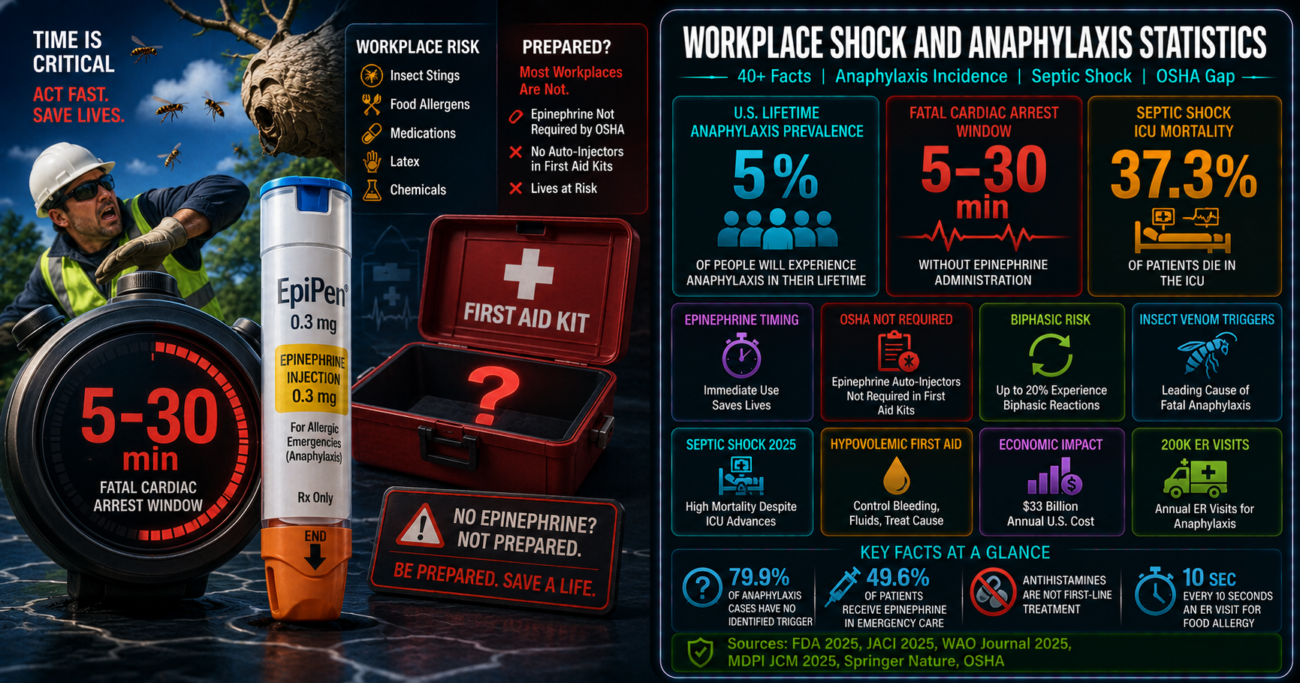
The data on fatal anaphylaxis is consistent: fatal reactions typically progress to respiratory or cardiac arrest within 5 to 30 minutes of exposure, and delayed or absent epinephrine use is the most consistent risk factor across food, drug, and venom triggers.

Anaphylaxis Recognition

Skin and appearance

Hives, flushing, facial or lip swelling, pale or blue skin. Present in over 80% of anaphylaxis cases but may lag behind other symptoms in rapid reactions.

Respiratory

Difficulty breathing, wheezing, stridor, throat tightness or hoarseness. Respiratory symptoms are the most immediately life-threatening presentation.

Circulatory

Rapid or weak pulse, dizziness, fainting, sudden drop in blood pressure. Circulatory signs indicate anaphylactic shock is developing.

Anaphylaxis First Aid Response

Anaphylaxis: immediate first aid sequence
1
Call 911 immediately. Do not wait to see if symptoms improve.
2
Administer epinephrine auto-injector (EpiPen) if available. Inject into the outer thigh, can be given through clothing. Hold 10 seconds. Antihistamines are not a substitute.
3
Position appropriately. Sitting upright if breathing difficulty. Flat with legs elevated if faint. Recovery position if unconscious and breathing. CPR if not breathing.
4
Note the time epinephrine was given. A second dose can be administered after 5 to 15 minutes if symptoms persist and a second auto-injector is available.
5
Monitor until EMS arrives. All anaphylaxis patients require physician evaluation even if symptoms resolve after epinephrine, due to biphasic reaction risk.
Critical: Antihistamines (diphenhydramine / Benadryl) do not reverse bronchospasm, vasodilation, or cardiovascular collapse in anaphylaxis. Giving them instead of or before epinephrine delays the only effective first-line treatment. This substitution is associated with fatal outcomes in the literature on anaphylaxis deaths.

The Epinephrine Access Gap

0
Hospital anaphylaxis rate
Approximately 1 in 3,000 US hospital inpatients experiences anaphylaxis

For workplace environments where workers are known to have severe allergies, having an epinephrine auto-injector accessible at the work location is a basic risk control measure — analogous to having a tourniquet where laceration injuries are foreseeable.

Common Assessment Finding

In workplace first aid program reviews, documented food or insect sting allergies in employee health records rarely result in epinephrine auto-injectors being stocked on site. The gap between knowing a worker has a severe allergy and having the treatment accessible at the work location is present in the majority of facilities we assess. Where that gap exists and an anaphylaxis event occurs, the OSHA 1910.151 adequacy question applies directly.

Universal Shock First Aid Principles

Regardless of shock type, the first aid framework shares core principles. These apply while EMS is en route without needing to diagnose which type is present.

Universal shock first aid: six principles
1Call 911 immediately. Shock requires hospital-level intervention; first aid buys time, it does not treat the cause.
2Control bleeding for hypovolemic shock: direct pressure, tourniquet, or wound packing.
3Position: lay flat, elevate legs 12 inches unless spinal injury, head injury, or breathing difficulty.
4Maintain warmth: cover to prevent heat loss; hypothermia compounds shock.
5Nothing by mouth: no food, water, or oral medications; surgery may be needed.
6Monitor and update EMS on changes in mental status, breathing rate, and pulse quality.
0
Cardiogenic shock mortality
Highest of the four shock types; results from heart pump failure after MI

Conclusion

The four types of shock differ in mechanism and mortality, but the first aid response framework is consistent: recognize early, call 911 immediately, control bleeding or administer epinephrine as indicated, position and monitor. For anaphylaxis specifically, the data on delayed epinephrine and fatal outcomes makes accessibility of auto-injectors at work locations where allergen exposure is foreseeable a practical safety management decision.

Sources

Add a Comment

Your email address will not be published. Required fields are marked *