

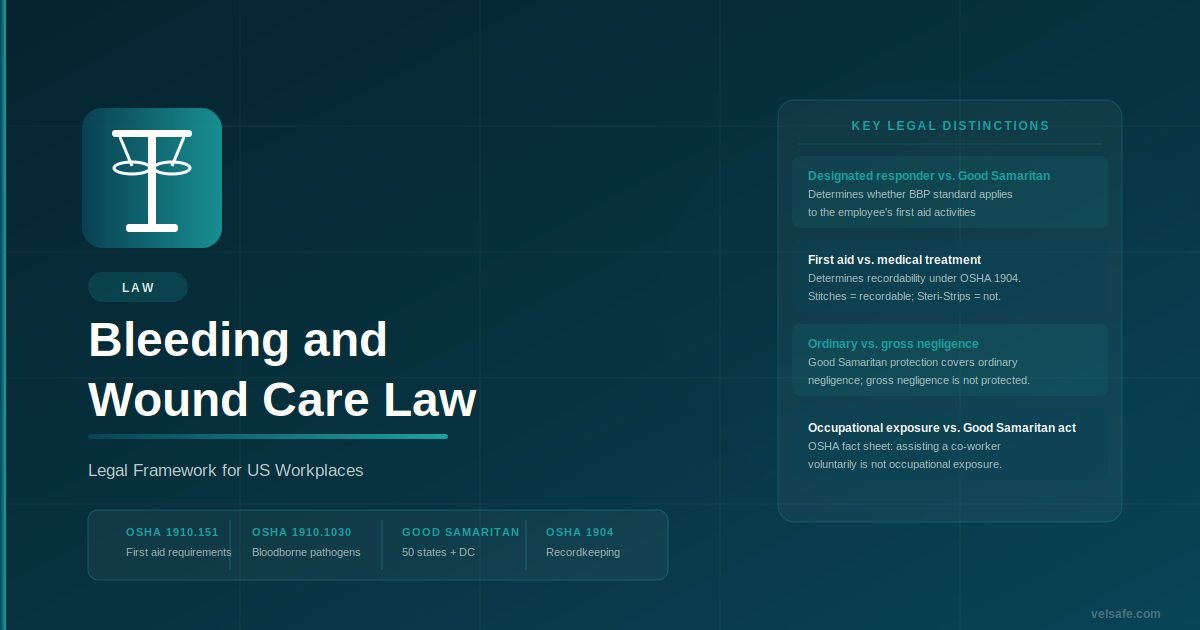
When a worker suffers a serious laceration on a job site, the immediate priority is clinical: control the bleeding, protect the airway, call 911. But embedded in that clinical moment are a series of legal obligations that govern what the employer must have in place, what the first aider is protected in doing, and what records must be created after. Getting those obligations wrong creates regulatory exposure that continues long after the wound has healed.
This article covers the US legal framework for workplace bleeding control and wound care: the OSHA standards governing first aid readiness, the bloodborne pathogen requirements that apply when blood is present, the scope and limits of Good Samaritan law protection, and the employer liability questions that arise from inadequate first aid programs.
The Regulatory Foundation
Three federal standards govern the legal framework around bleeding and wound care in US workplaces. They operate simultaneously and must be read together.
Requires employers to ensure that medical personnel are available for advice and consultation on matters of occupational health and that, in the absence of nearby medical facilities, a person or persons be adequately trained to render first aid. For high-hazard workplaces, OSHA interprets “near proximity” as a 3 to 4 minute EMS response time. Where that threshold cannot be met, trained on-site responders are a legal requirement.
Applies to employees with reasonably anticipated occupational exposure to blood or other potentially infectious materials. For bleeding control, this standard determines whether a designated first aid responder is covered by the full BBP compliance requirements, including an exposure control plan, hepatitis B vaccination offer, appropriate PPE, post-exposure medical follow-up, and training.
A workplace laceration or bleeding injury that requires more than first aid treatment (stitches, professional medical attention, restricted work days, or lost time) must be recorded on the OSHA 300 log and documented on the OSHA 301 incident report within 7 days. The distinction between first aid and medical treatment determines recordability and is frequently misapplied.
OSHA 1910.151: What Employers Must Have in Place
OSHA 1910.151 is a performance standard. It does not prescribe a specific number of first aiders or a specific kit configuration. It requires that the employer ensure adequate first aid is available, defined by the hazards present and the EMS response time at the specific location.
For bleeding injuries specifically, the standard’s adequacy is measured by whether a trained first aider with appropriate supplies was reachable in time to make a clinical difference. OSHA enforcement following a severe laceration or amputation will examine:
29 CFR 1910.1030: The Bloodborne Pathogen Standard and Bleeding Control
The presence of blood in a workplace bleeding control scenario raises a separate and distinct regulatory obligation under 29 CFR 1910.1030. Whether and how that standard applies depends on a specific legal distinction: the difference between “occupational exposure” and a “Good Samaritan act.”
The Occupational Exposure vs. Good Samaritan Distinction
OSHA’s bloodborne pathogen standard explicitly states that “Good Samaritan acts such as assisting a co-worker with a nosebleed would not be considered occupational exposure.” This carve-out is significant but has precise limits.
OSHA has stated that for enforcement purposes, if OSHA determines on a case-by-case basis that sufficient evidence exists of reasonably anticipated exposure, the employer will be held responsible for providing the protections of 29 CFR 1910.1030 to the employees with occupational exposure.
What the BBP Standard Requires for Designated First Aid Responders
When a first aid responder is formally designated as responsible for rendering medical assistance, they become covered employees under 1910.1030. The employer must then provide:
Good Samaritan Laws: Protection for Workplace First Aiders
All 50 states and the District of Columbia have Good Samaritan laws, along with federal laws for specific situations. In the workplace context, these laws provide civil liability protection to employees who render emergency first aid to an injured colleague.
What Good Samaritan Laws Generally Protect
Good Samaritan statutes typically shield a first aid provider from civil liability for ordinary negligence when:
What Good Samaritan Laws Do Not Protect
Performing CPR on a person who is clearly breathing and conscious. Applying a tourniquet in a manner so far outside standard practice that it causes additional harm. Actions that no reasonable person would take given the same circumstances.
Some jurisdictions limit Good Samaritan protection to voluntary acts. The carer must not have a pre-existing duty to help the victim. A formally designated workplace first aid responder acting within their designated duties may not qualify as a Good Samaritan in jurisdictions that require voluntariness.
Once a first aid provider begins rendering assistance, abandoning the injured person before EMS arrives or before a handoff is made may remove Good Samaritan protection in many jurisdictions.
State Variation
Good Samaritan law protection is not uniform across US jurisdictions. Louisiana, Minnesota, Rhode Island, and Vermont are states that have failure-to-act laws, which place a legal duty on witnesses to offer emergency help. Failing to provide reasonable assistance could result in criminal charges. In the vast majority of US states, there is no legal duty for a bystander to act; these four states are the exception.
In first aid program audits conducted before OSHA inspections, we find employers in states with duty-to-act laws who are unaware their state applies criminal liability to failure to provide emergency assistance. The more common gap is employers in states without duty-to-act laws who assume no legal obligation to act means no legal exposure if the first aid program fails. An inadequate first aid program under OSHA 1910.151 creates regulatory liability for the employer regardless of whether any individual bystander had a legal duty to personally assist.
Recordkeeping: First Aid vs. Medical Treatment
Every bleeding injury in the workplace must be evaluated for recordability under OSHA 29 CFR 1904. The distinction between first aid and medical treatment is both legally significant and frequently misapplied.
Post-Exposure Procedures for Bloodborne Pathogen Exposure
When a designated first aid responder has a skin, eye, or mucous membrane contact with blood during a bleeding control incident, 29 CFR 1910.1030 requires an immediate, specific response.
Employer Liability: Where the Gaps Create Exposure
The practical liability risk for employers in the bleeding and wound care context does not primarily arise from individual first aiders acting in good faith. It arises from systemic program failures that leave workers without adequate first aid when a serious injury occurs.
This is the most direct 1910.151 liability scenario. An injury requiring first aid that occurred on a shift with no trained responder present exposes the employer to a citation regardless of outcome.
A Class A kit in an environment with machinery that regularly causes lacerations, crush injuries, or amputations is a documented program failure. OSHA’s adequacy standard requires that supplies match the hazards.
Formally designating employees as first aid responders without implementing the BBP compliance program (exposure control plan, hepatitis B vaccination, PPE, training, post-exposure follow-up) creates a 1910.1030 violation.
Incorrectly classifying a laceration requiring sutures as “first aid only” to avoid recording it on the OSHA 300 log constitutes a 1904 recordkeeping violation, with enhanced penalties if the omission is found to be intentional.
Failing to provide immediate confidential medical evaluation and post-exposure follow-up to a designated first aider who has a blood contact incident violates 1910.1030 and may create additional worker’s compensation and civil liability.
Key Takeaways
Sources and Regulatory References
- OSHA, “29 CFR 1910.151: Medical Services and First Aid”
- OSHA, “29 CFR 1910.1030: Bloodborne Pathogens”
- OSHA, “Standard Interpretation: Good Samaritan Acts and Bloodborne Pathogens (1992)”
- OSHA, “29 CFR 1904: Recording and Reporting Occupational Injuries and Illnesses”
- OSHA, “Bloodborne Pathogens: Quick Reference Guide”
- CDC, “Emergency Needlestick Information and PEP Hotline: 1-888-448-4911”
- NCBI StatPearls, “Good Samaritan Laws”
- NCBI StatPearls, “OSHA Bloodborne Pathogen Standards”