

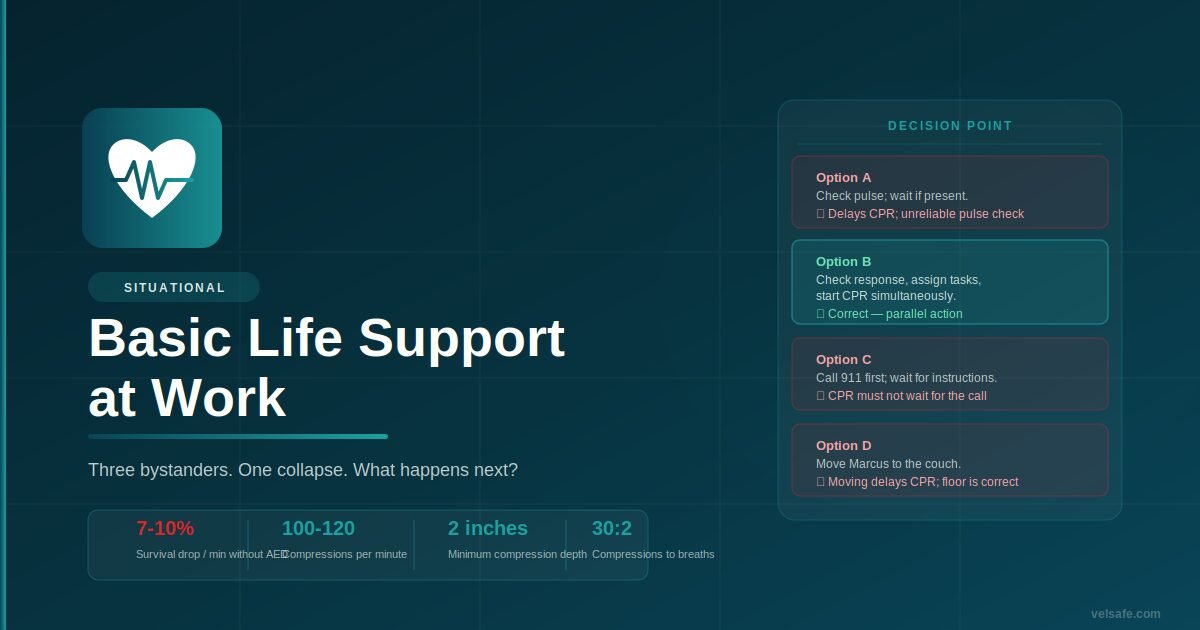
A 52-year-old facilities supervisor collapses in the break room of a mid-size manufacturing plant at 10:40 AM. Three workers are present. None of them are the plant’s designated first aid responder, who is on the floor. The AED is mounted on the wall 40 feet away. No one has started doing anything yet.
This scenario walks through the decisions that must happen in the next 90 seconds and why each one matters. It is grounded in the 2024 American Heart Association and American Red Cross First Aid Guidelines and OSHA’s requirements under 29 CFR 1910.151.
The Scenario
Location: Break room, manufacturing facility. The room has one exit into the main corridor. The nearest AED is mounted on the wall outside the break room door, approximately 40 feet away. The plant’s two designated first aid responders are both currently on the production floor.
The people in the room: – Carlos, a line supervisor, who has taken a CPR course two years ago but has never used it in an actual emergency. – Priya, an administrative coordinator, who completed a first aid course three years ago but does not feel confident. – Reuben, a maintenance technician, who has no formal first aid training.
What happened: The facilities supervisor, Marcus, stood up from a table, said “I don’t feel right,” and then collapsed sideways off his chair onto the floor. He is now lying on his back, not moving, and has made no response to anyone calling his name.
The current situation: Carlos is crouching next to Marcus. Priya is standing near the door. Reuben is at the far end of the room. All three are looking at each other. It has been approximately 15 seconds since Marcus collapsed.
Decision Point
Three things need to happen in the next 60 to 90 seconds. In what order should Carlos, Priya, and Reuben act?
Option A: Carlos checks for a pulse; if he finds one, everyone waits to see if Marcus wakes up.
Option B: Carlos taps Marcus’s shoulders and shouts his name; simultaneously directs Priya to call 911 and Reuben to retrieve the AED; immediately begins assessing breathing; starts chest compressions if Marcus is unresponsive and not breathing normally.
Option C: Priya calls 911 first; everyone waits for dispatcher instructions before doing anything else.
Option D: Carlos and Reuben together lift Marcus and carry him to the couch where he will be more comfortable while they wait for EMS.
What should happen?
Analysis: Why Option B Is Correct
Why the Other Options Are Wrong
Option A (check for pulse; wait if pulse present) introduces two problems. First, pulse checking by untrained rescuers is unreliable, with studies showing false-negative rates of 40% or more. Second, even if a pulse is present, an unresponsive, non-breathing adult may have a compromised airway that requires immediate management. Waiting to see if Marcus wakes up is not an option.
Option C (call 911 first; wait for dispatcher instructions) delays the start of CPR. The 911 call and CPR must happen simultaneously if there are multiple bystanders. If Carlos were alone, he would call 911 first for an adult, then begin CPR. With three people present, dispatching Priya to call while Carlos assesses is the correct approach.
Option D (moving Marcus to the couch) is the most dangerous option. Moving an unresponsive person wastes critical seconds. Moving someone who may be in cardiac arrest interrupts or delays CPR. And an unconscious person should be left on the floor, where compressions are most effective, not on a soft surface that absorbs compression force.
What Carlos Should Do: Step by Step
What Priya Should Do: Calling 911 Effectively
What Reuben Should Do: AED Use
Reuben has no formal first aid training, but AEDs are designed to be operated by untrained bystanders. The device guides the user through every step with voice prompts.
Retrieve the AED from the wall, run back to Carlos, turn on the device, and follow the voice prompts. The AED will tell him to attach pads, analyse the rhythm, and deliver a shock if indicated. He should not delay by reading the instructions on the case.
Carlos continues compressions while Reuben attaches the pads. Carlos pauses compressions only when the AED says “Analysing rhythm” and during the shock itself. Compressions resume immediately after the shock. The AED will reanalyse every 2 minutes.
Learning Points
In a group, “someone call 911” produces inaction. “Priya, call 911 now” produces a 911 call. This is not a communication style preference. It is the evidence-based intervention for preventing the bystander effect.
Priya felt unconfident, Reuben had no training, and Carlos had not practiced in two years. None of that changed what needed to happen. Hands-only CPR is effective and requires no equipment. The AED provides step-by-step guidance. The threshold for acting is lower than most bystanders believe.
Both designated responders were on the production floor. This scenario illustrates why first aid coverage requires physically present, reachable responders on every part of a facility, not just assigned on paper. The 3 to 4 minute OSHA response threshold means a first aider on another floor may not be in time.
In post-incident reviews of workplace cardiac events, the most consistent finding is a delay of 60 to 90 seconds between collapse and first compression. In every case, multiple people were present. The delay is not caused by ignorance of what to do. It is caused by the gap between knowing what to do and initiating action when the situation is real. The scenario in this post is not an edge case: it is the most common first-response situation in workplace cardiac arrest.
BLS Reference: Key Numbers
Related Resources
- AHA/Red Cross, “2024 First Aid Guidelines” (Circulation, 2024)
- AHA, “Hands-Only CPR: No Breathing Required”
- OSHA, “Medical Services and First Aid: 29 CFR 1910.151”
- OSHA Publication 3317, “Best Practices Guide: Fundamentals of a Workplace First-Aid Program”
- American Heart Association, “2024 CPR and ECC Guidelines”