

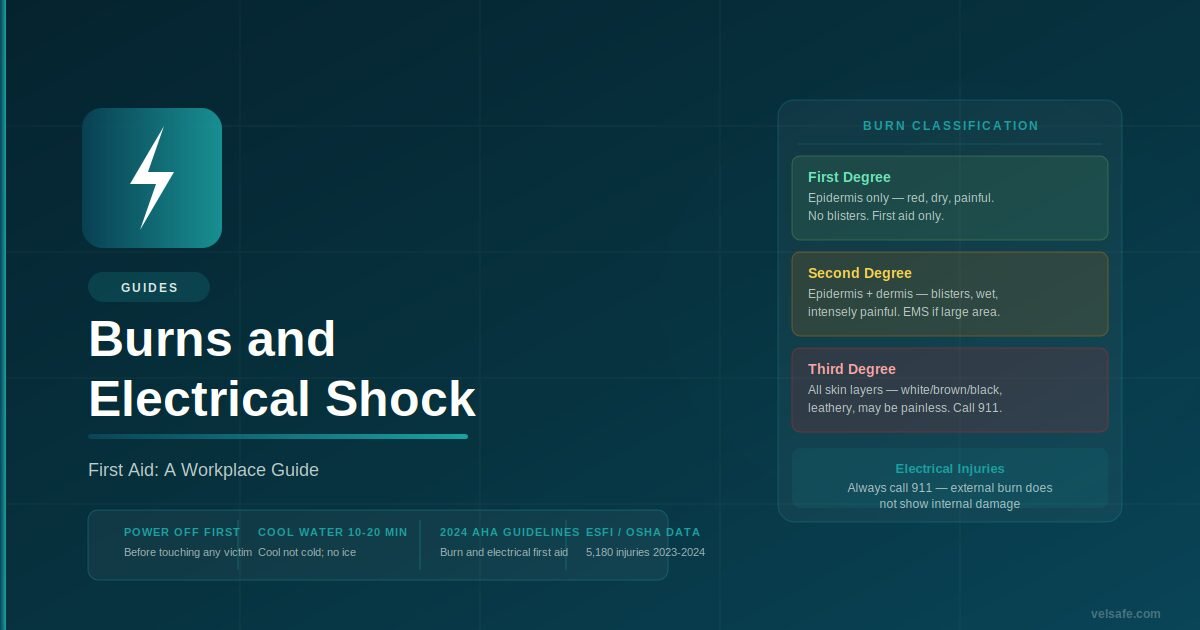
Burn injuries and electrical shock are among the most common serious injuries in construction and general industry. The Electrical Safety Foundation International reports 5,180 nonfatal electrical injuries involving days away from work in 2023-2024, a 59% increase from the previous two-year period. Overhead power line contact is the leading cause of fatal electrical injuries in the workplace, accounting for 49% of all electrical fatalities over the 2011-2024 period.
This guide covers first aid response for thermal burns and electrical shock injuries in the workplace, based on the 2024 American Heart Association and American Red Cross First Aid Guidelines and OSHA requirements under 29 CFR 1910 Subpart S and 29 CFR 1926 Subpart K.
Who This Guide Is For
This guide is written for designated first aid responders, supervisors, safety officers, and any worker who may be the first person on scene when a burn or electrical injury occurs. It covers recognition, scene safety, first aid response sequencing, and the most common errors in burn and electrical injury management. Formal first aid certification requires hands-on training with a qualified provider. This guide is a reference for recognition and initial response decisions.
Part 1: Burns
Burn Classification
The severity of a burn determines both the first aid response and whether the injury requires emergency care. The classification system used in US first aid is based on depth of tissue involvement.
When to Call 911 for a Burn
Call 911 immediately for any burn that:
First Aid for Thermal Burns
What Not to Do with Burns
Ice water causes additional tissue injury through vasoconstriction and ischemia. In large burns, it can also cause hypothermia. Cool running water is the correct intervention.
These substances trap heat in the tissue, increase the risk of infection, and make clinical assessment more difficult when the person reaches an emergency department.
Blisters are a protective barrier against infection. Breaking them exposes the wound to contamination. If a blister breaks on its own, clean gently with water and cover with a non-adherent dressing.
Chemical Burns
Chemical burns require a different approach than thermal burns. The goal is dilution, not cooling.
Part 2: Electrical Shock
Understanding Electrical Injuries
Electrical injuries are deceptive. The external burn visible at the entry and exit points of the current is often far less severe than the internal damage along the current’s pathway through the body. A current of 50 milliamperes can stop the heart. The severity of electrical injury depends on the current type (AC is more dangerous than DC at the same voltage), voltage, resistance of the tissue, pathway through the body, and duration of contact.
In post-incident reviews of electrical injuries on construction sites, the most consistent finding is that workers who appeared to have only minor skin burns were later diagnosed with significant internal injuries including cardiac arrhythmias, muscle damage, and nerve injury. An electrical injury that looks minor externally always requires medical evaluation. The burn on the skin is not a reliable indicator of internal damage.
Scene Safety: The Non-Negotiable First Step
The single most important principle in electrical injury first aid is that the first responder must not touch the injured worker until the electrical source is confirmed off. Contact with a person who is still connected to an electrical source will result in the first responder receiving the same shock. This is not a risk to manage; it is an absolute restriction.
Turn off the power at its source (circuit breaker, disconnect switch, or power strip). Do not use the switch near the worker; turn off the circuit. Confirm power is off before approaching or touching the worker.
Do not approach. Do not use any object, including wooden ones, to try to move the worker or the wire. Everything will conduct at high voltage. Stay at least 30 feet away and call 911 immediately. Do not enter the area until the power company has confirmed the line is de-energized.
If a vehicle has contacted a power line, occupants should stay inside the vehicle. The vehicle may be energized but the current is contained within it. Exiting the vehicle creates a path for current to flow through the person to the ground. Call 911 and wait for the utility company to de-energize the line.
First Aid Response After Power Is Confirmed Off
Once the power source is confirmed off and the scene is safe, the first aid response follows the primary survey and then addresses specific electrical injury needs.
Arc Flash Injuries
Arc flash is a form of electrical explosion caused when electrical energy jumps through the air between conductors. Arc flash incidents can cause severe thermal burns across exposed skin, pressure wave injuries, flash blindness, and hearing loss. The temperature of an arc flash can exceed 35,000 degrees Fahrenheit at its core. Arc flash injuries account for a significant proportion of electrical burn hospitalizations in industrial environments.
Common Mistakes in Burn and Electrical Shock Response
This converts the first responder into a second victim. Scene safety is not optional. Confirm power off before any contact with the worker or anything they are touching.
Ice water causes additional tissue injury and risks hypothermia in large burns. Cool running water for 10 to 20 minutes is the correct intervention; ice is not.
These trap heat, increase infection risk, and obscure the wound for medical assessment. They have no first aid benefit and have been contraindicated in guidelines for decades.
External appearance is not a reliable indicator of electrical injury severity. Internal burns to muscles, nerves, and heart tissue may be severe despite minimal visible skin damage. All electrical injuries require medical evaluation.
At high voltages, wood conducts. No non-trained person should approach downed power lines or attempt to move them with any material until the utility company confirms the line is de-energized.
Applying a base to an acid or vice versa generates heat through the neutralization reaction and can worsen the burn. Flush with large amounts of cool running water continuously until EMS arrives.
OSHA Reporting Requirements for Burn and Electrical Injuries
Recordability
Work-related burns and electrical injuries that require medical treatment beyond first aid must be recorded on the OSHA 300 log within 7 days. A burn requiring only cool water and a dressing is first aid and is not recordable. A burn requiring prescription medication, debridement, or skin grafting is medical treatment and is recordable.
Mandatory Reporting
OSHA requires employers to report certain incidents directly to OSHA regardless of recordability:
FAQs
Can I cool a burn with cold tap water instead of running water? Cold tap water is acceptable if running water is not immediately available, but it should not be used for extended periods because of the risk of hypothermia in large burns. Running cool water is preferred. Ice and ice-cold water are not acceptable.
Should I remove clothing from a burn area? Remove loose, non-adherent clothing before swelling makes it impossible. Do not forcibly remove clothing that is stuck to the burned skin; leave it in place and let medical personnel remove it.
What do I do if I cannot turn off the power source? If the power cannot be quickly isolated by an authorized person, do not approach the victim. Call 911 immediately. High-voltage injuries in particular require utility company intervention before any approach is safe.
Is an AED appropriate for an electrical injury victim? Yes. If the worker is in cardiac arrest following an electrical injury, begin CPR and use the AED as soon as it is available. Electrical injury frequently causes ventricular fibrillation, which is a shockable rhythm.
Sources
- AHA/Red Cross, “2024 First Aid Guidelines” (Circulation, 2024)
- ESFI, “Workplace Injury and Fatality Statistics: 2011-2024”
- Mayo Clinic, “Burns: First Aid”
- Mayo Clinic, “Electrical Burns: First Aid”
- OSHA, “29 CFR 1910.151: Medical Services and First Aid”
- OSHA, “29 CFR 1904.39: Reporting Fatalities, Hospitalizations, Amputations, and Losses of an Eye”
- OSHA, “Electrical: 29 CFR 1910 Subpart S”