

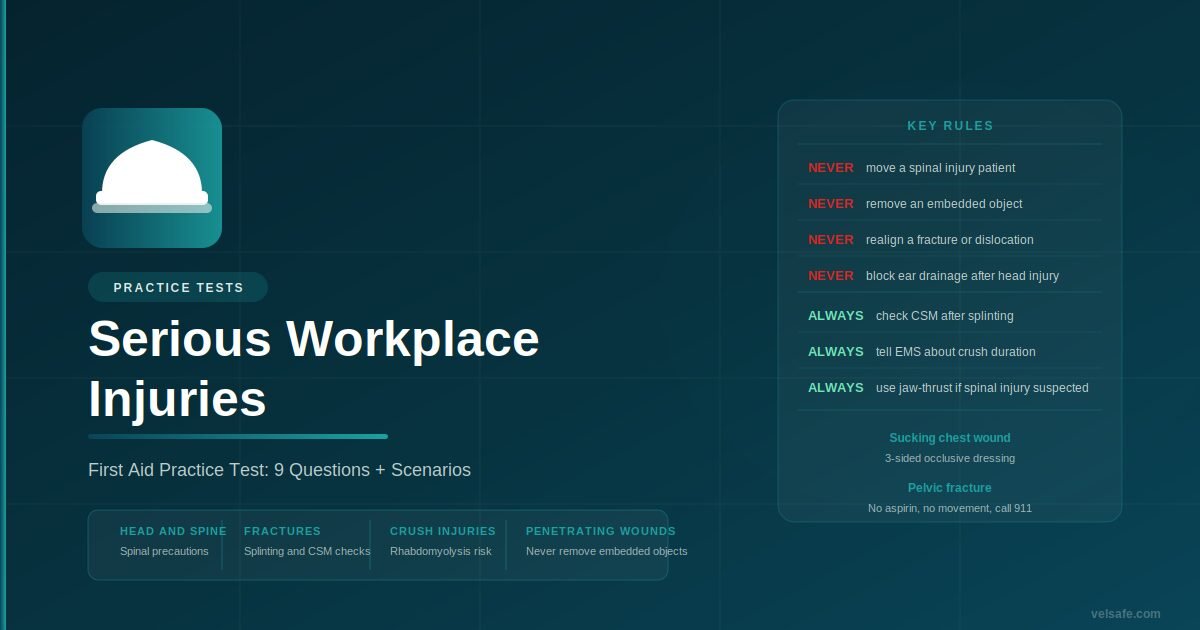
Serious traumatic injuries in the workplace — head and spinal trauma, fractures, crush injuries, and penetrating wounds — require first aid decisions that are more nuanced than minor wound care. The wrong action, such as moving a worker with a suspected spinal injury, can convert a survivable injury into permanent disability. The right action, performed correctly and in sequence, can maintain function until EMS arrives.
This practice test covers recognition, first aid response, and decision-making for serious traumatic injuries most likely to occur in construction, manufacturing, and general industry environments. Questions range from beginner to advanced and include scenario-based learning.
Introduction
The 2024 BLS data shows 5,070 fatal work injuries in the US and approximately 2.5 million nonfatal injuries requiring medical treatment beyond first aid. Among serious traumatic injuries, the decisions made in the first minutes determine outcomes that no amount of downstream medical care can reverse.
This practice test is designed for designated first aid responders, safety supervisors, and any worker in a high-hazard environment. Formal first aid certification requires hands-on training with a qualified provider. These questions test knowledge of recognition, response sequencing, and common errors. Every answer includes an explanation of why the correct answer is right and why the alternatives are wrong.
Head and Spinal Injuries
Question 1 | Beginner
A worker falls from a ladder and lands on a concrete floor. He is conscious and saying his neck hurts. What is the most important first aid action?
- A) Help him sit up so he is more comfortable
- B) Give him water to drink since he is conscious
- C) Tell him to hold still; prevent him from moving his head and neck while calling 911
- D) Check if anything is broken in his arms and legs before worrying about his neck
Why C is correct: Neck pain following a fall from height is a red flag for cervical spine injury until proven otherwise by imaging. The spinal cord is most vulnerable to additional damage when the vertebrae are unstable. Moving the person — sitting them up, repositioning the head, or helping them walk — risks converting a fracture without cord involvement into one with cord involvement, causing permanent paralysis. The correct action is to stabilize the head and neck in the position found, prevent movement, call 911, and keep the worker still until EMS arrives with spinal immobilization equipment.
Why A is incorrect: Sitting up requires cervical and thoracic spine movement that could cause catastrophic cord injury. Comfort is not the priority; spinal protection is.
Why B is incorrect: Giving food or water to anyone who may require surgery is contraindicated; aspiration risk increases with anesthesia. Consciousness is also not an indicator that serious injury is absent.
Why D is incorrect: Peripheral extremity injuries are secondary to the spinal cord risk. The mechanism of injury (fall from height) is the first indicator of spinal injury risk; waiting to assess limbs before addressing the neck is the wrong priority sequence.
Question 2 | Intermediate
A construction worker is found unconscious at the base of scaffolding. He has no visible wounds on his head. You notice blood and clear fluid coming from his left ear. What does this sign indicate and what should you do?
- A) The ear is bleeding from a minor wound; clean it with the first aid kit
- B) This is a sign of possible skull base fracture; call 911, do not pack or block the ear, apply spinal precautions
- C) He probably has a ruptured eardrum from noise exposure; this is not an emergency
- D) Apply direct pressure to the ear with a sterile gauze pad to stop the bleeding
Why B is correct: Blood or clear fluid (cerebrospinal fluid) draining from the ear after a head injury is a classic sign of basilar skull fracture. The fluid must not be blocked or packed. Blocking it can increase intracranial pressure in the presence of active bleeding. Call 911 immediately, do not apply pressure to the ear, and apply spinal precautions because any mechanism severe enough to cause a basilar skull fracture can also cause cervical spine injury.
Why A is incorrect: This is not a minor wound. The combination of an unconscious worker, a significant fall mechanism, and ear drainage is a serious traumatic brain injury presentation requiring emergency response.
Why C is incorrect: Noise-induced ruptured eardrums do not produce the combination of unconsciousness, fall mechanism, and blood-plus-clear fluid drainage. This presentation points specifically to skull fracture.
Why D is incorrect: Direct pressure to the ear is specifically contraindicated when basilar skull fracture is suspected. Blocking CSF drainage can worsen intracranial pressure.
Question 3 | Advanced
A worker is unconscious and not breathing normally following a head-on vehicle collision on a construction site. You suspect a cervical spine injury based on the mechanism. What is the correct CPR airway management approach?
- A) Do not open the airway because of the spinal injury risk; wait for EMS
- B) Use the jaw-thrust technique to open the airway without tilting the head
- C) Use head-tilt, chin-lift as normal because CPR takes priority over spinal precautions
- D) Roll the worker onto their side before beginning airway management
Why B is correct: The 2024 AHA/Red Cross guidelines state that when spinal injury is suspected, the jaw-thrust technique should be used to open the airway. This maneuver lifts the mandible forward to open the airway without extending the cervical spine. In a patient who is not breathing, airway management and CPR cannot be delayed; however, the jaw-thrust allows CPR to proceed while minimizing additional spinal risk. If the jaw-thrust is unsuccessful in opening the airway adequately, head-tilt chin-lift can be used because maintaining a patent airway takes precedence over spinal concerns.
Why A is incorrect: An unmanaged airway in an apneic patient is immediately life-threatening. Spinal precautions do not override the need to oxygenate the brain. Delaying airway management until EMS arrives would cause death.
Why C is incorrect: The jaw-thrust technique is specifically designed for this situation; head-tilt chin-lift should be attempted first only as a fallback if jaw-thrust fails to open the airway adequately.
Why D is incorrect: Rolling an unconscious patient with a suspected spinal injury without proper log-roll technique and personnel risks cord damage. It does not address the airway.
Fractures and Dislocations
Question 4 | Beginner
A worker is hit in the forearm by a falling object and cannot move her arm. The skin is intact, and the forearm is visibly deformed and swollen. What should the first aider do?
- A) Gently try to straighten the arm to reduce the fracture before splinting
- B) Splint the arm in the position it is in; do not try to realign the bones
- C) Have the worker continue working and see if the pain improves over the shift
- D) Apply an ice pack directly to the skin over the deformed area
Why B is correct: Splinting a suspected fracture in the position found is the correct first aid approach. Attempting to realign bones risks damaging the blood vessels, nerves, and soft tissue surrounding the fracture site. The splint should immobilize the joint above and below the injury. Use whatever firm material is available: a board, rolled magazine, or foam pad. Secure with bandages without cutting off circulation. Check for distal pulse before and after splinting.
Why A is incorrect: First aiders do not reduce (realign) fractures. That procedure requires imaging, anesthesia, and orthopedic expertise. Attempting it in the field without these causes additional injury.
Why C is incorrect: A visible deformity and inability to move the limb after impact are clear indicators of possible fracture requiring medical evaluation. Continuing work risks further displacement and injury, including conversion of a closed fracture to an open one.
Why D is incorrect: Ice should never be applied directly to skin; it can cause frostbite. If ice is used, it must be wrapped in a cloth barrier. The priority here is immobilization, not cold therapy.
Question 5 | Intermediate
After immobilizing a suspected forearm fracture, what must the first aider check and why?
- A) Color, warmth, and sensation distal to the injury, to confirm blood flow and nerve function
- B) The worker’s temperature, to rule out infection
- C) Whether the worker can write with the injured arm, to confirm fracture severity
- D) The location of the nearest hospital, before doing anything else
Why A is correct: Checking circulation, sensation, and motor function (CSM) distal to a fracture, meaning below the injury point toward the fingers, is a required step before and after splinting. The check includes: skin color (pale or blue indicates compromised circulation), warmth of the hand and fingers (cool skin suggests reduced blood flow), capillary refill time (press a fingernail, release, and count seconds until color returns; over 2 seconds is abnormal), sensation (can the worker feel you touching their fingertips?), and movement (can they wiggle their fingers?). If CSM worsens after splinting, the splint is too tight and must be loosened immediately.
Why B is incorrect: Infection does not develop in minutes. Temperature is not a relevant acute assessment point immediately after a fracture.
Why C is incorrect: Asking an injured person to use an injured limb is counterproductive. Fracture severity is determined by imaging, not by testing function of the broken bone.
Why D is incorrect: Hospital location is relevant but is not a clinical assessment step. 911 should have been called; EMS transport decisions are made by paramedics.
Question 6 | Advanced
A worker is suspected of having a pelvic fracture following a forklift collision. She is conscious and in severe pain. What are the two most important first aid actions in order?
- A) Log-roll her to a more comfortable position, then call 911
- B) Call 911 immediately; do not move her unless the environment is unsafe
- C) Splint the pelvis with a board and elevate her legs above heart level
- D) Give her aspirin and water while waiting for EMS
Why B is correct: Pelvic fractures are associated with massive internal hemorrhage; the pelvic cavity can hold several liters of blood. Moving the worker without proper immobilization can worsen bleeding by disrupting any clot that is forming. The immediate priorities are: call 911, keep the worker still, monitor for shock signs (pale, cool, clammy skin; rapid weak pulse; confusion), keep her warm, and do not move her unless she is in immediate danger from the environment. Advanced trauma teams may apply a pelvic binder in the field, but this is an EMS or trained responder procedure.
Why A is incorrect: Log-rolling is a spinal precaution technique requiring multiple trained personnel. Rolling a patient with a suspected pelvic fracture without proper spinal precautions and pelvic stabilization risks dramatically worsening internal hemorrhage.
Why C is incorrect: Splinting with a board is appropriate for limb fractures, not pelvic fractures. Elevating legs may be contraindicated with pelvic injury as it can increase internal bleeding.
Why D is incorrect: Aspirin is an anticoagulant and is specifically contraindicated in a patient with suspected internal bleeding. Water is also contraindicated given the likelihood of surgical intervention.
Crush Injuries and Compartment Syndrome
Question 7 | Intermediate
A worker’s hand and forearm have been trapped under a heavy equipment component for approximately 20 minutes. EMS has been called. The component is being lifted off. What should you be prepared for and what is the first action when the limb is freed?
- A) Expect immediate improvement; apply a heating pad to restore circulation
- B) Be prepared for crush syndrome; do not apply a tourniquet; call to update EMS that the limb is now freed
- C) Elevate the limb immediately as high as possible to prevent swelling
- D) Do not touch the limb until EMS arrives
Why B is correct: Prolonged crush injury (typically defined as more than one hour, though serious effects can begin earlier) can cause crush syndrome (rhabdomyolysis), where toxins released from damaged muscle tissue reach the bloodstream when compression is released and can cause acute kidney failure, cardiac arrhythmias, and death. When the limb is freed, update EMS immediately so they can prepare IV access and fluid resuscitation. Do not apply a tourniquet unless there is life-threatening arterial bleeding that cannot be controlled otherwise; a tourniquet on a crush-injured limb may worsen tissue damage. Keep the worker still and warm and monitor for shock.
Why A is incorrect: Heat increases metabolic demand in already-damaged tissue and accelerates release of breakdown products. The expectation of immediate improvement is clinically incorrect; workers with crush syndrome may appear to stabilize and then deteriorate rapidly after release.
Why C is incorrect: Elevation of a severely injured limb is generally discouraged in crush injuries because it may reduce perfusion to tissue that is already compromised. Elevation is also not a priority over monitoring for systemic effects.
Why D is incorrect: Monitoring and communication with EMS are active responsibilities. Passively waiting without assessment is not appropriate when the clinical situation may be changing rapidly.
Penetrating Wounds
Question 8 | Beginner
A worker has a piece of metal rod embedded in his thigh. The rod is approximately 6 inches long and is protruding about 3 inches from the wound. What is the correct first aid action?
- A) Remove the rod and apply direct pressure to the wound
- B) Leave the rod in place, stabilize it so it cannot move, apply pressure around the wound, and call 911
- C) Push the rod further in to reduce the portion that is sticking out
- D) Apply a tourniquet above the wound regardless of bleeding severity
Why B is correct: An embedded object must never be removed in the field. The object may be tamponading (plugging) a damaged blood vessel; removing it can cause immediate, severe bleeding. The correct approach is to stabilize the object so it cannot move (use bulky dressings built up around the base of the rod to prevent side-to-side movement), apply gentle direct pressure around the wound site without pressing on the object itself, keep the worker still to prevent the object from moving, and call 911 immediately. The object will be removed surgically in a controlled environment.
Why A is incorrect: Removing an embedded object before surgical control of the vessels it may be tamponading can cause rapid, life-threatening hemorrhage. This is explicitly contraindicated in all first aid guidelines.
Why C is incorrect: Pushing the object further in risks deeper tissue and vascular damage. Never manipulate an embedded object.
Why D is incorrect: A tourniquet is applied only when there is severe, life-threatening bleeding from a limb that cannot be controlled with direct pressure. It is not applied prophylactically to all penetrating wounds. In this scenario, apply pressure around the wound and assess bleeding severity before considering a tourniquet.
Question 9 | Advanced
A worker has a penetrating chest wound that is making a sucking sound with each breath. What does this indicate and what is the correct first aid response?
- A) This is normal after a chest impact; monitor and give water
- B) It indicates an open pneumothorax; seal the wound with an occlusive dressing on three sides
- C) It indicates a pneumothorax; do not touch the wound and call 911
- D) Apply tight circumferential bandaging around the entire chest to seal the wound
Why B is correct: A sucking chest wound (open pneumothorax) means air is entering the chest cavity directly through the wound with each breath, collapsing the lung on that side. The 2024 AHA/Red Cross guidelines recommend covering the wound with an occlusive (airtight) dressing. The three-sided seal is the traditional approach: tape the dressing on three sides, leaving the fourth side open to allow air to escape during exhalation but preventing it from entering during inhalation. Commercial vented chest seals are the preferred device when available. Call 911 immediately. Monitor for tension pneumothorax (increasing respiratory distress, trachea deviating to one side), which requires emergency medical intervention.
Why A is incorrect: A sucking chest wound is a life-threatening emergency. The sound indicates air entering the pleural cavity, not normal chest movement.
Why C is incorrect: Doing nothing while waiting for EMS allows continued lung collapse with each breath. The wound must be sealed to prevent further air entry.
Why D is incorrect: Circumferential bandaging around the entire chest restricts breathing and can worsen the pneumothorax by preventing chest expansion. Only the wound site is covered with the occlusive seal.
Scenario-Based Learning
Scenario 1: The Tower Crane Incident
A ironworker falls 15 feet from a tower crane and lands on a steel deck. He is conscious and appears disoriented. His hard hat is cracked. He tells you he cannot feel his legs. Co-workers want to move him to a safer location away from the crane.
Q1: Should the workers move him?
No, not without appropriate spinal immobilization. The loss of lower extremity sensation following a fall with a cracked helmet is highly suggestive of a spinal cord injury. Moving him without a proper log-roll technique and a rigid backboard risks converting an incomplete cord injury (some function preserved) into a complete cord injury (total loss of function below the injury level). The only exception is if the worker is in immediate, direct physical danger from the crane or environment. In that case, drag him straight back along his long axis, keeping head, neck, and spine in alignment as much as possible.
Q2: What is the correct sequence of actions?
Call 911 immediately and give the specific location. Assign one person to maintain the head and neck in the position found, preventing any movement. Keep other workers back to prevent further accidental movement. Keep the worker warm. Do not give food or water. Monitor for changes in consciousness and breathing. When asked about symptoms, note and report any numbness, tingling, pain, or weakness in any part of the body. When EMS arrives, report: the mechanism, the height of the fall, the presence of helmet damage, and the sensory findings.
Q3: What are the legal and regulatory implications?
This incident triggers OSHA mandatory reporting requirements: if the worker is hospitalized as an inpatient, the employer must report within 24 hours. If the injury results in death, report within 8 hours. The incident must be investigated under 29 CFR 1904 requirements. Fall protection deficiencies (if any) may result in citations under 29 CFR 1926.501.
Scenario 2: The Warehouse Crushing
A warehouse worker is pinned between a moving pallet jack and a fixed rack for approximately 45 minutes before a co-worker finds him and is able to release the equipment. He has a suspected rib fracture and significant bruising across the torso. He is conscious but confused.
Q1: What medical risk must EMS be warned about?
Crush syndrome (rhabdomyolysis) is the primary systemic risk after prolonged crush injury. Compressed muscle releases myoglobin and potassium into the bloodstream when compression is released. Elevated potassium can cause fatal cardiac arrhythmias. Myoglobin damages kidney tubules, causing acute kidney failure. EMS must be informed of the duration of crush and the mechanism so they can initiate IV fluids for rhabdomyolysis management before it is clinically apparent.
Q2: What should the first aider do while waiting for EMS?
Keep the worker still and warm. Monitor mental status continuously; confusion that worsens indicates deteriorating brain perfusion and is a sign of shock progression. Do not give food or water. Prepare to perform CPR if cardiac arrest occurs. Update EMS if the worker’s condition changes before their arrival.
Knowledge Check
What is the correct first aid action for a sucking chest wound before EMS arrives?
Apply an occlusive dressing sealed on three sides, leaving the fourth side open. This allows air to escape during exhalation but prevents air from entering during inhalation. A commercial vented chest seal is preferred when available. Call 911 immediately and monitor for tension pneumothorax (worsening respiratory distress, tracheal deviation).
Sources
- AHA/Red Cross, “2024 First Aid Guidelines” (Circulation, 2024)
- BLS, “Census of Fatal Occupational Injuries 2024”
- OSHA, “29 CFR 1910.151: Medical Services and First Aid”
- OSHA, “29 CFR 1904.39: Reporting Fatalities, Hospitalizations, Amputations”
- NCBI StatPearls, “Crush Injuries and Rhabdomyolysis”
- OSHA, “29 CFR 1926.501: Duty to Have Fall Protection”